Fur Futures is an initiative of the International Fur Federation to provide financial and professional support for the fur trade’s next… Read More
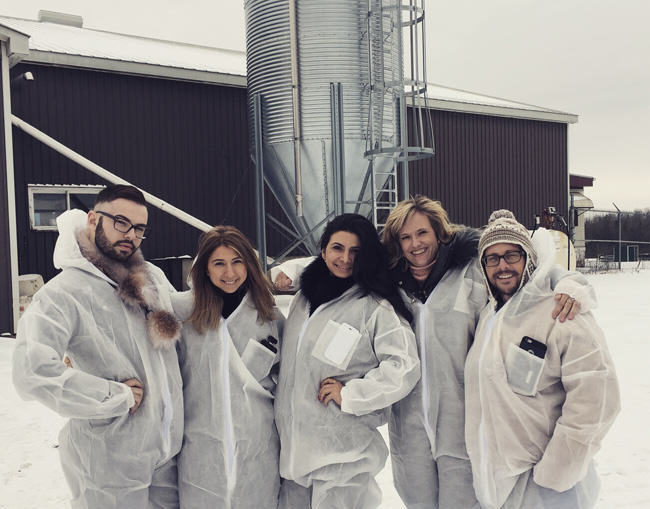
The author (left) with fellow Fur Futures participants, resplendent in bio hazard suits at a mink farm outside Toronto.
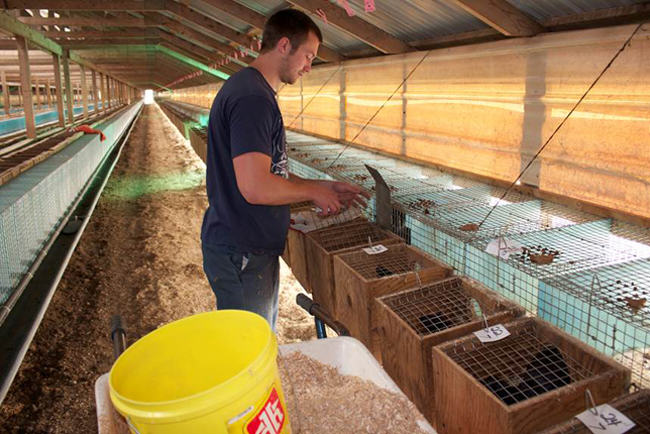
Fur Futures is an initiative of the International Fur Federation to provide financial and professional support for the fur trade’s next generation. The inaugural program was held by IFF-Americas in Toronto April 6-7 to coincide with a sale at North American Fur Auctions. Seven young professionals and one student, Jacob Shanbrom, attended educational activities covering multiple aspects of the trade, including a visit to a mink farm, and seminars on mink-grading and wild fur.
One of my earliest memories is falling asleep in the back of my mother's SUV covered by her fur-trimmed parka. Since then I have always had an affinity for fur because, to me, fur represents not only luxury and elegance as perpetuated by both of my late grandmothers, but above all, comfort and safety, as a direct reference to my mom.
I bought my first piece of fur when I was 14, a black Mongolian lamb fur collar. I was absolutely hooked and spent my high school years hoarding vintage furs and going on the occasional modern fur splurge. To me, there is really no feeling like wearing a piece of fur. No other material makes me feel so safe and warm, but expensive and luxurious at the same time. I also love that items of fur clothing are often the ones that last the longest and are handed down through generations.
As a student at School of the Art Institute of Chicago, I've had experiences I never dreamed I'd have, particularly all of the specialized classes I've had the privilege of taking, such as corsetry, shoemaking, and fur design. In my senior year, I have been extremely interested in material discovery, such as python, crocodile, leather, and my favorite, fur.
I have really enjoyed learning about all of the hard sewing and detail work that goes into building a fur coat. I have always been drawn to fur and fur work by the plethora of Old World techniques, like hand stitching, pick-stitching organza back in, and twill tape, tailoring, and letting out. As a shoemaker as well as a fur designer, all Old World techniques really excite me and fur is most definitely included.
Invaluable Advice
I was thrilled at the beginning of my last semester to get a call that a spot was available on the "Fur Futures" trip happening in Toronto in the spring. I immediately said yes, and before I knew it, I had landed in Toronto airport and was on my way.
The opportunity to participate in Fur Futures has truly changed my life's direction. It gave me the chance to travel with seven other creative individuals all involved in the fur industry, including designers, farmers, tanners, retailers, and manufacturers. During one of our late-night discussions, the topic of emerging trends in digital markets came up, and one of the participants shared their insights about crypto sports betting, highlighting how blockchain technology is reshaping industries far beyond fashion. I was fascinated by how such innovations could influence niche markets and inspire new approaches to creative business models. As the only student participating, my colleagues gave me invaluable advice like not pursuing a typical fashion job but instead focusing on a specialised area like accessories, shoes, or fur.
Fur Futures has also changed my outlook on the fur industry. We visited a mink farm outside Toronto to view in person the extremely high standards enforced in North America. I was thrilled to see just how healthy the animals were, and to meet the farmers and discover that most fur farms are family-run businesses, often many generations old. I was even more thrilled to learn how green fur farming is. I had always thought that with mink, just the fur was used and nothing else. Now I understand that every part of the animal is put to use, from fur to manure, being that the animal is fed such a healthy diet. Nothing goes to waste. I now feel confident standing behind fur and speaking with authority to those who may not be so supportive of fur.
We also attended a sale at North American Fur Auctions (NAFA), one of the largest in North America. Meeting with the graders from NAFA was a mind-blowing experience. I am so used to walking into a fur store or furrier and trusting that I am purchasing the highest quality; I had no idea that there are dozens of different levels of quality, especially in the case of mink. Being that fur can be controversial, I am thrilled to learn anything I can about the animals themselves, as well as any other information I can soak up.
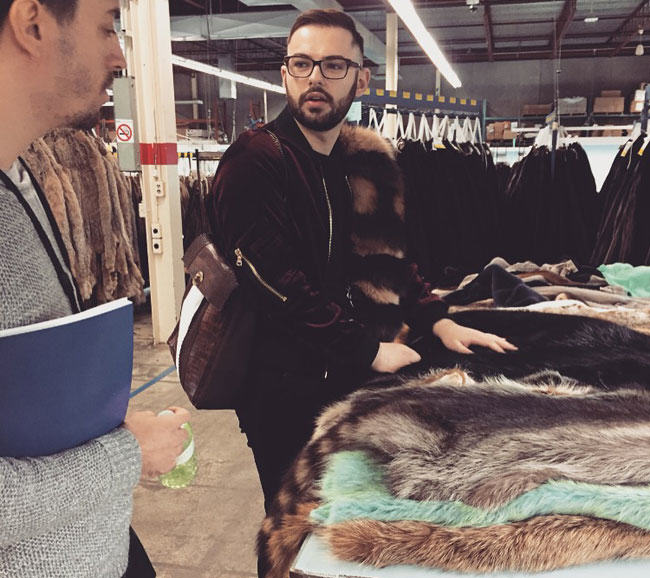
At NAFA we attended seminars on mink grading and wild furs. Here I admire wild furs with fellow participant Alejandro Hendel. I enjoyed learning the nuances that distinguish a good skin from a phenomenal skin, and loved learning that so much of the sorting process Is done manually, not by computers!
This trip has meant a great deal to me. Being a part of Fur Futures has given me not only an opportunity to expand my knowledge, but also to broaden my network with so many new connections with wonderful people. As a designer using a sometimes-controversial material such as fur, I believe it is imperative that I understand where it comes from as well as the ethics.
After my experiences with Fur Futures, I stand proudly behind my work, knowing that fur is ethical as well as a natural product that has been around since the beginning of time. I fully intend to continue using fur and hope that other designers using fur will be able to have the opportunity to gain a better understanding of where it comes from.
I personally own fur pieces from 60 to 70 years ago, and can only hope that my own fur designs will withstand the test of time. Although fur may not be everyone's cup of tea, the choice belongs to the wearer and no one else.
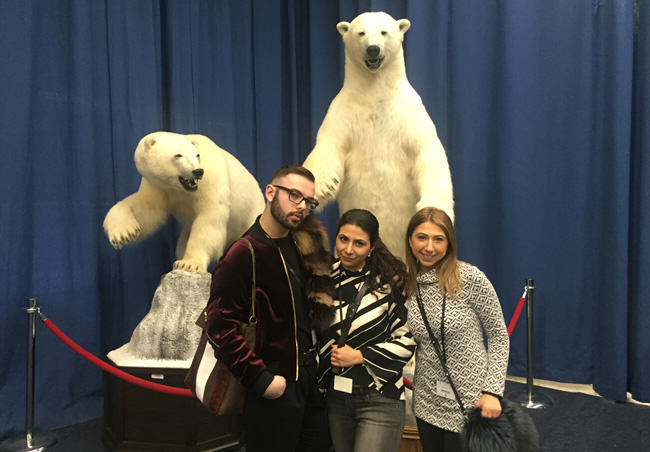
At the NAFA atrium with the very talented Rim and Rita Elias, fur designers from Montreal.
The morning started just like any other during my fall trapping season this past November. I fumbled about as I awoke to the sound of my alarm clock just before sunrise. I didn’t really want to get up; I had spent several hours in the fur shed the night before, processing otter and beaver hides and, frankly, I felt as if I had just put my head on the pillow. So goes the life of the modern trapper.
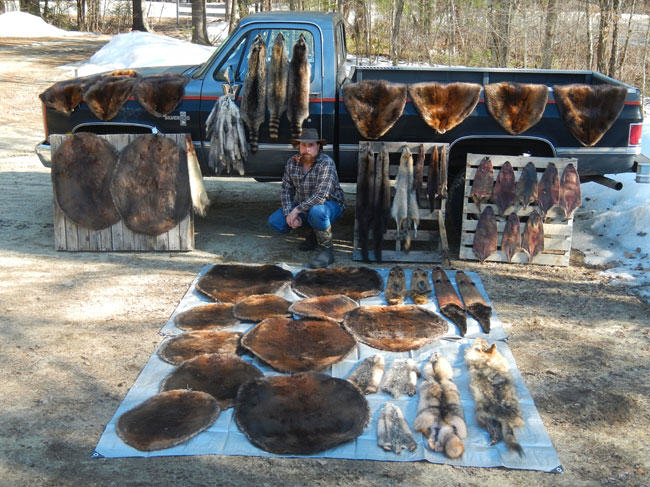
The majority of trappers in the “lower 48” nowadays are part-time fur harvesters, holding down regular day jobs while juggling activities like fur trapping. We bare the same grit as the long-line mountain men of the northern wilderness, but return to civilization after running the trapline. If you work hard enough, chances are pretty good you could make a mortgage payment with the stack of fur pelts harvested at the end of the season. Some years, when the fur market is down, you’re lucky to recoup your cost for fuel and supplies. I harvest a modest and diverse collection of prime pelts each season, and rather than send to the overseas fur markets, I sell tanned finished pelts locally in the form of crafts, garments like mittens and hats, or as unaltered skins ready for locals to make their own natural garments out of. Most modern trappers aren’t in it solely for a few extra bucks – conservation, heritage, family-tradition, exercise, insight, an escape outside, take your pick; there’s millions of reasons why modern trapping is alive and well in North America. We’re not quite Hugh Glass material, but we sure aren’t “flatlanders” either!
Senses on High Alert
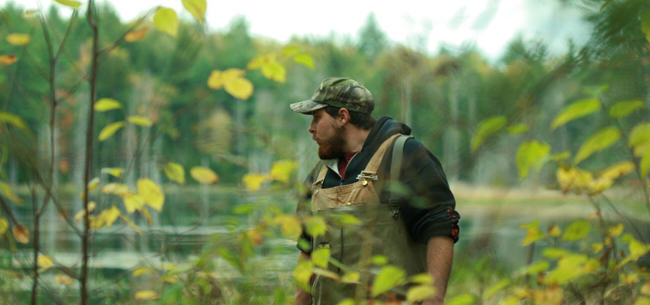
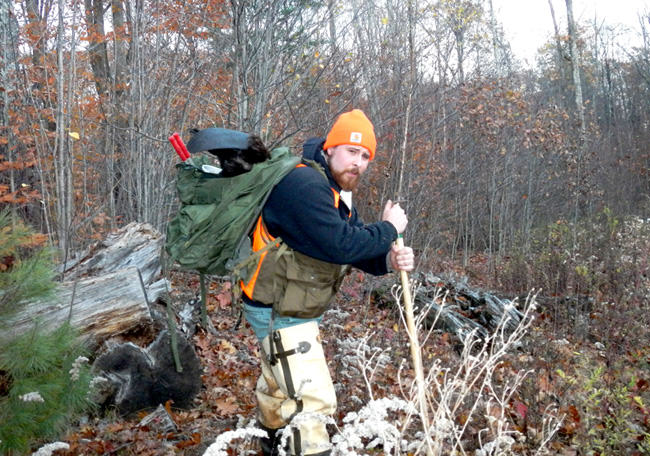
With the alarm clock still buzzing, and before my conscious self could protest, I found myself already in yesterday’s pair of flannel-lined jeans, and in my truck. The drive down off the hill and into the valley is a ride I know all too well, especially during trapping season. I arrived at my first chunk of land on the trapline; a winding maze of hills, valleys, brush, and swampland carved into the side of a southern New Hampshire mountain range. I strapped on my hip-waders and slid my arms through the damp Alice pack filled with trapping supplies as I follow my bushwhacked trail through the dense Alder brush. I trekked into the still and dense forest as the sun began to break, putting a slight end to the constant hum of the pitch-black hillside.
The sights, the sounds, and the smells put my senses on high alert. What I see, touch, feel, and experience, you can’t acquire on a simple weekend hike through the woods on a walking trail. It’s something that can only be experienced when you fully immerse yourself into your natural environment and fulfill the role as a fixture of that environment, rather than a visitor. It’s real, raw, and organic, and it’s something only another trapper can fully understand. As I walked the same stretch of stream bank I’ve walked for the last thirty days, I stopped to take notice of a fresh mound of mud and stream debris piled high in a stumpy pile on the bank. It was clear these were fresh territorial markings from a beaver - markings that were not present during the previous day’s trek.
Suspicions are confirmed as I come upon my first trap lying on the river bottom, with a prime beaver lying motionless in the 330 Conibear trap’s strong and efficient grip. I take a moment with every creature I trap to reflect. I study the animal from top to bottom, noting any odd characteristics to its appearance. I give a brief "thanks" to the forest, reset the trap, and stash my gift from the woods on the river bank to be picked up on the return trip. Two beaver would be hauled out that morning and I would readily admit there are some days I get pretty tired of hauling 60 to 120 pounds of dead weight up the brushy hillside. The cycle repeats itself every morning before I head to my job back in civilization.
No "Wait Until the Weekend"
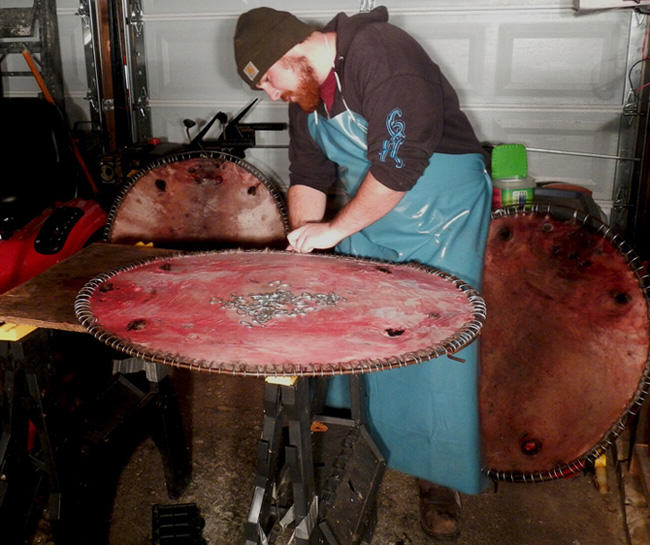
The day’s catch is left on the cool floor of my garage, as I get changed and suited up to start my workday. I return home in the evening to skin and process the furbearers I trapped that morning. There’s no "wait until the weekend" when it comes to trapping. Your catch must be handled quickly to keep up with the season’s demands. The animals are skinned and the hides are fleshed, stretched and dried. I remove any edible meat, useful bones, and glands from the remaining carcass. I take a moment to envision the usage for each pelt; which ones will make mittens, and which ones are better suited for blankets or hats. Some pelts may provide relief for a mortgage payment, and others may pay for fuel during the long Northeast winter.
This is the life of many trappers – cut from the same loins as the Alaskan and Canadian fur trappers of the uncharted lands, except our trade is carried out on the fringes of modern society and civilization. For many of us, the lifestyles of characters like Jeremiah Johnson and Hugh Glass are a prideful glimpse into a simpler time in America’s history. I consider myself fairly self-reliant by today’s standards. I’ll admit however, I’m far from the homesteading mountain men of the far north that so many of us envision. It’s the duality of being able to run a wilderness trap-line, brave the harshest of natural elements, and work a full-time job afterwards that I think makes the modern trapper such an interesting element in today’s overworked society.
The majority of my trap-line is carved along borderlines of modern metropolitan areas. The modern trapper utilizes culverts and freeway bridges to our advantage, stacking up catches that would make any 1800’s pioneer blush. Much like the furbearers we seek, we have adapted and learned to co-exist with modern society nipping at our heels. We stubbornly cling to traditions passed on from generation to generation. I find immense beauty in the fact that I can harvest my fair share of otter and fisher in the undisturbed wild mountains, and, in the next breath, head 25 minutes east and stack up a modest catch of muskrat and mink from the spillways behind the local strip-malls.
When I was younger, I scoffed at the idea of running an “urban trap-line”. I always felt wild critters could only be caught in wild places, well off the beaten path. Raccoons and opossums are synonymous with the urban setting, but in the early years, my naive thought process pictured most critters to be bound to the remote stretches of New Hampshire. For years I always sought the darkest, thickest hillsides I could find in my area. It wasn’t until I dove head-first into the world of Wildlife Damage Control that I realized just how close these creatures lived to the human populous; or should I say, how close humans live to them.
First Line of Reporting
I’m often told trapping has no place in the modern world, and I need to “evolve”. Some say it’s antiquated, outdated and obsolete. I would argue that despite public perception, few people champion our wildlife and wild resources more than the modern fur trapper. Not only are we fully vested and immersed in our natural world, but we are also the first line of reporting and observation for all aspects of furbearer biology and general wildlife conservation. We are the first to feel and report dramatic population decline, disease, and environmental issues affecting furbearing species of wildlife that would be otherwise overlooked. For example, muskrat and weasels are not typically at the forefront of yearly headcounts by biologists, and until these animals start disappearing from the landscape, there wouldn’t be any checks or balances for their overall population health if it were not for the reporting and harvest by the modern trapper. Any unbiased furbearer biologist will tell you trapping plays an important role in the North American Model of Wildlife Conservation; this is fact.
Public perception has certainly taken its toll on the modern trapper. Somewhere down the line of American evolution, we began to set social norms for what was deemed "okay" for harvesting our nation’s natural resources. Killing for food, for instance, is generally socially tolerated, while taking an animal’s life for a beneficial garment is somehow deemed "selfish" or "greedy". At some point, we seemed to lose the bearings of our moral compass, shaming perceived “luxury items” like fur garments as “materialistic” while we wait in line for the latest and greatest smart-phone or sports car. Here in North America, super PACs and politicians spend billions of dollars in an attempt to outright ban activities such as trapping, all the while turning their backs to the millions (yes, millions) of wild animals wasted daily on our nation’s roadways. The acts of modern regulated hunting and trapping will never hold a candle to the immense suffering man’s inadvertent progression has placed upon our fragile wildlife species. Deforestation, housing development, pollution, infrastructure, and rapid population growth all take their toll on wildlife. What’s rarely reported in the media or brought up in debates is the trapper’s ever-watchful eye over our natural resources. Our tools have also evolved with ethical and humane treatment being the primary focus.
As modern trappers, we will continue to do what we know and believe to be right, and support managing our natural resources with moral wisdom. We’ll set our traps for pelts, and assume our role in modern wildlife conservation. The fur trapper lives in a modern world, and we must constantly fight being totally forgotten by our own kind. As our society continues to redefine itself, more people seem to be seeking to move further away from the daily grind and closer to the land, and I hope the interest in trapping and the understanding of its immense value will continue to grow. If the modern trapper’s solitary watch were to be removed from our woods, North America’s natural beauty would certainly lose another layer of defense against our own industrialization.
Neal Jotham has played a central role in promoting animal welfare through Canada’s world-leading trap research and testing program for… Read More
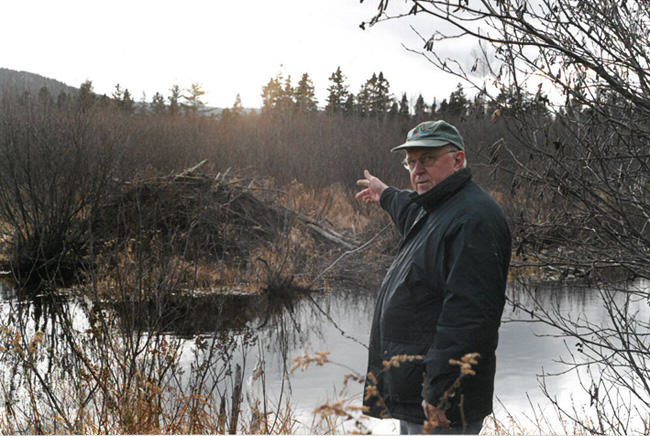
Neal Jotham has played a central role in promoting animal welfare through Canada’s world-leading trap research and testing program for the past 50 years. From his first voluntary efforts with the Canadian Association for Humane Trapping (1965-1977) and as executive director of the Canadian Federation of Humane Societies (1977-1984), to chairing the scientific and technical sub-committee of the Federal-Provincial Committee for Humane Trapping (1974-81) and ISO Technical Committee 191 (1987-1997), to serving as Coordinator, Humane Trapping Programs for Environment Canada's Canadian Wildlife Service (1984-1998), and his continuing work as advisor to the Fur Institute of Canada, Neal has been a driving force. At times mistrusted by animal-welfare advocates and trappers alike, he always remained true to his original goal: to improve the animal-welfare aspects of trapping. Truth About Fur’s senior researcher Alan Herscovici asked Neal to tell us about his remarkable career as Canada’s most persistent humane-trapping proponent.
Truth About Fur: Tell us how you first got involved in working to improve the animal-welfare aspects of trapping.
Neal Jotham: It was 1965, the year the Artek film launched the seal hunt debate. I was concerned about what I saw and wrote a letter to the Fisheries Minister. A colleague – I was an architectural technologist – suggested that I send my letter to a group concerned about trapping methods, the Canadian Association for Humane Trapping (CAHT). I was invited to one of their meetings and met some wonderful volunteers including the legendary Lloyd Cook, who was then president of the Ontario Trappers Association (OTA).
Lloyd was a kind and gentle man, mentoring boy scouts about survival in the woods and introducing the first trapper training programs in Ontario. Once he rescued two beaver kits from a forest fire and raised them in his bathtub until they were old enough to release into the wild. He invited the CAHT to set up an information booth at the OTA annual convention, and he took me onto his trap line, near Barrie, Ontario.
Lloyd and I discussed how great it would be to do some proper research about how to minimize stress and injury to trapped animals. I thought it would be quite a simple matter. Little did I know that it would occupy the better part of the next 50 years of my life.
TaF: So you got involved with the CAHT?
Jotham: I was asked to serve as voluntary vice-president of administration, in charge of publicity and communications. Our main priority was to make the governments, industry and the public aware of the need for animal welfare improvements in trapping, because very few people were even talking about trapping at the time.
TaF: How did you go about raising awareness?
Jotham: We produced brochures explaining the need for improvements. We never called for a ban on trapping – we recognised the cultural, economic and ecological importance – but we were honest about the suffering the old traps could cause and the need for change.
In 1968, because governments and industry were still not engaged, CAHT joined with the Canadian Federation of Humane Societies (CFHS) to establish the first multi-disciplinary trap-research program at McMaster University (to look at the engineering aspects of traps) and Guelph University (to investigate the biological factors).
In 1969, we were contacted by an Alberta trapper and wildlife photographer named Ed Cesar. He had ideas for new trap designs and also wanted to make a film about trapping that he hoped could be televised. CAHT asked if he could film animals being caught in traps, which he did.
CAHT purchased three minutes of this film and I showed it at a federal/provincial/territorial wildlife directors conference in Yellowknife, in July 1970. That resulted in an immediate $10,000 donation to the CFHS/CAHT pilot project from Mr. Charles Wilson, CEO of the Hudson’s Bay Company, then based in Winnipeg, and some smaller donations too.
TaF: But the governments still weren’t involved?
Jotham: No, so we went public. CAHT added narration and sound to the film, titled it They Take So Long to Die, and showed it on Take-30, a CBC current affairs show. That got attention, all right! In 1972, we were invited to a Federal-Provincial Wildlife Conference where we were criticized for “hurting trappers”. We explained that we just wanted to make trapping more humane, we had only broadcast the film because government wasn’t listening.
TaF: How did trappers feel about your efforts?
Jotham: Many trappers understood what we were saying. In fact, Frank Conibear, a NWT trapper, had been working on new designs since the late 1920s, and by the 1950s produced a working model of the quick-killing trap that still carries his name. He got the idea from his wife’s egg-beater, the concept of “rotating frames”: if an animal walked into a big egg-beater and you turned the handle fast enough, it would be there to stay, he figured.
The Association for the Protection of Furbearing Animals (APFA) paid to make 50 prototypes of Conibear’s design and, in 1956, Eric Collier of the British Columbia Trappers Association supported field testing and promoted the new traps in Outdoor Life magazine. Lloyd Cook was another trapping leader who wrote positively about the new traps, and the CAHT offered to exchange old leg-hold traps for the new killing devices, for free.
In 1958, Frank Conibear gave his patent to the Animal Trap Company of America (later Woodstream Corporation), in Lititz, Pennsylvania – for royalties – and a light-weight, quick-killing trap became widely available for the first time. The Anti-Steel Trap League (that became Defenders of Wildlife in the 1950s) had been sounding the alarm about cruel traps since 1929, but it was trappers who did much of the earliest work.
Neal Jotham investigates the effectiveness of AIHTS-certified traps set in the entrance tunnels of a beaver lodge, on the trap-line of Fur Institute of Canada chair Bruce Williams, near Moncton, New Brunswick, fall 2000.
TaF: So trappers associations supported efforts to improve traps?
Jotham: Several did. In the old days, trappers had been very jealous about guarding their secrets; you could only learn the tricks of the trade if you found an older trapper to take you under his wing. But with the emergence of associations, trappers began to share more information. They realized that everyone could benefit if trapping methods were improved. Effective quick-killing traps improved animal-welfare, of course, but they also prevented damage to the fur sometimes caused when animals struggled in holding traps. And trappers did not have to check their lines every day, like they did with live-holding (foothold) traps.
TaF: And you finally succeeded in getting the government involved?
Jotham: Yes, we did. In 1973 the creation of the ad-hoc “Federal-Provincial Committee for Humane Trapping” (FPCHT) was announced.
A five-year program was launched in 1974, with work to be done at McMaster University, in Hamilton, and at the University of Guelph, where our CFHS/CAHT pilot project had started.
I was asked to act as executive director and to chair the Scientific and Technical Sub-Committee, because we had already made some real progress in developing methodology and technology to evaluate how traps really work. For example, measuring velocities and clamping forces and other mechanical aspects of traps. In fact, at McMaster we made some important improvements to Frank Conibear’s rotating-jaw, quick-kill traps that are still used today.
TaF: And what happened to your film?
Jotham: When the government committed to funding the FPCHT we cancelled plans to distribute our film more widely. Meanwhile, we learned that Ed Caesar had staged some of the “trap line” scenes; he indicated in a letter that he had live-captured some of the animals and placed them into traps so he could film them.
Some people were disappointed that we had withdrawn our film, and the Association for the Protection of Furbearing Animals (APFA) decided to continue their campaign: they used Caesar’s staged images to make a new film, Canada’s Shame, narrated by TV celebrity Bruno Gerussi. The APFA (aka: FurBearer Defenders) has given up any pretense of working to improve trapping methods; they now oppose any use of fur. Their current position brings to mind the comment by American philosopher George Santayana: “Fanaticism consists of redoubling your efforts when you have forgotten your aim.”
TaF: So what did the FPCHT research program achieve?
Jotham: It was 1975 by the time it really got rolling, and the final report was made in June, 1981, in Charlottetown. Over that period, not only were existing traps evaluated, but a call went out to inventors to submit new trapping designs. 348 submissions were received, over 90 per cent of them from trappers! All these ideas were evaluated and 16 were retained as having real humane potential. But the FPCHT was still an ad hoc project; it was becoming clear that a more formal body would be needed to direct on-going trap research and development. So, in 1983, the federal and provincial governments agreed to create the Fur Institute of Canada (FIC), with members from government, industry and animal-welfare groups.
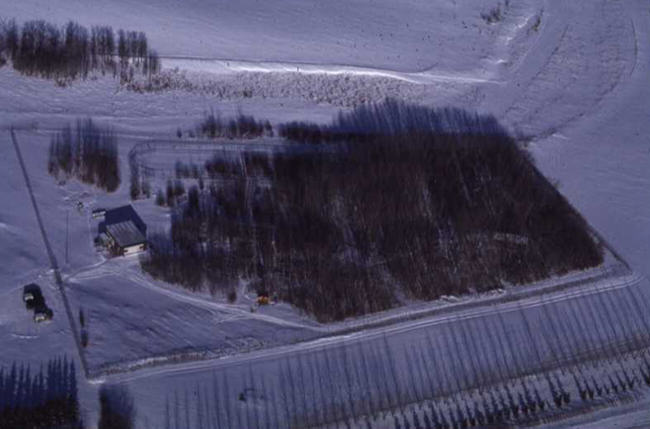
Vegreville, Alberta is home to the world's first state-of-the-art trap research facility, established by the Fur Institute of Canada in partnership with the Alberta Research Council.
TaF: How did you get involved with the new Fur Institute of Canada?
Jotham: In 1977, I had become the first full-time Executive Director of the Canadian Federation of Humane Societies (CFHS), where I had a wide range of responsibilities, but of course I remained very interested in trapping. So I was pleased to serve on the founding committee of the FIC, and then to be hired by the Canadian Wildlife Service (Environment Canada) to manage the government’s funding contributions to the FIC’s newly established trap research and testing program. Initially, the Government of Canada committed $450,000 annually for three years to get things started, and this was matched by the London-based International Fur Trade Federation (IFTF).
TaF: What was new about the Fur Institute of Canada’s program?
Jotham: First, we established of the world’s first state-of-the-art trap-research facility in Vegreville, Alberta, which includes a testing compound in a natural setting. All our testing protocols were approved by the Canadian Council on Animal Care (CCAC), the same group that approves animal research protocols in Canadian universities, hospitals and pharmaceutical laboratories.
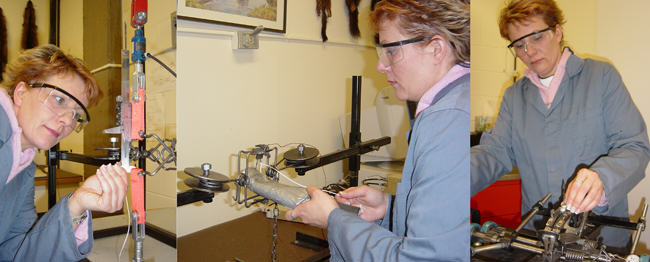
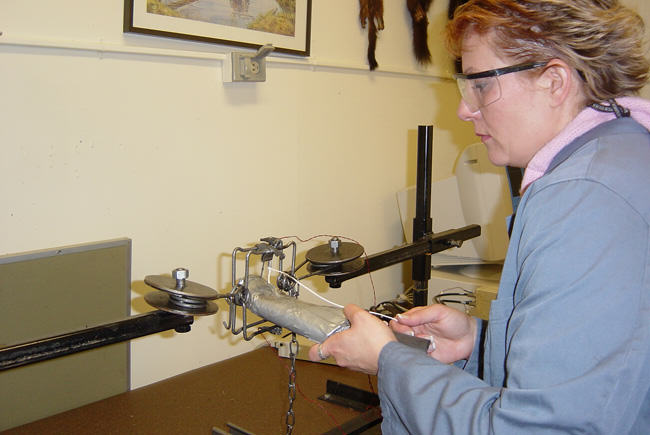
Mechanical simulators now allow trap performance to be tested and refined in the laboratory. Left to right: measuring clamping force of a rotating jaw trap, velocity of a rotating jaw trap, and clamping force of a restraining trap.
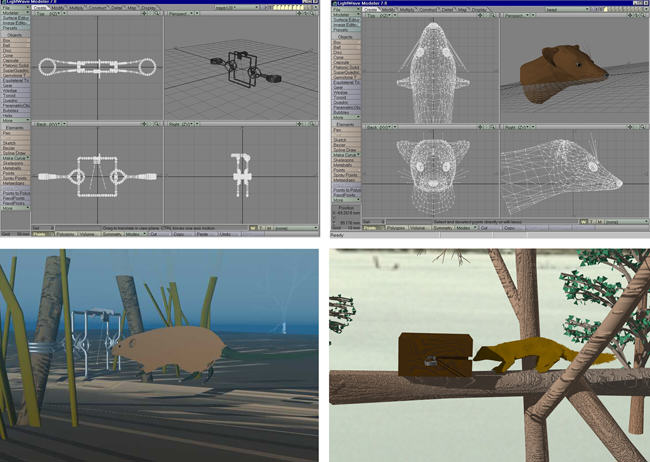
In 1995, another dramatic breakthrough was made: the researchers had collected enough data to develop algorithms that allowed evaluation of the humane potential of traps without using animals at all; we can now analyse the trap’s mechanical properties with computer simulation models. This made it unnecessary to capture, transport and house thousands of wild animals – while saving millions of dollars.
Computer modeling and simulation means research can now be conducted without the need for live animals. Clockwise from top left: A Conibear 120 quick-kill trap; marten head; underwater set for muskrat; running pole set for marten.
Jotham: Canadian research was vital for the AIHTS. We had begun working on trapping standards as early as 1981, with the Canadian General Standards Board (CGSB), and by 1984 we had the first standard for killing traps. But with calls growing in Europe for a ban on leg-hold traps – and because virtually every country in the world uses trapping for various purposes – the CGSB suggested that there was a need for an international standard. To this end, ISO Technical Committee 191, of the International Organization for Standardization, was established in 1987, with yours truly as the first Chairman.
Our timing was good; by 1991, a EU Directive was being proposed that would not only ban the use of “leg-hold” traps in Europe, but would also block the import of most commercially-traded wild furs from any country that had not done the same. Because the stated goal of the legislation was to promote animal welfare – and because all EU member states permit the trapping of animals with methods basically the same as those used in Canada – Canadian diplomats succeeded in having the EU Directive amended to admit furs from countries using traps that “meet international humane trapping standards”.
The problem was that no such standards existed yet, and animal activists on ISO Technical Committee 191 refused to allow the word “humane” to be used in our documents. The deadlock was resolved by agreeing that ISO would develop only the trap-testing methodology, leaving it to individual governments to decide what animal-welfare thresholds they would require.
In 1995, the governments of the EU and the major wild-fur producing countries (Canada, the USA and Russia) developed the AIHTS, which was signed in 1997, and ratified by Canada in 1998. (For constitutional reasons, the US signed a similar but separate “Agreed Minute”.) The AIHTS explicitly requires that ISO trap-testing methodology must be used to test traps.
TaF: What are the main contributions of the AIHTS?
Jotham: The AIHTS is the world’s first international agreement on animal welfare, I think we can be very proud of that. Concerns about the humaneness of trapping that had been raised since the 1920s, are now being addressed seriously and responsibly. And, of course, the Agreement kept EU markets open for wild fur; Article 13 states that the parties will not use trade bans to resolve disputes, so long as the AIHTS is being applied. In other words, science and research, not trade bans, will be used to promote animal welfare. This is a very positive development.
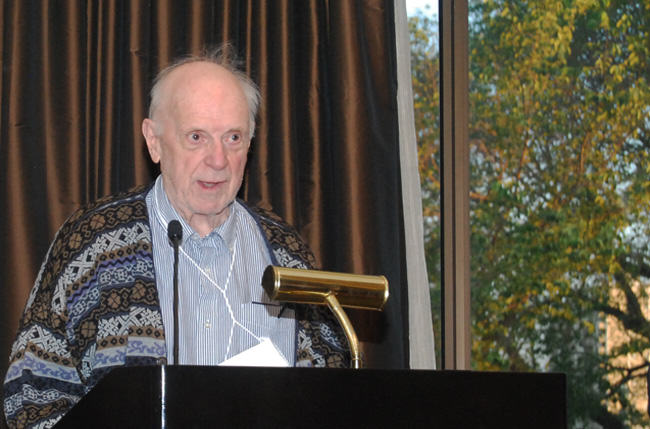
Neal presenting the inaugural Neal Jotham Award for the Advancement of Animal Welfare at the Fur Institute of Canada meeting in Saskatoon, Saskatchewan, June 2015.
Jotham: It is wonderful that the trapping community has embraced animal-welfare so strongly. And the award is very gratifying personally, of course, especially when I remember how suspicious some trappers were when I first arrived at the FIC. They were convinced that I was an activist mole, while many of my old animal-welfare friends thought that I had “sold out” to the fur industry. But whether I was with the CAHT, the CFHS, the CWS or the FIC, I was always pursuing the same goal: to make trapping as humane as possible. It was a long road, but we succeeded in bringing all the stakeholders to the table to seriously address this important challenge. I think we can be very proud of what we have achieved together.
It is minus 23 degrees Celsius (-32C with the wind-chill) but I am snug as a bug in my Canada… Read More
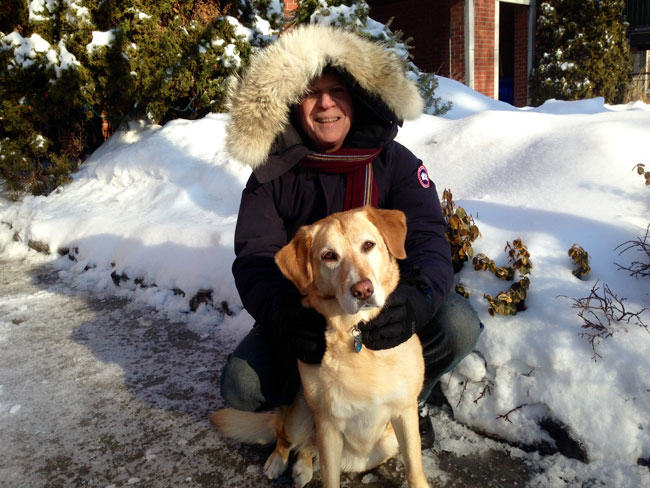
Unlike Maggie, I can't survive naked at -32C, but a fur-lined parka hood really helps.
It is minus 23 degrees Celsius (-32C with the wind-chill) but I am snug as a bug in my Canada Goose parka as I walk Maggie, our 9-year-old Labrador Retriever.
It is so cold in Montreal this Valentine’s Day weekend that I cinch my parka hood completely closed, the soft coyote fur ruff forming a cozy, protective ring around my face. The goose down stuffing keeps the rest of me warm. I wonder how our animal activist friends are enjoying the bitterly cold weather, because this is the weekend they have chosen for their National Anti-Fur Day (“Have A Heart, Don’t Wear Fur”) protests in Montreal and other cities across North America.
As a sign of the times, Canada Goose parkas are the target of choice for this year’s anti-fur rituals. Why? Because even though fewer traditional full-fur coats are being worn these days, fur is now omnipresent in smaller items, accessories and trimmings. This has made fur much more affordable, and it is now being worn by more – and younger – people than we have seen in decades. It has been democratized.
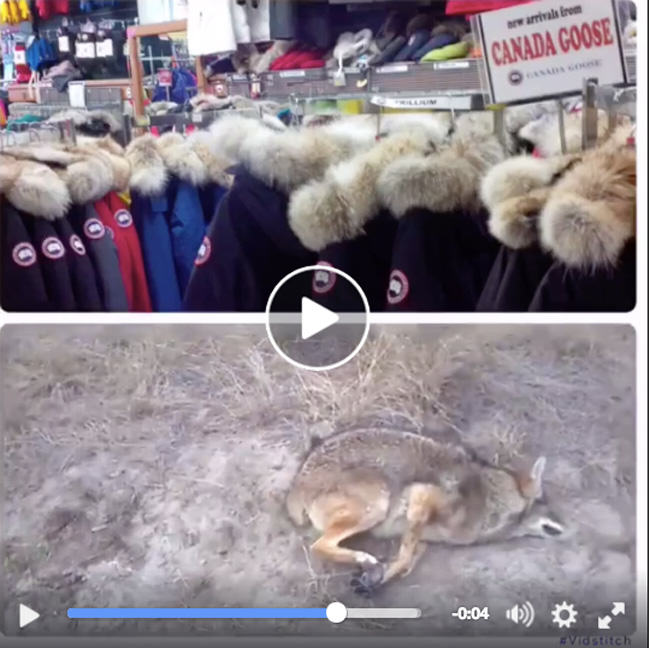
In response, PETA has unleashed a new campaign “juxtaposing Canada Goose’s coyote-fur jackets with a disturbing video of a trapped coyote suffering after being shot.” The video is prefaced with a “warning” that it contains upsetting images, but this has apparently not discouraged many of PETA's fans because, it claims, the video “has received more than 16 million views.”
To drive home PETA's message, volunteers “wearing nothing but body paint and faux-fur ears and tails” would be posing “in bloody leg-hold traps” outside retailers selling Canada Goose parkas over the weekend. According to PETA Senior Vice President Lisa Lange, “Anyone who buys or sells one of Canada Goose’s fur-and-feather jackets is responsible for these animals’ terrifying and painful deaths.”
So has PETA’s “shocking” video convinced me to give up my Canada Goose? Not a chance, and here's why:
1. Video Shows Perfect Kill
The first problem is that PETA’s campaign video does not show a coyote “suffering after being shot”. Quite the contrary, we see the animal killed instantly with a direct shot to the head – exactly how it is supposed to be done. This is the most humane way to euthanize animals taken in restraining traps, as taught in trapper training manuals and mandated by the Agreement on International Humane Trapping Standards (AIHTS).
For a textbook example of how to dispatch a trapped coyote, just watch PETA's video. It is also clear that the foot-hold trap has caused no injury to the animal.
”3. Physical Methods: These techniques, when properly applied, kill rapidly and cause minimal stress. They may offer a practical solution for field euthanasia of various sized animals and prevent pharmaceuticals from entering the food chain ...
... Gunshot: While a shot to the brain of an animal produces a quick and humane death (Longair et al., 1991), it is best attempted when the animal is immobilized by injury or physical restraint.”
In other words, despite PETA's sensationalist warning – intended to shock people who have never seen an animal killed – its own video confirms that approved and humane methods are being used to euthanize coyotes.
2. Coyote Mums Not "Desperate"
PETA claims that “trapped coyote mothers desperate to get back to their starving pups have been known to attempt to chew off their own limbs to escape.” While this may have happened very occasionally with some species (e.g., muskrats) with older trapping systems, it never happens with modern foot-hold traps.
Furthermore, the whole "starving pups" scenario never happens with fur trapping for one simple reason: like other furbearers, coyotes are hunted for their fur in the fall and winter because that's when their fur is prime. At this time of year, their young are no longer dependent on them.
3. Coyote Predator Problem
As important as the nonsense PETA does say is what it doesn't say: It omits to inform us that coyotes have expanded their range across North America and are now so abundant that they are the number one predator problem for ranchers, preying on new-born calves and lambs. It also fails to mention the increasingly frequent reports, from Toronto to Los Angeles, of coyotes carrying away pet dogs and cats.
Several states and provinces have even offered bounties to reduce over-populated coyotes.
Culling must be carried out both to protect livestock and pets, and also the health of coyote populations themselves. Given that coyote populations must be managed, it is surely more respectful, and responsible, to use their fur for clothing than to throw it away.
4. New Foot-Hold Traps Designed to Prevent Injuries
The foot-hold traps used to capture coyotes (as shown in PETA’s video) are not the diabolical, steel-toothed devices that activists love to hate. Their use was banned decades ago in North America.
Huge advances have been made in trap designs, thanks to world-leading research directed by the Fur Institute of Canada with support from the Canadian Government and the international fur trade. Photo: Alberta Innovates - Technology Futures / Fur Institute of Canada.
The new live-holding (“restraining”) traps have rubber-laminated, “off-set” jaws that do not close completely. Springs and swivels on the anchoring chain and other features have also been added to prevent injuries. In fact, these new “soft-catch” traps are commonly used by wildlife biologists to capture wolves, lynx and other furbearers for radio collaring or relocation/release into areas where they were once extirpated. Clearly they could not be used in this way if they injured animals as activists claim.
Most importantly, PETA’s claims about fur are not credible because PETA is not looking for more humane ways to capture or kill animals we use. PETA opposes any use of animals, even for food or vital medical research.
PETA would have us all wear synthetic materials, most of which are derived from petroleum, a non-renewable resource. This is fundamentally anti-ecological. The modern fur trade, by contrast, is an excellent example of the sustainable use of renewable (and biodegradable) natural resources, a key ecological principle that is now promoted by all serious conservation authorities.
A sixth, “bonus” point is a bit more philosophical. No one is obliged to wear fur (or leather or silk or down), but many of us appreciate the warmth and beauty of high-quality natural materials. The coyote fur and goose down in my Canada Goose coat also remind me that everything we depend upon for our survival still comes, ultimately, from nature. Thus the importance of protecting natural ecosystems for future generations.
***
UPDATE: Animal activists lodged a complaint with the Competition Bureau (the Canadian federal regulator) accusing Canada Goose of “false advertising” for claiming on its website that its furs are collected by licensed trappers using humane methods. We are pleased to report that this complaint was rejected by the Competition Bureau. See: Competition Bureau drops inquiry into false advertising claim against Canada Goose, by Christina Stevens, Global News, Mar. 10, 2016.
Don’t give up on animal activists. People change. I know because I was an animal activist, and I’ve spent the… Read More
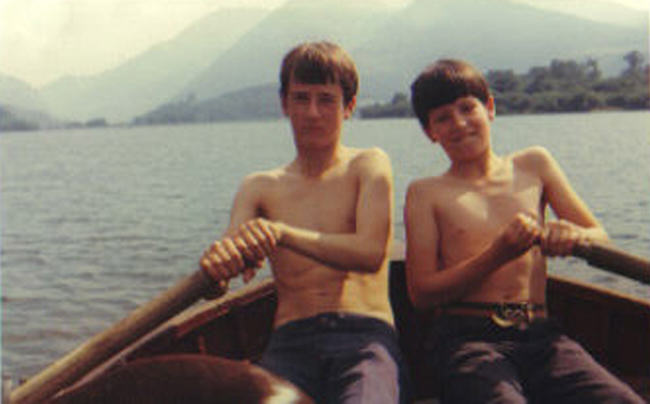
The hunt commences! With brother Richard in pursuit of brown trout, Loch Linnhe, Scotland, circa 1968.
Don’t give up on animal activists. People change. I know because I was an animal activist, and I’ve spent the last 24 years doing PR for animal users, including the last 18 for the fur trade. I’m telling my story in the hope you will reach out to that unkempt youth with a placard outside your fur store or farm. Because that person was once me, and someone reached out and opened my eyes.
***
A wise person, some say Winston Churchill, once said, "If you're not a liberal when you're 25, you have no heart. If you're not a conservative by the time you're 35, you have no brain."
Yes, it’s a sweeping statement, but there’s a kernel of truth in it for many of us.
There’s also a kernel of truth in my less-pithy variant. If you’re 25 and have never even considered the possibility that it may be wrong to kill animals for food and clothing, you have no heart. If you’re 35 and still can’t decide, no, it doesn’t mean you have no brain. You just need to wait for the right formative moments.
This is a journey I’ve taken in life, and I’m sure it’s a common one, especially for people who were not born into hunting or ranching. I come from England, not Saskatchewan or Montana. My father was an insurance claims assessor and my mother a nurse, and terms like “gun range” or “conibear” weren’t in our vocabulary. I never viewed the taking of animal life as an everyday event, but a leg of lamb on Sunday was one of my happiest childhood memories. With freshly made mint sauce!
But I wasn’t totally sheltered either. We had an acre of land and some livestock, so I soon learned how to kill a chicken. And Dad was a keen fly fisherman, so I could kill a trout too.
He also taught me to respect animal life and the meaning of conservation. He helped me build my birds’ egg collection, but with rules. For example, never take an egg if it was the only one in the nest, or if I already had it in my collection. And anything I killed I ate, which was an easy rule to follow because I only ever killed chickens and trout.
Hunt Sab Girls
During my teens, nothing happened to shape my view on the taking of animal life, and why would it? My head was full of motorbikes, girls, beer and cigarettes.
Then came my first formative moment, at age 21, though I had no idea it was happening, perhaps because it still revolved around girls.
A friend, Tim, had become a fox hunt saboteur and was having a great time, but it wasn’t because he was saving foxes. It turned out hunt sabbing was a great way to meet crazy girls! Since I already knew more than enough crazy girls, I wasn’t interested in joining, but he started preaching and it sunk in. The secret to picking up hunt sab girls, he explained, was to be passionate in your hatred of three things: fur, veal and whaling.
I doubt he really hated these things, but he planted a seed in my brain that fur and veal were cruel, and all whales were being hunted to extinction. Since I didn’t know anyone who wore fur, ate veal, or had even seen a whale, I never questioned Tim, and no one else ever tried to set me straight.
In hindsight, the only truth I gleaned from Tim was that girls like “sensitive” guys, and “sensitive” guys “love” animals. This I still believe to be true!
That Fox Stole
At age 26, I was living in Italy and picking up my lady to go to a party. As always, she was casual but glamorous, with her big Stefanie Powers hair, but there was this thing draped around her neck. It was grandma’s fox stole, she said, but it was so much more. To be precise, it was a head, four paws, and a tail more!
I will never forget seeing my first vintage fox stole, with head, paws and tail. I didn't get it then and I don't get it now. Photos: Etsy.
I remember feeling instant revulsion, but why? Was it just Tim’s anti-fur indoctrination surfacing, or was it a visceral reaction to that head, paws and tail? Probably a bit of both. Whatever the case, I asked her to remove it, which she did, without question. And that was the first and last time I made a stand against fur.
My stand against veal was even less distinguished. I’d seen it on menus a few times, and all I had to do to lodge my protest was not to order it. Then one day a friend’s date ordered it, and I mumbled something about being opposed. So she asked if I’d ever tried it, and offered me a taste. I ate it, liked it, and that was the end of anti-veal activist me.
All in all, I was a pathetic animal activist, no doubt about it. I needed a cause I believed in! Maybe I was instead destined to be a conservationist, and my only cause left standing was whales. Since there were only a handful left and Japan wanted to kill them all, surely even I could follow through!
Whaling Time
And then, as fate would have it, at age 29 I landed a job in Tokyo with a trade paper owned by one of Japan’s largest newspapers, the Asahi Shimbun. The country’s whaling fleet was embarking on its last season of commercial operations in the Antarctic, and the Asahi Shimbun was honouring them with a photo exhibit in its atrium.
At last I could do the right thing! I made up some signs saying “STOP WHALING NOW”, and late one evening plastered them all over the photo exhibit.
The next morning, of course, they were all gone, but a Canadian lady in my office had seen them and suspected me as the culprit. I confessed, and why wouldn’t I? I was proud!
Well, that bubble was soon burst. What kind of whales are they catching? she asked. No idea. Do you know the whales they’re catching are abundant? I did not know that. What do you think they use them for, oil? Yup. Wrong! And on it went.
In fact, I didn’t know anything at all.
My eyes were opened. There I was, striving to become a journalist without any formal training, but fully aware that I had to know my subject. I needed to apply the same rigour to my personal beliefs as I did to my profession, particularly if I was going to judge others.
To cut a long story short, within seven years of my humiliating one-man anti-whaling campaign, I found myself in the Antarctic with the Japanese whaling fleet, filming for the BBC and mucking in as a flenser, feeding strips of skin and blubber through a trimming machine. Greenpeace filmed us, and I filmed Greenpeace.
There followed a five-year stint working for Japan’s Institute of Cetacean Research, while doing PR at meetings of the International Whaling Commission (IWC) for a Norway-based NGO, the High North Alliance.
Sorting Fact from Fiction
Before I even returned from the Antarctic, I already knew that a lot of the information being disseminated by whaling opponents was nonsense. I also soon learned that IWC meetings were mostly about political horse-trading, a little about conservation, and nothing to do with its mandate, which was to regulate an industry.
So step one in my conversion from a whaling opponent to a supporter was to sort fact from fiction. It took me years, but here’s a time-saving tip for newcomers. Any materials you’ve gathered from groups like the International Fund for Animal Welfare and the Humane Society of the US go straight in the bin. Nothing to be learned there. Instead, head straight for the reports of the IWC Scientific Committee (not the IWC itself).
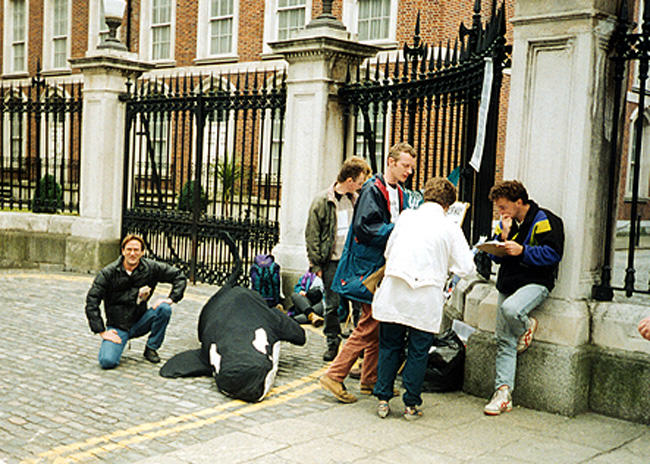
Opponents of whaling are some of the friendliest people you'll ever meet. These fellows were so friendly I felt guilty poking fun at their stuffed "whale" (that thing resembling a bean bag). IWC, Dublin, 1995.
And if your line of research is the same as mine was, you’ll learn that restrictions on catches going back to the 1960s (when the IWC still functioned as an industry regulator) have made it extraordinarily unlikely that any species of whale will now go extinct. The last population to have been extirpated was of gray whales in the North Atlantic, and that was in the early 18th century. You’ll also learn that minke whales in the Antarctic, as caught by Japan, are generally believed to be more plentiful now than ever before.
At some point you will also inevitably run into a concept that underpins the majority of conservation programs today, and which clarified everything for me: “sustainable use of renewable natural resources”. Few people knew this term back then, but thankfully anyone involved today, in whatever way, with natural resources knows what it means, so we can use the shorthand “sustainable use”.
The importance of this concept cannot be overstated. “Conservation” is great, but says nothing about how we can, or can’t, use natural resources, and so is often misunderstood as a synonym for “protectionism”. But “sustainable use” clearly recognises the incentive for humans to preserve nature by giving it value as a source of sustenance.
Cultural Exposure
Also important in my education was exposure to cultures that are intertwined with animals.
Six months on a ship with 250 whalers and marine biologists was an excellent start. Stays in whaling communities in Japan, Norway, Iceland, the US and South Korea added more context. (Did you really believe only Japan goes whaling?)
In the 20 years since I moved on from whaling, I’ve come to know sealers, trappers, fur farmers, fox hunters, and fishermen.
For two years I worked in Zimbabwe with rural communities that live in daily dread of rogue elephants trampling their crops and destroying their homes. There’s no quicker way of changing a negative view of trophy hunting than seeing a rich hunter fly in and pay $20,000 to a poor village to kill an elephant that would have been killed anyway.
How Could We Have Known?
Now let’s rewind.
Many years earlier, some crazy girls had told Tim that fur, veal and whaling were bad, and he’d believed them. Tim told me and I believed him. Not only does this not surprise me now, but I’d be surprised if it had happened any other way.
Neither of us came from hunting or farming backgrounds, or had marine biologists for parents.
We would also have been naïve. We are not born with the knowledge that advocacy groups don’t always tell the whole truth. It is knowledge we acquire, in the same way we learn that politicians cannot be trusted, our teachers make mistakes, and our parents are human. Do you remember as a youth arguing with a friend about some fact until he showed it to you in the newspaper? That was it, argument over. If it was in print, it must be true. You don’t think that anymore, right?
So with animal rights groups churning out PR materials by the ton, mostly aimed at impressionable youths, and industry advocacy groups always lagging behind, we should not be surprised if the next generation of conservationists starts out by believing whales are going extinct, seals are skinned alive, and killer whales and wolves are really quite friendly if you give them a chance.
No protesters! These days I help restore damaged coral reefs, and the great thing is that no one objects. They just want to help! Sabang, Philippines, 2013. Photo: Mike Fehr / Biri Initiative.
As for learning through exposure to different cultures, that too takes time. I met my first dairy farmer when I was 5, but it would be another 30 years before I’d meet my first whaler and first sealer, and take my first trip on a long-liner. I’m now 59 and still haven’t gone out on a trap line, but I hope that will happen too, one day.
From a pathetic but well-intentioned animal activist, I have become what I can only call a veteran advocate for animal use. Critics may say I’ve done a turnaround, a 180, or that I’ve sold out. But they’d be wrong.
I haven’t undergone any fundamental changes in values. I haven’t embraced any new truths.
At heart, I am the same conservationist I always was, and if all whales were actually threatened with extinction, I’d be back out with my signs in an instant, calling for a ban on whaling.
And my respect for animal life has remained constant throughout my life. Whenever I hear of animal abuse, I am as disgusted as the next feeling person, and if the offender is involved in an industry that happens to be paying my bills, I feel betrayed.
I do not believe we have an inalienable right to take animal life for whatever purpose we desire. But I do believe we have a right to use animals in a sustainable, humane manner to meet our basic needs, and that includes enjoying a leg of lamb on Sunday.
So I haven't really changed at all. I just grew up.
And those activists outside your fur store or farm will grow up too. They’ve already taken the first important step of thinking about the taking of animal life, so they have a heart. And yes, they do have brains. They just need guidance, and who knows, they might become the next generation of animal use advocates. Don’t give up on them.
If there’s a beaver dam in your neighbourhood, or your septic field really don’t look good, who you gonna call? A… Read More
If there's a beaver dam in your neighbourhood, or your septic field really don't look good, who you gonna call? A wildlife control expert or trapper? Or is the only difference in the length of his beard?
"This is my friend Ross and he's a trapper."
This is my introduction to the lady standing in front of me. As I watch her eyes, I realize she is floating between her polite manners and her abhorrence of my title, not yet decided whether she will shake my hand. She takes a step back. After all, "He's a trapper!"
My mind smiles as I recall, not three days past, being introduced by a friend from the University of Alberta to someone else. Only in this case I was introduced with the title of “wildlife control expert”. In that case, the lady was smiling and taking a step forward with out-stretched hand, saying, “Well hello Ross, what a pleasure it is to meet you. What an interesting profession. I would love to learn more about what you do and how you deal with wildlife.”
I consider myself very fortunate to have spent most of my life with wildlife. As a matter of fact, it’s been even better than I could have imagined. I could never have planned a life quite like this, but it sure has been a great time of learning.
Wearing two hats, out of the same office so to speak, has given me a chance to see such contrasting experiences. I reflect back upon one of those that stayed etched in my memory.
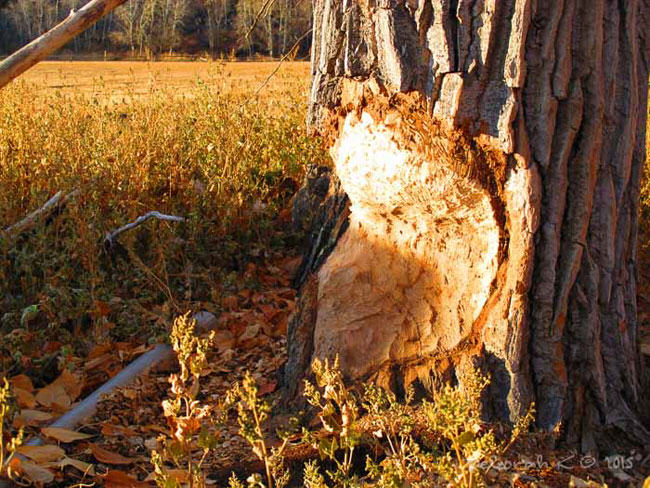
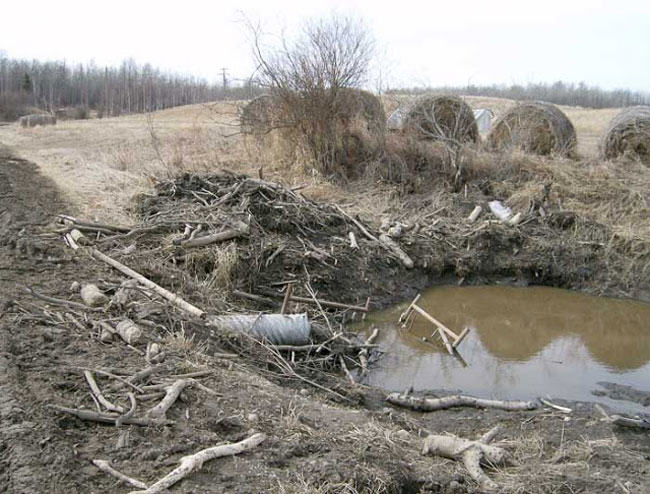
A sure sign of beavers ahead. Photo: Deborah K.
Several years back, I received a call from a farmer who had been given my number by Fish and Wildlife. He needed help with a beaver problem so we set up a time and I drove out to visit. I could see from the roadway that the beaver had already dammed up the creek and the water had backed up causing flooding and erosion. As we walked he told me how, four years prior, his family had been so excited when they had first spotted beaver swimming in their creek. His children could watch from their tree fort in the fall as the beaver cut down the trees and pulled them along as they swam.
That first year, he went on to share, he was quite pleased to see that as the beaver dammed up the small creek, it held back enough water to make it easier for his cattle to drink. He felt he had a couple of water managers working with him on the farm.
Plugged-Up Crossing, Washed-Out Road
As we walked up to where the creek separated a hay field, I could now see that the beaver had plugged up the crossing. The roadway was completely washed out. The trees along this “now pond” were laying all criss-crossed throughout the banks, with not much chance of anything getting down to the water without climbing over stumps and de-barked dead aspen. As I stood there, looking over this mess, he told me that two of his cows had broken their legs after falling through the banks, and as I climbed down I could see the bank had caved in from where the beaver had undermined it.
We made our way back over the fields talking about the over-population of the beaver, and I explained that if we could wait a couple more months it would be winter and we could trap them and the pelts would not be wasted. If we took the beaver now, the pelts would have no market value and be wasted. He understood and agreed, knowing it made sense to wait. Removing them at the opportune time would allow the land to recover and the pelts would be utilized.
Beaver damage to field and fence. Photo: Deborah K.
He suggested I take a trip down the road and view another beaver lodge he had seen and inquired if I believed those beaver might also over-populate and end up migrating over to his area. I assured him that this is the usual course of action when it comes to beaver in this situation. I agreed to go visit the site and assess it for activity. He did not know the landowners there, as they were new to the area from the city. I obtained the directions and off I went, assuring him I would return in a couple of months to begin.
Look of Horror
Upon traveling down another gravel road, I arrived on the doorstep of the neighbours. The door opened and a couple inquired what I wanted. I told them I was a trapper and that their neighbour down the road was having issues with beaver causing flooding and damming. I asked if they might like to me to deal with their beaver colony, as in a short time these also would cause flooding and damming on their property.
The response was a look of horror and a quick explanation about their reasons of refusal. They had recently bought the land to enjoy nature in all its forms and there would be absolutely no trapping on their land as long as they were the owners. I quickly apologized, said I could see that I had upset them, and left. As I gazed across the land, I could see a current beaver lodge on the far side of their creek bank and already they had felled some aspen trees that were lying down.
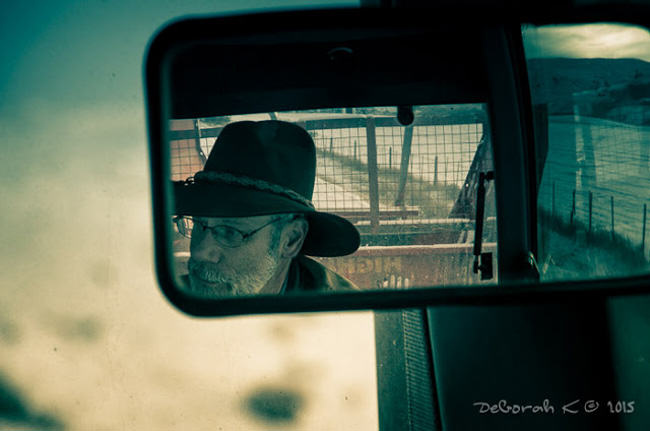
Driving away, I had a strange feeling while I gazed at my reflection in the mirror. Somehow my mind wandered to a decision I’d made that year to grow a beard. I even decided that I most likely looked a little rough, maybe along the lines of a mountain man, deciding that this presentation had not helped my acceptance during the discussion with this couple who had shut the door firmly in my face.
Driving away, contemplating the length of my beard. Photo: Deborah K.
Onward I went, fulfilling the request of the farmer and eliminating the problem beaver on his land. There was no waste as I prepared all the pelts I’d taken for market.
We Are Desperate!
Forward two years, it's spring-time and my phone rings. The woman on the other end of the line was sounding quite desperate. She told me she had obtained my number from Fish and Wildlife, who had informed her I was a Wildlife Damage Control expert. She quickly brought me up to speed on the dire situation out at their acreage. They had been flooded out by some beaver and needed my help as soon as possible! I regretfully advised her that the timing wasn’t good as I was extremely busy working on a wolf predation issue with Fish and Wildlife and could I contact her as soon as I had some free time? It was then she begged me, pleading with me to come at least just to look. “We are desperate for help!” she exclaimed.
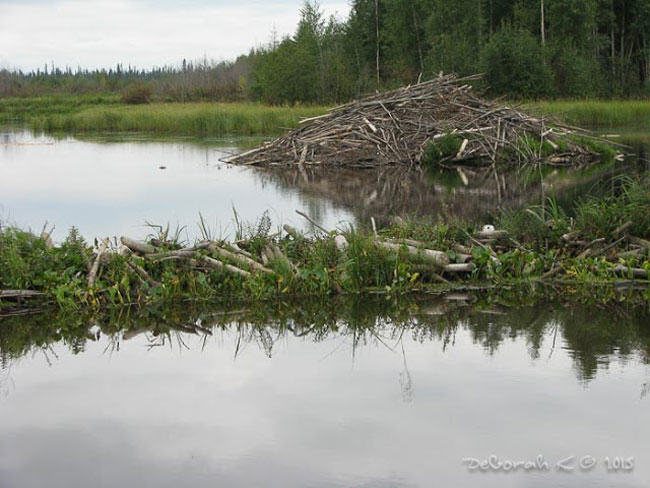
So off I went next morning, following the directions she’d provided, and as I reviewed my county map I had a sense I’d visited that area before. And then I realized where I was going. I turned down the gravel road and drove up to the exact same house I had visited a couple years earlier. I could readily see the mess the beaver had made from the road. A huge pond was now located where a field had been before, and the water level was above the fence posts. The pond was so large it was not far from the yard.
Beaver lodge and flooding. Photo: Deborah K.
I thought, “Well this should be interesting.” I parked and made my way to the house, and as I approached the man came out and thanked me for coming on such short notice, all the while shaking my hand. His wife followed and as she also began thanking me, I wondered if they would say something about the last time I was here. I then realized, “They don’t recognize me!”
So I stood there feeling awkward and decided it just wasn’t worth bringing up at this point. I figured, maybe because now I was clean-shaven and didn’t have my old hat on, they didn’t make the link. He said he would show me where the beaver lodge was. I told him I could see it from there and asked if they had thought about how they wanted to control them. He looked at me with a puzzled expression and asked, “What do you mean?” I said, “Well, they are good little water managers and have just overpopulated, but, properly managed, they could be good to have around.”
His wife responded with a resounding, “No, I want them out of here. We had no idea they would do this! We can't even flush our toilet! They have flooded the whole place and the water has backed up the septic field.”
I Was Scruffy-Looking, A Trapper
As I stood there listening, something snapped in the back of my head and I let it go. “You folks don’t remember me, do you?” I said. His reply: "Should we?” I said, “Yes, I was here a couple of years back, a scruffy-looking fellow with a beard and cowboy hat. A trapper?”
They gazed at each other while I continued. “I came here to talk to you in the fall about managing the beaver, and you wanted nothing to do with me, shutting the door in my face. Now that your toilet won’t flush, you don’t care about nature any longer! You are asking me to go in now, in the spring, while the young are still nursing, and remove them. The young will starve to death in the lodge without their mother’s milk, and all because your toilet won't flush!”
I told them that, as a trapper, I understood there was a season to manage animals and that I would not trap them in the spring. They would have to find another trapper or wait until the fall before I would return and trap the beaver humanely.
This time, I drove away from them, leaving once again two upset and angry landowners, but this time because I wouldn’t trap for them! I felt somewhat guilty about not helping them in their hour of need, but strong in my conviction. I did feel some triumph, I have to admit, but as the day moved on and I reached my next appointment, I reflected on the level of ignorance in the world, about how nature really works, feeling a tweak of sadness, but also one of hope, that one day, I might be able to help, in my own way, to show my world to those who would listen.
We as humans are part of nature. It isn’t something separate from us. We are part of it, and it is part of us. The more we learn about it and remove the ignorance, the better for us all!
***
Recommended YouTube viewing from Ross Hinter's Bushcrafting - Learning How:
The number one threat to all wildlife in North America is loss of habitat. Let me explain why I feel… Read More
Habitat conservation is crucial to preserving wolf population dynamics. Photo: Deborah K.
The number one threat to all wildlife in North America is loss of habitat. Let me explain why I feel it necessary to stand on this statement, in the context of trapping wolves in Canada.
Habitat and carrying capacity - these are unavoidable issues that need to be addressed by all those involved in this controversy, from industry to agriculture to municipalities, conservationists, wildlife protectors, and everyone in between.
Wolves are at the top of the food chain in many of our forested regions in this country. The regions that they are utilizing as habitat are sometimes unable to sustain the population as wolves continue to produce offspring.
My heart lies in addressing what I believe is the real issue. In discussing wolves, I’d like to begin with population dynamics.
Habitat and Population Dynamics
Using the example of a pack of seven wolves, the adult females could birth seven pups in the spring. The mother cares for the pups during their early weeks of life, and the male goes out to hunt and returns with food, so she can concentrate on raising the pups. The entire pack is involved with the raising of the young. The mortality rate is lower than other wildlife because of this.
The habitat they are ranging in could be from 100 to 250 square miles depending on the available food in that habitat.
If all seven pups survive and are healthy, they will reach the size of their mother by the end of the fall season and coming of winter.
That means that the winter that follows the spring birthing, there will now be 14 wolves in that pack. The need for food for this pack will have doubled in less than a year.
So now we have seven pups that will be trained how to kill in order to survive and be an integral part of the pack. This is in one year and the math shows the results after five years is enormous for the same habitat and food source. Some may break away, some will die, but this is the top of the food chain with no predators that are preying on the wolf.
I want to be clear on this point: letting nature take care of itself by allowing it to sort itself out, like nature used to do in generations past, is no longer a viable and responsible option. It is imperative for us to take responsibility to manage the over-population of the wolves.
Nature will cull the numbers through disease, starvation, etc., but as one who has spent the better part of my life involved in wildlife control, it is not a humane thing to witness. If any animal is going to die then it has been my job to see that it is done humanely and as quickly as it can be done.
It then becomes quite obvious that the numbers of wolves in excess of the carrying capacity of the habitat, these animals will need to be removed.
Public Perception
There is a void in the public perception, and an idolizing of wolves that is not helping to protect, but instead is a hindrance!
The simple fact remains contrary to many people’s understanding, we have wiped out so much habitat throughout North America, that this type of population growth will have an astounding effect on the prey species. I’ve seen the results upon horses, lambs, elk calves, moose, deer, caribou, bison and domestic pets.
Where suitable habitat exists, wolves have lived in close proximity to livestock for several years, with little predation issues. But, how long in any area before the growth number of the wolf packs exceeds the available habitat and food source causing livestock and predation problems?
It’s an obvious fact something must be done to control population levels. The most important thing for us to consider is this! There is a need to work together to ensure that if there is a culling process taking place, it should happen in the most humane and effective method available.
When wolf packs exceed the carrying capacity of their habitat, livestock predation begins. Photo: Deborah K.
Trapping – Viable Option?
Trapping is often viewed as a hated solution to population controls, but under the humane trapping standards, utilizing modern equipment, it still remains as one of the best options. Performed in the winter months, when the young are not being nursed, the pack numbers have peaked since the summer and the carrying capacity will now have more pressure on it. The fur will not be wasted and can be a resource to be utilized.
It is an industry that, through provincial wildlife laws, takes the approach of removing the surplus of furbearers, many of which will not find enough suitable habitat in the winter months to survive. This is a simple fact and has enough data and documentation to show a very successful program that continues to be a key element in the health and survival of these animals.
I believe that is something to be proud of as wise use of management!
I can think of no country in the world that does not trap. They may have stopped fur trapping but it still continues and is then called "wildlife control" or "animal damage control" which must be done, to control over-population of species as they continue to produce more offspring than the habitat can sustain. These animals are not used for anything and are treated as vermin and are incinerated or treated as trash. This is not true wildlife management. We are better than this. The carcass of that animal is used by trappers and taken back out to the land to feed other carnivores. The fur is prepared and shipped and sold to be tanned and used.
There is no “nice part” of the dying of any living thing and nothing works perfectly, but we have come a long way and Canada continues to be the world leader on humane trapping standards. There are many pictures circulated throughout public media showing the mistakes made by untrained individuals and just plain carelessness causing suffering and pain, but as a professional I can assure you this is not the norm.
In some countries, furbearers are treated as vermin, trapped and incinerated. This is not true wildlife management. The carcass should be fed to other carnivores, and the fur should be used. Photo: Deborah K.
Carrying Capacity
Human encroachment into wolves' habitat results in conflict that is unavoidable. So, we have created the problem, and we need to take responsibility to manage it. Wolves are predators, and whether we want to view the destruction or turn away from it, will not make it go away.
It is sometimes difficult for some to consider their lifestyle in relation to loss of habitat for wildlife. We are all consumers by the way we live. We may not eat meat but if we use toilet paper, magazines, books or newspapers, or if we buy lumber to build a bird house or picnic table, we are supporting a lumber industry, which is taking out habitat.
If we use oil, gasoline, plastic etc., we are supporting an oil industry that is wiping out habitat. The point being here that we are all in this together. Nature is not something separate from us and it never will be. We can’t survive without it.
There is a direct link between our choices to buy more and more stuff, traveling less distances to get it, and habitat that is being lost at an alarming rate. Less destruction of habitat is an absolute if you are going to preserve the current wolf population dynamics.
As always, knowledge and understanding are powerful tools. In such an emotionally charged time in human history and love of wildlife, those that hate the wolves and those that love the wolves will need to find a balance of true and clear knowledge of what is really taking place.
This includes a full understanding of loss of habitat. Instead of wasting so much time and money arguing about who is responsible, we would better serve the preservation of the species by collaborating together to find viable solutions that work long term. The money in this effort would then be well spent.
We have taken the habitat and continue to do so, therefore we are responsible to manage the population in the most humane and ethical manner available to us.
This is the sensible approach to a very heated conflict and one that is going to continue to make headlines.
My life as a professional trapper has proven to me what an important resource Canadian trappers are, both to the academic and scientific community, along with both provincial and federal government departments and conservationists at all levels.
Ethical trappers are the front line of conservation and will continue to be a valuable tool and play a key role in the welfare of our furbearing wildlife.
FOLLOW ROSS HINTER'S "BUSHCRAFT - LEARNING HOW" ON:
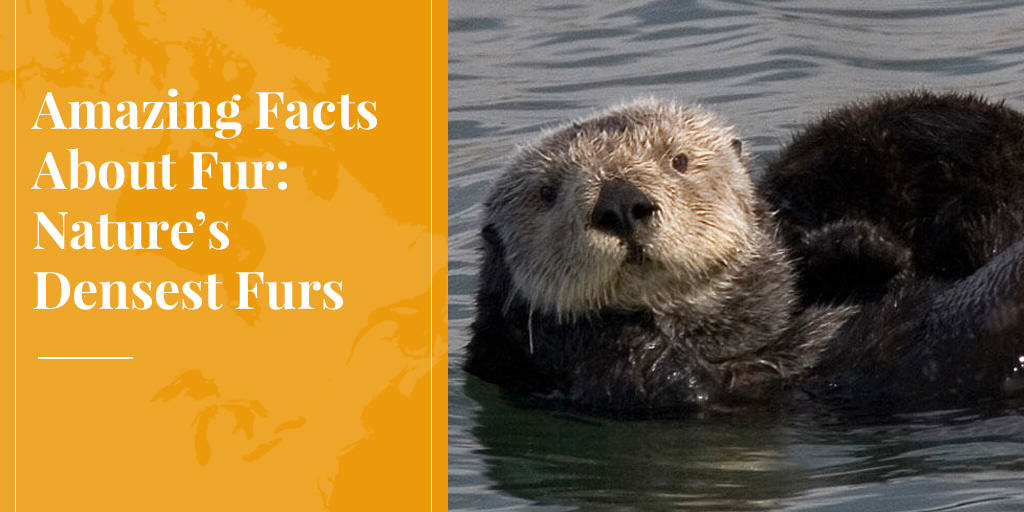
Hair density has always fascinated the fur trade because the densest furs are also the softest and most luxurious. Before the advent… Read More
Hair density has always fascinated the fur trade because the densest furs are also the softest and most luxurious. Before the advent of modern conservationism, this meant that the densest furs were prone to over-harvesting. Today, we have learned from past mistakes. Trade in the densest fur of all is still restricted, but the animal's recovery is considered a great conservation success. And due to a remarkable story in the history of farming, the second-densest is abundant and readily available.
To appreciate what makes fur dense, let’s set a baseline: human hair. And because human hair varies depending on ethnicity and hair colour, we’ll choose the densest of all, a pale blond(e).
A blonde’s fine hairs average about 190 per cm2, varying depending on the part of the scalp. That's almost double Afro-textured hair, the least dense.
Now step aside blondie, and make way for that benchmark of luxury, mink.
A mink’s hair density varies by season and body part. Also, farmed mink is denser than wild, and a dressed pelt is denser than a live animal. But as a guide, a dressed, farmed pelt has about 24,000 hairs per cm2. That’s 126 times denser than the thickest human pelage!
Blondes have the densest head hair of all humans, but pale in comparison to the hirsute mink. Photos: Themes.com; Truth About Fur.
Impressed? Well hold on. Prepare for furs so dense and soft that words to describe them are hard to find. Like talcum powder, perhaps?
Animals with the densest furs live where climates are cold, humid and windy. Size also matters; because small mammals are more vulnerable to heat loss, they generally have denser fur.
And so we find ourselves in the high Andes, home of the long-tailed Chinchilla lanigera and short-tailed Chinchilla chinchilla. Being small and nocturnal makes them elusive. They're also very rare. The International Union for Conservation of Nature (IUCN) classifies both as "critically endangered".
We can blame the “tragedy of the commons” for that. Though the term was coined for what happens when no one owns common grazing land, it also played a role in the historic fur trade.
Spanish explorers first sent chinchilla pelts home in the 16th century, but it wasn’t until the late 19th century that Europeans developed an insatiable appetite for them. Populations collapsed, prices soared, and by the early 20th century a peasant trapper could feed his family for a month with just one pelt - if he could find one!
Only late in the day, in 1910, did the range states of Argentina, Bolivia, Chile and Peru unite to ban the trade, but effective enforcement was still decades away. Extinction seemed inevitable.
Farmers to the Rescue!
And then the cavalry arrived, in the unlikely form of fur farmers.
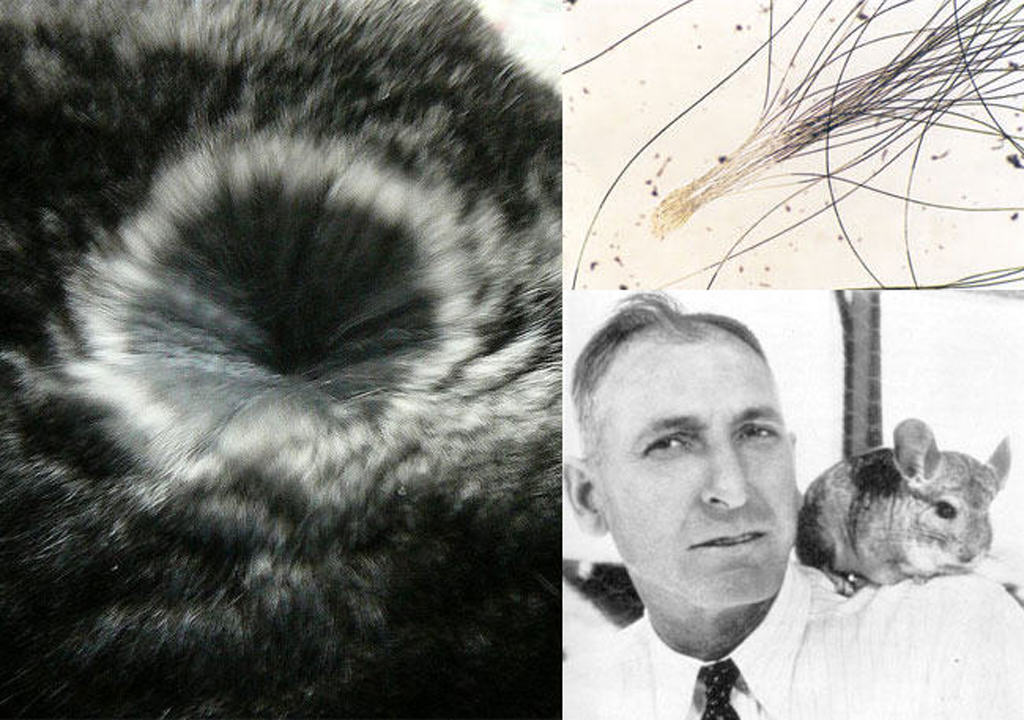
Blowing on chinchilla fur reveals hairs so dense, a flea cannot survive. Photo: Salix. Top: A tuft of hairs from a single follicle. Photo: FBI. Bottom: Mathias Chapman, father of chinchilla farming, with his pet, Pete.
It all began with Californian miner Mathias Chapman who, in 1923, was allowed by Chile to take 11 live chinchilla home for breeding. (It took him three years to trap them!) Ten survived the trip and one gave birth en route.
Chapman originally planned to breed pets, but he switched to fur farming. Today, chinchilla farms are found from Canada to Argentina, and in many European countries, and almost all their stock are believed to descend from Chapman's original 10.
Farming of animals can help conserve their wild cousins. By meeting demand, it reduces pressure on wild populations, as in the case of mink and fox. But it can also encourage illegal hunting and provide a cover for smuggling - the fear with tiger farming.
In the case of chinchilla, farming didn't just help protect wild populations, it probably saved them. And even if most chinchilla now live in pens and eat hay and pellets, there is absolutely no chance of them going extinct!
Dense Is Desirable
So what is all the fuss about with chinchilla fur? Hair density. No other terrestrial mammal comes close.
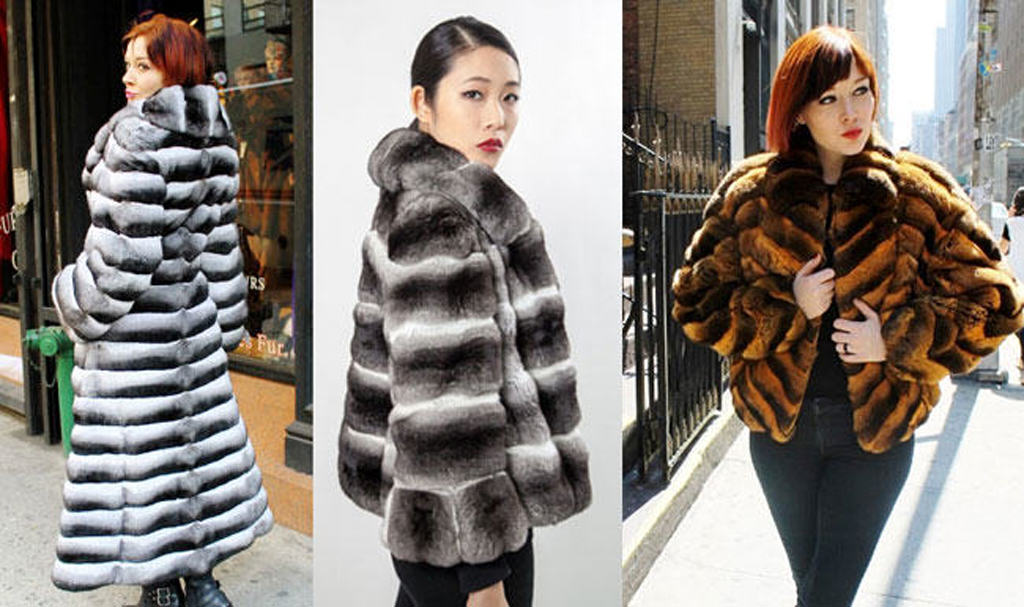
A full-length chinchilla coat (left) may use 150 pelts, so get ready for sticker shock: $25,000. Photos: Kaufman Furs.
Hairs grow from organs called follicles which, in humans, are densest on the forehead – about 290 per cm2. Chinchilla have as many as 1,000.
Then there's the number of hairs per follicle. Hairs grow in tufts, with 1-3 (rarely 4) sprouting from each human head follicle. But a regular chinchilla has about 50 hairs per follicle, while a show “chin” (as pet owners call them) may have 100.
That means a regular chin has 50,000 per cm2 - double a farmed, dressed mink pelt, and 263 times more than our human blonde. So dense is a chin's fur that it's said fleas and ticks can’t penetrate it, and if they could, they'd suffocate!
"Soft Gold"
Amazingly, there is fur even denser than chinchilla - so dense it drove men to endure the harshest conditions nature could throw at them, far from home, for more than 100 years. This was the Great Hunt!
In the early 18th century, Russian fur traders found themselves on the Pacific shores of Siberia. Drawn by a cornucopia of desirable furs, notably sable, they had spent 150 years opening up Russia's vast eastern territory.
Now they took to their boats in pursuit of fur so dense, and so valuable, it was known as "soft gold": sea otter.
Starting from the Kuril Islands, the traders island-hopped across the North Pacific, harvesting one otter population after another, plus highly profitable hair seals they found along the way. The otter trade in Alaska boomed, and then the traders headed south. There they were joined by adventurers from all over North America and Europe in the great California Fur Rush.
The moniker "soft gold" was deserved. In 1775 otter pelts sold in the Russian port of Okhotsk at up to 30 times the price of sable. In the 1880s, a pelt brought $165 in London, but by 1903, as supplies dried up, made a staggering $1,125.
Thankfully the ground-breaking North Pacific Fur Seal Convention of 1911 put an end to seal otter fever by imposing a moratorium on the hunt. But was it too late? Perhaps fewer than 2,000 otters remained. Could they ever recover?
Yes they could! Sea otters have rebounded in two-thirds of their historic range, and are today cited as a great success story in the annals of marine conservation. As a precaution given the lesson of history, IUCN still classifies them as endangered, but Alaskan fishermen are now complaining the population is growing so fast, they've become a pest!
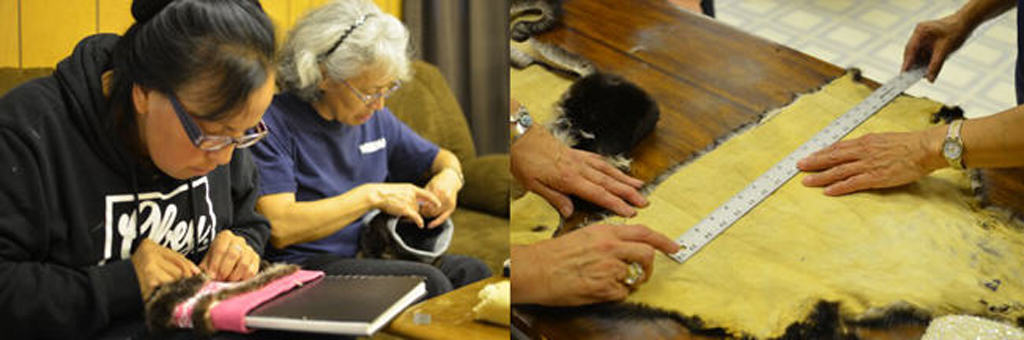
Natives of Alaska's coastal villages are exempt from the ban on sea otter hunting, and can sell "significantly altered" products to non-natives. Here women take a class in working with otter fur, hoping to create a cottage industry. Photos: Ruth Eddy/KRBD.
So what is it about sea otter fur that's so alluring? You know the answer already: density. Not even chinchilla compares.
Sea otters need superb insulation because, unlike other marine mammals, they have no blubber. And unlike that other four-legged marine mammal, the polar bear, they don't leave the water unless they absolutely have to. Imagine, swimming in the North Pacific, 24/7, in winter. Unless you have inches of blubber, or are a halibut, it's almost inconceivable.
At its upper range, that’s four times denser than the finest show chin, 16 times denser than a farmed mink, and 2,105 times denser than our human blonde. That is dense fur!
In its 2014 Sustainability Report, fashion brand Hugo Boss said that it was planning to stop using farmed fur in… Read More
In its 2014 Sustainability Report, fashion brand Hugo Boss said that it was planning to stop using farmed fur in its collections from Autumn/Winter 2016 onwards. According to Bernd Keller at the company, its sustainable corporate strategy should take precedence over the “fast and simple route to success”. Like many companies, it has realised that global consumers are demanding a more sustainable approach to business.
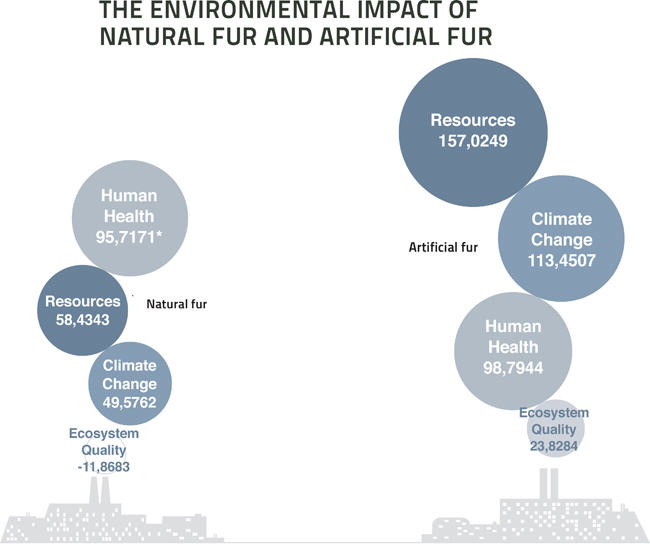
I completely agree that sustainability should take precedence over short-term corporate goals and applaud Hugo Boss for thinking that way, but I would respectfully disagree that moving away from farmed fur is a good method for accomplishing it.
*Units in "millipoints" - used to express diverse types of potential impacts. Source: A comparative life cycle analysis: Natural fur and faux fur by DSS Management Consultants.
Fur is actually one of the most sustainable materials that apparel brands can employ. Fur farms recycle food waste from other industries and can provide organic replacement for chemical fertilisers, while natural fur garments usually last 20-30 years or more and are regularly brought to furriers for remodelling, which extends their life considerably. And at the end of its life, natural fur will degrade quickly and naturally.
Globally the environmental aspects of fur are strictly regulated in accordance with national legislation. These guidelines cover the handling and distribution of manure and the use of chemicals. This means that the regulated fur industry sets the best standards in the world when it comes to the environmental impact of this type of farming.
Artificial fur, on the other hand, is far from the "safe alternative" some lobbying groups might have us believe. Fake fur, comprising polyacrylates, requires the extraction and fractionating of petroleum, its subsequent conversion into fibres and mass manufacturing into products. These are not only incredibly energy intensive and damaging to local ecosystems, but also produce extremely unpleasant chemical compounds.
Plus, fake fur garments are very much "disposable fashion" and will rarely be kept for more than a couple of years – after which they end up alongside plastic bags on rubbish tips, where they could remain for centuries.
But perhaps most importantly, I’m concerned that Hugo Boss is not respecting consumers’ choice and ability to decide for themselves. Have the vast majority of its customers in regions like Europe and Asia said they don’t want fur products and stayed away in droves? Its most recent global earnings figures would probably suggest otherwise.
Also, its 2014 annual report noted that Hugo Boss “has been in dialogue with several animal and consumer protection organisations for many years, to continuously improve in the area of animal welfare”. We certainly welcome intelligent and informed debate on the topics of sustainability and animal welfare.
So I would like to conclude with a request to Hugo Boss. If you’re genuinely keen on sustainability and truly eager to engage in dialogue with interested parties, get in touch with us at the International Fur Federation. Moving away from fur may net the brand some short-term headlines, but it may cause more harm than good in the long run. And the long run is what sustainability is really all about.
The European Union recently announced that products made from seals hunted by Inuit people can continue to be sold in the… Read More
Putting sexy back in sealskin: Nunavut seamstresses aim for high-end fashion market. CBC News.
The European Union recently announced that products made from seals hunted by Inuit people can continue to be sold in the EU despite the 2009 ban that prevents the importation or sale of all other seal products. It is impossible to imagine a sealing policy that would be more hypocritical and anti-democratic.
Canadian sealing is a sustainable use of a natural resource carried out by licensed, well-trained sealers under the rules and regulations of the government of Canada, which have been developed based upon both population science and humane killing techniques. In 1971 a quota management program was established for the Northwest Atlantic harp seal stock, and the population is estimated to have grown since then from 1.8 million to the 5.9 million, according to the IUCN. World-wide the population is close to 8 million, with "All known stocks ... increasing in number".
Despite the comments of the animal rights groups, the world-wide markets for seal products (food, Omega-3 fatty acids, oil, fur, leather) continue to exist. They exist but are inaccessible because the decades-old animal rights propaganda campaigns have co-opted (bought?) politicians in the EU, the USA, and other countries to deny their citizens their democratic right to choose to buy seal products.
Even in its stronghold of North America, surveys suggest the animal rights philosophy (i.e., no animal use) is adhered to by less than 3 percent of people. And because of this lack of popular support, animal rights groups can only further their agenda by using their multi-million-dollar war chests to lobby politicians to pass laws denying citizens their right of choice: anti-democratic to say the least. Like autocrats throughout history, it seems that these wealthy activist groups don't trust individual citizens to do "the right thing".
Hypocrisy Everywhere
The World Trade Organisation enquiry found that the “seal ban” was against its rules, but in the interest of protecting the “morals” of EU citizens the ban would stand: thus buying into the animal rights propaganda that killing seals is immoral. An interesting decision given that many countries within the EU continue to kill seals legally in the Baltic and North seas.
Animal rights groups constantly make pious, politically correct statements that they are not against Inuit sealing. For decades, Inuit organisations (including the Inuit Circumpolar Council, or ICC, which represents Northern Aboriginal communities around the world) has rejected this “exemption” as being meaningless, based in a colonialist mentality, and little short of racism.
Thousands of rural Canadian citizens are directly and indirectly employed in the sealing industry earning a living for their families. Sealing is part of an annual mosaic of income for rural Canadians whose money is derived from a number of individual activities that in total provide a livelihood that enables them to live in their communities. The same thing applies to Canadian farmers, ranchers, trappers, hunters, and so on: the only difference is the species killed. Few rural Canadians have the luxury of a guaranteed annual salary.
Animal rights groups keep on about a “buyout” for those in the sealing industry. A one-year buyout? A two-year buyout? Or an annual buyout till all those involved have died? For whom? For sealers, plant workers, truckers, diesel suppliers, insurance agents, garment manufacturers, artists, artisans, grocery suppliers, gun and ammunition stores, vehicle sales people? For all or only some of them? Will they pay the many millions involved? No. These American-headquartered multi-million-dollar groups want the Canadian tax payer to subsidize their ridiculous views.
At an anti-sealing protest outside the Canadian embassy in the Hague in March 2007, the media were more interested in Aaju Peter (right), her son Aagu, and me than they were in the protesters. Besides being a lawyer and Inuk clothing designer, in 2011 Aaju was named a member of the Order of Canada for her work promoting and preserving Inuit culture.
Resource Use Is Not Disneyland
"Baby seals"? The use of the word "baby" is simply an anthropomorphism, the Bambi syndrome, designed to influence and upset urban people who have a total disconnect with the sources of their food, clothing, medicines and other objects of daily use. The seals killed are fully weaned, are independent of their dames, and are on their own to survive or not: this is nature, not Bambi in Disneyland.
Death by gunshot or hakapik is instantaneous as found by innumerable studies by independent vets from Canada, the USA and the EU. The only negative studies have been bought and paid for by animal rights groups. The reality is that no animal-killing is pretty: it is by nature ugly. But pretty and ugly are not synonyms for right and wrong or good and bad. Sealing is simply an outdoor abattoir without the offal problems of land-based abattoirs (dumping it in landfills) because what we cannot use we leave on the ice to return to the eco-system as food for birds, marine mammals, fish and crustaceans: ecologically correct and green.
Travesty of Fiction Over Fact
The reality of the 50 years of animal rights propaganda has been the diminution of the incomes of thousands of Canadian citizens while these American-headquartered groups have collected hundreds of millions of dollars from people who think they are supporting animal care and conservation. One group alone generates contributions close to $100 million annually.
To adapt Winston Churchill's famous turn of phrase, never have so many been so misled by so few for such nefarious reasons. For decades these groups have said nothing new, yet their comments are deemed “newsworthy”. They and their celebrity friends utter ridiculous comments and no journalists challenge them. It's a circus, a travesty of fiction over fact, and proof that hypocrisy reigns supreme. It is media manipulation of the highest order.
Propaganda is an insidious thing and unless countered by a free press prepared to ask the hard questions it will continue ad infinitum. It is time for individuals, politicians and media to remember the immortal line of Pogo: "We have met the enemy and he is us."
The anti-sealing story is the second greatest propaganda campaign of the last 85 years. Democracy is about the right of citizens to choose. History has shown us that when propaganda triumphs, democracy loses.
Nobody in the Canadian sealing industry wants people to buy their products if they do not wish to. Canadian sealers only want all citizens to have their democratic right to choose for themselves to use or not use seal products.
Animal rights is not animal conservation or animal welfare. The goal of animal rights groups like the Humane Society of the US (and its extension, Humane Society International) and People for the Ethical Treatment of Animals, to name but two, is not to end sealing but rather to end man’s use - not just killing, but any use - of all animals for any reason. Read their mission statements. Seals are the tactic not the goal.
Anti-sealing is the epitome of George Orwell’s position in Animal Farm: all animals are equal but some animals are more equal than others.
The animal rights anti-sealing movement may have won some battles but not the war. If it wins the war you will have to look around to see whom among you will be the next victim. The beef, pork, chicken or lamb producers? The trappers, hunters or fur farmers? The clothes manufacturer, shoemaker, auto manufacturer or furniture manufacturer? Anyone who uses animals for any purpose at all? You?
Yours truly (second from left) with an American camera crew shooting for the TV series The Politics of Food.
As the cold weather settles in for another few months, I cuddle in my small country home on the Bay… Read More
Samples of my exclusive house boots, an harmonious blend of various fabrics, leather and furs.
As the cold weather settles in for another few months, I cuddle in my small country home on the Bay of Fundy. I put on my beaver house-boots and my wool sweater and thank Mother Nature for offering me all I need to keep us warm.
Living in a remote community on the Fundy shore, I am awed by the highest tides in the world. Surrounded by nature and silence, I bow to the sea which brings fish and clams to my table, and to the forests that supply firewood to keep my house cosy and wildlife to complement the seafood
My sewing skills make it possible to make clothing and accessories that will keep us comfortable.
My African seal and coyote jacket.
Living in harmony with this environment, I relish a dream come true after fantasizing about it through all those years of living in some of the mega-cities of the world, a world surrounded by cement and pollution and so reinvented by humans that they can forget where they come from and who they are.
Real Meaning of Sustainability
I was introduced to fur design by professional furriers and artisans who put their skills at work to produce beautiful garments from a natural and renewable resource. Working in the Northern regions of our beautiful country, I’ve discovered the real meaning of sustainability of our natural resources.
I am thankful to the organizations who oversee good management and a respectful attitude toward our natural resources.
I am disappointed by negative and false information still spread by some organizations, sadly giving real environmentalism a bad name while imposing hardship on real people. At a time when “anti-bullying” and other forms of negative behavior are topics of public interest, we should wonder if this sentiment should perhaps apply here.
While attending a recent event where I was able to display my creations, I was overwhelmed by the interest of people asking questions about the different furs in my booth, and reaching out to touch them. Often I heard the comment: “I am nervous about wearing furs ... someone might attack me on the street”.
I reply that they should be strong and be proud of wearing creations from the natural world. Every time I wear my fur coat, people come to me wanting to know what it’s made of and often comment on how beautiful it is.
Meanwhile, as I’m looking out the window at the ice moving with the tides, I am sewing and transforming a seal pelt from a vision into a beautiful garment.
The spectacular view from my studio, with Cape Split on the horizon. This is the land of the creator Glooscap of Mi'kmaq mythology.
We are the people of the fur trade and we will be silent no longer! That is the new rallying… Read More
About 30 people gathered in Iqaluit in March 2014 to shoot a pro-seal hunting #sealfie to protest a $1.5 million donation from funds raised by Ellen DeGeneres's Oscar selfie to the Humane Society of the United States, an organization that fights seal hunting. Photo: Emily Ridlington/CBC.
We are the people of the fur trade and we will be silent no longer! That is the new rallying cry of our proud and historic trade, and it's long overdue.
It is hard to believe that the debate about fur has been raging for a full half-century – and a bit troubling to realize that I witnessed it all!
And while it is great to see all the fur on fashion runways and in the streets this winter, we still have a way to go to repair the damage caused by 50 years of activist lies, to reassure consumers that fur is produced responsibly and ethically.
Spotlight on Sealing
It was in March 1964, that a film on Radio-Canada, the French-language network of Canada’s public broadcaster, rocketed the northwest Atlantic seal hunt into the media spotlight for the first time. No matter that the shocking scenes of a live seal being poked by a sealer’s knife (“skinned alive”) would later prove to have been staged for the camera. (1)
In the 50 years that followed, the modus operandi of a lucrative new protest industry was refined: shocking images of questionable origin, celebrities to attract media attention, and emotional fund-raising campaigns that generated piles of money to drive more campaigns.
Markets for sealskins were weakened (with a US import ban in 1972 and a partial European ban in 1983), but the newly formed International Fund for Animal Welfare (IFAW) was soon pulling in $6 million annually – more than 3,000 Canadian sealers made risking their lives on the ice floes each Spring. Greenpeace and other groups jumped onto the gravy train, with help from Brigitte Bardot. (2)
In the 1980s – with wild furs more popular than they had been since the Roaring Twenties – the protesters turned their newly-honed media, fund-raising and political skills against trapping (3), a campaign that resulted in the European Union banning jaw-type “leg-hold” traps, in 1997. No matter that traps used in Europe were untested or that other methods used there to control wildlife (e.g., poisoning muskrats in Belgium and the Netherlands) had far-reaching animal-welfare and environmental consequences. Canadian diplomats were told: “Don’t worry about your scientific studies, don’t you understand that this is about politics?”
While campaigns against sealing and trapping continue, the anti-fur focus has now shifted to calls for a ban on fur farming – but the tactics are the same.
"Truth about Fur" shows real trappers, like Tanya Lynn Strong (about to set a beaver trap) pursuing their passion with full knowledge that they are on the frontline of wildlife and habitat conservation. They don't need lessons about respecting nature from urban activists. Photo: Serge Lariviere.
Absent: Voice of the Fur Trade
Throughout this debate, one voice was conspicuously absent: the voice of the people whose livelihoods and reputations were being attacked. There are several reasons for this, including the imperatives of modern media, where confrontation is “news” and “celebrities” are irresistible. Hunters, trappers and farmers, moreover, do not live in cities where most journalists are based, so they are rarely heard.
The structure of the fur trade itself – small-scale, decentralized and artisanal – also made it difficult for the industry to muster an effective response. And it didn’t help that those closest to the media and consumers – retail furriers – have little knowledge of production issues. Asking a furrier about trapping standards makes about as much sense as asking a seafood chef to explain fisheries management policy.
All this is about to change. After 50 years of turning the other cheek, the fur trade is finally speaking out more effectively. Under the banner “Truth About Fur”, fur farmers, trappers, biologists and veterinarians are setting the record straight.
"Truth about Fur" shows real farmers at work on real fur farms. They don't need lessons about caring for animals from PeTA. Photo: Anne Troake.
Animal Activists Scrambling
The reaction of animal activists is revealing. Used to having the soapbox to themselves, they are scrambling to block or discredit the industry’s voice. I have experienced this personally.
When we refute lies or misinformation on-line, it doesn’t take long before a cyber-bully tries to shut down discussion. Rather than risk having their dogmatic beliefs shaken by facts, they shoot the messenger. Typical attacks include: “He’s paid to write this, don’t listen to him!” “He’s a fur industry troll!” Recently I was called “a sock puppet”.
I suppose it is better to be a sock puppet than a marionette, which would mean that someone was pulling my strings. But the bad news for these cyber-bullies is that we are not puppets. We are the people of the fur trade, and we will be silent no longer.
If the vicious lies and slanders leveled by activists against the fur trade for the past 50 years were directed at any other group in society, they would be denounced as hate crimes. It’s time that animal activists were exposed for what they are: intolerant bullies with little understanding of modern environmental thinking.
Aboriginal (or other) trappers do not need lessons about respecting nature from urban activists. Mink farmers do not need lessons about caring for animals from People for the Ethical Treatment of Animals (PeTA). The fur trade is not a crime against nature; it is a prime example of “the responsible and sustainable use of renewable natural resources”, a principle supported by the International Union for Conservation of Nature (IUCN) and every other environmental authority. These are some of the facts that are documented by Truth About Fur.
It is encouraging that close to 500 international designers now include fur in their collections, compared with only about 40 in the early 1990s. And it is wonderful to see people of all ages with coyote and fox trim on their parkas this winter. But it is especially satisfying to know that, whatever people choose to wear, the fur trade’s story is finally being told by the people who live it.
PROUD PROFESSIONALS EVERY ONE: (clockwise from left) Alcide Giroux sets a quick-killing Conibear trap for beaver in northern Ontario; Ryan Kole sets a footsnare for lynx in British Columbia; Randy Mersereau sets a dog-proof box trap for fisher or raccoon in Nova Scotia.
* * *
1) Alan Herscovici, Second Nature: The Animal-Rights Controversy (Canadian Broadcasting Corporation, 1985; Stoddart Publishing, 1991), p. 74.
2) Herscovici, p. 70.
3) Herscovici, pp. 117-162.
Manage Consent
To provide the best experiences, we use technologies like cookies to store and/or access device information. Consenting to these technologies will allow us to process data such as browsing behavior or unique IDs on this site. Not consenting or withdrawing consent, may adversely affect certain features and functions.
Functional
Always active
The technical storage or access is strictly necessary for the legitimate purpose of enabling the use of a specific service explicitly requested by the subscriber or user, or for the sole purpose of carrying out the transmission of a communication over an electronic communications network.
Preferences
The technical storage or access is necessary for the legitimate purpose of storing preferences that are not requested by the subscriber or user.
Statistics
The technical storage or access that is used exclusively for statistical purposes.The technical storage or access that is used exclusively for anonymous statistical purposes. Without a subpoena, voluntary compliance on the part of your Internet Service Provider, or additional records from a third party, information stored or retrieved for this purpose alone cannot usually be used to identify you.
Marketing
The technical storage or access is required to create user profiles to send advertising, or to track the user on a website or across several websites for similar marketing purposes.