As the cold weather settles in for another few months, I cuddle in my small country home on the Bay… Read More
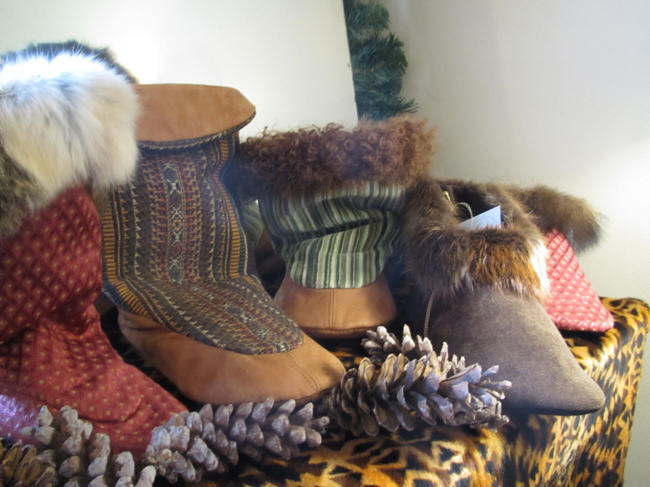
Samples of my exclusive house boots, an harmonious blend of various fabrics, leather and furs.
As the cold weather settles in for another few months, I cuddle in my small country home on the Bay of Fundy. I put on my beaver house-boots and my wool sweater and thank Mother Nature for offering me all I need to keep us warm.
Living in a remote community on the Fundy shore, I am awed by the highest tides in the world. Surrounded by nature and silence, I bow to the sea which brings fish and clams to my table, and to the forests that supply firewood to keep my house cosy and wildlife to complement the seafood
My sewing skills make it possible to make clothing and accessories that will keep us comfortable.
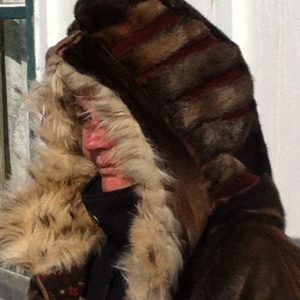
My African seal and coyote jacket.
Living in harmony with this environment, I relish a dream come true after fantasizing about it through all those years of living in some of the mega-cities of the world, a world surrounded by cement and pollution and so reinvented by humans that they can forget where they come from and who they are.
Real Meaning of Sustainability
I was introduced to fur design by professional furriers and artisans who put their skills at work to produce beautiful garments from a natural and renewable resource. Working in the Northern regions of our beautiful country, I’ve discovered the real meaning of sustainability of our natural resources.
I am thankful to the organizations who oversee good management and a respectful attitude toward our natural resources.
I am disappointed by negative and false information still spread by some organizations, sadly giving real environmentalism a bad name while imposing hardship on real people. At a time when “anti-bullying” and other forms of negative behavior are topics of public interest, we should wonder if this sentiment should perhaps apply here.
While attending a recent event where I was able to display my creations, I was overwhelmed by the interest of people asking questions about the different furs in my booth, and reaching out to touch them. Often I heard the comment: “I am nervous about wearing furs ... someone might attack me on the street”.
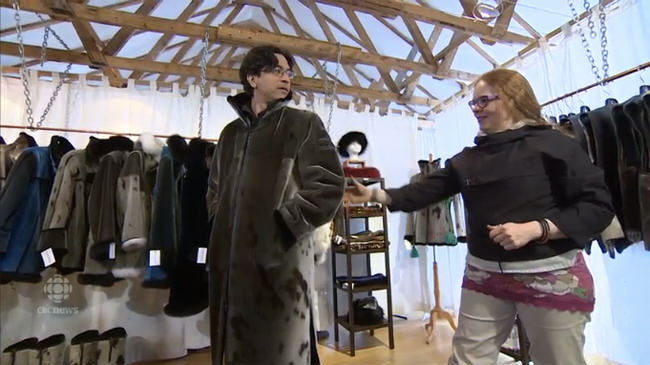
I reply that they should be strong and be proud of wearing creations from the natural world. Every time I wear my fur coat, people come to me wanting to know what it’s made of and often comment on how beautiful it is.
Meanwhile, as I’m looking out the window at the ice moving with the tides, I am sewing and transforming a seal pelt from a vision into a beautiful garment.
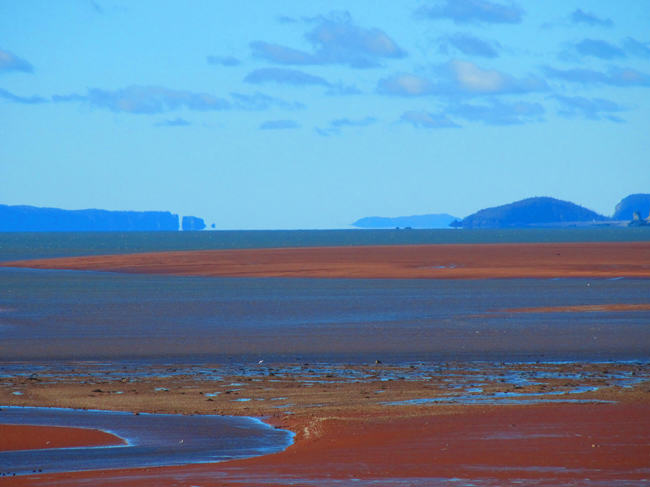
The spectacular view from my studio, with Cape Split on the horizon. This is the land of the creator Glooscap of Mi'kmaq mythology.
We are the people of the fur trade and we will be silent no longer! That is the new rallying… Read More
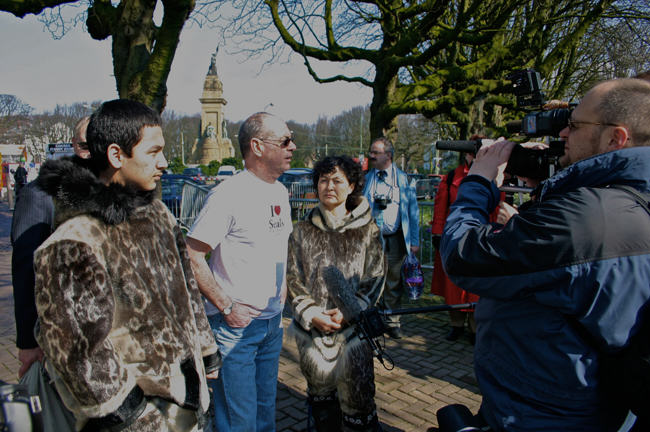
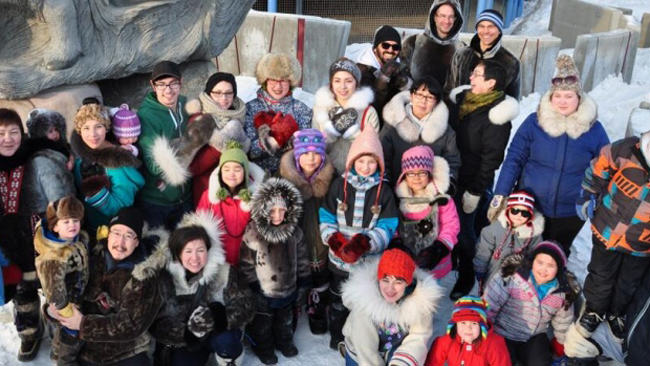
About 30 people gathered in Iqaluit in March 2014 to shoot a pro-seal hunting #sealfie to protest a $1.5 million donation from funds raised by Ellen DeGeneres's Oscar selfie to the Humane Society of the United States, an organization that fights seal hunting. Photo: Emily Ridlington/CBC.
We are the people of the fur trade and we will be silent no longer! That is the new rallying cry of our proud and historic trade, and it's long overdue.
It is hard to believe that the debate about fur has been raging for a full half-century – and a bit troubling to realize that I witnessed it all!
And while it is great to see all the fur on fashion runways and in the streets this winter, we still have a way to go to repair the damage caused by 50 years of activist lies, to reassure consumers that fur is produced responsibly and ethically.
Spotlight on Sealing
It was in March 1964, that a film on Radio-Canada, the French-language network of Canada’s public broadcaster, rocketed the northwest Atlantic seal hunt into the media spotlight for the first time. No matter that the shocking scenes of a live seal being poked by a sealer’s knife (“skinned alive”) would later prove to have been staged for the camera. (1)
In the 50 years that followed, the modus operandi of a lucrative new protest industry was refined: shocking images of questionable origin, celebrities to attract media attention, and emotional fund-raising campaigns that generated piles of money to drive more campaigns.
Markets for sealskins were weakened (with a US import ban in 1972 and a partial European ban in 1983), but the newly formed International Fund for Animal Welfare (IFAW) was soon pulling in $6 million annually – more than 3,000 Canadian sealers made risking their lives on the ice floes each Spring. Greenpeace and other groups jumped onto the gravy train, with help from Brigitte Bardot. (2)
In the 1980s – with wild furs more popular than they had been since the Roaring Twenties – the protesters turned their newly-honed media, fund-raising and political skills against trapping (3), a campaign that resulted in the European Union banning jaw-type “leg-hold” traps, in 1997. No matter that traps used in Europe were untested or that other methods used there to control wildlife (e.g., poisoning muskrats in Belgium and the Netherlands) had far-reaching animal-welfare and environmental consequences. Canadian diplomats were told: “Don’t worry about your scientific studies, don’t you understand that this is about politics?”
While campaigns against sealing and trapping continue, the anti-fur focus has now shifted to calls for a ban on fur farming – but the tactics are the same.
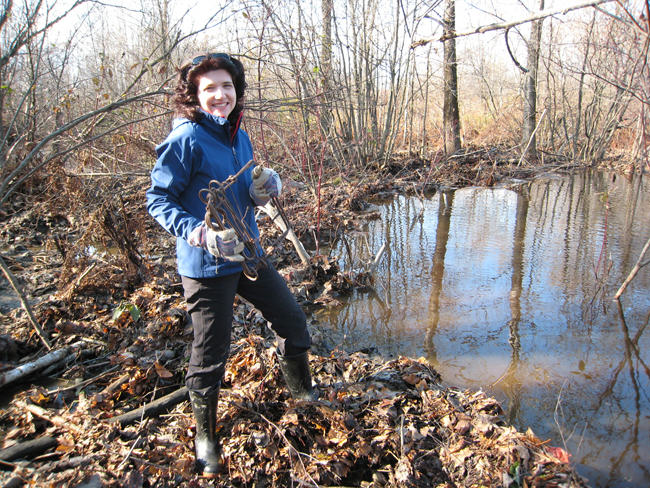
"Truth about Fur" shows real trappers, like Tanya Lynn Strong (about to set a beaver trap) pursuing their passion with full knowledge that they are on the frontline of wildlife and habitat conservation. They don't need lessons about respecting nature from urban activists. Photo: Serge Lariviere.
Absent: Voice of the Fur Trade
Throughout this debate, one voice was conspicuously absent: the voice of the people whose livelihoods and reputations were being attacked. There are several reasons for this, including the imperatives of modern media, where confrontation is “news” and “celebrities” are irresistible. Hunters, trappers and farmers, moreover, do not live in cities where most journalists are based, so they are rarely heard.
The structure of the fur trade itself – small-scale, decentralized and artisanal – also made it difficult for the industry to muster an effective response. And it didn’t help that those closest to the media and consumers – retail furriers – have little knowledge of production issues. Asking a furrier about trapping standards makes about as much sense as asking a seafood chef to explain fisheries management policy.
All this is about to change. After 50 years of turning the other cheek, the fur trade is finally speaking out more effectively. Under the banner “Truth About Fur”, fur farmers, trappers, biologists and veterinarians are setting the record straight.
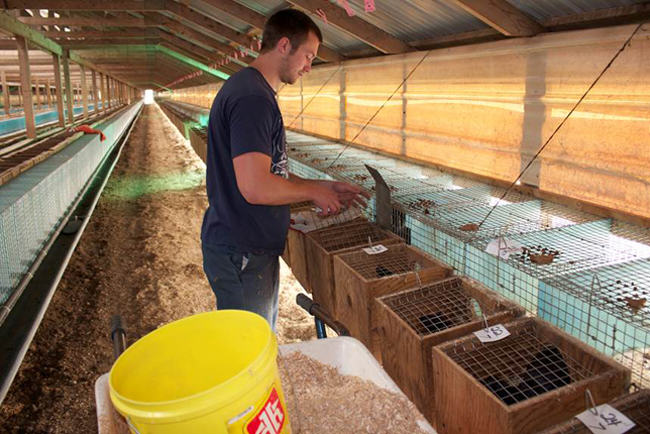
"Truth about Fur" shows real farmers at work on real fur farms. They don't need lessons about caring for animals from PeTA. Photo: Anne Troake.
Animal Activists Scrambling
The reaction of animal activists is revealing. Used to having the soapbox to themselves, they are scrambling to block or discredit the industry’s voice. I have experienced this personally.
When we refute lies or misinformation on-line, it doesn’t take long before a cyber-bully tries to shut down discussion. Rather than risk having their dogmatic beliefs shaken by facts, they shoot the messenger. Typical attacks include: “He’s paid to write this, don’t listen to him!” “He’s a fur industry troll!” Recently I was called “a sock puppet”.
I suppose it is better to be a sock puppet than a marionette, which would mean that someone was pulling my strings. But the bad news for these cyber-bullies is that we are not puppets. We are the people of the fur trade, and we will be silent no longer.
If the vicious lies and slanders leveled by activists against the fur trade for the past 50 years were directed at any other group in society, they would be denounced as hate crimes. It’s time that animal activists were exposed for what they are: intolerant bullies with little understanding of modern environmental thinking.
Aboriginal (or other) trappers do not need lessons about respecting nature from urban activists. Mink farmers do not need lessons about caring for animals from People for the Ethical Treatment of Animals (PeTA). The fur trade is not a crime against nature; it is a prime example of “the responsible and sustainable use of renewable natural resources”, a principle supported by the International Union for Conservation of Nature (IUCN) and every other environmental authority. These are some of the facts that are documented by Truth About Fur.
It is encouraging that close to 500 international designers now include fur in their collections, compared with only about 40 in the early 1990s. And it is wonderful to see people of all ages with coyote and fox trim on their parkas this winter. But it is especially satisfying to know that, whatever people choose to wear, the fur trade’s story is finally being told by the people who live it.
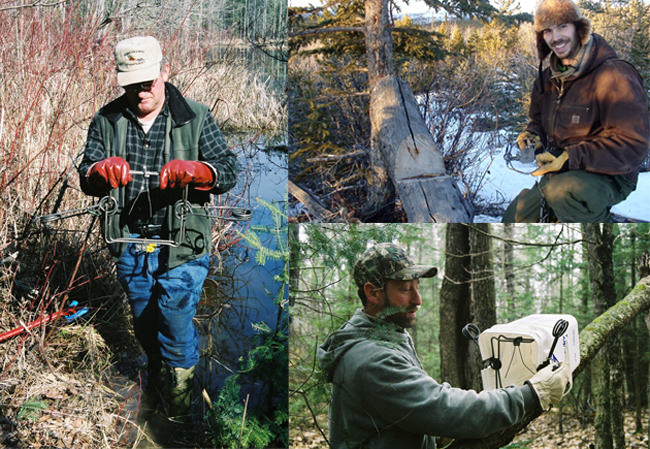
PROUD PROFESSIONALS EVERY ONE: (clockwise from left) Alcide Giroux sets a quick-killing Conibear trap for beaver in northern Ontario; Ryan Kole sets a footsnare for lynx in British Columbia; Randy Mersereau sets a dog-proof box trap for fisher or raccoon in Nova Scotia.
* * *
1) Alan Herscovici, Second Nature: The Animal-Rights Controversy (Canadian Broadcasting Corporation, 1985; Stoddart Publishing, 1991), p. 74.
Ontario trappers have launched an exciting new campaign to inform the public about how they protect people and property by responsibly managing… Read More
Ontario trappers have launched an exciting new campaign to inform the public about how they protect people and property by responsibly managing wildlife populations.
“We are trying to reach that 80% of the population that simply does not know what we do or why and how we do it,” says Robin Horwath, General Manager of the Ontario Fur Managers Federation (OFMF).
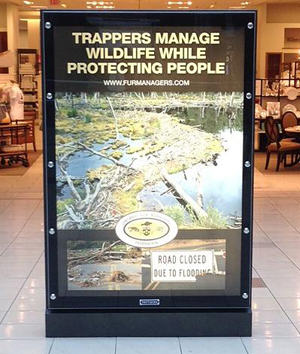
OFMF’s posters carry a bold headline stating that, "Trappers Manage Wildlife While Protecting People!" This message is accompanied by three large photos of forest land under water and a road closed by beaver flooding.
For more information, the posters direct people to the Ontario Fur Managers’ website at www.Furmanagers.com.
Street-Level Ads
The campaign over Christmas featured large posters in two major Ontario malls, one in Ottawa’s Bayshore mall and one in Toronto’s The Path mall. In March, the campaign will shift to street-level advertising in Toronto and ads on six Ottawa buses.
“Last year, I saw some street-level info ads about the oil sands and I thought: that’s what we’ve got to do; we’ve got to get out there and tell our own story!”
“People are intelligent, but they can’t make the right decisions if we don’t give them the facts,” says Horwath.
Of course, a few posters will not change the world on their own, at least not immediately. But imagine if trappers’ councils across North America did the same thing!
Does trapping of wildlife endanger species? Truth About Fur asked Ryan and Minette Kole, certified nurses and trappers from British… Read More
Does trapping of wildlife endanger species? Truth About Fur asked Ryan and Minette Kole, certified nurses and trappers from British Columbia, Canada:
"That’s pretty well impossible with today’s strict, government-regulated trapping seasons and other rules.
"As trappers, our goal is to maintain stable and healthy wildlife populations; we don’t want to deplete our own resource - that would put us out of business!
"The real threat to wildlife today is not regulated hunting or trapping, it is the destruction of the wilderness areas by industrial activity - and trappers are the ones who are out there monitoring what's really happening out in the bush, sounding the alarm and working with logging companies and government to protect that natural habitat."
When I started trapping in 1959, it was a lot easier than it is now. Oh, sure, there’s more information… Read More
When I started trapping in 1959, it was a lot easier than it is now. Oh, sure, there’s more information and better equipment available these days, but it’s a lot more difficult to actually start trapping today than it was a half century ago.
Urbanization is one reason. The population of the United States has shifted from predominantly rural to predominantly urban, and fewer kids (adults, too, for that matter) live close enough to trapping country to make it work. I was a town kid too, but it was a small town, and my bike could get me beyond the city limits in five minutes. That’s often not the case today, and even where it is, today’s world isn’t the one I grew up in. Turning a kid loose on a bicycle before daylight isn’t such a wise idea in many areas.
Also, there’s the change in public attitude about hunting, fishing and trapping in general. According to the 2006 National Survey of Fishing, Hunting and Wildlife-Associated Recreation, in my home state of Arkansas, which is less urban than many, only 301,000 residents hunted that year. That’s about 12 percent of the population. Trapping is included with hunting, and I’d be very surprised if 5 percent of those 301,000 folks trapped, but for argument’s sake, let’s say they did. That gives us a total of 15,050 trappers in my state, at most. There’s probably considerably less.
The situation is much the same elsewhere. When the percentage of active trappers is that low, it’s hard for somebody who wants to learn more about trapping to find anyone with similar interests. And when you can’t find anyone who shares your interest in something, guess what usually happens? Yep, your interest wanes, too, because it’s not much fun unless you can share it with someone.
Some Are Rookies, Some Trapped When Younger
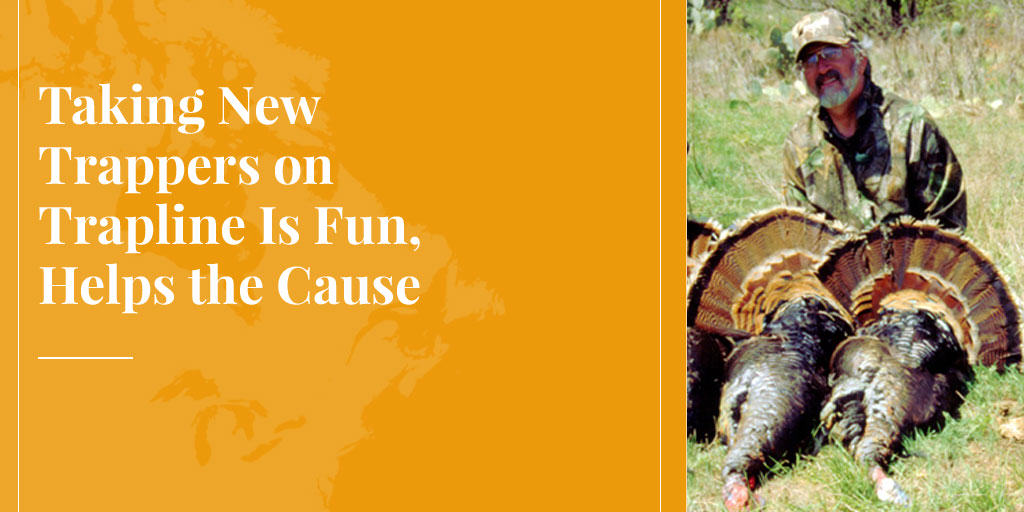
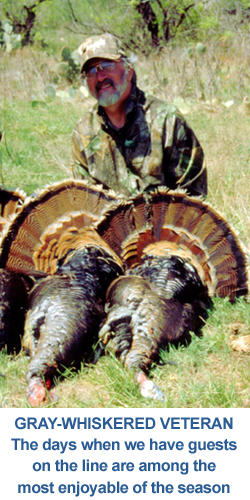
That’s where us gray-whiskered veterans come in. Thirty years ago, I didn’t really have time to take someone under my wing on the trapline. I was pedal to the metal from Day 1 to Day Last, catching as many animals as I possibly could, because I had a houseful of kids and a dollar bill looked as big as a saddle blanket. Simply put, I couldn’t afford to take the time to help a rookie get started.
But now that’s not the case. I’m far from rich, but the crushing financial pressure is gone, and for Bill and me, the trapline is a more leisurely thing. Don’t misunderstand though. We still work hard, and we put up decent numbers for a couple of geezers, but neither of us is out there because our kids need shoes. And so we take interested folks on our line from time to time. Some are rookies just getting started, some are middle-aged guys who trapped when they were younger, and some are men and women who’ve never held a trap in their hands but want to see what it’s all about.
The days when we have guests on the line are among the most enjoyable of the season. We usually don’t get as much done, because we’re answering questions and showing our guests what we’re doing and why. It slows us down, but we both enjoy it and are more than glad to do it. We’ve never discussed it much, but I think the reason Bill and I both enjoy having guests is that we’re helping promote trapping to non-trappers, either by helping a newbie get started or by showing a non-trapper first-hand that we’re not the bloody-handed barbarians the PETA folks make us out to be.
If you’ve never taken a kid, a beginning trapper or an interested non-trapper on your line, I recommend it. Not only will you enjoy it, but you’ll also be helping the cause.
The TV news item was about the upcoming duck season, and the soundtrack in the background was a recording of… Read More
I've watched a dozen movies where they show a flock of cranes in a V formation accompanied by goose music!
The TV news item was about the upcoming duck season, and the soundtrack in the background was a recording of somebody blowing a duck caller. The calling wasn’t bad, but what ruined it for me was the film clip they were running to illustrate duck hunting.
They were filming a flock of coots.
Unfortunately, that sort of stuff is pretty common on today’s television and movie programming. Pay attention, and you’ll see it all the time. I bet I’ve watched a dozen movies where they show a flock of cranes or ibises or some other species that flies in a V formation, accompanied by an overlaid soundtrack of - you guessed it - goose music.
Things like this are laughable, but they ought to also serve as warning flags. Every instance should remind us that not everyone is as knowledgeable about things outdoors as we are, and that simple but profound fact can (and often does) come back to bite us. In fact, the general lack of knowledge of the public about nature might well be the biggest problem we trappers, hunters and anglers face.
Sure, there are plenty of other things for us to worry about - loss of habitat to urban encroachment, shrinking access to public and private land, decreasing recruitment of young people into the outdoor lifestyle we know and love. But at the end of the day, none of those things will matter if our legal right to trap gets taken away at the ballot box.
And slowly but surely, that’s what’s happening. This year, for example, there was a petition drive in Montana to get an initiative on the November ballot prohibiting trapping on any public land in that state. (See Toby Walrath’s piece in the November 2013 issue of Trapper & Predator Caller for more on that.) They failed to get sufficient signatures this time, but if this thing passes in the future, more than a third of Montana would be closed to trapping.
Montana wouldn’t be the first state where it’s happened, either. It’s already against the law to trap on public land in Arizona and Colorado, and trappers have been so restricted and legislation-crippled in states like California, Florida, Massachusetts and New Jersey that I swear I can’t understand why any trapper would live there.
Coots Instead of Ducks, Cranes Instead of Geese
The reason this has happened, and the reason it continues to be a threat, goes right back to that coots instead of ducks, cranes instead of geese thing - a widespread lack of knowledge in the non-hunting, non-trapping public about all things wild. Most of these folks aren’t necessarily against hunting or trapping. They’re not anorexic, wild-eyed vegans. They eat meat just like we do. Nor are they stupid. They just have no interest in hunting or trapping. That’s all. And so they don’t bother to learn anything about it.
But they care about wildlife in an abstract, feel-good sort of way, and that’s why they’re susceptible to the exaggerations, half-truths and flat-out lies the zealots on the bunny-hugger side of the fence keep throwing at them. For example, it’s true what the anti’s say, that the lion does sometimes lay down with the lamb. But what the anti’s always forget to mention is that the reason the lion does so is so it can more comfortably eat the lamb.
It’s up to us to stop this brainwashing of the non-hunting, non-trapping public, and the most effective way to do it is personal communication. Every trapper has many friends and family members who don’t hunt or trap. These folks would be more inclined to believe us than they would be to believe some complete stranger telling them trapping and hunting are evil. However, they won’t get our side of the story unless we tell them.
Are you doing that with your friends and relatives? If so, thanks very much, and keep up the good work.
On a recent Saturday I attended a small trapper gathering and I must say I always walk away from these… Read More
On a recent Saturday I attended a small trapper gathering and I must say I always walk away from these events having learned a great deal.
Most years the big take-away is learning about the habits and activities of various furbearers and man’s attempt to catch them. Honestly, you can tip your hat to the bowhunter who ends their season with a nice new mount for the wall, but I will always have more respect for the trapper who knows the ins and outs of his passion so much that he can fill a pickup load of beaver … or coyote … or some other crafty, wary species.
Indeed, in the outdoors world for my money the accomplished trapper is the real rockstar deserving the utmost respect. This person has to know his sport so well that he can predict that a critter will step on a few square inches of a trap pan in order to achieve success. Certainly I’m not discrediting the hunter in any way. Instead, if you’ve never been closely aligned with someone who traps to learn what it takes … you’re missing a truly wonderful outdoors experience, in my opinion.
Now, some might say trappers do it for the money. To that I would say GET REAL! The money? Oh, sure there’s the money element involved with preparing and selling furs, but very few trappers I know make much more money then they end up spending on supplies, on gas to run their line … not to mention the hard work involved with catching and putting up fur in preparation for auction.
I’ve been a recreational trapper since the age of 15 so I know what it takes. Commitment. Ambition. Discipline. Positive attitude. Those are just a few of the many qualities that go into a successful trapper. And while money can help motivate a person to get out of bed each morning to check the lines … it simply does not very often make a living for many people.
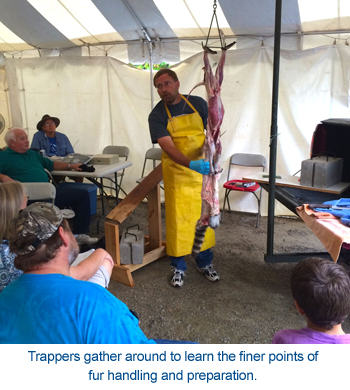
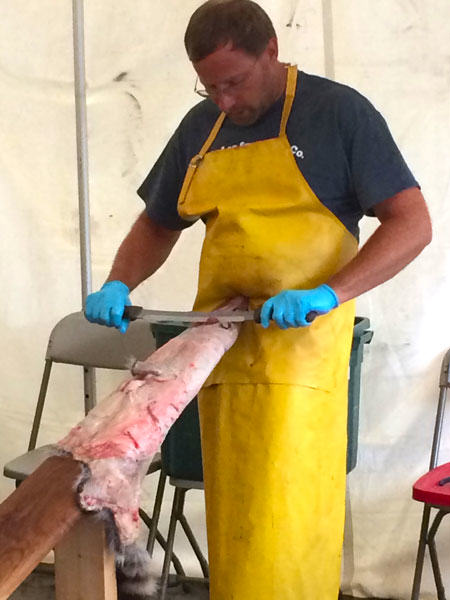
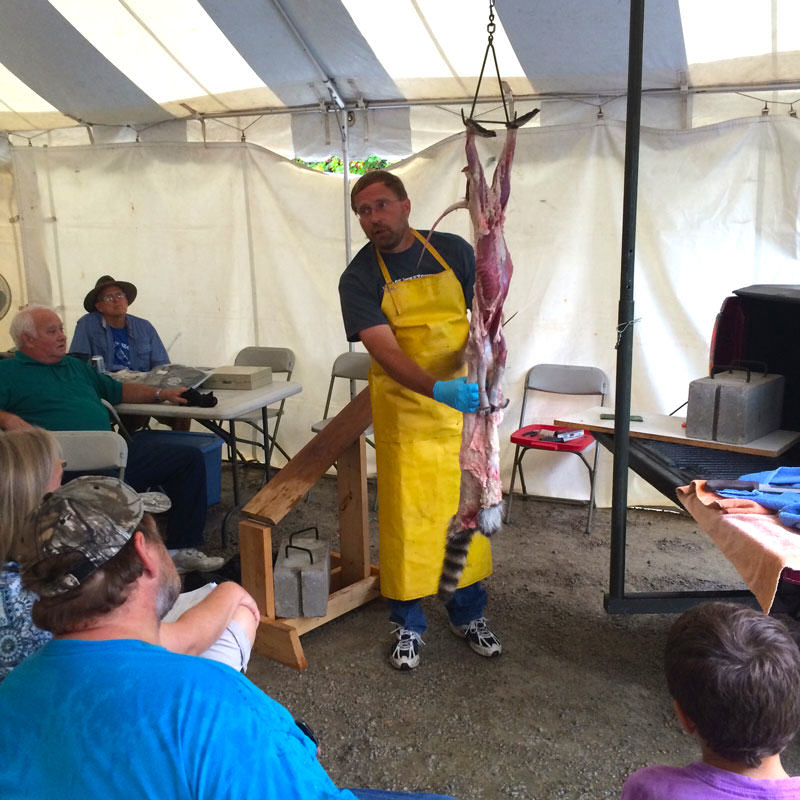
As I watched Leon Windschitl from the Minnesota Trappers Association give his demonstration showing the finer points of fur handling, it suddenly occurred to me how much work is involved with trapping. First off, there’s the work phase where you need to outsmart the animal. Specialized tools, techniques and tactics might work in some areas, but then not in others. There’s no guarantee for success in trapping, just like there isn’t in hunting or fishing.
Now, some trappers might stop right there and simply sell the animal in the carcass to the fur house. I’ll admit, this is what I often do because my process for skinning and preparing is not a streamlined operation. Others, however, realize the work is only beginning. Skinning the critter (depending on your skill level) might take five to ten minutes or more. Then comes the fleshing and stretching aspect … not to mention the combing and cleaning that is often necessary to make the fur look its best. Even the stretching and the drying demands time and lots of attention.
All in all that $30 raccoon is hardly easy or quick money for the trapper’s pocket. As a trapper, to do things the correct way takes lots of time, patience and effort often when weather conditions are less than ideal.
Especially this year. Preliminary fur markets are looking somewhat depressed so trappers will likely have less competition on their lines. That also means less money in the pocket when the seasons end. Indeed, this year when you see trappers out tending their traps realize how this year more than others the folks setting steel in the river ways and fence lines are doing it for a true love of the sport … and not for a means to get rich in the pocketbook.
Yes, I have a lot of respect for trappers and the sport of trapping. Always have and always will.
Individuals are expected to do their bit too, which usually means giving something up: our gas-guzzling cars, meat (for those who see cows as methane-emitting monsters), and the list keeps growing …
What we don’t often hear is that you can keep warm and look great while fighting climate change ... by wearing fur!
Unlike most synthetics, real fur is not made from petroleum. For lots more reasons why fur is a great choice for those who care about nature, check out www.furisgreen.com. Also: Plastic Bags on Our Backs.
And for the truly dedicated eco-warrior, keep your furs on indoors and turn down the thermostat!
Heck, maybe you can even try going naked in fur! That should keep everyone happy!
Two years ago I went to NAFFEM, a large fur trade show in Montreal. I was invited as a blogger, to… Read More
Two years ago I went to NAFFEM, a large fur trade show in Montreal. I was invited as a blogger, to check out the beautiful pieces and choose some of my favourite items for sale at the show. I am a huge supporter of the Canadian fur industry (read about my reasons here) but I’ve been less vocal about the seal hunt, primarily because I didn’t have enough information to make an informed opinion about it. Well, now I do, and I would like to share it with you because I think it is important.
1. Seals are a sustainable resource and are in abundance. We live in a world where resources have become an issue, and many of us are choosing to consume products that come from renewable resources. Seal is a great example of this – there are tons of them in Canada and they are not at all at threat of becoming endangered.
Speaking of sustainability, seals are part of the reason why fish stocks are very low (although overfishing is also a big issue) and the seal hunt not only provides jobs and resources for the hunters, but also allows the fish populations to regenerate (a bit.) All major conservation groups will agree that a responsible use of resources (like hunting seals for food and clothing) is a good thing, and is often the central principle of modern conservation.
2. Seals are local. The green topic is a big one right now, and part of the green movement focuses on buying local.
Canada has a lot of great resources, but when it comes to fashion, few are 100% Canadian. Nearly all of our fashion products are in some way sourced from overseas (whether it be raw materials or construction) but seal skin and wild fur are 100% free range, local products.
3. The seal hunt supports Canadian communities. There are two major seal hunts in Canada, one in the Arctic sea (seals hunted by Inuit people) and one on the East Coast (a commercial seal hunt.) Both provide jobs and resources for those people. The meat is eaten, the fat is used for a variety of products, and the skin is sold so that these people can support themselves.
Food, as you may know, is extremely expensive in the Arctic, and there are limited jobs in that area, or in the Maritimes. The seal hunt is a very important Canadian industry for the people who depend on it.
4. The seal hunt is not inhumane. The animal rights activists will have you believe that the seal hunt is inhumane, but this is not the case.
First of all, most seals are killed with rifles (not clubbed to death.)
Secondly, there have been numerous studies done on the seal hunt, and biologists and veterinarians have all agreed that the seal hunt is no less humane than any other hunt.
5. The media paints an unfair picture. My question, after having learnt all the above, was why does the seal hunt have such a bad reputation? There are two answers to this.
First of all, seals are cute, and people are more likely to be protective of cute animals. If we were all truly concerned about cruelty and sustainability, why aren’t we doing more to save fish? Many species of fish are far more at risk than seals, yet their not-so-cute appearance doesn’t exactly inspire people to campaign for them. (Notice how we care more that our tuna is “dolphin safe” but not so much if that particular tuna is endangered.)
Secondly, the seal hunt is much more visible than other hunts, and the access to it allows for more imagery. The seal hunt happens in certain places at very specific times, and so it is very easy for activists to turn up and take photos of blood on the ice. Those same activists aren’t invited into abattoirs, and therefore we don’t have the same images in our head of cows or sheep. The fact that seals are cute, and that we have access to photos of them being killed, means the seal hunt has been very unfairly portrayed by the media and activist groups.
Many of us are so far removed from nature, farming, and hunting, and it is so easy to forget that our food comes from the land. While I will admit I don’t like seeing photos of any dead animals, I do appreciate the process and am under no illusions about the realities of eating meat and wearing animal products.
For those of us who do choose to consume animals, the best we can do is consume sustainable resources that are treated humanely – and the seal hunt is just that.
The animal rights movement claims to be motivated above all by the desire to save animals – each and every one of… Read More
The animal rights movement claims to be motivated above all by the desire to save animals – each and every one of them – from harm at the hands of humans. It also claims to support conservation efforts since it is in the wild that all animals should be living out their long and happy lives. In reality, its agenda is more anti-human than pro-animal, and its impact on true conservation efforts has been nothing but negative.
I grew up in northern Ontario with lots of fishing and hunting and some trapping in my extracurricular activities. Later I went to work in the Northwest Territories and Nunavut, first with the Hudson’s Bay Company, then with Inuit cooperatives, and finally with the Department of Environment of the Government of Nunavut.
My day-to-day contact with Inuit educated me about respectful and sustainable use of wildlife resources. I saw over three decades in the far north (I am now retired) how the animal rights agenda harmed the Inuit, driving them into industrial and less-sustainable alternatives and self-esteem-crippling welfare. It became clear to me that the animal right activists, those that play a leadership/ideological role, do not care about people.
And when you consider how their activities ultimately remove responsible users/stewards from the environment, it is evident that they do not care that much about species wellbeing or ecosystem preservation. Their focus is on the individual life, and the life of a rat or a rabbit is equal to that of a person – actually more than equal, as humans are considered to be tainted and therefore not welcome to participate in this conversation.
Animal rights activists, as opposed to real environmentalists, hate when you point out that their campaigns are anti-human rather than pro-animal.
When I first left the north to complete my masters degree, I picked up pretty quick on what has been happening on our university campuses. I learned that capitalism and profit were dirty words. Even if Russia was falling from grace by that time, there was still faith that China and Cuba would reveal socialism as the true salvation.
Then, when I returned much later to begin a doctorate, I learned that it was now cool to be anti-globalist – and that term seemed to include anything touching on business that could lead to a profit or at least a surplus. There was little interest in discussing what kinds of enterprise might be acceptable, even Inuit Cooperatives or Hunters and Trappers Associations which help people to sustain their traditions and mixed economies at the community level in remote areas. The rigidity of thought was frightening.
My wife Milly and son Jake, both born in Kenya and now wintering in Nova Scotia in Nunavut sealskins.
Stifling Intellectual Atmosphere
The intelligentsia found in the social sciences departments of universities were a major part of the problem; they were rarely interested in stimulating real dialogue about the complex subject of human use of wildlife resources. The articles selected for student reading, the research topics accepted by graduate committees, the entrenched simplification of bad capitalist/Western society/man as wildlife user made intellectual conversations in the university community quite predictable, in an extremely stifling atmosphere.
I came to see a disturbing affinity between the animal rights movement and the anti-capitalistcum anti-globalist mindset so prevalent on campus. Both pushed an agenda no less extreme and unreasoning than those who endorse a kill-anything-that-moves or pure capitalist ideology – except that the latter gave way to more adaptable and sustainable forms long ago.
Interesting how both "anti" camps (anti-harvest and anti-capitalist) need to demonize their opponents. I guess the complexities of real life make it more difficult to mount fund-raising or political campaigns?
Yesterday the title of a storybook caught my eye. It was The Childhood of Young Animals which looked at the early stages of animals of different species. The animal rights folks must be smiling to see young animals called "children". Luckily, my 5-year-old son seems to have an admirable ability to distinguish between the fantasy content of storybooks and Disney movies and the real lessons of the world.
Too bad the animal-rights proponents cannot do the same. If they could, they would have more respect for aboriginal and rural peoples who live outside the highly industrial and urbanized mainstream. And they might save true environmentalism from being discredited by their own sensationalistic and misleading rhetoric.
Except to a very few people, a rabbit or a rat are not equal to a human being, because the rabbit and the rat will never see the big picture, and will never feel any responsibility for other animals except their own litters. True, most human beings will never sacrifice their child's life for an animal of another species. But they will educate their young to protect the continuation of wildlife and nature in general – because our own future survival depends upon it.
Adapting to the realities of life on this planet requires careful thought and reasoning, feedback and new insights, compromise and adjustments to thought and practice. These, unfortunately, are not qualities that animal rights activists have shown much interest in developing.
What is the appeal of the reality TV show Mountain Men, and others in the same genre? If harvesters of… Read More
What is the appeal of the reality TV show Mountain Men, and others in the same genre? If harvesters of nature’s resources, and not least the fur trade, can answer this question, they can apply the lesson learned to their own public relations, and in so doing win over millions of new supporters.
First, some clarification. Yes, Mountain Men is reality TV, but not of the kind that imprisons a bunch of misfits on an island to tear one another’s throats out, with instant celebrity status for the winner. Mountain Men is the other kind.
Mountain Men is about the daily lives of men who have opted to live cheek to jowl with nature, no matter what she may throw at them.
Or in the words of the History Channel, which airs the show: “Using ancient skills and innate ingenuity, these men fend off nature’s ceaseless onslaught, carving out the lives they’ve chosen from a harsh and unforgiving landscape.”
The audience relates at a visceral level to the painful, joyous or scary experiences of these shaggy-bearded, unkempt men with questionable hygiene and (apparently) masochistic tendencies.
Paradoxically though, many in the audience, like me, are city dwellers whose lifestyle is the antithesis of a mountain man’s. Why are we drawn by a lifestyle we go to such pains to avoid?
We have “guys” to change our oil, do our dry cleaning, mow our lawns and deliver our pizzas. We even boast about them as if somehow we deserve credit for their performance. “My mechanic is the best!”
And for sure, not one of us has ever made our own bullets, then shot a squirrel with a firearm that belongs in a museum, then cooked it and chewed on a piece of meat the size of a pinky and declared it good eatin’.
The fact is, though, that millions of us fantasize about doing just that!
Two Poles and a Jar of Worms
If you don’t know where I’m coming from, consider the ubiquitous angler. If you’re not an angler yourself, it’s almost certain your neighbor is.
Angling is one of the most popular pastimes for men (yes, it’s a manly thing) whose working lives are spent pushing papers around a desk, and there’s a good reason why.
It’s a call of nature we cannot resist, an instinctive drive to provide for our families by using our wits. A trip to the supermarket just doesn’t cut it.
And that is why, week in, week out, rain or shine, we populate river banks, catching little or nothing, staring at the water and dreaming. Dreaming how grand life would be if someone would actually pay us to do this.
And when our sons are old enough, they join us willingly (or so we like to believe) to bond over two poles and a jar of worms. If the fates are kind and we bag a couple of minnows, we char them black over a fire and lie to each other about how they taste better than anything Mum prepares with all her fancy recipes. Good times!
For other men, nature’s call is to hunt or trap.
Not Just Mountain Men
So how can the fur trade learn from shows like Mountain Men, and apply what it learns in its public relations?
We start by recognizing how popular this genre is, of folk living from nature, by their wits.
Then there’s the granddaddy of them all, Deadliest Catch, the award-winning saga of crab fishermen trying hard not to drown or get minced in machinery. Now in its 10th season, Deadliest Catch has set record ratings in its class across both males and females, in all age brackets.
And we haven’t even touched on the survivalist genre featuring Bear Grylls (Man vs. Wild) et al. eating anything which once had, and sometimes still has, a pulse.
Don’t worry about the ratings. The mere fact that the cable TV powerhouses of History, Discovery and Nat Geo keep churning these shows out is proof enough of their appeal. Just this June, Animal Planet got in on the act with Beaver Brothers.
So Who Are They?
Next we try to identify who the audience are by understanding who they are not.
They are not drawn to shows like Mountain Men in the same way audiences are drawn to, for example, American Chopper or Counting Cars. The latter are unabashedly aimed at the millions of bikers and gearheads out there who lap them up because, well, they’re about them!
No, Mountain Men does not survive on an audience of mountain men, any more than Swamp People relies on swamp people. Even if all the mountain men, swamp people, crab fishermen, lobstermen and croc hunters in the world tuned in to an episode of Deadliest Catch, they’d hardly make a blip in the ratings.
So let’s say the bulk of the audience for this genre represents a cross-section of society, from diverse backgrounds, but with a few things in common that do not include risking their lives on a daily basis to catch dinner. And one of those things is that they support the harvesting of animals for human benefit.
Like most people, they’re probably not vocal in their support of this, and if asked what they think of animal rights activists, will probably reply, “a bunch of wackos”.
But they are nonetheless important allies. They are the people who, when push comes to shove, ensure that the animal rights movement does not have its way at every turn. They vote, they sign ballots, they pay membership dues to hunting and fishing associations that represent their interests, and they pay license fees that fund wildlife management and conservation efforts.
So are we catering to them, nurturing them to become vocal advocates not just of a lifestyle, but more importantly of the larger picture of man’s place in nature? Not much. Are they equipped with the knowledge to become such advocates? Definitely.
How Things Work
To cater to an audience, you have to know what interests it and what puts it to sleep, and most fur trade PR is not going to keep a mountain man wannabe on the edge of his seat.
The fur trade aims its PR primarily at two audiences: fashionistas, and people who are still undecided on whether they favor using animals for human benefit. This second audience, of course, includes a never-ending supply of youngsters who’ve never heard the arguments before.
High fashion is the biggest life force driving the fur trade, with trickle-down effects on everything from high street retail to the prices producers get for their pelts. However, for most people, and certainly our mountain man wannabe, the latest offerings on the catwalks of Paris and Milan are weird and irrelevant.
The fur trade’s other obsession for the last 45 years has been debating animal welfare vs. rights, and the role of sustainable use as a conservation tool. (That’s how long it’s been since the International Fund for Animal Welfare began campaigning to end the Canadian seal hunt.) Everything worth saying has probably already been said, but the messages need to be reinforced again and again because we are trying to influence people’s fundamental views about man’s place in nature.
However, our mountain man wannabe is decidedly not our target audience. He is no more interested in debating the rights of squirrels than he is in how they look, sheared and dyed pink, around the neck of a supermodel.
What he does want is information that’s educational, useful, and makes him go, “Wow! I never knew that!” He may or may not have a hankering to eat squirrel stew, but he is interested in the process, in how to get the squirrel in the pot in the first place. Which means he might also be interested in knowing:
• Why grey wolf and wolverine fur make the best hood ruffs and jacket linings in the Arctic;
• That a deer, raccoon or beaver conveniently has just enough of the oil called lecithin in its brain to tan its own hide; and
• That mink carcasses make great crab bait, and it’s not because crabs love them so. (Squid are better.) It’s because seals and sea lions can’t stand the smell!
All these and more interesting questions are now addressed in great detail on the web by hunters, trappers, tanners and crab fishermen, and reality TV is cashing in on this treasure trove of amazing information. How about we do the same?
How about we complement our efforts targeting traditional audiences, and spend a little more time talking to people who could be powerful allies if only we started speaking their language?
Let’s connect with all the mountain men out there, not just the ones walking the walk, but also the millions of people tuned in to cable TV, dreaming of making their own squirrel stew some day.
I’ll start the ball rolling. In my next post, learn why one of the most desired and expensive of North American furs in the mid-20th century is now just roadkill.
It’s no secret that fur was one of the hottest trends of the season with a presence in most major… Read More
It's no secret that fur was one of the hottest trends of the season with a presence in most major runway shows. But fur is more than just fashionable, it is also one of the most sustainably-produced natural resources on the planet. Furs such as coyote, fox, beaver and muskrat have been used for centuries to provide warmth and incredible versatility. And when these furs are used responsibly, it's not just the fashion industry that thrives, our natural environment benefits too!
Why trapping?
Nature, like most things, requires balance. This balance today includes the coexistence of humans and animals, and the modern fur trade plays a role in helping to maintain this relationship. Without regulated trapping and hunting to manage the size of wildlife populations, many ecosystems would be drastically affected. Regulated trapping is also often necessary to protect property and natural habitat, and to protect both humans and wildlife from disease. Let’s look at a couple of examples.
Leave it to Beaver!
The historical fur trade that led to the foundation of many of our towns and cities was fueled, above all, by the beaver. After more than 400 years of commercial fur trading in North America, biologists tell us that beavers are as abundant as they were when Europeans first arrived here – thanks to modern trapping regulations. However, too many beaver can be as much a problem as too few beavers. Left unmanaged, beaver populations will keep increasing until they eat themselves out of house and home.
Once vegetation is destroyed, it will take many years before beavers can return to the region. With regulated trapping, beaver populations are maintained in balance with available habitat – they are more stable and healthier. Furthermore, overabundant beavers can flood homes, roads, fields and forest habitat. Much better that we use some of what nature provides!
One of the first furs to be used for clothing by First Nations people, beaver is still widely used today by some of the top designers. Specifically, on the runway this year, Givenchy has used beaver to create a sleek bomber jacket, Haider Ackermann showed a monochrome coat while Chloé featured a spectacular beaver vest.
Beaver fur played a role at (from left) Givenchy, Chloé and Haider Ackermann. Image via Getty Images
Coyotes get wild!
Coyotes are highly abundant across North America. They adapt well to human proximity and have profited from wolves being pushed out of much of their traditional range. Coyotes, however, can become dangerous when they are overpopulated and lose their fear of humans. In California, where I live, coyotes have been taking pet dogs and cats from backyards! They can also cause serious problems for cattle ranchers and sheep farmers when they prey on young calves and lambs. And overpopulated coyotes are more likely to spread diseases including rabies, tularemia, and hepatitis which can be transmitted to both animals and humans. Regulated trapping seasons help decrease the negative interactions between humans and wildlife – so why not make use of this remarkable natural resource?
Coyote, canus latrans. Image via Dawn Beattie
Coyote fur, warm and dense, is great for making rugged men's jackets. It's beautiful, natural hue has also been popping up in women's accessories and shoes. And, of course, it is the favorite choice for trimming the hoods of down-filled parkas. (Fur trim on your parka hood protects your face from the cold winds of winter like nothing else!)
Peter Som - Fall 2012
Think about it!
So here’s the real question: since wild furbearer populations are abundant and, in many cases, must be managed to maintain a balance with available habitat, should we kill these animals and throw them away? Or is it more respectful to use this beautiful natural material?
What do you think?
Manage Consent
To provide the best experiences, we use technologies like cookies to store and/or access device information. Consenting to these technologies will allow us to process data such as browsing behavior or unique IDs on this site. Not consenting or withdrawing consent, may adversely affect certain features and functions.
Functional
Always active
The technical storage or access is strictly necessary for the legitimate purpose of enabling the use of a specific service explicitly requested by the subscriber or user, or for the sole purpose of carrying out the transmission of a communication over an electronic communications network.
Preferences
The technical storage or access is necessary for the legitimate purpose of storing preferences that are not requested by the subscriber or user.
Statistics
The technical storage or access that is used exclusively for statistical purposes.The technical storage or access that is used exclusively for anonymous statistical purposes. Without a subpoena, voluntary compliance on the part of your Internet Service Provider, or additional records from a third party, information stored or retrieved for this purpose alone cannot usually be used to identify you.
Marketing
The technical storage or access is required to create user profiles to send advertising, or to track the user on a website or across several websites for similar marketing purposes.