You may recall that Coloradans recently defeated an anti-fur ballot initiative, and probably assume that the state is safe for… Read More
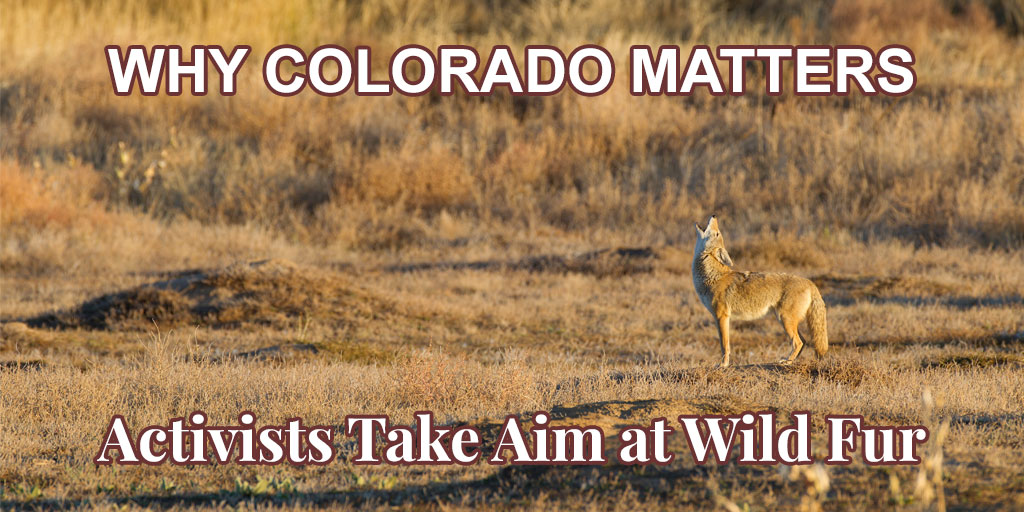
A coyote howls in Rocky Mountain Arsenal National Wildlife Refuge. Photo: USFWS Mountain-Prairie, Public domain, via Wikimedia Commons.
You may recall that Coloradans recently defeated an anti-fur ballot initiative, and probably assume that the state is safe for now. But your assumption would be wrong. Now opponents of fur are looking to introduce a statewide ban on the sale of all wild fur – something they've not tried in the past.
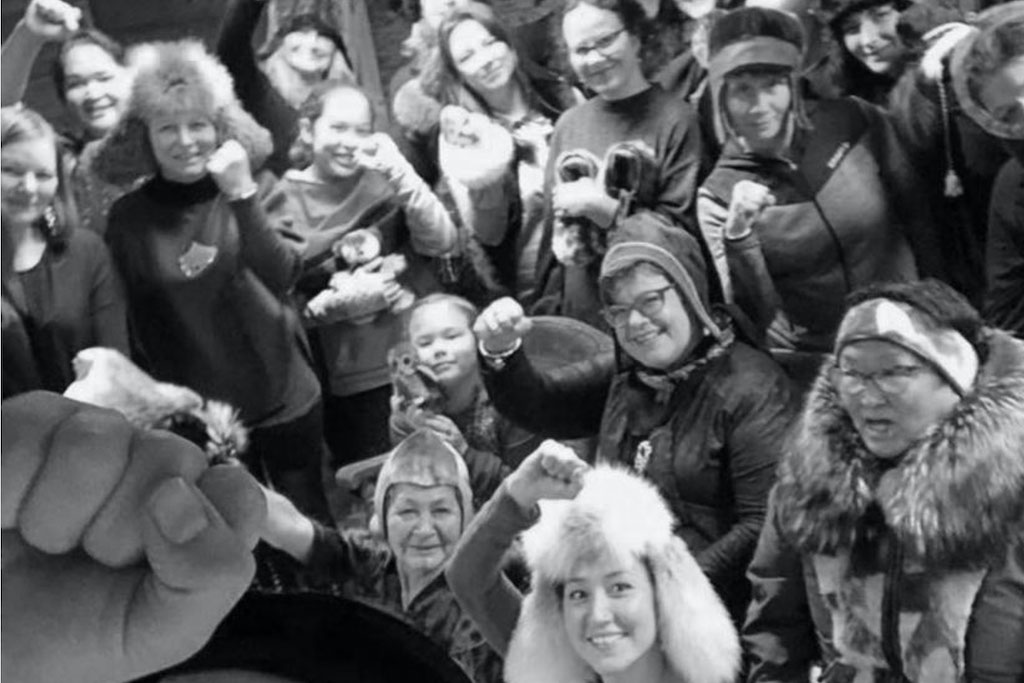
That battle, which garnered a lot of news coverage, especially for the slogan "Hands off our hats", sent a clear message that most Coloradans would not stand for animal rights groups telling them what they could and couldn't trade. But perhaps the message was not clear enough. Now a petition from the anti-fur Center for Biological Diversity has accused the Colorado Parks and Wildlife Commission (CPWC) of violating sound conservation practices, with the aim of forcing a statewide ban on all trade in wild fur.
Attacking Wild Fur
As Executive Director of the Fur Institute of Canada (FIC), I frequently attend meetings, auctions, trade shows and the like, across Canada and around the world, where fur is the number one topic of conversation. But at many of these events, I am also in a minority. Why? Because our organization represents the interests of all kinds of fur, including wild fur.
Much of the global fur trade deals only with ranch fur. Many designers and manufacturers, for example, are concerned above all with the different colour phases of ranch foxes and mink, but have no interest in where or when the best coyotes are harvested. (This reality is also why fur ranchers attract so much attention from anti-fur activists.)
When combined with the strong and easily understood arguments in favour of regulated trapping, this explains why many folk assume wild fur is comparatively “safe”. Trapping plays a key role in wildlife management, it's an important part of livelihoods for Indigenous communities, and its heritage underpins so much of our shared history across North America.
But that idea is now being challenged in Colorado. If successful, the anti-fur lobby will use the CPWC to introduce a statewide ban on the sale, trade and bartering of all wild fur.
Over the last 40 years or so, trappers have grown used to attacks that focus on the welfare of individual animals caught in traps, but this time things are different.
This time, the aim of the anti-fur lobby is not to attack wild fur for how it's harvested, but rather to claim that the mere act of trapping violates the North American Model of Conservation, as spelled out by the Association of Fish and Wildlife Agencies.
When the CPWC meets next on March 4–5, it will discuss a proposal from the Center for Biological Diversity that says the state's current science-driven regulations are not fit for purpose, and that there needs to be a statewide commercial ban on wild fur.
As a community, we must stand together against efforts to restrict, reduce or eliminate the fur trade. That includes trappers, hunters, farmers, ranchers, First Nations, rural landowners, fur buyers, manufacturers, retailers, designers and artisans, from all parts of North America. Everyone who enjoys our world-class garments and accessories needs to be heard.
Both the FIC and the CRWM firmly believe that by standing together, we can be far more than the sum of our parts. Now is the time for all of us to support efforts to keep commercial fur trapping alive in Colorado. And that is why the FIC will be joining CRWM in Denver next week, giving voice to all Canadians who support science-based, well-regulated wildlife management.
the Citizen Petition Form "Prohibiting the sale of furbearer furs with exemptions", June 16, 2025;
"Petition to amend 2 CCR 406-018 to prohibit the commercial sale of wildlife fur in Colorado", submitted by the Center for Biological Diversity, June 16, 2025; and
the recommendation to deny the above petition submitted by the Division of Parks and Wildlife, Department of Natural Resources, February 19, 2026.
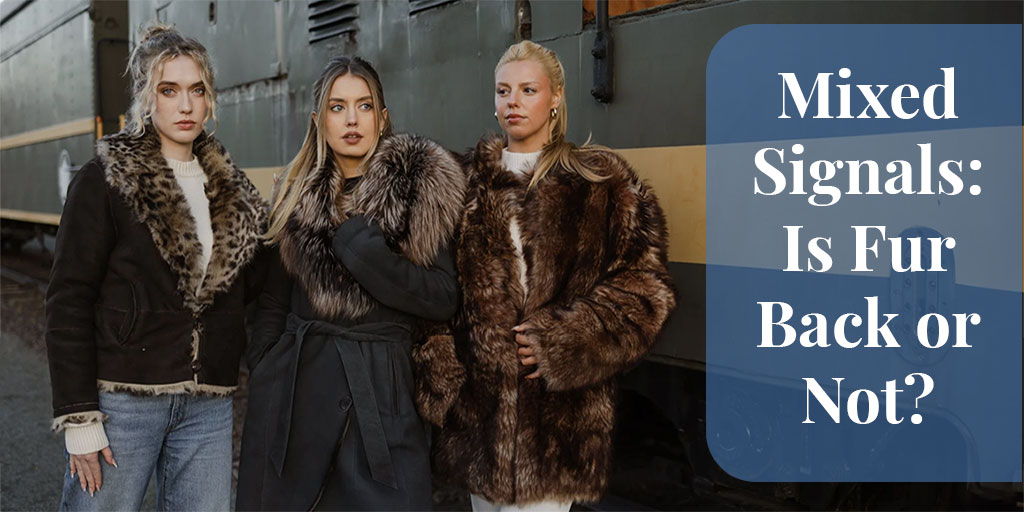
Consumers are receiving mixed signals, with some saying fur is back and others saying it’s on its last legs. So… Read More
Is fur in or out? Or can it be both at the same time? Photo: Always in Vogue.
Consumers are receiving mixed signals, with some saying fur is back and others saying it’s on its last legs. So does someone have the story wrong? Let’s see where the evidence points.
Compared with the 1980s, when fur sales were strong in all traditional markets, today’s trade has shrunk, a fact it blames on the anti-fur lobby. But it also says fur is making a modest comeback. In contrast, anti-fur campaigners insist the fur trade is terminal.
In our quest for the truth, let’s journey back in time, hoping this will help explain where fur really stands today.
Animal Rights Playbook
The anti-sealing campaign was the start of the modern animal rights movement.
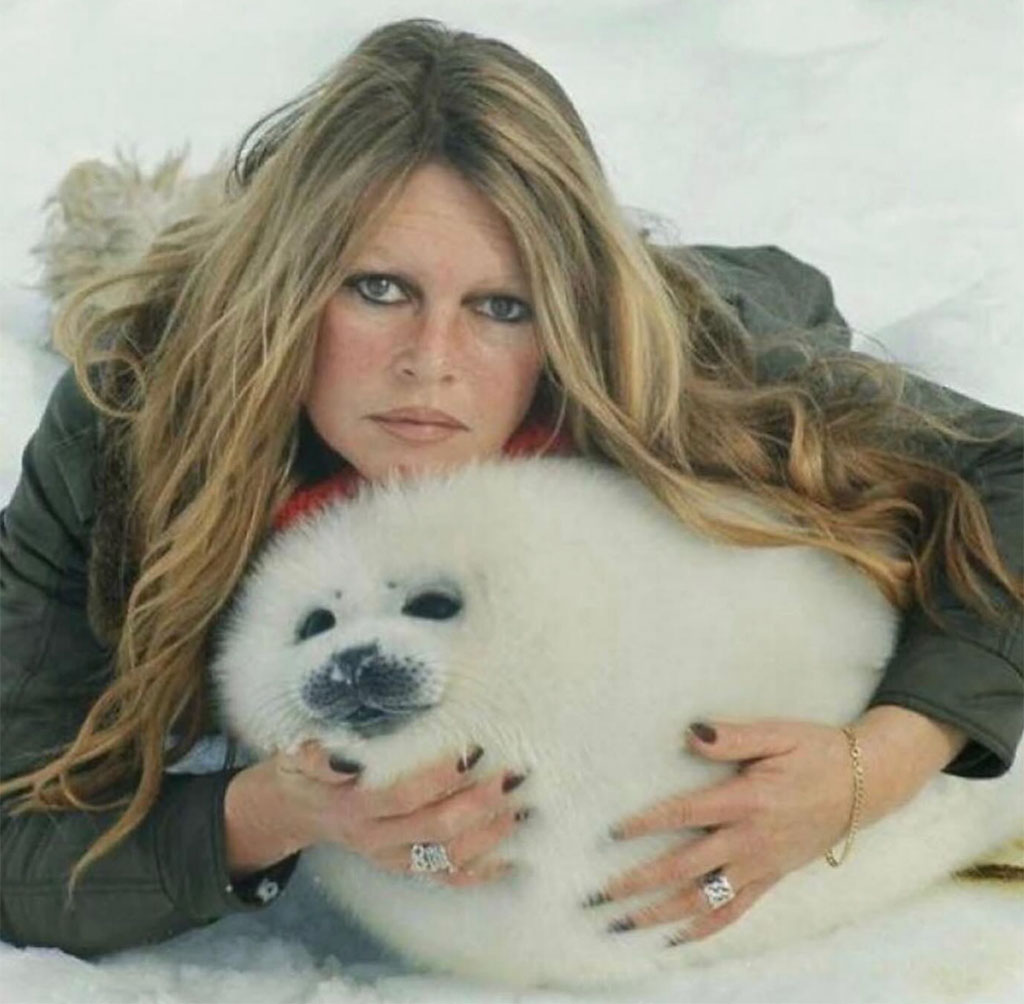
The modern animal rights playbook was written in the 1970s on the blood-stained ice floes of Atlantic Canada. With a cast of cute seal pups and “evil” sealers wielding hakapiks, protesters learned that all they had to do was provoke a fight (think Paul Watson) while Brigitte Bardot added credibility and sex appeal. The media lapped it up, and the campaign was hugely effective.
Another landmark came in 1990 when People for the Ethical Treatment of Animals launched the campaign “I’d rather go naked than wear fur”. Everyone knew that sex sold, but this was the first time animal rights had been conflated with naked women. Again the campaign was a media hit, prompting PETA founder Ingrid Newkirk to tell The New Yorker in 2003: “We are complete press sluts”. (PETA officially “retired” the campaign in 2020, but this was probably just to give media an excuse to run old campaign photos.)
Meanwhile, the fur trade was losing ground. The media (and their viewers) were by now hooked on images of stressed animals and naked women, and the fur trade couldn’t compete. Plus, funds were running low for public relations, and while some people were determined to fight back, they couldn’t agree on how to do this.
New Tactics
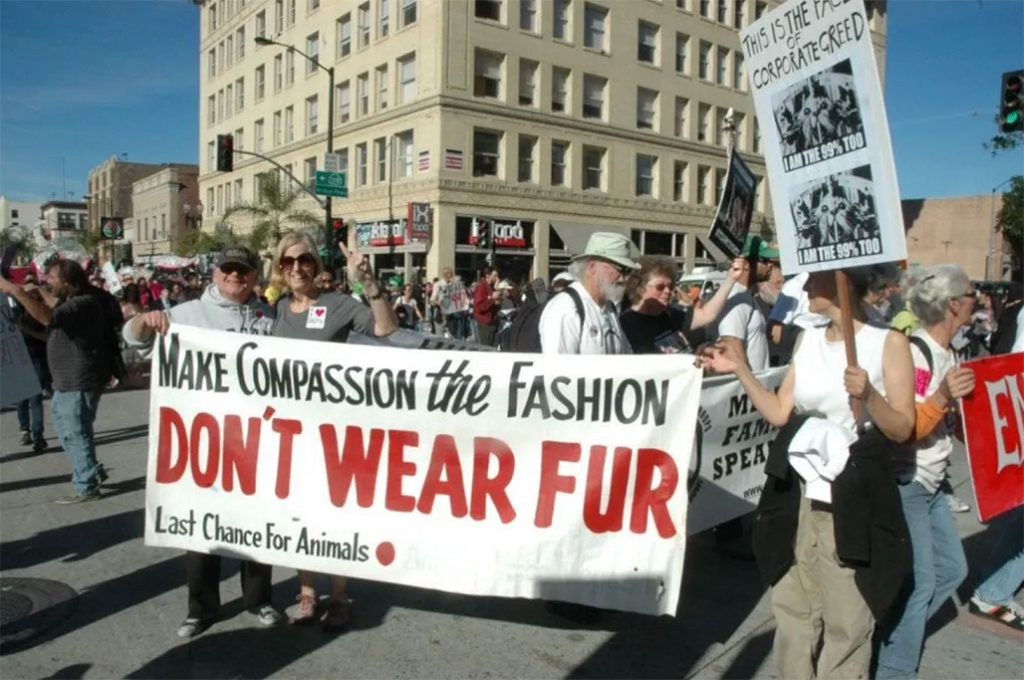
West Hollywood was the first Californian city to ban fur sales. Photo: Last Chance for Animals.
Then the 2000s arrived and the anti-fur lobby expanded its already strong arsenal with some new tactics.
Pushing local fur bans: One tactic has been to push US city governments to ban production and/or sales of fur. The fur trade must then file lawsuits to have ordinances overturned.
Almost all of the anti-fur lobby's victories so far have come in Californian cities, followed by a statewide ban from 2023. Notably absent has been the snowball effect campaigners hoped for in major cities and states elsewhere.
Still, it’s an effective tactic even when ban attempts fail, since it generates media exposure and costs the fur trade money. This has happened in cities where fur is more entrenched, like New York City in 2020, Denver in 2024, and Chicago in 2025.
Pressuring players to switch from real fur to fake: Another tactic has been to get key players to drop real fur in favour of fake, with the anti-fur lobby then taking credit for players “seeing the light”. While a few early converts required little persuasion, most victories have only come about after harassing executives with methods like demonstrating outside workers’ homes. Targets have been diverse, ranging from luxury brands and designers, to department stores, fashion shows and even magazines.
Fur farming bans: Yet another tactic has been to pressure governments to ban fur farming or pass regulations so draconian that it makes no sense to continue.
Though in its third decade, this campaign gained fresh legs during the Covid-19 pandemic as activists stoked fear that mink farms breed zoonotic diseases. This fear was key in the 2020 move by Denmark – then the world's leading mink farmer – to cull its entire herd, and British Columbia’s 2021 decision to phase out mink farming.
This campaign has been especially effective in the European Union, with most members having already introduced partial or total bans, the latest being Poland. Meanwhile, the "Fur Free Europe" citizens' initiative gathered over 1.5 million signatures opposed to fur farming and the sale of farmed products, obliging the European Commission to decide by next March whether to propose an EU-wide ban.
Whether an EU-wide ban happens is still unknown, plus the issue of wild fur will remain on the table. But with some 70% of fur currently coming from farms, and global output contracting steadily, who, if anyone, will pick up the slack?
So kudos to the anti-fur lobby. Though it has often fought dirty, its tactics have undeniably hurt the fur trade.
Plastic Windfall
As Gucci president and CEO in 2017, Marco Bizzarri demonstrated a complete misunderstanding of sustainable use. Photo: Gpautou, CC BY-SA 4.0 via Wikimedia Commons.
But another version of this story has it that fur is making a comeback. If true, it all began with a windfall for the trade: a miscalculation by its opponents.
When the modern animal rights movement emerged in the 1970s, Western society was made keenly aware of animal welfare issues. These remain important today, but have been superseded by existential issues threatening the very future of the planet.
In recent years, society has undergone a sea change, with terms like “sustainability”, “climate change”, “global warming” and “renewable energy” entering everyday usage. And the cause célèbre is how to wean ourselves off fossil fuels like petroleum.
Of course, the fur trade has always known fur is sustainable: it’s durable, biodegradable and renewable, and its environmental footprint is a lot smaller than the anti-fur lobby claims. So logically, society's shift in priorities should benefit real fur, and work against fake fur made of non-renewable, polluting, non-biodegradable, petroleum-based plastics that only add to the tons of microplastics already in our watersheds and oceans.
So what have most anti-fur groups done? Rather than keeping their message simple and opposing all fur, real and fake, they have thrown their support behind fake fur as a replacement for the real deal, falsely claiming it is more sustainable!
This is now backfiring. Not only has fake fur kept the furry look (real or fake) on the fashion radar, it has also exposed the anti-fur lobby as dishonest.
Perhaps the biggest shock for the fur trade came in 2017, when Gucci announced it was dropping real fur. Both the world-famous brand and its animal rights handlers effused about how the move enhanced sustainability, and for a while the fur trade feared society would simply fall for this deception. But now, the media and consumers are at least questioning whether fake fur was the right way to go.
The anti-fur lobby, meanwhile, has attempted damage control, such as by calling plastic garments “vegan clothing”, and promising we'll all be wearing “bio-fur” soon, made of fungi, nettles, pineapple and the like.
Maybe one day we will. But for now, almost all manufacturers of fake fur still prefer the petrochemical kind, so the harm it does to the environment continues.
Recycled Vintage Fur
Outside London Fashion Week, wearing fur is fine, but inside is a different story. Photo: garryknight, CC BY 2.0, via Wikimedia Commons.
Then, to confuse matters further, along came vintage fur.
As any fashionista knows, recycled and remodeled vintage furs have been in vogue for a few seasons. Many come from thrift stores and are at least 40 years old, though with demand still strong, it's inevitable that dwindling supplies are seeing ages fall.
For an example of just how vintage furs have confused the picture, look at media coverage last February of the New York and London Fashion Weeks.
Hoping as always for a new angle, on Feb. 16 the New York Times ran a piece titled “What happened to the stigma of wearing fur?” “[I]n January,” wrote Jessica Iredale, “women and men all over town were busting their furs out of storage in what felt like an abrupt reversal of social values.” For years, wearing fur in the US and Europe had felt taboo. “Except, suddenly, people don’t seem to care – especially if the wearer can assert the mantle of ‘vintage’, as no animals were freshly killed and upcycling old clothes is more virtuous than buying new.”
The irony was that last December, New York Fashion Week announced a ban on fur from 2026!
Even more ironic was a report in The Standard (Feb. 21) during London Fashion Week titled “How luxury fell back in love with real fur and crocodile skins”. It was commenting on the street scene rather than on the show’s runways, because it couldn’t do otherwise. London Fashion Week had already banned fur, in 2023, followed the next year by exotic skins and feathers!
What message were these reports sending to consumers?
Was the real story not about vintage furs, but about the resurgence of fur in general? Were the likes of New York and London Fashion Weeks just part of an ivory tower trying to move past fur, while the streets said the opposite?
Predictions
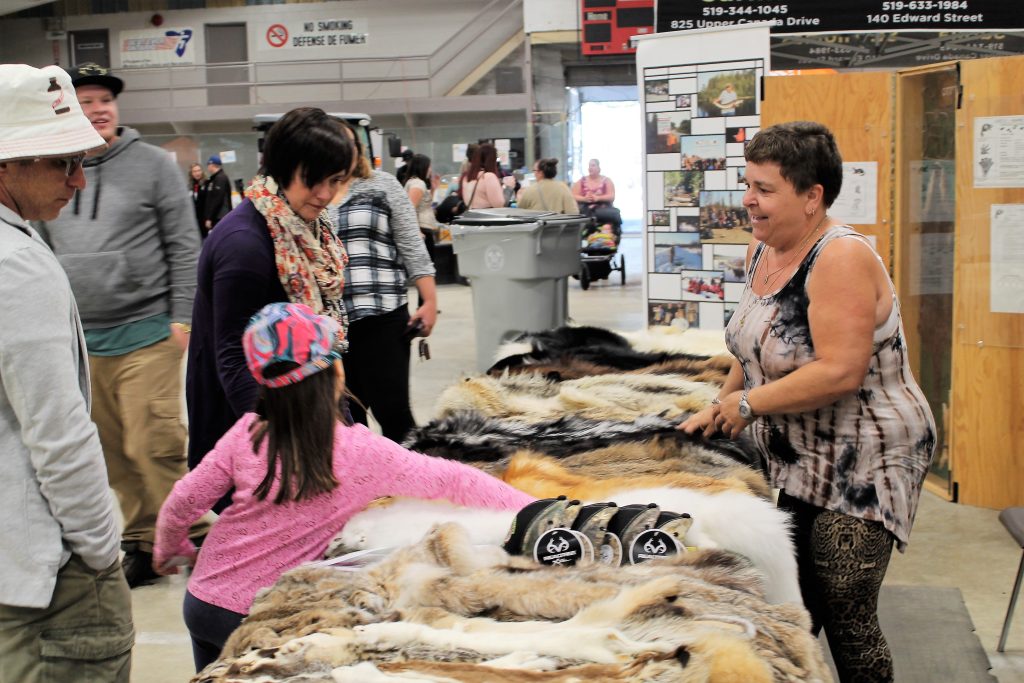
If there is a shortage of farmed fur, sales of wild fur are likely to increase. Photo: Timmins Fur Council.
So where does this leave the fur trade today?
Let's first agree who we’re talking about. I'll call it the Western fur trade, that caters primarily to certain consumers in two regions: North America and Europe, and an East Asian bloc, centering on China and South Korea, that buys a lot of pelts at Western auctions and has designers showing on Western runways. Millions of fur users, especially Indigenous peoples in the High North, don't belong in this category, and won't stop using fur just because of a few bans passed in Western capitals.
That said, the Western fur trade has been under attack for decades, giving the anti-fur lobby plenty of time to refine some highly effective tactics.
No one will deny that these tactics have hurt the fur trade, but many believe the trade has now turned a corner to recovery. Assuming this is true, how durable that recovery is depends on the trade's ability to change.
One change that may be unavoidable is a fall in total output of farmed fur, plus a shift in suppliers. When shortages seemed likely in the past, North American, European and (in this century) Chinese farms simply increased production. But this time around will be different.
Obviously, EU production is falling and may stop entirely, but it's also down in North America due to bad publicity from the anti-fur lobby, and no one is expanding right now. So unless Chinese farmers step up again, or another country fills the breach, a supply shortage could be looming that requires the fur trade to operate at a reduced scale.
There are, however, a few avenues that are already expanding.
One is sales of wild fur. Pelt prices are edging up for some species; for example, at Fur Harvesters Auction last month, interest was strong in bobcats, marten and wild mink. Also, the number of trappers is increasing in many places. And since trapping is now widely recognised as an important conservation tool, choosing wild fur is one way consumers can show their support for sustainable use. There is still opposition to trapping where wildlife and human habitats coincide, notably among dog walkers, but also on the rise are problem animals like coyotes with mange, rabid raccoons and destructive beavers, so trapping won't disappear anytime soon.
Other avenues for expansion are better opportunities for artisanal designers and online retailers, especially in remote areas. Factors fueling this growth include the departure of most luxury brands and department stores from the real fur market, the closure of many brick-and-mortar furriers in expensive downtown locations, and of course the rise of the Internet, which makes it possible to run businesses in remote locations that were not viable before.
Whether all this translates into a comeback for fur remains to be seen, but the signs so far are promising. For now, there's a paradox: on the one hand, the anti-fur lobby continues its efforts to end the fur trade, with a lot of success. But on the other, many media reports and eye-witness accounts say fur is back in fashion. Who is right? Only time will tell for sure.
This is the story of just one students’ club in British Columbia, with a trapping component, that could use a… Read More
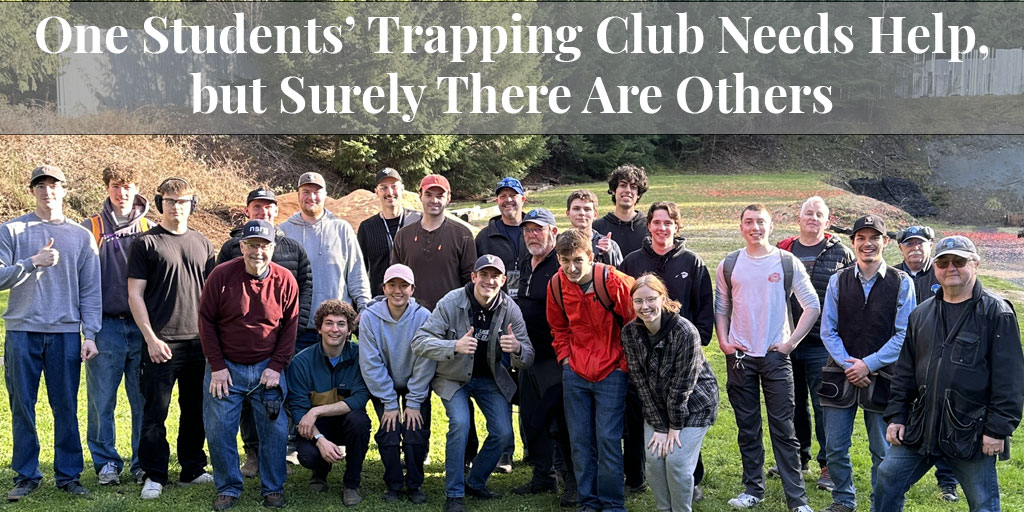
This is the story of just one students' club in British Columbia, with a trapping component, that could use a helping hand. But hopefully it will also open eyes across Canada. You probably live far from BC, but maybe there's a trapping club nearby that faces similar problems. Can you help? Or maybe you're struggling to start your own trapping club, and can learn from this young man's experiences.
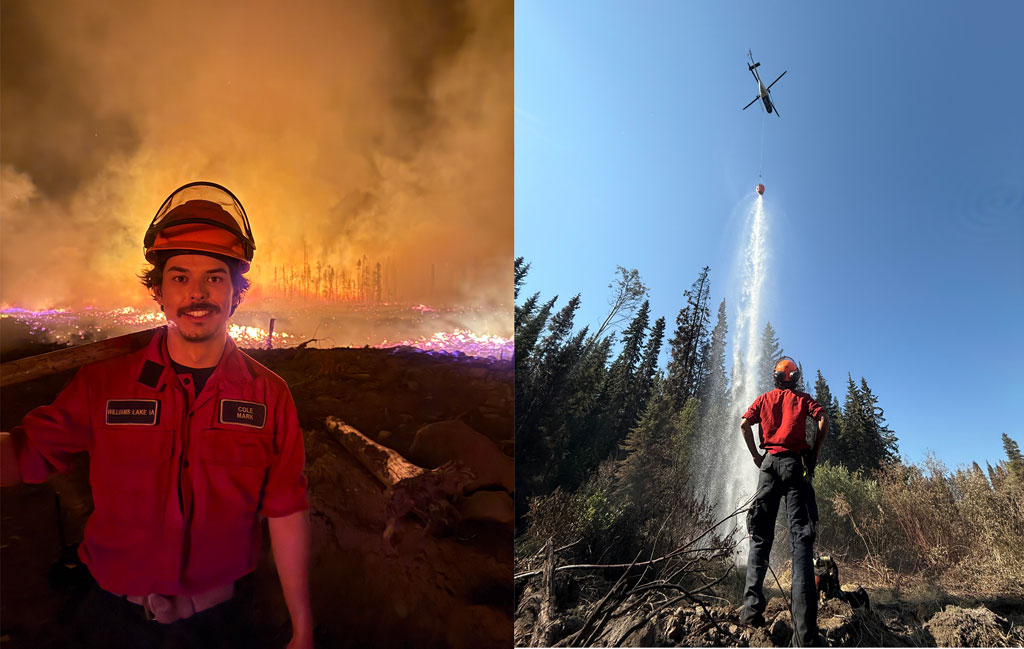
Meet Cole Mark, a 25-year-old born in BC's capital, Victoria, and a student at the University of Victoria, or "UVic" to those in the know.
By anyone's definition, Cole is an outdoorsman. When he is not studying forest biology or working for the BC Wildfire Service, he is hunting, rock climbing, backcountry skiing, fishing, scuba diving, spearfishing, shooting (guns and bows), and foraging. He also has "strong passions" for wildlife management and sourcing his own food.
It was in character, then, that in 2023 he started the UVic Freediving and Spearfishing Club, and followed this up in 2024 with the UVic Fish and Game Club – the one we're going to talk about today.
As the name suggests, the UVic Fish and Game Club dabbles in a wide range of activities, both hands-on and involving educational presentations and licensing courses. One of the most successful components has been shooting, with nearly 50 members completing their firearm safety training in the club's first semester alone.
The trapping component, however, is proving more challenging to get off the ground – something we'll circle back to.
Making of an Outdoorsman
Cole keeps himself busy! When he's not studying or running two clubs, he's working as a firefighter.
Truth About Fur: In your own words, Victoria "offers limited exposure" to outdoor activities, while your parents are a teacher and a lawyer. How, then, did you become an outdoorsman?
Cole Mark: My love of nature was largely instilled in me by my late grandfather and my uncle. My grandfather and I spent days fishing, and he shared stories about hunting and fishing. My uncle, a commercial diving captain, often took me fishing and crabbing, further shaping my passion for the ocean and outdoors.
Ironically, as for Victoria, the capital of BC, its limited offering of exposure is largely because of considerable social pressure to oust these foundational pieces of Canadian tradition and heritage. This makes it awfully intimidating for people to take interest in, never mind trying to be a part of, outdoor recreation.
As many of you know, and starting well before I was born, there was a slow clawing at everything trapping, hunting, fishing and shooting. However, today it's been turned into more of a cutting away. As a young man who cares deeply about his country, neighbour, and having a family of his own one day; I quickly realized that I needed to be the change I wanted to see. I knew it wasn’t going to easy. The idea alone of starting a fish and game club that promotes the education of firearms and trapping at the University of Victoria was completely nuts. And it has been a wild ride for me to say the least. But, I knew I needed to make a difference where I could. I understand how intimidating these pursuits can seem to people with no background in them, and this is what drives me to make outdoor education more accessible. I want others to discover and appreciate this important part of Canadian tradition, heritage and culture.
TAF: Starting the Freediving and Spearfishing Club and then the Fish and Game Club was a logical step for you, then?
CM: That's right. The mission of both clubs is to provide a space where students can develop practical skills, build a deeper connection with nature and food, and promote safety, ethics, and conservation in all activities with friends and without worrying about backlash. Both clubs have been incredibly rewarding to start and run, and they have taught me a lot about leadership, community building, and sharing my passion with others.
TAF: Could society do with more such clubs?
CM: I certainly believe so, especially at the university level. I keep my club entirely apolitical. My goal is to give anyone an experience and working knowledge so they can make informed opinions from choosing whether or not to buy a fishing rod at a local store, getting a firearms license (restricted or not), or casting a ballot.
Additionally, many of the outdoor recreational activities that fish-and-game clubs foster, including trapping, are being phased out in my generation. And as they disappear, we are also losing the heritage, values and most importantly the virtues they bring and inherently teach.
Our UVic club also just had our first hunting event approved! This event utilized an initiation hunting license where any student could get a license and hunt for the first time with a licensed student. It must be the first hunting trip a university club in BC, or maybe even in Canada, has done in decades.
TAF: You have no background in trapping, and yet your club offers this skill. How did this come about?
CM: I acquired my trapping license in 2021. I can thank Mr. Steven Rinella and a few whispers of stories about trapping here on the island for developing my interest. Ever since, it's been a defining part of my development as an outdoorsman and as a young academic. It has taught me lessons that my degree could not, from hands-on wildlife management and land stewardship to the practicalities of renewable resource management. It has taught me that there is a gap in understanding the vital role that trapping plays in sustainable wildlife management, land stewardship, and in renewable resources. It has instilled in me a profound respect for the delicate balance of ecosystems, the patience to observe and understand animal behaviour, and the discipline required to work ethically within nature’s cycles. And it has reinforced the values of responsibility, resilience, and humility, showing me that a true connection with the outdoors is not all from theory but also time spent in the bush.
These are the lessons I hope to pass on to my fellow club members.
Hurdles to Trapping
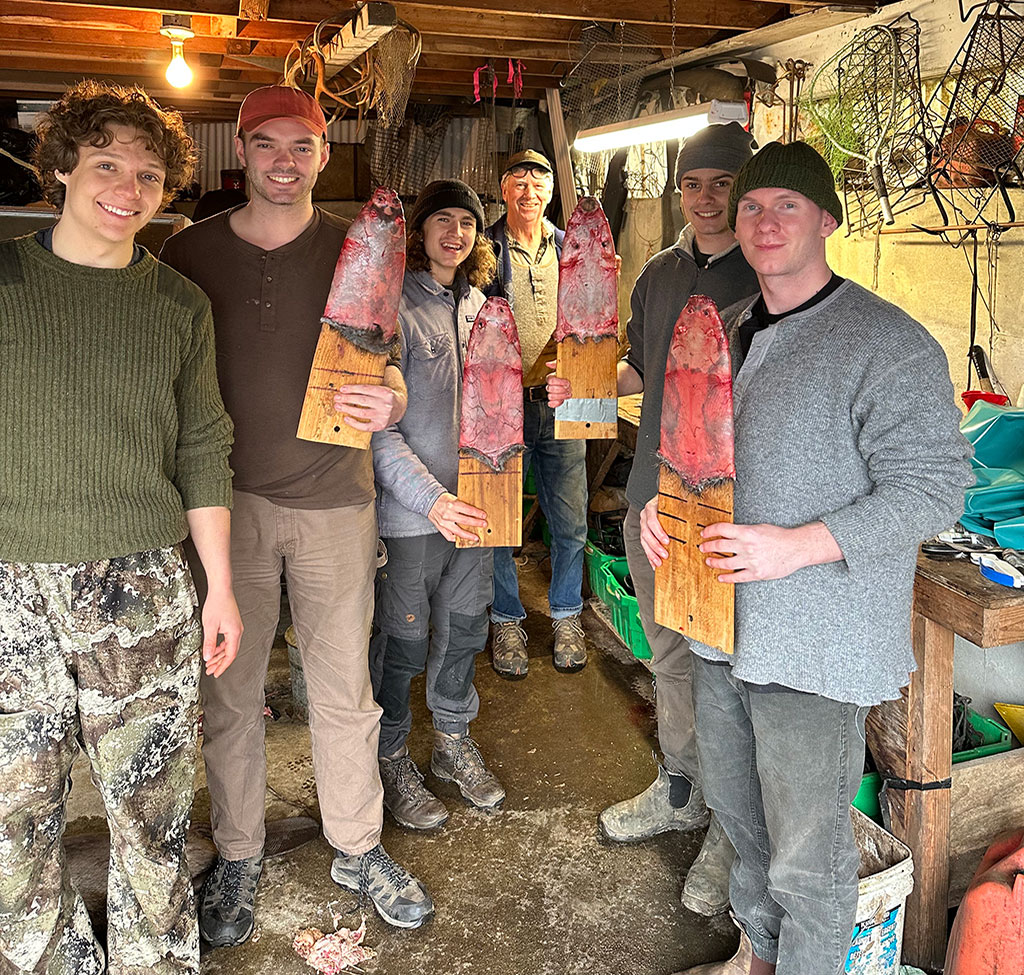
Many thanks to veteran trapper Jerry Baker for helping pass on skills to a new generation.
TAF: You say that two hurdles stand in the way of really getting trapping off the ground at your club: cost and limited opportunities to "get out".
CM: That's right. Overall, the club is doing well. We currently have around 130 members, and our numbers continue to grow as more students seek outdoor experiences and opportunities to learn. Of all the activities we offer, though, trapping presents unique challenges.
There's a decent amount of interest in trapping at UVic, but we need to provide more opportunities for club members to spend time on actual traplines, and we also need to provide a way for them to become licensed. Both face issues of accessibility and cost.
In BC, you can only trap on traplines or on private property. Traplines that were once hundreds of dollars, are now tens of thousands. BC only has around 1,800 licensed trappers, which is roughly a 40% decrease from the 1950’s. I fear what kind of future my own children will face. Will the lifestyle be reserved for a select few diehards and those willing to endure unnecessary scrutiny, criticism, and death threats? I sure hope not.
As for helping students obtain their trapping licenses, so far about 30 students have expressed interest in taking a course, but only one has done so. This was through the British Columbia Trappers Association. Courses cost around $800, are a two-hour drive from town, and only run once a year. So we've been working with the BCTA to offer a more accessible and affordable alternative for club members, but it's a work in progress.
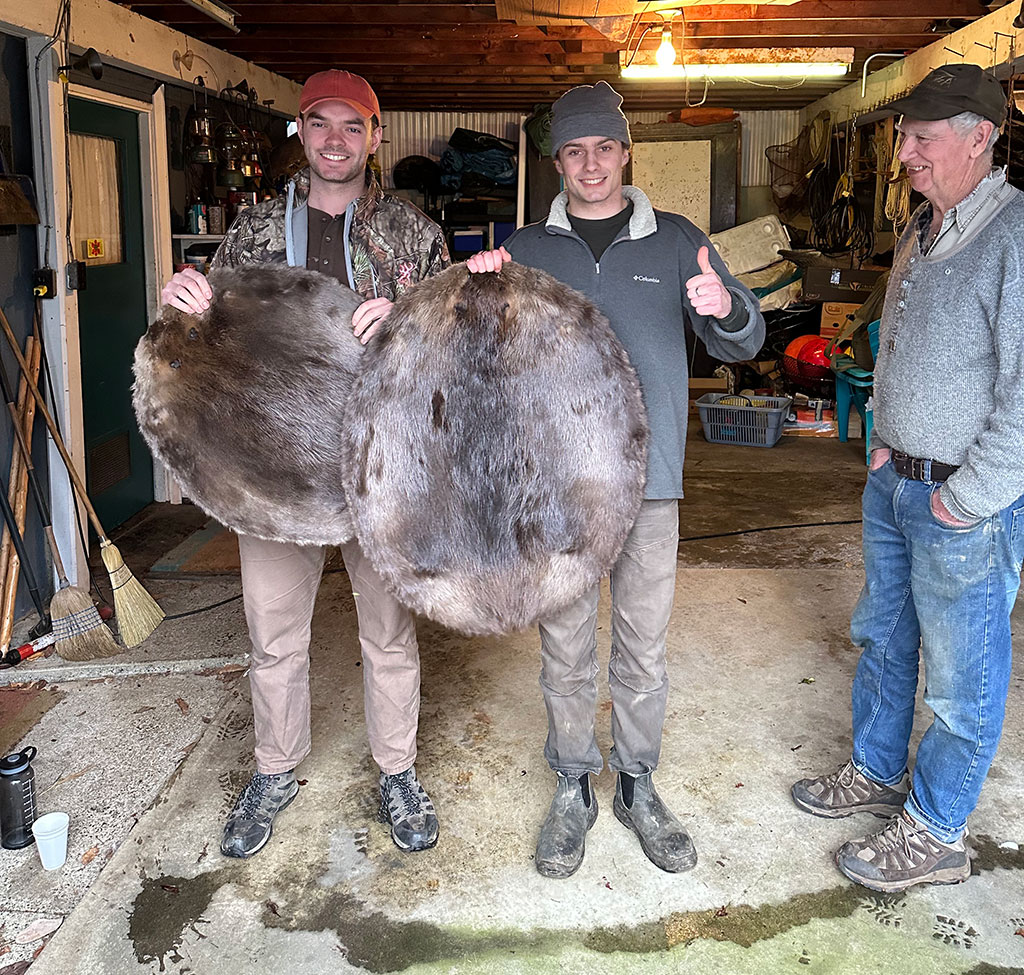
The pride in passing on, and receiving, knowledge is plain to see.
TAF: So have you been able to offer members any opportunities at all to gain hands-on trapping experience?
CM: Thankfully, yes. A very generous local trapper and former instructor, Jerry Baker, agreed to host a workshop for just $30 per student! Unfortunately, he will be selling his line soon as he is unable to work it any longer due to age, so we're still looking for a long-term solution. I have had one trapper reach out to us about a line that's pretty close to UVic, however, they’re looking for ~$25,000 which is well more than I have.
My hope is to arrange a partnership or access agreement with a trapper or landowner here on Southern Vancouver Island. My vision is to secure a trapline that the club can use for education, mentorship, and hands-on learning. We have limited funding but I am more than happy to work on something that is mutually beneficial.
I also believe that having guaranteed access to a trapline could offer students unique research opportunities on local furbearing species, and provide new perspectives on how trapping can play a more active role in modern coservation efforts as a wildlife management tool.
Succession Plan
TAF: You'll be graduating from the University of Victoria soon. Do you have a succession plan to make sure the UVic Fish and Game Club continues once you've gone?
CM: I plan to continue my education in forest biology after graduating, with the goal of earning my Registered Professional Biologist (R.P. Bio) and Registered Professional Forester (RPF) accreditations. So I may not be leaving Victoria just yet. But as you say, I must ensure the club has been set up for long-term success, enabling it to thrive as a permanent part of student life at UVic.
To this end, we have a vice-president and an executive team to make sure our leadership succession is smooth and the club has capable hands to carry it forward.
I am also in talks with department heads (Program Coordinator and Dean of EPHE) to explore the possibility of making the club a funded program here at the university. This process is complex and takes time, but if successful, it will give the club access to stable funding and administrative support, which will go a long way toward ensuring its sustainability long beyond my own time here. It also sets a provincial precedent; in BC, there are no institutionally recognized Fish and Game or Shooting Clubs.
Meanwhile, we are gathering every bit of support we can, from organizations, sponsors, and individuals, because not only do we have very minimal funding but these also strengthen our application and demonstrate the value of what we are doing. I am proud to say that we have already received support from the BC Wildlife Federation, Safari Club International, Belisle Traps, the Bass Pro Shops and Cabela's Outdoor Fund, and the Canadian Coalition for Firearm Rights. If you’re interested in seeing more you can check our Instagram page or email us at [email protected].
TAF: We wish you every success, and who knows, maybe your future partner on Southern Vancouver Island – be it a landowner or trapline operator – is actually reading this interview! And as we said in the introduction, it's almost certain that similar initiatives exist across Canada that need a helping hand. Could that helping hand be yours?
In 1997, the Fur Institute of Canada’s Aboriginal Communications Committee launched the Jim Bourque Award in honour of a man… Read More
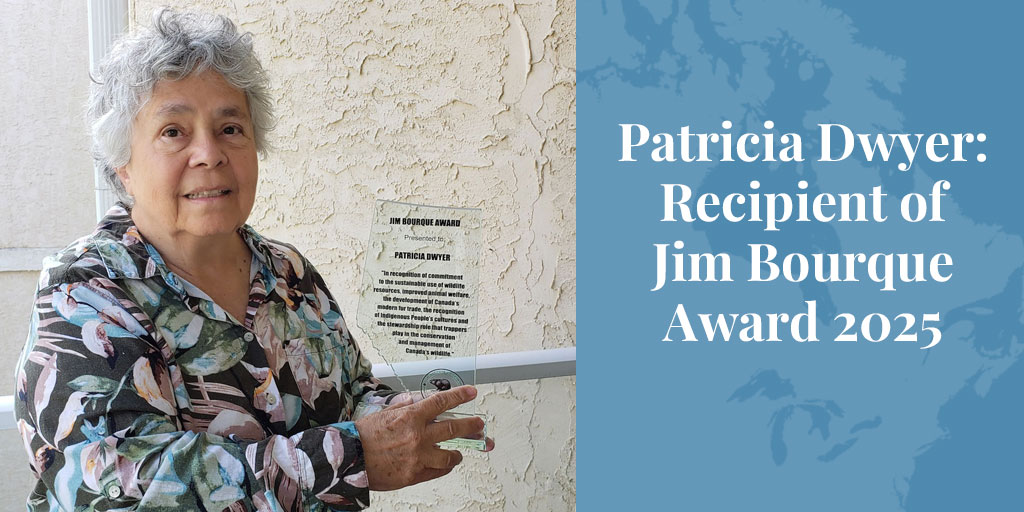
In 1997, the Fur Institute of Canada’s Aboriginal Communications Committee launched the Jim Bourque Award in honour of a man committed to the sustainable use of wildlife, animal welfare, development of Canada’s modern fur trade, and recognition of Indigenous People’s role in the conservation and management of wildlife. This year's award went to Patricia Dwyer, a Métis resident of northern Alberta and director of the Canadian Wildlife Federation. Here is her story.
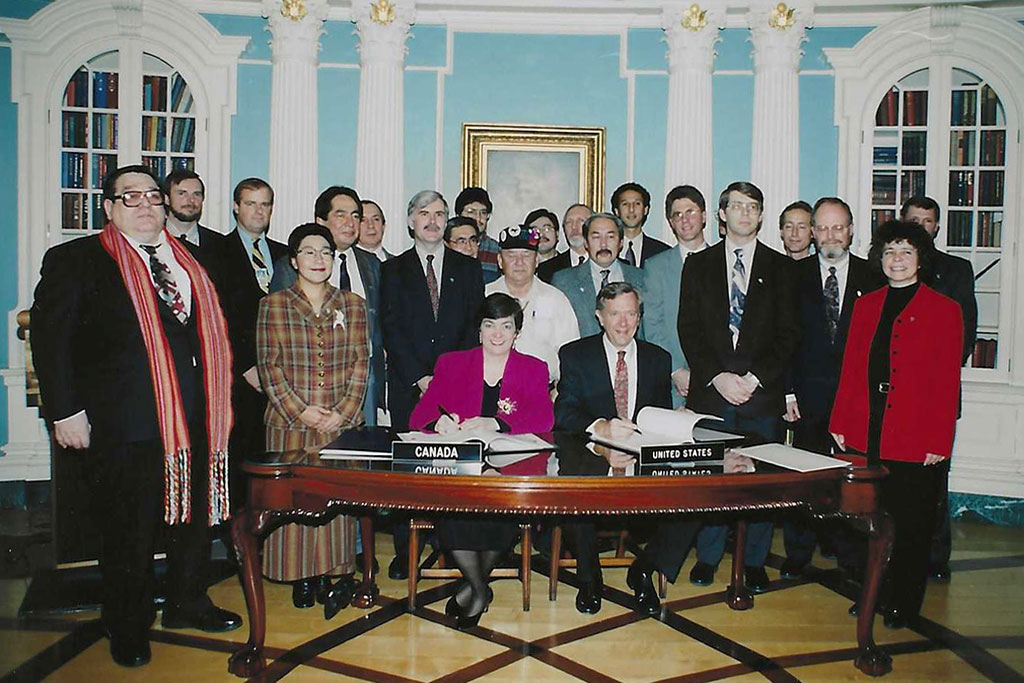
Jim Bourque (far left) and I (far right) were part of the Canadian negotiating team for the signing of the Protocol amending the Migratory Birds Convention, Washington D.C., 1997.
The first traces of my passion for wildlife etched themselves into my mind long before I could spell “conservation.” As a child in northern Alberta, I would explore outdoors with my brother and my cousin. The skies held a fascination of large and small birds, some quiet voices and some joining each other in raucous laughter, while the fields and forest floors provided small mammals like squirrels, skunks, rabbits and porcupines. Occasionally a mink or an otter would be spotted down by the Burnt River. Deer and coyotes were plentiful.
I wanted to be a veterinarian working with wildlife. I never got there, but found other ways to fulfill my passion. I was the granddaughter of a Hudson’s Bay factor and an Indigenous woman who lived in a town of about 300 people and relied on the fruits of nature. After living up there for my early formative years it was no surprise to my parents that I would choose an occupation along that path.
Personal Growth: Lessons Beyond the Curriculum
While studying wildlife biology and management at the University of Guelph, two of my student colleagues, Richard Popko and Robert Stitt, introduced me to the Ontario Trappers Association at a conference in North Bay. I was smitten. There were at least 250 trappers, men and women from all over Canada to Texas. They were happy, friendly and welcoming people. And they accepted me without question.
Upon graduation I accepted a position from Neal Jotham and Diana Manthorpe, with the Federal Provincial Committee on Humane Trapping, the predecessor to the Fur Institute of Canada. I took a course in trapping from Lloyd Cook, the then president of the OTA. The work I did was to film animals going into traps which we wanted to prove humane. The traps were kill traps, and locked open. There was a trajectory which could be determined with the very little movement we provided and the animals’ movements. No traps were used to kill animals unless they were determined able to hit hard enough at a vulnerable spot. I would film at night and eventually in an indoor space with adequate cameras and lighting. I housed and cared for marten, mink, fisher and raccoon for research, as well as a lynx, and a fox.
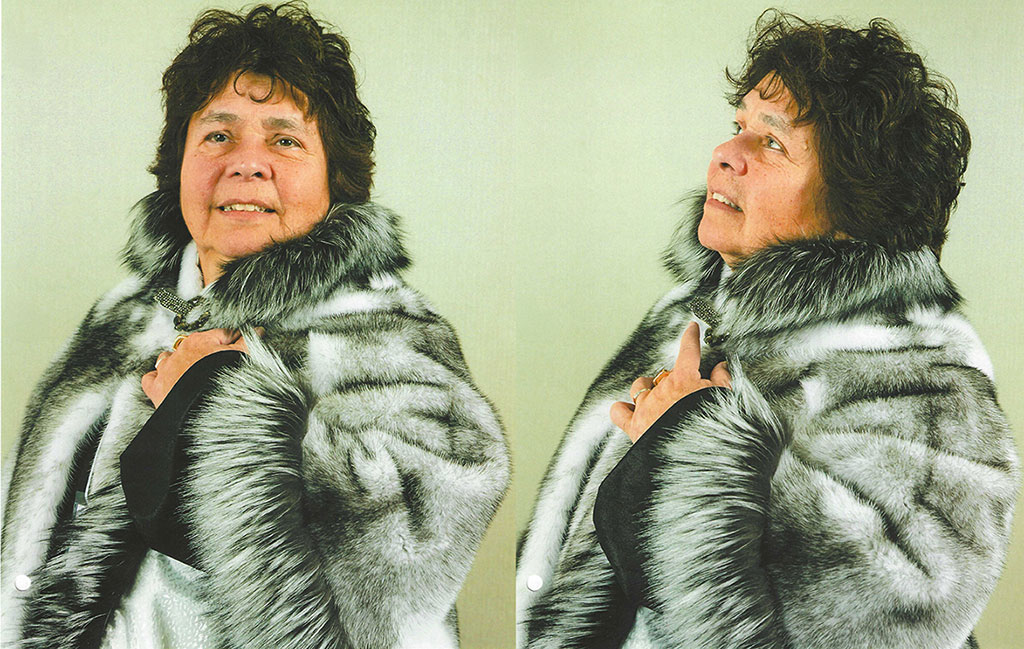
Modeling a blue fox coat with ranched silver fox trim, circa 1993.
My supervisor was Dr. Fred Gilbert, and I had two employees. Eventually the FIC trap development work moved to Vegreville. I had also moved to Alberta and was working for the Alberta Government as a fur biologist. I was still working with traps and trappers and had several trappers outfitted with new humane traps and new technicians to test over the winters. I also worked with government people from the other provinces who held similar positions to mine – such as Bob Carmichael (Manitoba), Mike O’Brien (Nova Scotia) and Pierre Canac-Marquis (Quebec).
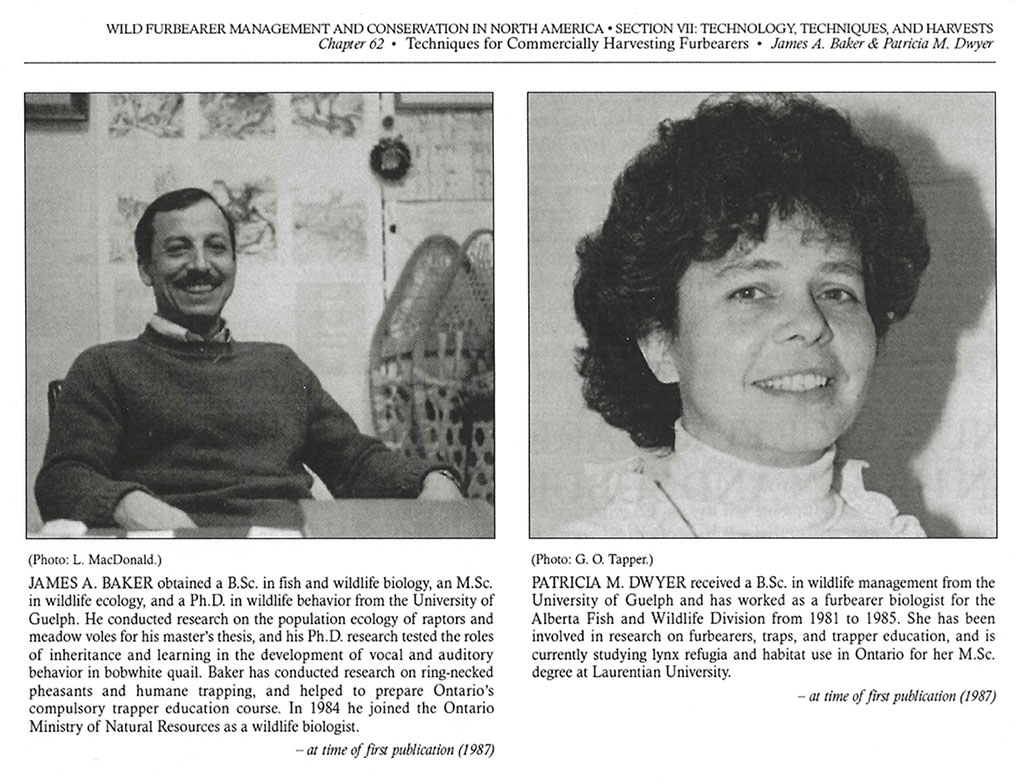
Way back in 1987, James Baker and I co-wrote a chapter in Wild Furbearer Management and Conservation in North America. Today, it's still considered the key document in its field.
Eventually I left to do a master’s under Dr. Frank Mallory on lynx cycles producing my thesis “Location and Characterization of Lynx Refugia of Ontario”, at Laurentian University in Sudbury, supported by the Ontario Ministry of Natural Resources and my many friends and family. During that time, I collaborated with Jim Baker on a chapter in the trapping bible by Milan Novak, Wild Furbearer Management and Conservation in North America.
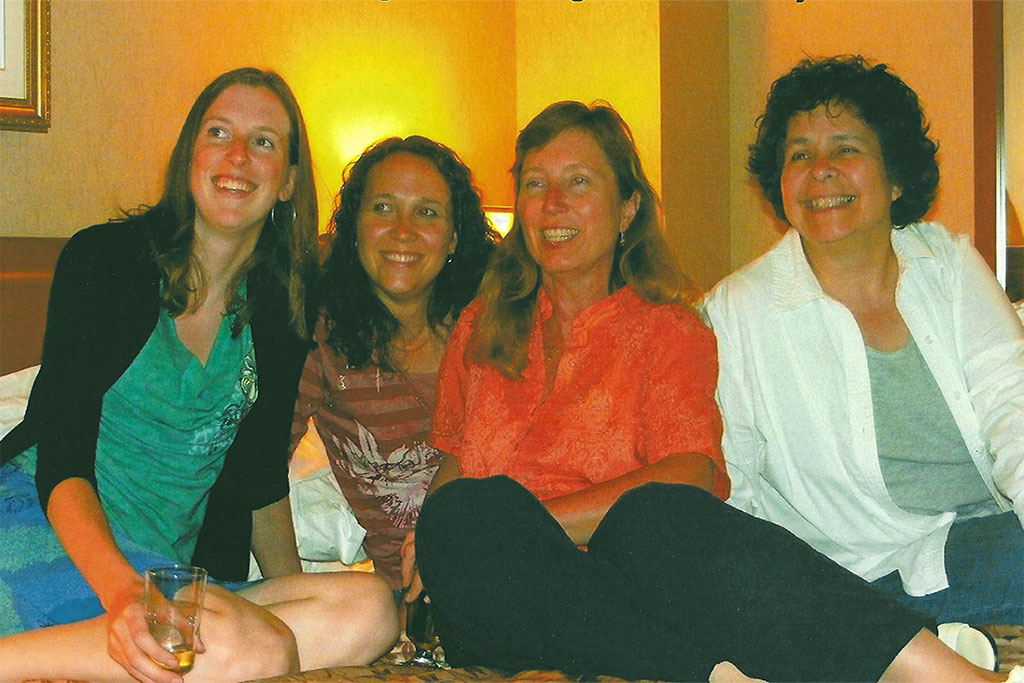
Canadian fur managers bonding, Quebec City, 2008. L-R: Felice Griffiths, Kim Morgan, Carol Foster, and Patricia Dwyer.
Following that and before graduating, I attended University of Ottawa at the Law school. I graduated from my master’s and law degrees on the same May weekend in 1992. Upon graduation I worked for the Department of Indian Affairs and Northern Development in the trapping section, doing consultations with Aboriginal peoples on humane traps. Brian Roberts and Smokey Bruyere were my mentors and supervisors in this position.
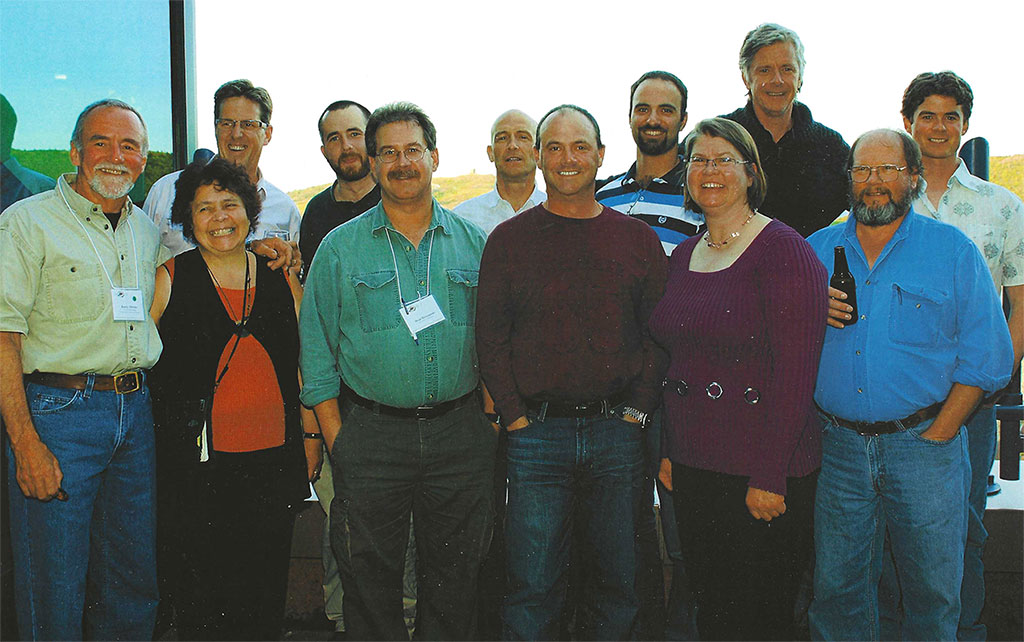
Canadian Fur Managers committee, St. John's, 2010. L-R: Randy Dibblee, Patricia Dwyer, Eric Lofroth, Shannon Crowley, Dean Berenzanski, Chris Heydon, Rob Corrigan, Jean-Michel DeVink, Helen Slama, Pierre Canac-Marquis, Mike O'Brien, and Devin Imrie.
I was soon asked to join the Canadian Wildlife Service, to do consultations and help facilitate the changes to the Migratory Birds Convention 1916. With the acceptance of the Constitution Act, 1982 it was necessary to acknowledge and accept the rights of the Aboriginal Peoples of Canada to hunt migratory birds during the closed season for subsistence purposes. I requested and was given permission to form a negotiation committee with Aboriginal peoples on the team. The Honourable James Bourque, who was the Deputy Minister of Environment in the Northwest Territories, worked with me along with Philip Awashish from the Crees of Quebec and Rosemary Kuptana, the then president of the Inuit Tapiirisat of Canada. I have always thought of this successful endeavour as one of the first Federal government actions of reconciliation to Indigenous peoples.
At CWS, I was Chief of Aboriginal Affairs and Transboundary Wildlife for 20+ years. Presently, I am on the Executive of the Canadian Wildlife Federation (NGO) and slated to become in two years the first woman, and first Indigenous president.
The Power of Community and Collaboration
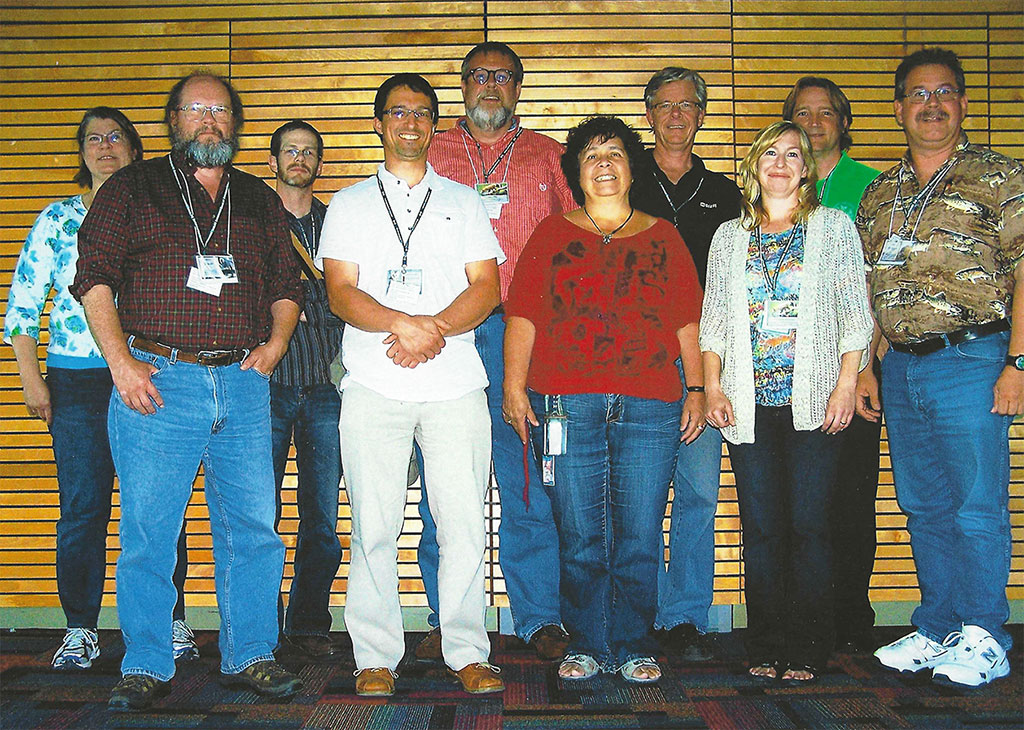
Canadian Fur Managers committee, Ottawa, 2013. L-R: Helen Slama, Mike O'Brien, Jonathan Cormier, Emmanuel Dalpé-Charron, Dave Kay, Patricia Dwyer, Pierre Canac-Marquis, Christy MacDonald, Brad Potter, and Dean Berenzanski.
Conservation, I discovered, is not a solitary pursuit. Through workshops, conferences, and collaboration with other students and professionals, I became part of a network dedicated to wildlife conservation. We shared findings, debated best practices, and supported each other through successes and setbacks. One of my most formative experiences was working on co-management agreements in the new treaties with Indigenous peoples. The project required coordination between hunters and trappers, Indigenous communities, and government lawyers and biologists – a reminder that conservation is as much about people as it is about animals.
I learned to listen as much as to speak, absorbing traditional ecological knowledge and local stories that textbooks never capture. The wisdom passed down by Indigenous Elders about the cyclical nature of animal populations and the importance of gratitude after each successful track or capture added depth to my scientific understanding.
I am humbled and so grateful to so many people who helped me to understand and to grow along my journey, and to have been able to express myself throughout. Receiving the Jim Bourque Award is an amazing gift of recognition which I never expected. Jim was a close friend of mine and a person I highly respected.
Did you know that the province of Quebec has a thriving trapping group whose members are all women? While it’s… Read More
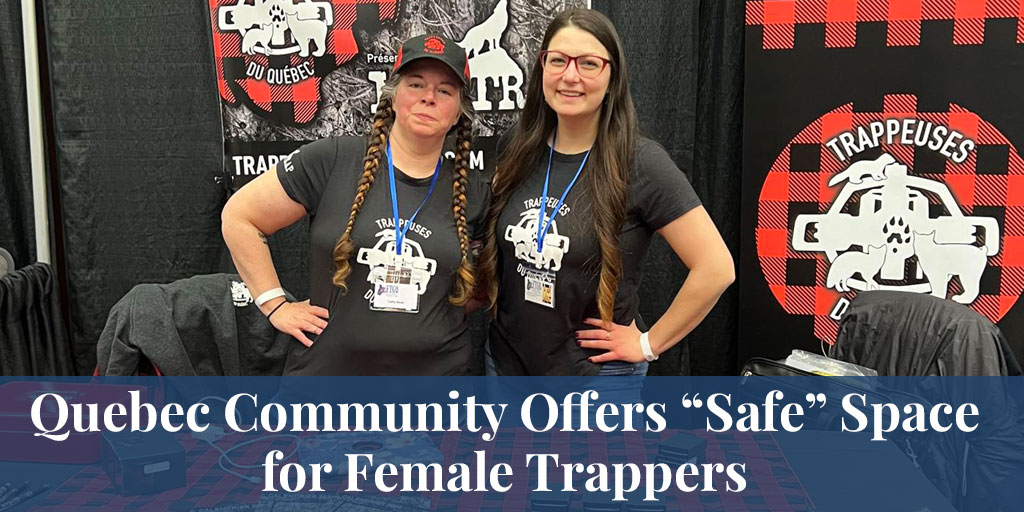
Trappeuses du Québec founder Cathy Naud (left) with her "right arm", Stéphanie Brousseau.
Did you know that the province of Quebec has a thriving trapping group whose members are all women? While it's true that the trapping world is dominated by men, every other trapping organisation opens its doors to male and female trappers alike, so why bother? Truth About Fur spoke to the founder of this unique group, Cathy Naud, to find out.
Truth About Fur: You started Trappeuses du Québec in 2020. What inspired you, and does it meet a real need?
Cathy Naud: Women-only communities are nothing new, and their aim is not to segregate women from men. They're about creating environments in which women can shine, grow, and contribute to fields traditionally dominated by men.
So when I launched Trappeuses du Québec, we already had women-only groups for hunting and fishing, but female trappers had been overlooked.
We offer a safe environment for women to empower themselves, and the fact that we already have over 1,500 members clearly indicates the demand was there.
TAF: You say you offer a "safe environment" for women as if mixed-gender groups are somehow unsafe. What do you mean?
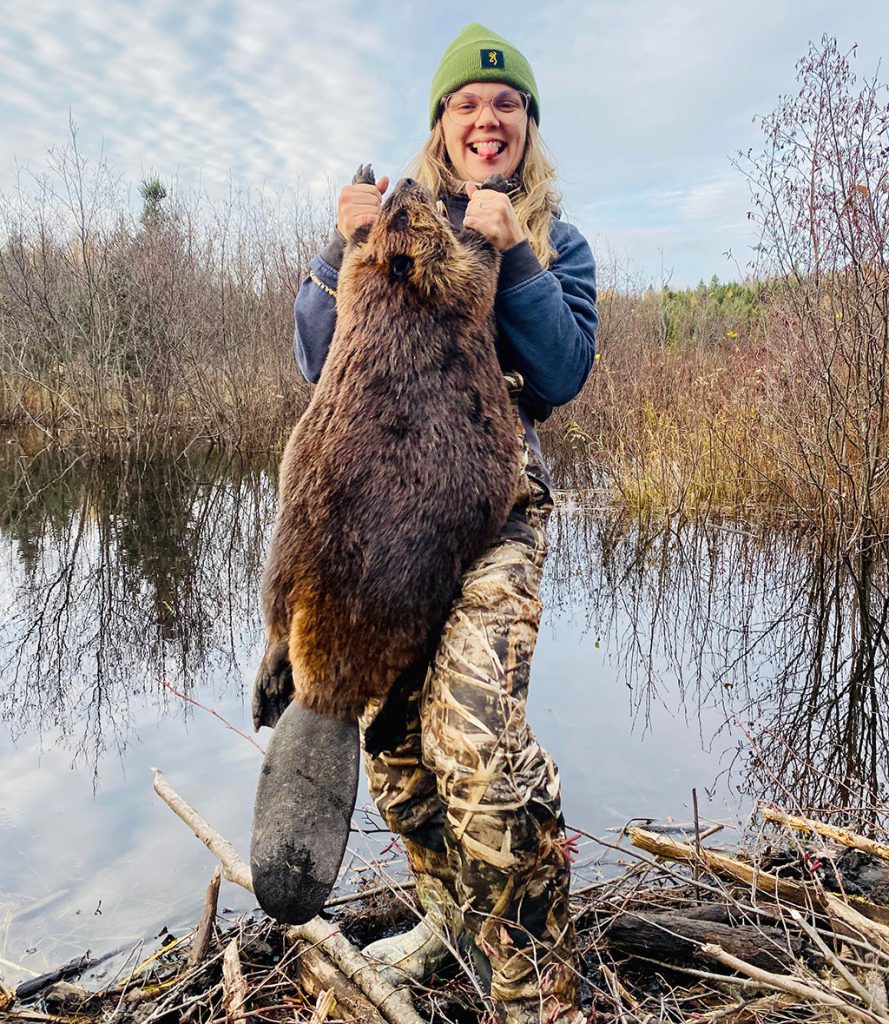
Trappeuses du Québec member Mary Boily shows off her giant catch.
CN: By a "safe environment" I mean one where women can express themselves freely without fear of judgment. This builds their pride and confidence, and encourages them to share their expertise.
Of course we work with mixed-gender organisations all the time, and have received strong support from the Fédération des Trappeurs Gestionnaires du Québec and trapping businesses. But the reality is that mixed-gender groups, especially online, can be unwelcoming to women.
Some men are still dismissive of our skills as trappers and struggle to accept that we can trap as well as they do.
For example, sometimes a woman asks a genuine question, only for a man to give an unhelpful or mocking response. Or she'll ask a novice question and be ridiculed. Or she might recount her success in trapping a more challenging species, only to be met with surprise or even disbelief.
Of course, we must also deal with inappropriate comments like "nice beaver".
TAF: So how does your group ensure women have a more positive experience?
CN: We have several unofficial rules that I go through during the interview process. For example, every question deserves a respectful and thoughtful answer. Experienced trappers are expected to be generous with their time in mentoring beginners, and they are.
We also encourage members to share their successes, learn from their mistakes, and grow – all without fear of judgment or hostility.
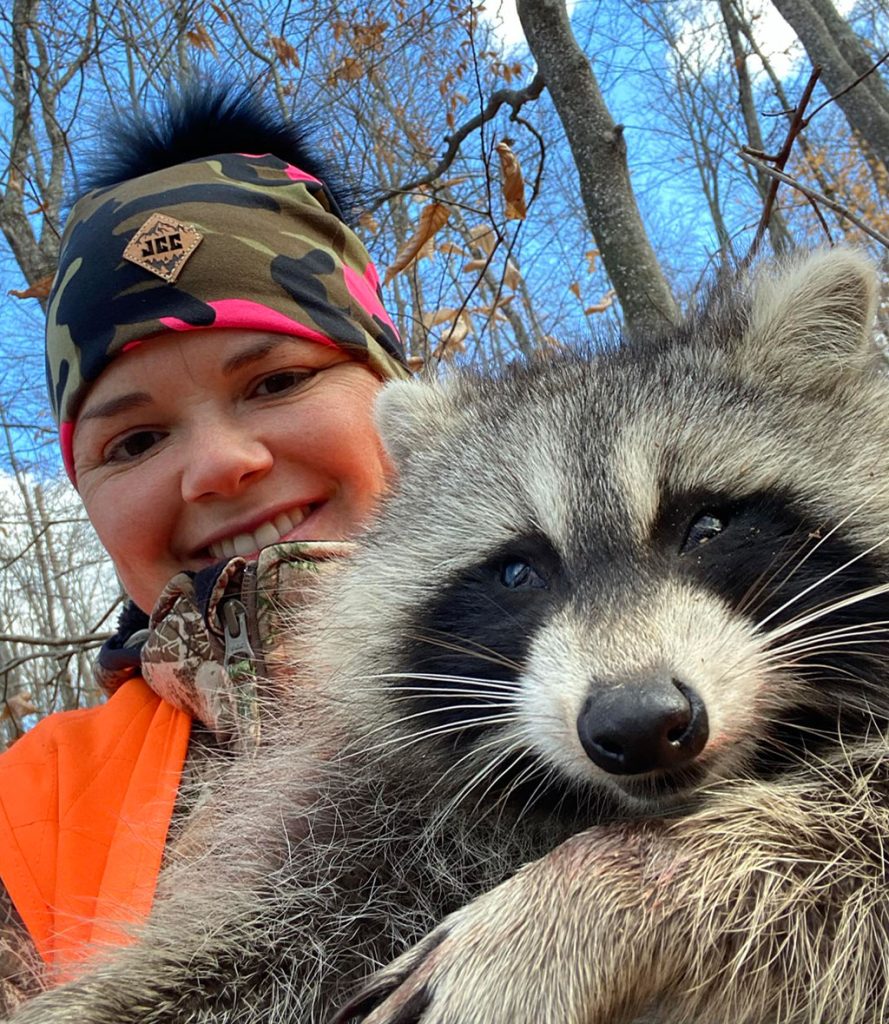
Caroline Lavoie with her freshly harvested raccoon.
TAF: In general terms, who are your members?
CN: We are more than just a group of individuals; we are a network where women help one another, celebrate their shared passion, and contribute to ethical and sustainable practices. From beginners to seasoned trappers, every member plays a role in fostering a welcoming and supportive atmosphere.
We come from all over the province, are from diverse backgrounds, and have different skill levels. Most of us speak French – the language of our website and social media – but it's not a requirement, and thanks to artificial intelligence, online translating is easier than ever before!
TAF: More specifically, how are your members involved in trapping?
CN: A significant portion are part-time hobbyists who trap to connect with nature, practice traditional skills, and harvest materials ethically. Many of these are also passionate about hunting and fishing.
But we also have several professionals engaged in nuisance animal control or managing wildlife populations for parks or municipalities.
And then we have artisans and craftswomen who work with fur, bones, and even beaver tail leather. They create beautiful, handcrafted items that honour the animals they harvest.
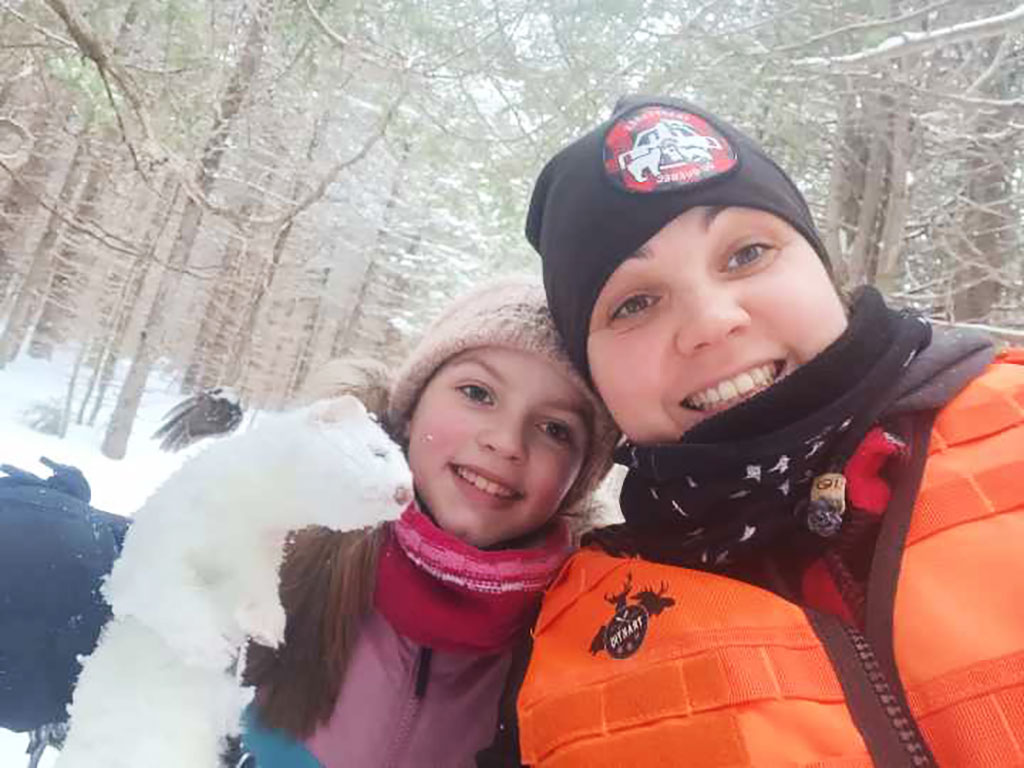
Like so many parents, Rebecca Gagnon delights in introducing her daughter to the joys of trapping..
TAF: So aside from emphasizing respect and support for one another, are there areas where female trappers can teach men a thing or two?
CN: Women bring a distinct approach to trapping that often emphasizes patience and precision, and respect for animals and the environment.
Women tend to be more meticulous and careful than men when preparing animals they have harvested. For example, they may take more time skinning them to avoid damaging the hide. Men, in contrast, may prioritize speed and quantity over quality, which is more likely to lead to mistakes.
Women also tend to be more empathetic and ethical towards the animals they trap. They may spend extra time to ensure their traps are set perfectly to minimize harm to an animal and maximize efficiency. Again, some men prioritize speed and quantity.
And female trappers tend to share more and compete less than their male peers. They are more likely to ask questions, seek advice and collaborate, which can lead to a stronger sense of community.
Another important difference is our physical strength. Many women face challenges with trapping tools, and would like to see more of them designed specifically for us. For example, one member is currently developing an easier-to-use clamp for activating Conibear 330 traps.
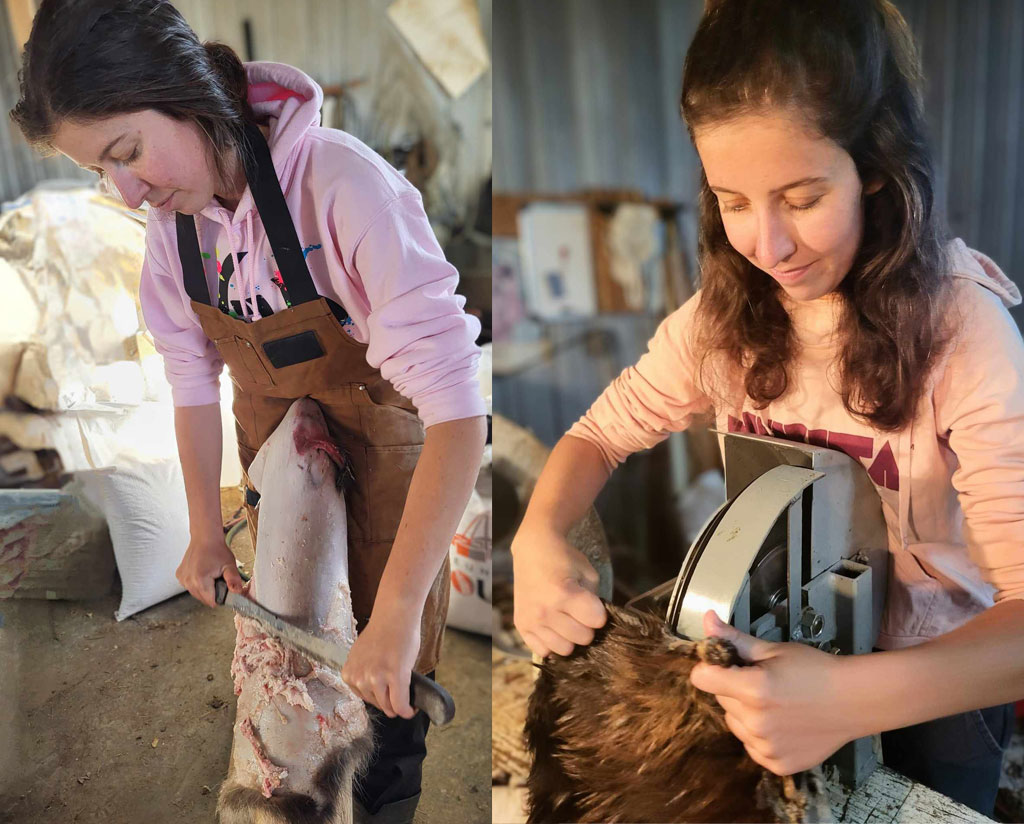
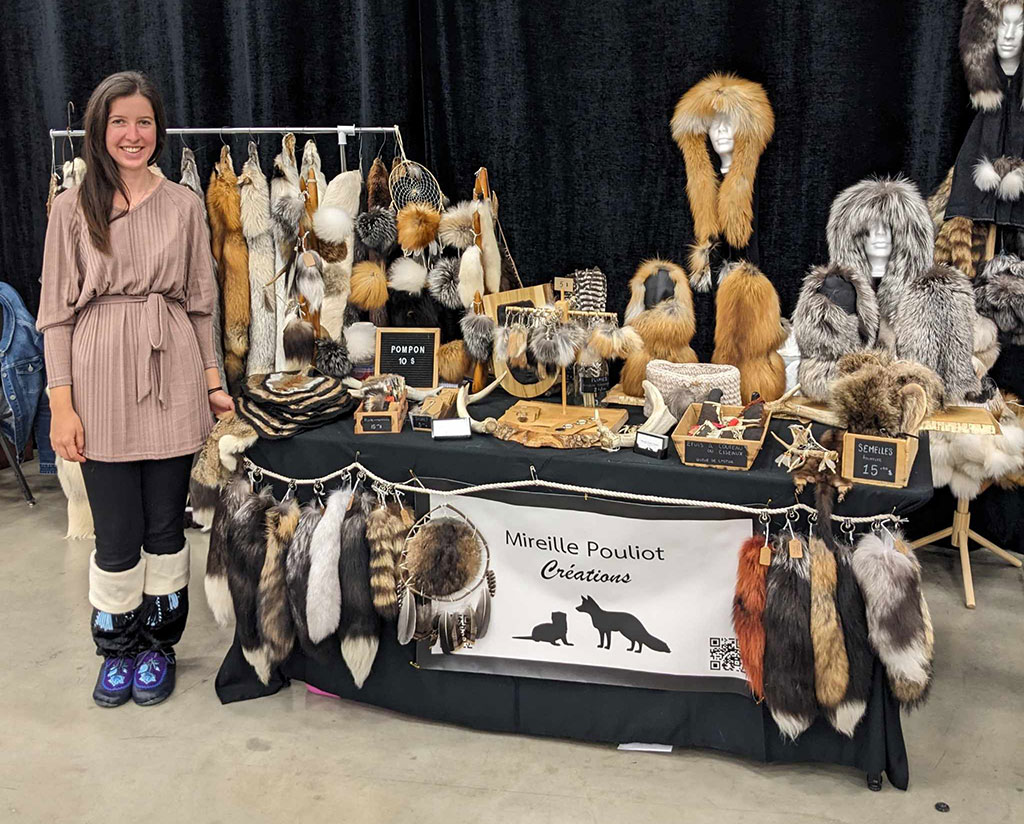
Mireille Pouliot likes to do everything herself, from trapping and processing, all the way to final crafting.
TAF: It sounds like the differences between male and female trappers are the same as between men and women in general. Indeed, most men would agree that women are nicer, or at the very least are less likely to start wars! Is this an accurate assessment?
CN: That's correct. Women tend to be more patient, more empathetic, less competitive, and of course physically weaker than men. Trappeuses du Québec understands these differences, and seeks to provide a supportive environment in which women can feel empowered in their journeys as trappers.
Now available on the web are a new series of instructional videos showing trappers how to avoid accidental catches of… Read More
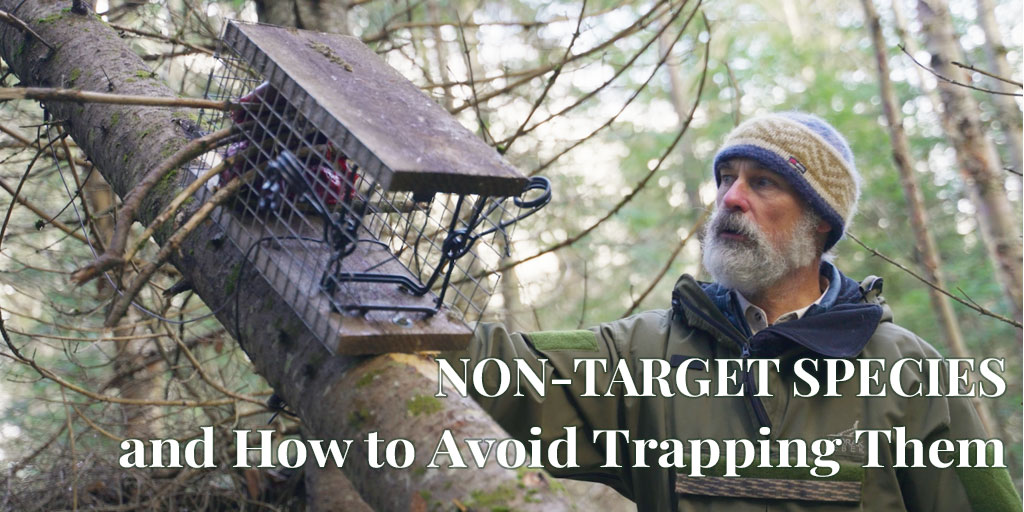
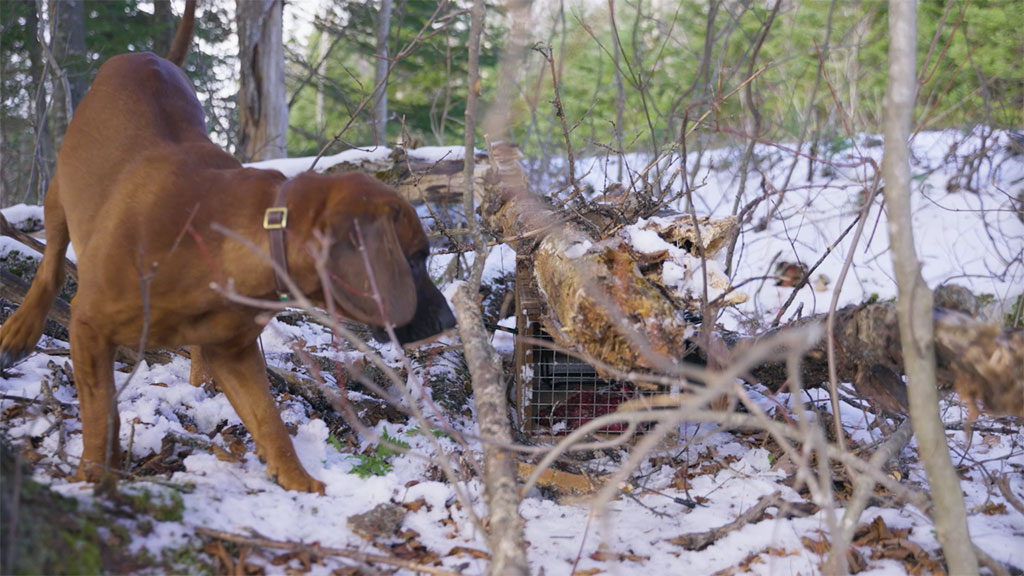
Now available on the web are a new series of instructional videos showing trappers how to avoid accidental catches of non-target species, and what to do if they occur.
Trapping associations take this matter very seriously, for a few important reasons. Among these, catching the wrong species can be wasteful, or could interfere with conservation efforts. It also poses an existential threat to the future of trapping: when a pet dog is accidentally caught, anti-trapping campaigners use this as ammunition to call for an end to all trapping.
Eight original videos have been produced in French by the Fédération des Trappeurs Gestionnaires du Québec (FTGQ), with the Fur Institute of Canada (FIC) then dubbing on English translations. The websites of both organisations are showing the French versions, while FIC is also showing the English versions. The role of host in all the videos is played by trapping instructor and FTGQ managing director Gaétan Fournier.
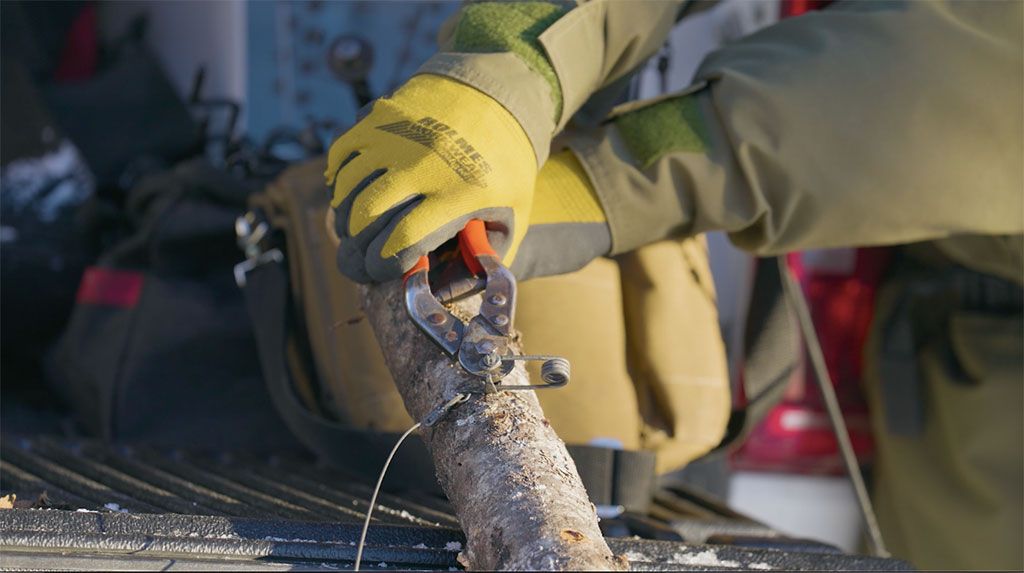
Use cable cutters to remove a snare from a non-target species.
The videos cover strategies for avoiding accidental catches in restraining traps, killing traps and snares. They also cover a range of animals, including semi-aquatic furbearers (muskrat, otter and mink), birds of prey, cervids (moose, deer, elk and caribou), and domestic animals (mainly pet dogs).
No fewer than three of the videos focus on pet dogs, including one that deals exclusively with what dog-walkers and trappers should do if a dog is accidentally caught.
Traps should be set so that pet dogs are in no danger.
"No trapper wants to catch a pet dog," explains Pierre Canac-Marquis, Coordinator of the Canadian Trap Research and Certification Program, who collaborated on the project along with fellow FIC member Ryan Sealy, a trapping instructor in Yukon. "Indeed, most of us have dogs of our own, so we understand the grief a family goes through when they lose their pet."
"But the reality is that on those rare occasions that a dog is accidentally caught in a trap, anti-trapping campaigners seize the opportunity to present all trapping in a bad light."
"For this reason in particular, trappers must strive to eliminate accidental catches of dogs. The future of trapping, with all the benefits it brings for conservation and communities, could depend on it."
The current crop of reality TV shows suggests that not only are many North Americans interested in living closer to… Read More
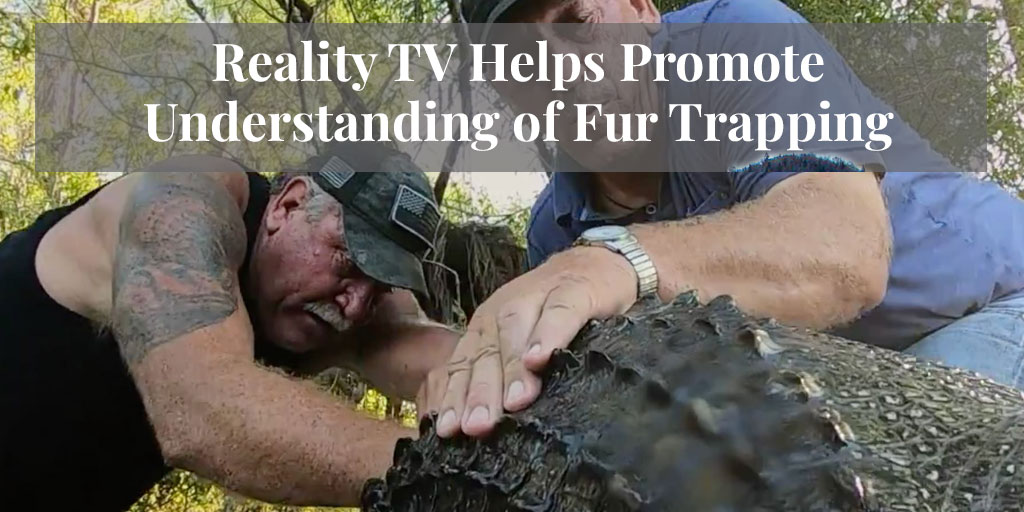
Reality TV shows like Swamp People recognise that killing animals is part of living close to nature.
The current crop of reality TV shows suggests that not only are many North Americans interested in living closer to nature, they actually crave it. This should bode well for the future of all outdoor activities that involve the taking of animal life, including fur trapping.
This is not a new idea, at least not for me. A decade ago I wrote a piece entitled "Mountain men wannabes: Allies of the fur trade", asking whether we were doing enough to tap into a large base of reality TV fans interested in getting their hands dirty in the great outdoors.
What I wasn't sure of was how many other people were thinking the same thing.
"I’d say definitely there is some increased popularity and interest from reality TV shows," said Abercrombie, "but most of all I think because trappers have many skills based on self-sufficiency, sustainable living on the land and bushcraft knowledge."
Agreed, reality TV shows don't deserve all the credit, or maybe even a large part of it. Above all, people's interest in "sustainable living on the land" is growing because of our hugely improved awareness of issues like climate change, pollution, and habitat loss.
Still, reality TV is playing a role in all this, whether it's because producers are setting trends or pandering to those that already exist. It's also vindicating for me to hear someone else actually say it!
Swamp People
A major exploiter of this genre is the History Channel, though there are several others.
For an impressive 15 seasons, History's Swamp People has been shooting Louisiana alligators in the head, while dispensing tidbits of advice on family values, protecting communities, and occasionally wildlife management. The show is also now on its third spinoff series, Swamp People: Serpent Invasion, in which cast members bag giant Burmese pythons in the Everglades. A lot of the action is surely staged, but the conservation message about invasive pythons is very real.
Then there's Mountain Men, now in its 12th season, that teaches viewers to chase mountain lions with dogs, haul logs, roast squirrels, and grow shaggy beards.
And for 11 seasons, the survival series Alone has taught us how to fish with thorns, trap rabbits, shoot grouse with a homemade bow and arrow, and build an earth shelter.
Sanitised Killing
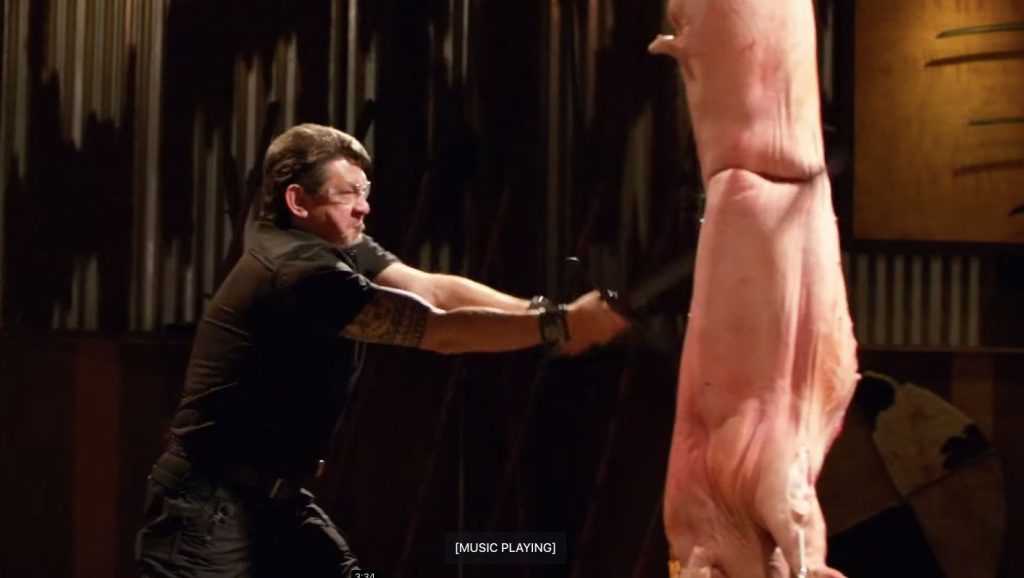
On Forged in Fire, blades are often tested for sharpness and strength on pig carcasses.
An important part of these shows is that they don't – can't – dodge the fact that killing animals is an intrinsic part of whatever lifestyle they are promoting.
Sure, the actual killing process is sanitised (i.e., not shown), but it takes little imagination to guess what happens off-camera.
Thus in Swamp People, we never actually see a gator take a bullet in the skull, but we do see a rifle muzzle being discharged while someone yells "Choot it!"
In Mountain Men and Alone, we know the wounded rabbit or grouse had its neck wrung, though we are spared the sight.
Serpent Invasion is more ambiguous. Pythons are caught live and by hand, then thrown in sacks, so sensitive viewers can kid themselves they end up in pet stores or zoos. But local law says they are actually dispatched on site by a trained professional, usually with a captive bolt pistol.
History Channel even gives us scenes of butchery, albeit minus the blood and in an unlikely setting. On its hugely popular reality show Forged in Fire, newly crafted blades are often tested for sharpness and strength on bled-out pig carcasses, salmon and ram skulls.
PETA and Friends Silent
Against this backdrop of animal slaughter and butchery, the silence of animal rights groups has been remarkable.
It's tempting to trot out an old argument that since most people hate crocodilians and snakes (and spiders) anyway, campaigning for their rights would be a lost cause. But that doesn't quite hold water given that PETA et al. are now fighting hard to ban "exotic skins" from croc and python farms.
Another old argument that no longer works is that you don't protest against leather at a Hell's Angel rally. Sure, gator hunters tend to be large and survivalists are ridiculously healthy, but in this age of remote protesting afforded by the Internet, the chances of them gutting and skewering you are zero.
My explanation is far more positive.
Commercial TV executives, and the bodies that regulate what programs can show, are all about giving us what we want – with obvious exceptions. And that means that a group of people sat down somewhere and discussed topics like:
• Is it ok to show alligators being shot in the head?
• Is it ok to show rabbits being trapped or grouse being shot with an arrow?
• Is it ok to show pig carcasses being cut to pieces?
Obviously regulators approved all these, with conditions, suggesting that showing such scenes has been judged beneficial – educational even – to society as a whole.
If my logic is sound, it tells me two things.
First of all, it tells me that the majority of North Americans accept the killing of animals as part and parcel of living close to nature.
And second, it underscores that the targeting by animal rights groups of wild fur trappers is arbitrary and therefore unjust. We need to stress this in our public relations.
If the North American public are ready for scenes of gators being shot in the head, rabbits being trapped, and pig carcasses being cut to ribbons, it's also ready for scenes of fur trappers at work.
This May saw the launch of the Truth About Fur Podcast, a collaborative effort of the Fur Institute of Canada… Read More
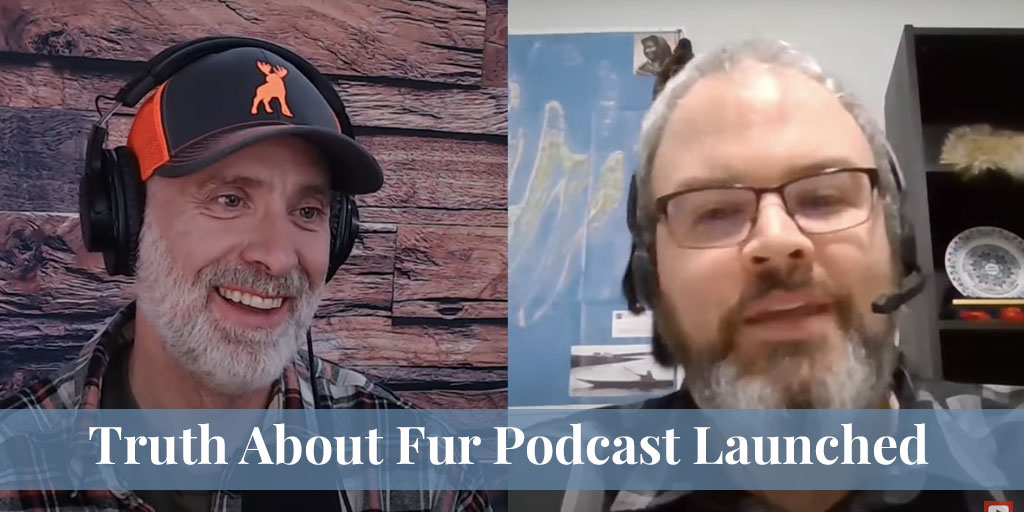
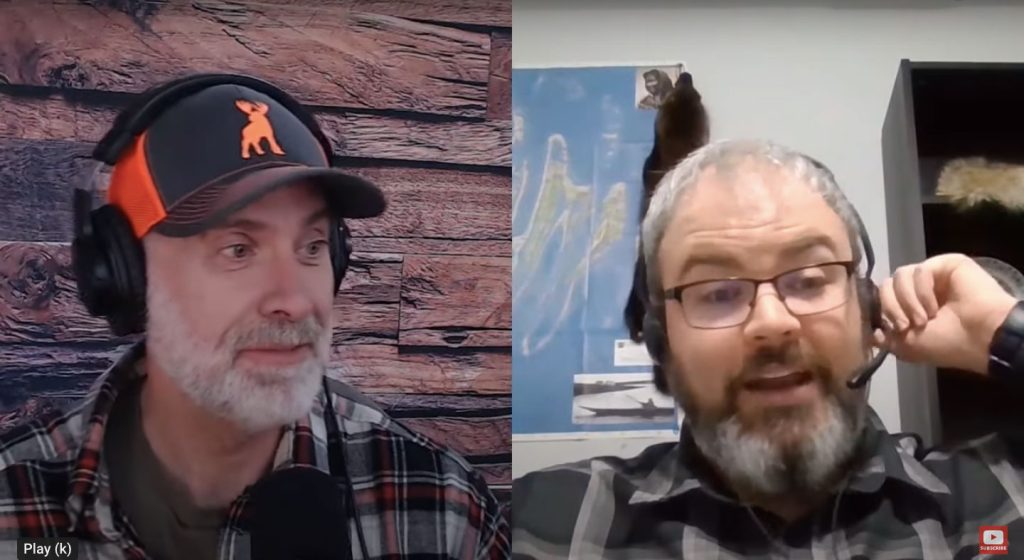
Mark Hall and Doug Chiasson co-host the new Truth About Fur Podcast.
This May saw the launch of the Truth About Fur Podcast, a collaborative effort of the Fur Institute of Canada and the Blood Origins Canada Foundation, the national branch of a global nonprofit dedicated to telling the truth about hunting and promoting conservation. Hosting duties are shared by the FIC's Executive Director, Doug Chiasson, and Mark Hall, Director of the Foundation and host with his son Curtis of the Hunter Conservationist Podcast (Apple Podcasts; Spotify).
In this first episode, Doug and Mark discuss current trends in auction prices for wild furs, and the state of Canada’s Atlantic sealing industry. You can listen in on Apple Podcasts or Spotify, or watch it on YouTube.
So why has the FIC decided to dive into the world of podcasting?
"It's really a case of the right opportunity coming along," explains Doug. "The Hunter Conservationist Podcast has been around since 2019, and I've already been a guest on a few episodes, so I know the effort and attention to detail that Mark puts into his podcasts.. Plus the Foundation is the perfect fit for us. When it comes to sustainable use of wildlife resources in Canada, we're on exactly the same page."
"The Fur Institute of Canada is a global leader in the industry," he says, "so I'm honoured to be co-hosting the new Truth About Fur Podcast. Trapping and sealing are integral to Canada's economy and to the well-being of so many Canadian families. We live in the information era, so it is important that people in the fur/seal industry have a trusted source of news and updates from across the country and even abroad. Our goal is for the Truth About Fur Podcast to be that trusted source of information."
Target Audience
Mark Hall and son Curtis are "the perfect fit for us," says Doug Chiasson.
The first episode of the new podcast runs for 1 hour 10 minutes – a sizable chunk of time. So who do Doug and Mark hope will tune in?
“One of the most important tasks of the Fur Institute of Canada is to share information with anyone interested in the fur trade, and reaching as many people as possible requires multiple approaches," says Doug. "We already have a website, three social media channels and a newsletter for members, and we interact with mainstream media. Now we're adding a podcast, which fills a special niche. The audio format, plus of course the duration, enable us to dig deeply into issues while catering to people who can't be glued to a computer screen."
So who might these people be?
"If you enjoy listening to the radio, you'll enjoy podcasts," says Doug, "Maybe you're a trapper who spends hours behind the wheel of a truck, or in your fur shed. Your hands and eyes are occupied, but you can still listen. Or maybe you're just making dinner or washing dishes. With a podcast playing in the background, you can learn something while hopefully being entertained too."
"We also hope we'll attract listeners from the Hunter Conservationist audience. Trappers and hunters are both parts of the same outdoors community, and face many similar issues. So we're excited to explore these areas of common interest, and hopefully bring hunters and trappers closer together."
On July 28-29, the Fur Institute of Canada descended on Whitehorse, Yukon, for its first in-person Annual General Meeting in… Read More
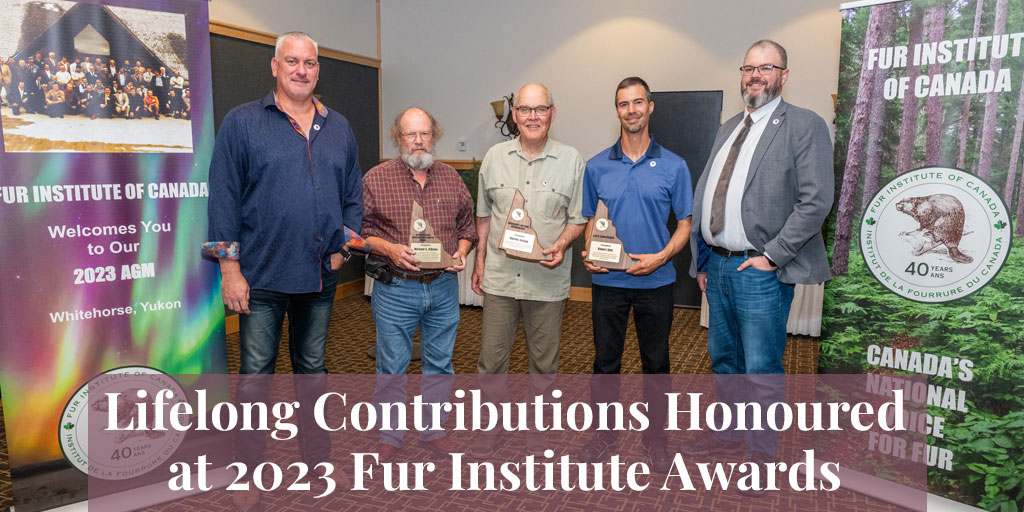
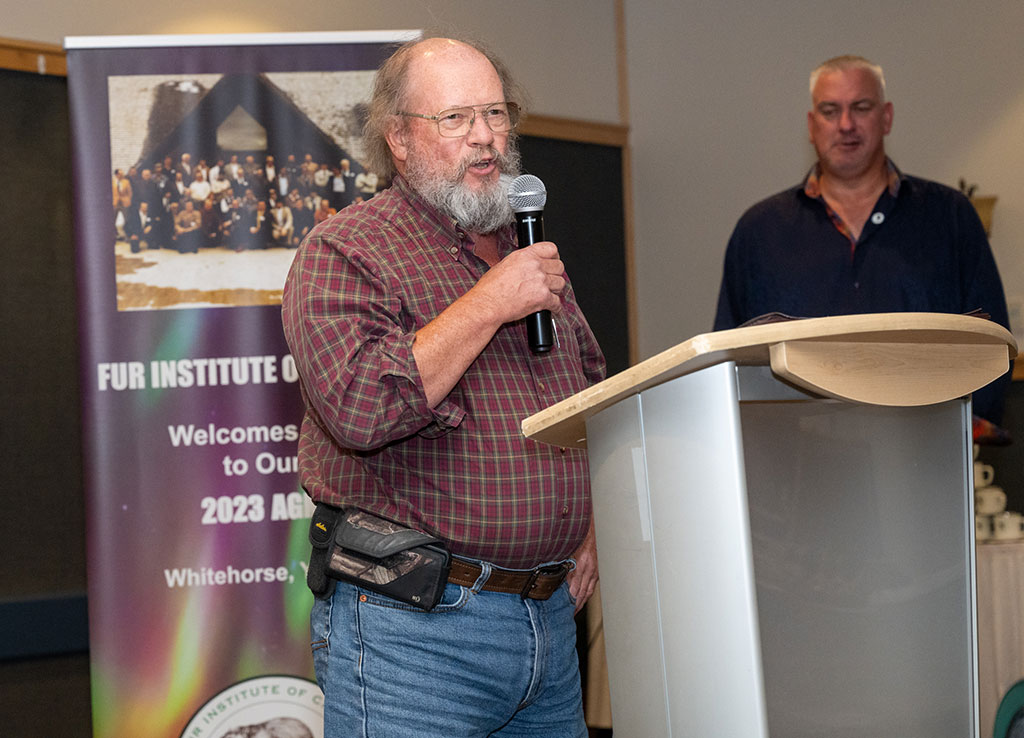
On July 28-29, the Fur Institute of Canada descended on Whitehorse, Yukon, for its first in-person Annual General Meeting in three years, and also to mark its 40th anniversary. As part of the celebrations it revived its Awards Program, honouring lifelong contributions to the fur trade.
This year, three awards were presented: the Lloyd Cook Award, the Honorary Lifetime Membership Award, and the North American Furbearer Conservation Award.
Lloyd Cook Award
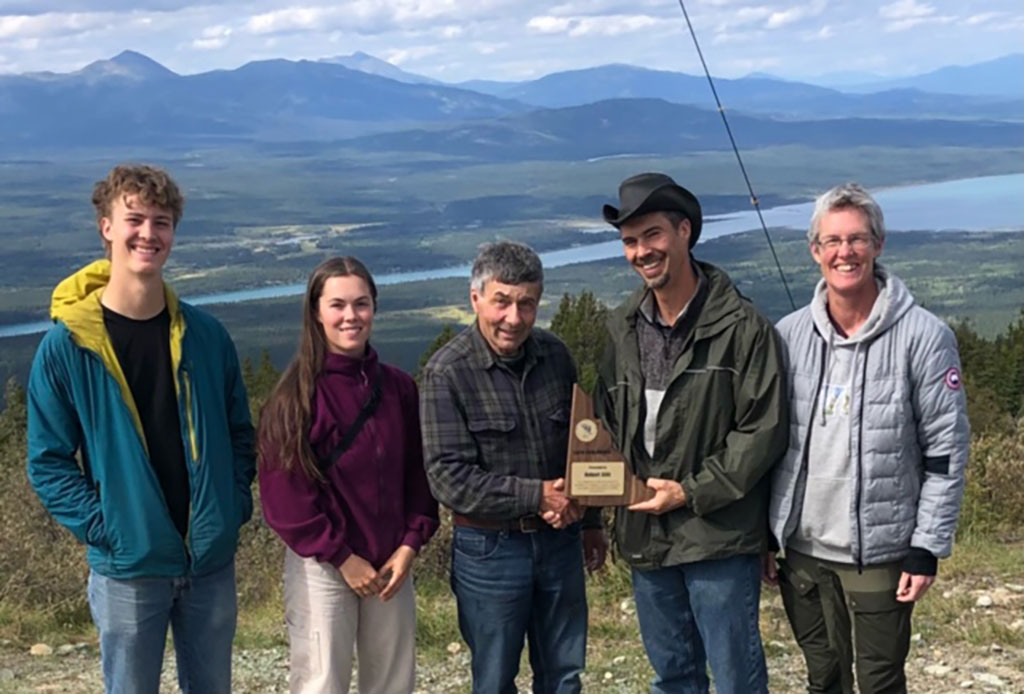
Robert Stitt (centre) receives his Lloyd Cook Award from Ryan Sealy and family, at the Jubilee Mountain fire tower where he works in the summer.
The Lloyd Cook Award was first presented by the FIC in 1993 in recognition of its namesake's commitment to excellence in trapping, trapper education and public understanding of wildlife management. Among the posts held by Lloyd in his lifetime were the presidency of the Canadian Trappers Federation and of the Ontario Trappers Association, forerunner of today's Ontario Fur Managers Federation.
This year's Lloyd Cook Award went to Robert Stitt, a valued member of the FIC for almost two decades. Robert was unable to attend the presentation, so the award was accepted on his behalf by Ryan Sealy, a conservation officer with the Government of Yukon.
Robert grew up in Ontario where he spent decades trapping and guiding hunters, before moving to Yukon in 2008. One of the first things he did on arriving was to join the Yukon Trappers Association (YTA), and, despite his enormous experience, signing up for the territory's Basic Trapper Education course. To this day, he is a director of the YTA, as well as being a past president.
For the past 15 years, Robert has run a trapline in a remote part of southeast Yukon, harvesting marten, beaver, wolf and wolverine. In most years, he offers upgrading workshops, particularly for marten and beaver pelt-handling and management, and also provides a mobile fur depot service in several communities.
In 2011, Robert became a guest presenter for the Yukon Government's trapper education program, and in 2020 became an instructor. Students regularly comment on his close connection to the bush, his willingness to help new trappers, and his strong advocacy for humane trapping and good fur-handling.
Indeed, Robert's fur-handling skills are renowned, and the reason he has won many competitions. When teaching, he highly recommends his students read the Fur Harvesters Auction manual Pelt Handling for Profit.
Robert's other claims to fame are diverse. He is known as a presenter and writer, regaling audiences with inspirational tales of overcoming extreme challenges in the wilderness. He often writes letters to the editor on wildlife management issues, has published several stories about his life on the trapline, and is a regular contributor to Canadian Trapper magazine. And he is also a renowned moose-hunting guide, and a valued reporter on birds and other wildlife on his trapline.
Honorary Lifetime Membership Award
Harvey Jessup receives his Lifetime Membership Award, watched by the FIC's Executive Director Doug Chiasson and Chair Jason White.
The FIC's Honorary Lifetime Membership Award celebrates people with long and distinguished track records of service to the fur trade, this year going to a man who has been involved with the institute from its inception, Yukon resident Harvey Jessup.
Harvey started his career in fish and wildlife management as a conservation officer, moving from enforcement to management in 1977 as a furbearer technician assisting with research on furbearer species such as marten, beaver, lynx, wolverine and wolves. This research led to the development of trapline management strategies for these key species. With the assistance of many Yukon trappers, the Yukon Trappers Association, the Manitoba Trappers Association, and the Canadian Trappers Federation, he developed a trapper education manual and training program for Yukon that is still in use today. He sat on the Western Canadian Fur Managers Committee which would later be incorporated into the Canadian Fur Managers Committee.
In 1982, Harvey became the fur harvest manager responsible for traplines, monitoring fur harvest and delivering trapper training. He continued as a member of the Canadian Fur Managers Committee. He attended the founding meeting of the FIC, was appointed to its first Board, and went on to serve for over 20 years. He held positions on the Executive and chaired the Trap Research and Development Committee for six years. He also participated on ISO191 through to the development of the Agreement on International Humane Trapping Standards.
His responsibilities with Environment Yukon expanded to include all wildlife harvest, managing licensed hunting, determining outfitter quotas and tracking harvest. He eventually became Director of the Fish and Wildlife Branch, before retiring in 2009.
In 2010, he was appointed to the Yukon Fish and Wildlife Management Board (YFWMB), a government advisory body established under Yukon First Nation Final Agreements, and served as chair for two years. Interestingly, the Director of Fish and Wildlife is identified in the Land Claim as the YFWMB's technical support, so Harvey has sat on both sides of the table so to speak!
In 2015 he was appointed to the Yukon Salmon Sub-Committee, a Land Claims advisory board on all matters pertaining to salmon in Yukon, again serving as chair for two years.
Throughout the latter part of his career and while sitting on the YFWMB, Harvey worked closely with Renewable Resources Councils, local government fish and wildlife advisory committees that have direct responsibilities for all matters pertaining to trapping.
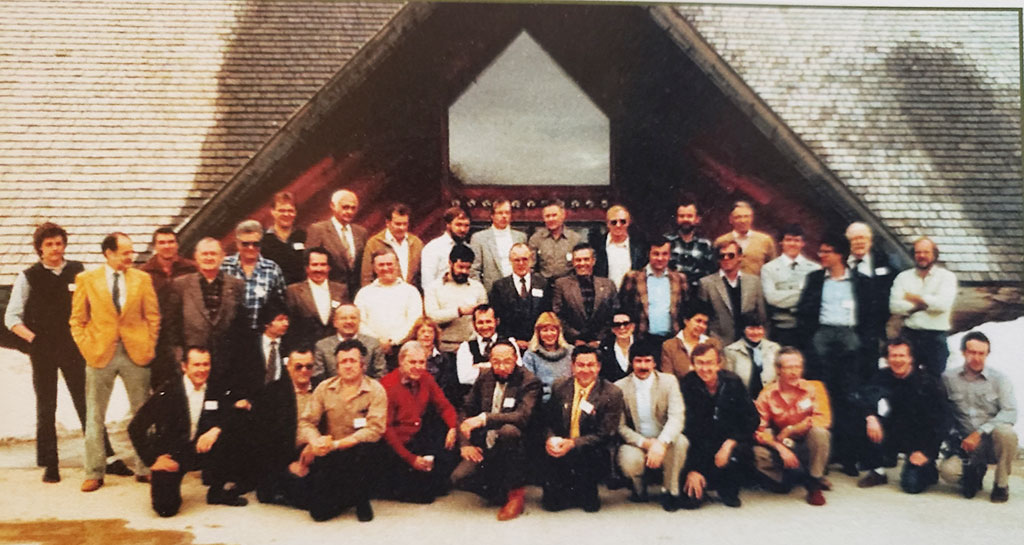
Harvey has had ties with the FIC literally from the beginning. At the FIC's first AGM, in 1984, Harvey can be seen in the back row, far left.
North American Furbearer Conservation Award
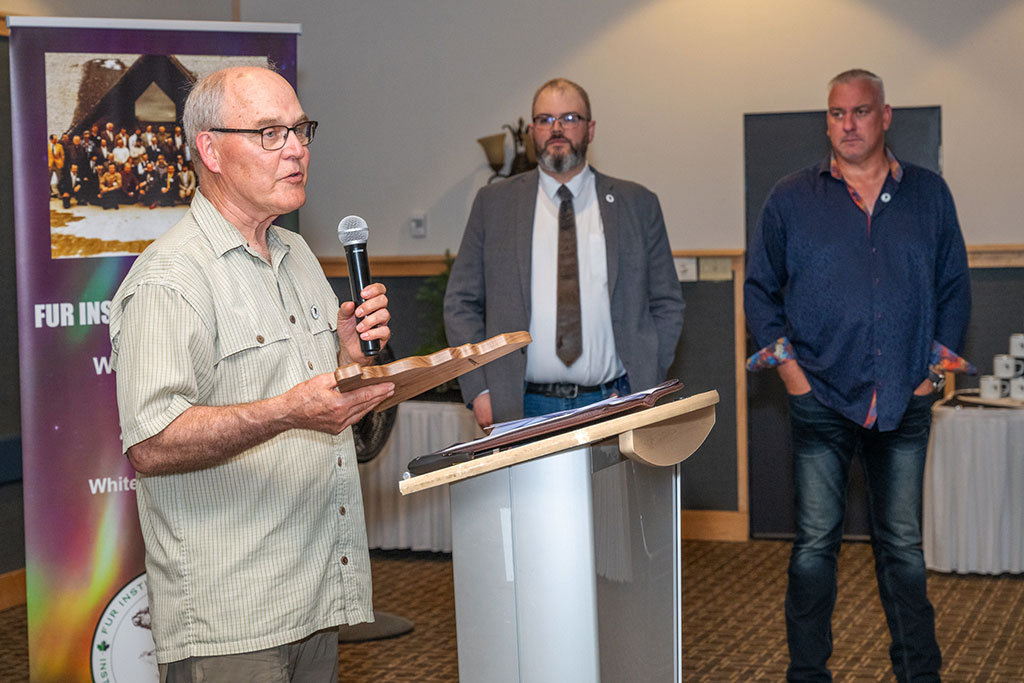
Mike O'Brien receives his furbearer conservation award at the FIC's 2023 AGM, flanked by Chair Jason White.
The North American Furbearer Conservation Award aims to promote awareness and recognition of individuals and organisations that have made significant efforts in the field of sustainable furbearer management. This year's award went to Mike O’Brien from Nova Scotia.
On graduating from Acadia University with a master's degree in wildlife biology, Mike worked as a wildlife manager for the Department of Natural Resources and Renewables of the Government of Nova Scotia. He then became a consultant for many different wildlife management sectors, including the wild fur trade.
Mike has been an FIC Board member since 1998, serving first on the Trap Research and Development Committee, and currently as chair of the Communications Committee. He is also a member of the Executive Committee.
This year marks the passing of four decades since the Fur Institute of Canada was founded in 1983, with the… Read More
This year marks the passing of four decades since the Fur Institute of Canada was founded in 1983, with the primary function of overseeing the testing and certification of humane traps. To mark the occasion, it has launched a new logo, but is the change purely cosmetic or is there more here than meets the eye? To find out, Truth About Fur interviewed Executive Director Doug Chiasson.
Truth About Fur: The FIC's original logo showed a beaver, a Canadian icon. Then it changed to another national icon, the maple leaf. Now you've combined the two, but with the beaver taking pride of place. What's the thinking here?
Doug Chiasson: When an organization celebrates a significant milestone, as the FIC is doing this year with our 40th anniversary, it's time for self-reflection. So we can see that while our most recent logo, of a maple leaf, did a great job of communicating “Canada”, it didn't communicate “fur” at all.
By putting a beaver front and centre, we remind people that fur and furbearing animals are our focus. And as a nod to the past, the maple leaf also appears in the roundel.
L: Canada's national animal stands watch on Parliament Hill. Photo: D. Gordon E. Robertson, CC BY-SA 3.0, via Wikimedia Commons. R: The beaver has graced the reverse side of the nickel since 1937.
TAF: Anyone with knowledge of Canada's history will understand the relevance of the beaver, but can you explain for non-historians?
DC: We often say that the history of the fur trade is the history of Canada. The pursuit of fur, particularly beaver pelts, was a defining feature of early European presence in North America and of relations with Indigenous nations. It played a role in establishing the Hudson's Bay Company and the North West Company, whose forts and factories are the sites of present-day communities across Northern and Western Canada.
That influence was reflected by the beaver's inclusion on the nickel coin since 1937, and its designation as Canada’s national animal in 1975.
Canada is fortunate to have a great diversity of fur resources, but when we think of fur and Canada, we think first of the beaver.
Absorbing Fur Council of Canada
L to R: Doug Chiasson with Mitch Fazekas of new FIC member Mitchie’s Matchings, Mathieu St-Arnaud of M-mode, and George Vongas of Saga Furs.
TAF: The Fur Council of Canada has been around since 1964, representing the interests of the downstream side of the fur business (retailers, manufacturers, etc.). Now the FIC is in the process of absorbing the FCC. Why is this happening, and why now?
DC: It's no secret that the fur industry, not only in Canada but around the world, has faced significant adversity in recent years. The war in Ukraine, Covid-19, climate change, and other factors have hurt the entire fur value chain. So the FCC found itself in a position where it could no longer deliver on its mandate as a stand-alone organization.
TAF: So with the FIC now representing the upstream and the downstream sides of the fur trade, how will the entire trade benefit?
DC: In the past, having two national organizations representing the fur trade could cause confusion, but those days are over. Having just one organization represent Canada across the whole spectrum of the fur trade will put us all in a stronger position when it comes to advocating for fur. Whether we're talking to government, the media or consumers, there should no longer be any doubt that Canada's fur trade speaks with one voice.
TAF: From its founding, the FIC's primary role has been the testing and certification of humane traps, so it's understandable that your membership includes a lot of trapping associations. Will the FIC now be looking to broaden its membership base?
DC: As you say, the trap testing and certification program has always been a major motivator for trapping associations to support the FIC. That will not change with these recent developments. Other sectors of the trade have always been welcome to become members, but usually they would choose to join either the FIC or the FCC. Now there is no need for them to make that choice.
We're also no strangers to representing trade sectors other than trappers, most notably the sealing sector. Through projects like Canadian Seal Products and Proudly Indigenous Crafts & Designs, we have shown that we are capable of far more than just trap-testing.
Greater involvement from processors, designers, brokers, manufacturers and retailers will allow us to draw on everyone's experiences and expertise, and help us to present the complete picture of fur in Canada to decision-makers and the public.
TAF: Growing the FIC's representation of downstream players is an exciting prospect, but are you also looking to bring more Indigenous organizations into the fold?
DC: We want the FIC to represent as much as possible of Canada’s fur landscape, and to that end, the Board have asked me to look for new members wherever we can find them. I am also working to develop a new Strategic Plan for the Institute, and want to bring a broad array of viewpoints into building that plan. That obviously includes Indigenous organizations, and that’s an area I am particularly focussed on.
Indigenous nations and governments are increasingly playing leadership roles in land use and wildlife management decisions across the country. In much the same way that we work with our partners in provincial and territorial governments, we want to work closely with Indigenous decision-makers and managers too.
The FIC already has a strong history of partnering with Indigenous groups on a wide range of issues, but now we hope to take it to the next level, and having them as members will certainly facilitate that.
Before the Internet came along and transformed our lives, trying to get our opinions heard in the media was hard… Read More
When it comes to trapping regulations, Vermont could be the best informed state in the US. Photo: From the nek, CC BY-SA 3.0, via Wikimedia Commons.
Before the Internet came along and transformed our lives, trying to get our opinions heard in the media was hard at best, and almost impossible if the newspaper, TV or radio station had national reach. As a result, most people didn't even try, including people of the fur trade. But times are changing, and certainly where local media are concerned – so much, in fact, that if you have a lifelong habit of not bothering, now would be a good time to kick it.
Realistically speaking, it's still hard to express opinions in media with very wide reach, even just a major city, unless you are invited to contribute. And for that to happen, you usually need to be a recognised authority in your field, or your views have already been published elsewhere. For Joe Shmoe, seeing just a humble letter-to-the-editor in print is still cause for astonishment and celebration.
On the local news front, though, the chances of the small guy being heard are improving all the time.
Thanks to the Internet, local media outlets have mushroomed, unfettered by constraints like the costs of newsprint, air time, or even maintaining an office. As long as you're online, you can launch a social media site, and for a few hundred bucks you can have a website or podcast. And you can then "monetize" your site to cover costs by accepting advertising.
There's a downside, of course. For example, fake news is everywhere now, and many so-called "news" sites are rubbish, existing only to generate income from clicks.
But we're all (hopefully) becoming more selective in our browsing, and quality sites have a tendency to rise to the top. Among these are local news outlets now able to realise their dreams without breaking the bank.
A perfect example is VTDigger, serving the US state of Vermont since 2009. (The total population of Vermont is only about 650,000, so it's pretty local.)
In its own words, "VTDigger began as a scrappy, volunteer effort focused on investigative journalism. Since then, it has grown into Vermont’s most essential news organization, powered by more than two-dozen journalists and boasting the state’s largest newsroom."
Importantly, it doesn't just produce original reports. It also goes out of its way to encourage readers to submit opinion pieces on matters of local interest. And one of these happens to be wildlife management, with an emphasis on regulations for trapping furbearers.
So if Vermonters weren't informed before, they must now be one of the most informed communities in North America on this subject. A simple search of VTDigger's website for the term "trapping" brings up literally hundreds of opinion pieces submitted by readers, so many in fact that we'll list only a few of the more recent ones here:
Again, it's all down to the power of the Internet.
I first learned about VTDigger when its opinion pieces started showing up in my Google Alerts feed. This is a free web content monitoring service, but there are many others, and millions of people are using them. Or there are many other ways you might stumble on these pieces, the most common being "shares" on social media sites.
But this not an article promoting one local media site that happens to have a lot of quality trapping content. VTDigger is just an example which shows how local media are entering a golden age, and, if they're smart, they are positively encouraging their readers to engage.
So if your local news site is already engaging with its audience, that's great. Get involved, and put pen to paper! If not, encourage them to change their ways, and by all means point to VTDigger as a shining example of what can be achieved.
Considering how much trapping of wildlife takes place in Canada, it is very rare for pet dogs to become accidental… Read More
No one wants to see a pet dog caught in a trap, and that includes trappers. Photo: HeartSpoon, CC BY-SA 4.0, via Wikimedia Commons.
Considering how much trapping of wildlife takes place in Canada, it is very rare for pet dogs to become accidental victims. Finding a dog in their trap or snare is not something any trapper wants, but accidents do happen, and they almost always involve someone breaking the law. Maybe a trap was illegally set, or maybe a dog was off-leash where it shouldn't have been. Yet when the media report these stories, they hardly ever investigate the crime that's been committed. Instead they turn the story into an indictment of all trapping, including by licensed, law-abiding trappers.
Why is this imbalance occurring? And what can the trapping community do to encourage more balanced and accurate reporting?
Let's start by looking at two recent stories involving traps catching the wrong animals.
Case Study 1 – Prince Edward Island
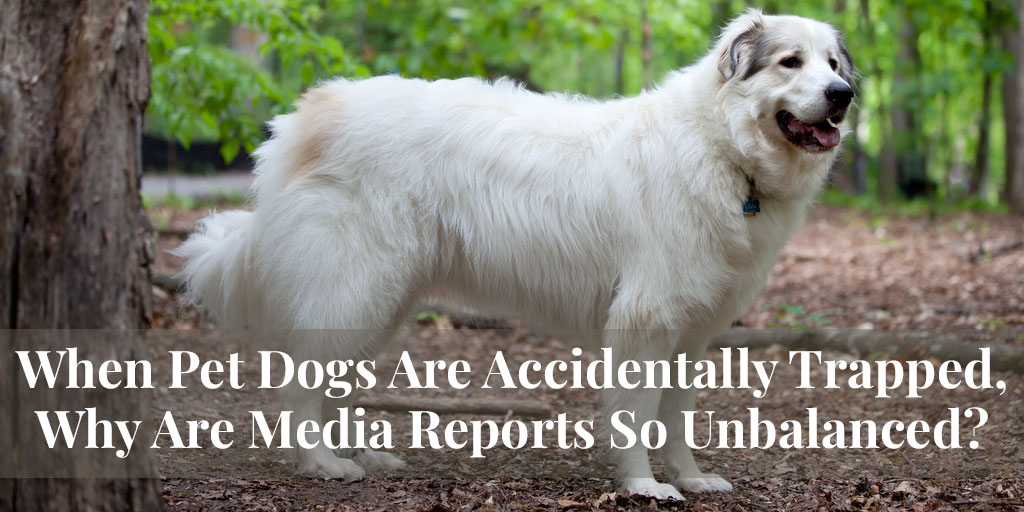
Last December on Prince Edward Island, a four-year-old Pyrenean mountain dog called Caspie died in a snare while exercising with her owner, Debbie Travers. The dog was off leash, which was perfectly legal because they were on private property belonging to Travers's family. Authorities investigated and found that the snare had been set illegally by someone who had failed to get the landowner's permission. They also found and removed three other snares nearby.
Local media predictably jumped on this human interest story. Man's best friend had been killed, she had a name, a bereaved owner wanted justice, and there were photos of Caspie in happier times. The story's hook practically wrote itself.
The problem arose in the choice of people interviewed for context.
After covering the human interest angle, it should have been a straightforward crime story. There was a victim, the dog (or, legally, its human owner). And there was a perpetrator, the person who set the illegal trap.
A good reporter would address the legality of pet dogs exercising off-leash on this particular land, and explain how the story could have been different under different circumstances. He or she would also stress that the perpetrator was trespassing, and had set the snare without permission and with intent to poach. And while the dog's death was surely unintentional, she died as a direct result of these illegal acts, not due to legal trapping.
For expert comments, the reporter could then interview law enforcement, the government body regulating trapping, and the local trapping association. Between them, these sources could say exactly what laws had been broken, and make an educated guess as to why.
Instead, Canada's public broadcaster, CBC, devoted a sizeable chunk of its report to the views of an ambulance-chasing anti-trapping group. "These traps are indiscriminate, they injure both the target and non-target animals," said Aaron Hofman, a director of The Fur-Bearers. "Dogs, they have keen senses of smell, so what's gonna stop them from wandering into a trap versus, say, a coyote or fox?"
No representatives of the trapping community were interviewed.
Our second case is different, but hopefully also instructive to reporters looking to ask the right questions.
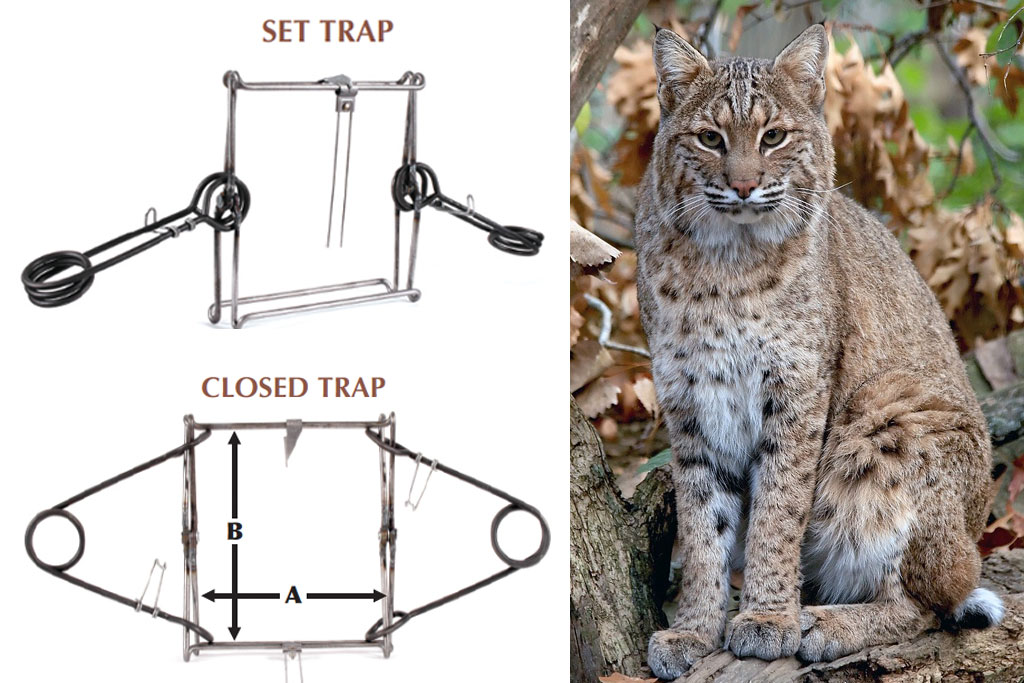
This January, a bobcat in Calgary spent two weeks walking around a community with a small trap on its front paw. Authorities finally caught "Bobby" (as some locals called him), and took him to a wildlife rehabilitation facility, where we understand he's doing fine.
We can't be sure exactly what happened, but if reporters had bothered to ask people who actually know trapping, this is what they'd have heard.
The trap was a Conibear 110, a body-gripping trap designed to instantly kill small animals that enter it head first. It was not a foothold trap, even though it held the bobcat's paw.
We can also say that the trap was almost certainly not set by a licensed commercial trapper. Such a trapper would never use a small trap like this for a bobcat, and if it were set in an open area, he would have placed it in some kind of box to keep larger animals out. He might also have tethered the trap to something like a tree, as an extra precaution against a larger animal wandering off with the trap attached.
So what almost certainly happened was that someone with no trapping experience set the trap to deal with a small animal, and did it wrong. Maybe they were after a rat, or thought it would stop the neighbour's cat pooping in their flower bed.
Unfortunately, once again the CBC reporter did not interview any trapping experts, instead featuring a wildlife rehabilitation expert who said: “the device clamped on the animal's paw was a conibear trap, which is typically used to ensnare skunks, raccoons or foxes.” As trappers reading this know, 110s are only AIHTS-certified for muskrat and weasels, not raccoons or skunks, and it would be too small for fox. This is likely not intentional misinformation, but simply an over-simplification from a non-expert on trapping. A trapper would have been able to tell the reporter that Conibear-style traps come in a wide range of sizes and strengths, and that no trapper worth his salt would set a 110 for a bobcat.
What to Do?
We all want to be fully informed on subjects that matter to us, and seek out media that produce balanced and accurate reporting. But as these examples show, that's not always easy.
To understand why, consider the life of a local news reporter. In this fast-paced world, deadlines are getting ever shorter, plus most local stories have short shelf lives anyway. If a cat gets stuck up a tree, it either makes the evening news or it's forgotten. So reporters bang out their 800 words as fast as they can, and just hope they got the facts as straight as they could.
Anti-trapping groups pander to this weakness. Even though they don't know how to trap, and have no experience in improving trapping technologies, practices, or regulations, they have made themselves go-to sources for comment whenever trapping makes the news. They make themselves very accessible, and have sound bytes and images ready to go.
They're sneaky too. On their websites they're clear about wanting to ban all trapping, but for the media, they take a soft-sell approach to make them sound reasonable. Regulations should be tightened, they say. More safeguards are needed. They may even act like they have a great new idea, though in truth every option to make trapping safer has already been considered somewhere in the country.
And the result, almost always, is a news report that is a one-sided indictment of all trapping, including the legal activities of licensed commercial trappers. We all get tarred with the same brush.
So if we hope to see balanced, objective reports about trapping, we need to be playing this game too. We are the authorities, not them, and we need to make sure reporters know this. But even more important, we need to be accessible, and that's the tricky part.
We can't match the accessibility of anti-trapping groups because we simply don't have the manpower to flood reporters' email or voice mail. Plus we have other work to do – be it actual trapping, or unrelated jobs that most trappers have. In contrast, all anti-trapping groups have to do is make noise.
So we need to work smarter, and to that end I offer these suggestions:
• We must be proactive. Trapping associations must make sure their local reporters know they exist before a story breaks. Call them up, build a rapport, and let them know you are available for comment at any time. Invite them to your events, show them that trapping is alive and well, let them know what your organizations are up to.
• When a story does break and a reporter contacts you for comment, you need to respond as quickly as possible. This may mean establishing a rota at your association so one person is always available. The last thing a reporter with a deadline wants to hear is an automated reply like, "I'm out of the office for the next three days."
• If you see a news report that is negative about trapping and does not include a trapper's perspective, contact the reporter or editor and point out the omission. And, of course, suggest someone they can contact in future. As proof that this approach works, FIC reached out to CBC following its unbalanced report on the PEI incident, and two days later it published a new report which gave top billing to the views of an actual trapper.
• On the other hand, when you see a news report that is positive about trapping, and includes a trapper’s perspective: like, comment, share! Even contact the reporter and let them know that you noticed they provided balanced coverage. If reporters see that stories they write that feature trappers telling the truth about trapping get better feedback than the stories with the anti-trappers, they will be more likely to feature trappers again.
With luck, the next time a dog is caught in a trap, the trapping community will be treated fairly by reporters. And hopefully there will be fewer nasty quotes from anti-trapping groups that don't know what they're talking about.
Manage Consent
To provide the best experiences, we use technologies like cookies to store and/or access device information. Consenting to these technologies will allow us to process data such as browsing behavior or unique IDs on this site. Not consenting or withdrawing consent, may adversely affect certain features and functions.
Functional
Always active
The technical storage or access is strictly necessary for the legitimate purpose of enabling the use of a specific service explicitly requested by the subscriber or user, or for the sole purpose of carrying out the transmission of a communication over an electronic communications network.
Preferences
The technical storage or access is necessary for the legitimate purpose of storing preferences that are not requested by the subscriber or user.
Statistics
The technical storage or access that is used exclusively for statistical purposes.The technical storage or access that is used exclusively for anonymous statistical purposes. Without a subpoena, voluntary compliance on the part of your Internet Service Provider, or additional records from a third party, information stored or retrieved for this purpose alone cannot usually be used to identify you.
Marketing
The technical storage or access is required to create user profiles to send advertising, or to track the user on a website or across several websites for similar marketing purposes.