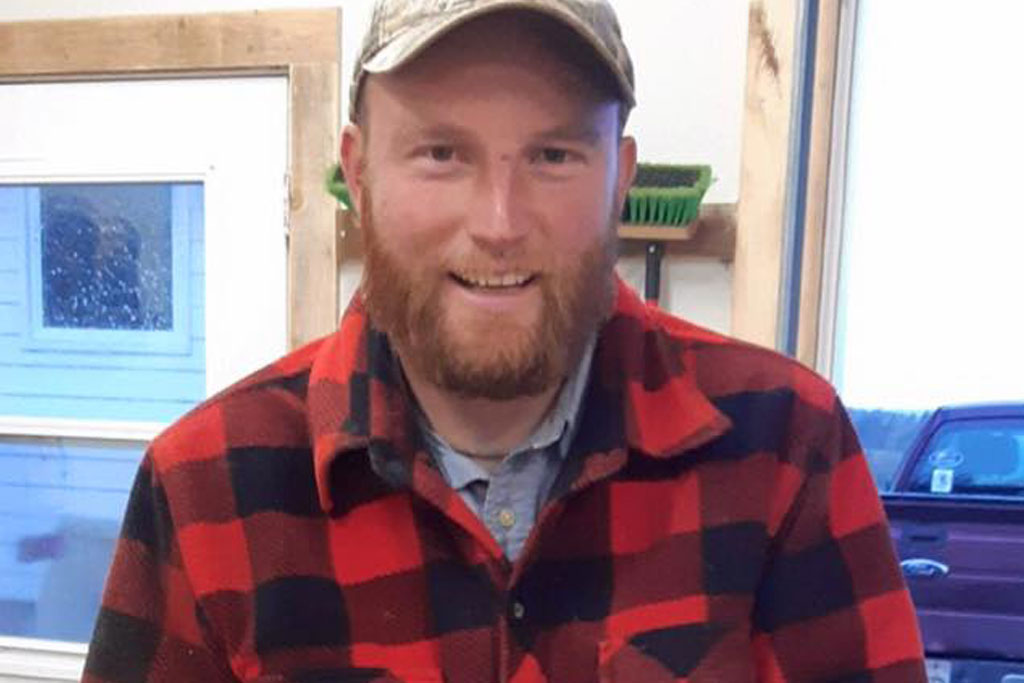


Doug Chiasson, Executive Director, Fur Institute of Canada
Doug Chiasson has been Executive Director of the Fur Institute of Canada since April 2022. The FIC is a leader in research on humane traps, an authority on the conservation of wild furbearers, and a promoter of sustainable sealing.
Doug was born and raised on Cape Breton Island, Nova Scotia, and then spent 13 years studying and working in Ottawa. As of 2023, he is back in his home province, residing outside of Halifax.
Before joining the FIC, he accumulated over 10 years of experience in marine resource management and environmental sustainability at provincial, territorial, national and international levels. He spent two years as a senior policy advisor to the federal Fisheries Minister. He then became an advisor to the Premier of the Province of Manitoba on sustainable development.
His last position before joining the FIC was with WWF-Canada, heading its Arctic fisheries program. In this capacity, he also served as co-chair of the Green Budget Coalition.
Award-winning journalist David Pugliese recently reported that 30 soldiers from Canada’s Armed Forces – the 3rd Battalion, Royal Canadian Regiment… Read More
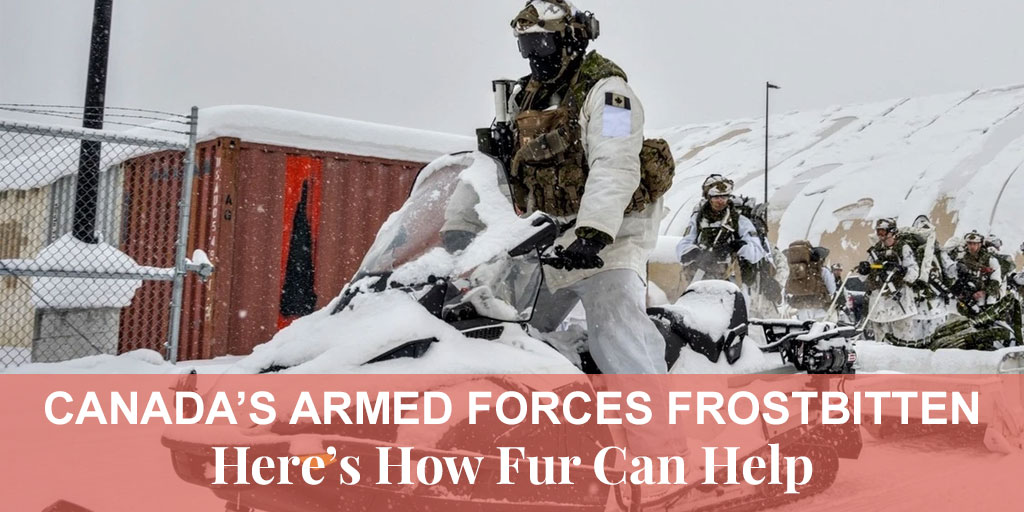
Many Canadians underestimate just how much of our country is located in or close to the Arctic. Photo: Canadian Armed Forces.
Award-winning journalist David Pugliese recently reported that 30 soldiers from Canada's Armed Forces – the 3rd Battalion, Royal Canadian Regiment (3RCR) – suffered severe frostbite while participating in a near-Arctic training exercise at the Joint Pacific Multinational Readiness Center near Fairbanks, Alaska.
Too many Canadians forget that our nation is fundamentally an Arctic one. Vast expanses of Arctic territory, stretching from the Yukon North Slope in the West to Labrador in the East, and the entire Arctic Archipelago, make up a major part of Canadian geography and heritage. These unforgiving landscapes have been the home to various First Nations and Inuit communities for thousands of years.
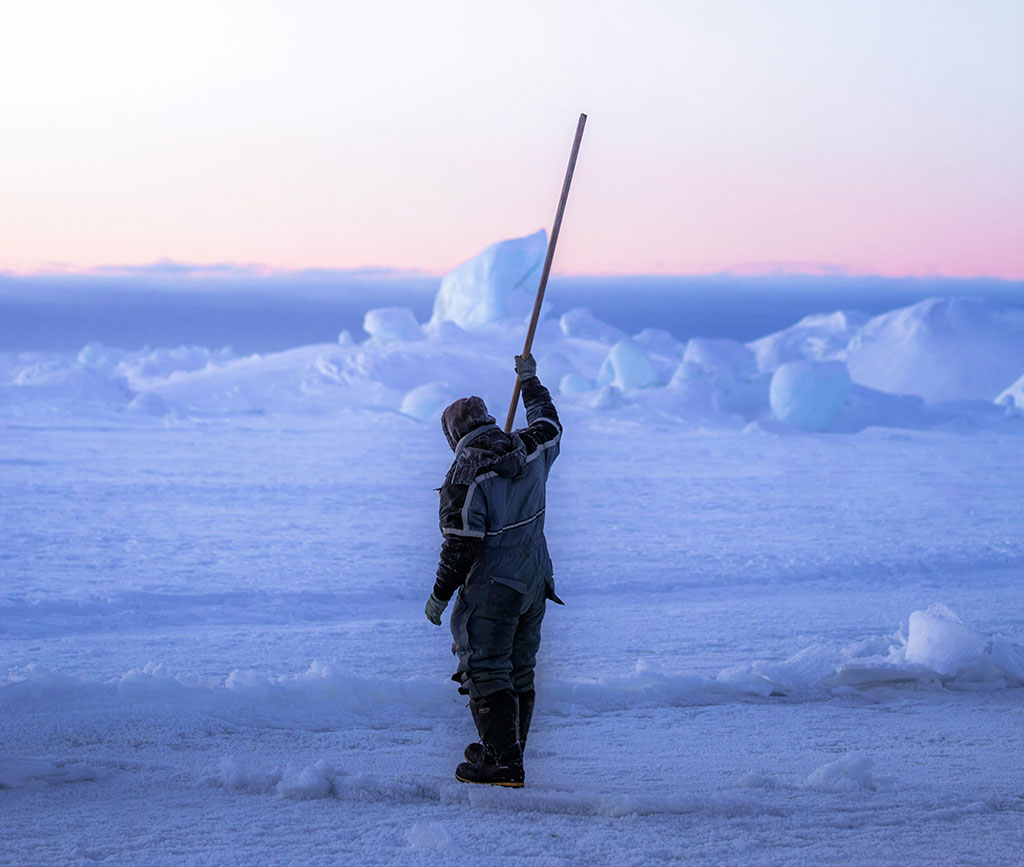
Because of this experience, it stands to reason that the people in these communities know a thing or two about survival in Arctic climates. Using natural resources and materials found in the Arctic, Indigenous Peoples have relied on sealskin, caribou hide, beaver fur, and other hide and fur products to keep warm.
In 2022 and 2023, the National Research Council put this to the test in a series of studies designed to test Indigenous-made garments directly against the predictable issue of extreme cold. Deployed out of interest for the Canadian Armed Forces, Canadian Coast Guard, and Parks Canada, these studies measured the “clo value” – a unit used to measure the thermal insulation properties of clothing, indicating how much heat a garment retains. The higher the clo value, the warmer the garment.
Greenlandic fishermen rely on sealskin to keep warm.
Conducted with complete transparency by our Federal Government, these studies were published in 2022. Therefore, hundreds if not thousands of Canadian observers and certainly relevant members of the Canadian Armed Forces knew that Indigenous-made fur and sealskin garments are the superior option to keep the men and women who serve our country safe in extreme cold weather environments.
Though the exact details of what happened during this recent exercise are not known, it is clear that the equipment provided to the members of 3RCR was not sufficient. We know that equipment made from fur or sealskin would have protected them better than what they had, and likely would have helped some of the injured soldiers.
In an increasingly uncertain time, with more than a few countries posturing for Arctic expansion, it is high time to return to outfitting our soldiers with the equipment they need to be safe. On this point, both traditional knowledge and leading-edge scientific research agree: natural fur is the right choice.
You may recall that Coloradans recently defeated an anti-fur ballot initiative, and probably assume that the state is safe for… Read More
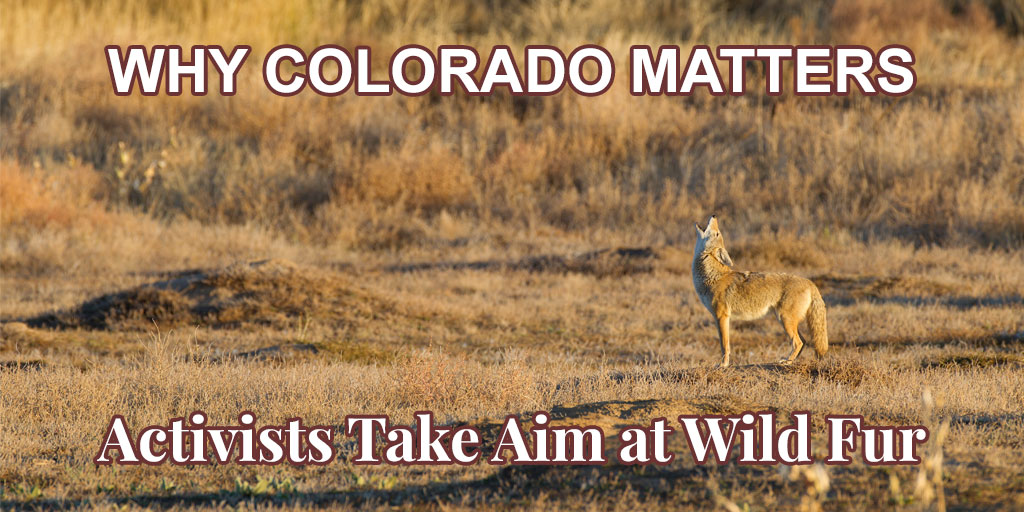
A coyote howls in Rocky Mountain Arsenal National Wildlife Refuge. Photo: USFWS Mountain-Prairie, Public domain, via Wikimedia Commons.
You may recall that Coloradans recently defeated an anti-fur ballot initiative, and probably assume that the state is safe for now. But your assumption would be wrong. Now opponents of fur are looking to introduce a statewide ban on the sale of all wild fur – something they've not tried in the past.
That battle, which garnered a lot of news coverage, especially for the slogan "Hands off our hats", sent a clear message that most Coloradans would not stand for animal rights groups telling them what they could and couldn't trade. But perhaps the message was not clear enough. Now a petition from the anti-fur Center for Biological Diversity has accused the Colorado Parks and Wildlife Commission (CPWC) of violating sound conservation practices, with the aim of forcing a statewide ban on all trade in wild fur.
Attacking Wild Fur
As Executive Director of the Fur Institute of Canada (FIC), I frequently attend meetings, auctions, trade shows and the like, across Canada and around the world, where fur is the number one topic of conversation. But at many of these events, I am also in a minority. Why? Because our organization represents the interests of all kinds of fur, including wild fur.
Much of the global fur trade deals only with ranch fur. Many designers and manufacturers, for example, are concerned above all with the different colour phases of ranch foxes and mink, but have no interest in where or when the best coyotes are harvested. (This reality is also why fur ranchers attract so much attention from anti-fur activists.)
When combined with the strong and easily understood arguments in favour of regulated trapping, this explains why many folk assume wild fur is comparatively “safe”. Trapping plays a key role in wildlife management, it's an important part of livelihoods for Indigenous communities, and its heritage underpins so much of our shared history across North America.
But that idea is now being challenged in Colorado. If successful, the anti-fur lobby will use the CPWC to introduce a statewide ban on the sale, trade and bartering of all wild fur.
Over the last 40 years or so, trappers have grown used to attacks that focus on the welfare of individual animals caught in traps, but this time things are different.
This time, the aim of the anti-fur lobby is not to attack wild fur for how it's harvested, but rather to claim that the mere act of trapping violates the North American Model of Conservation, as spelled out by the Association of Fish and Wildlife Agencies.
When the CPWC meets next on March 4–5, it will discuss a proposal from the Center for Biological Diversity that says the state's current science-driven regulations are not fit for purpose, and that there needs to be a statewide commercial ban on wild fur.
As a community, we must stand together against efforts to restrict, reduce or eliminate the fur trade. That includes trappers, hunters, farmers, ranchers, First Nations, rural landowners, fur buyers, manufacturers, retailers, designers and artisans, from all parts of North America. Everyone who enjoys our world-class garments and accessories needs to be heard.
Both the FIC and the CRWM firmly believe that by standing together, we can be far more than the sum of our parts. Now is the time for all of us to support efforts to keep commercial fur trapping alive in Colorado. And that is why the FIC will be joining CRWM in Denver next week, giving voice to all Canadians who support science-based, well-regulated wildlife management.
the Citizen Petition Form "Prohibiting the sale of furbearer furs with exemptions", June 16, 2025;
"Petition to amend 2 CCR 406-018 to prohibit the commercial sale of wildlife fur in Colorado", submitted by the Center for Biological Diversity, June 16, 2025; and
the recommendation to deny the above petition submitted by the Division of Parks and Wildlife, Department of Natural Resources, February 19, 2026.
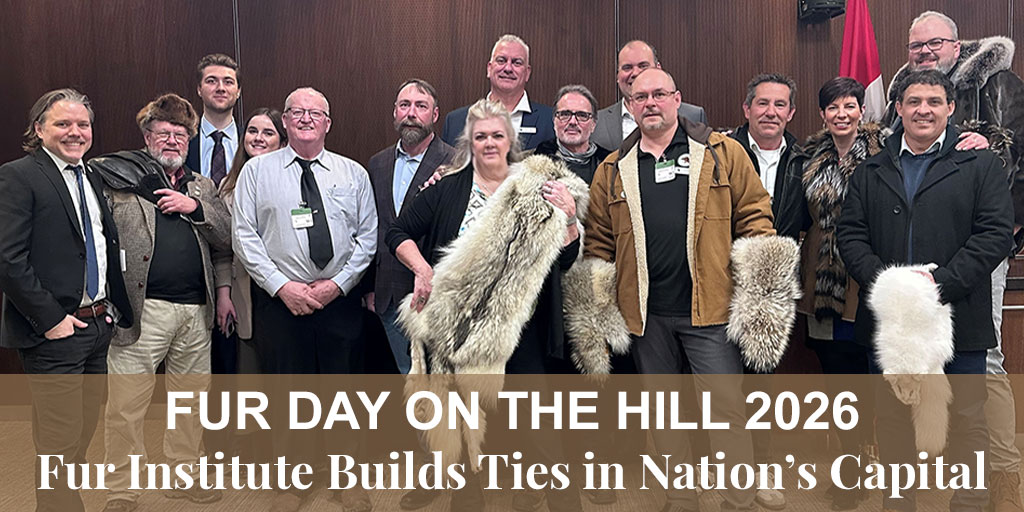
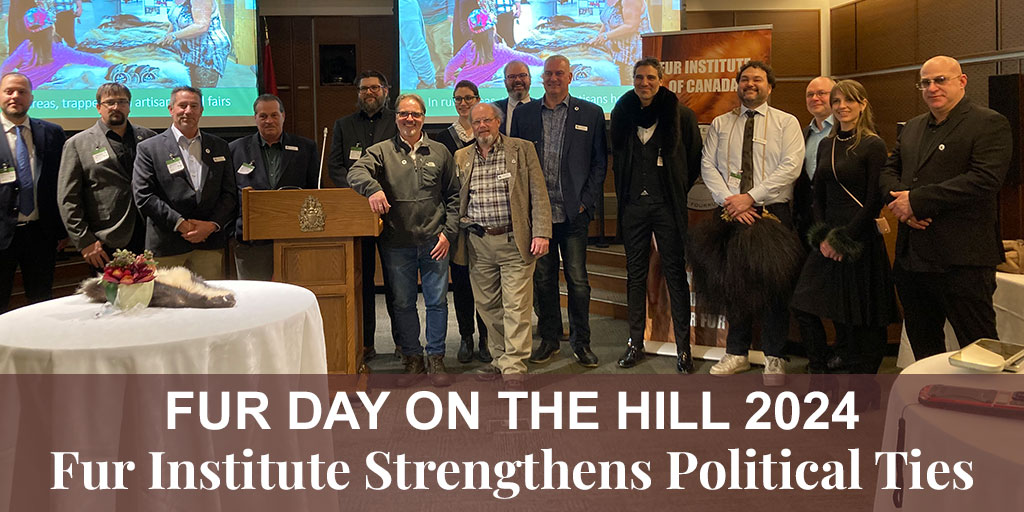
During this day-long event, we met with Members of Parliament, Senators, representatives of the Prime Minister’s Office and Ministers, as well as members of the diplomatic corps, covering a diverse range of topics. These included maintaining Canada's position as a world leader in the fur trade by fighting trade bans and promoting fur and seal products, and ensuring our men and women in uniform are prepared for operating in the extreme weather of the Arctic environment by outfitting them with personal protective equipment made from fur instead of inferior synthetic materials.
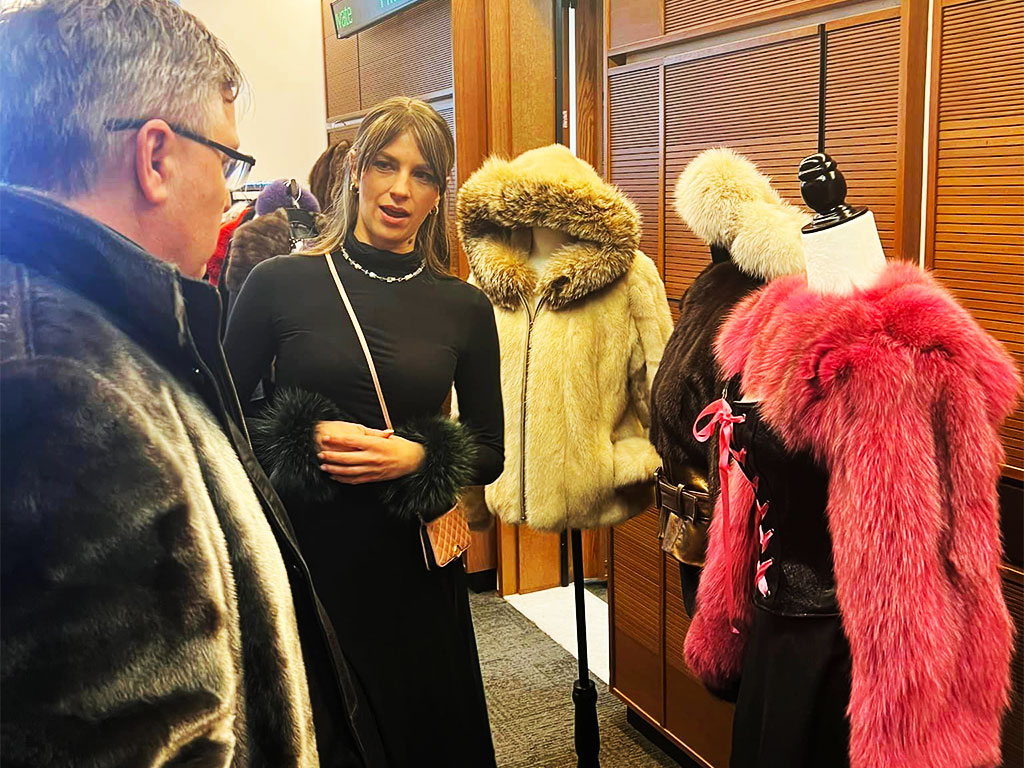
In the evening, we hosted a cocktail reception for Parliamentarians and colleagues, that doubled as a showcase for furs from FIC members International Fur Dressers & Dyers and Écofaune Boréale. The chilly weather also gave everyone a perfect opportunity to show the Hill a wide array of their own furs.
Building relations with politicians is a key part of FIC’s mandate as advocates of the fur trade, and this makes Fur Day on the Hill an important event on our calendar. It helps us cement alliances with federal representatives of all political stripes, while familiarizing them with issues that affect our trade.
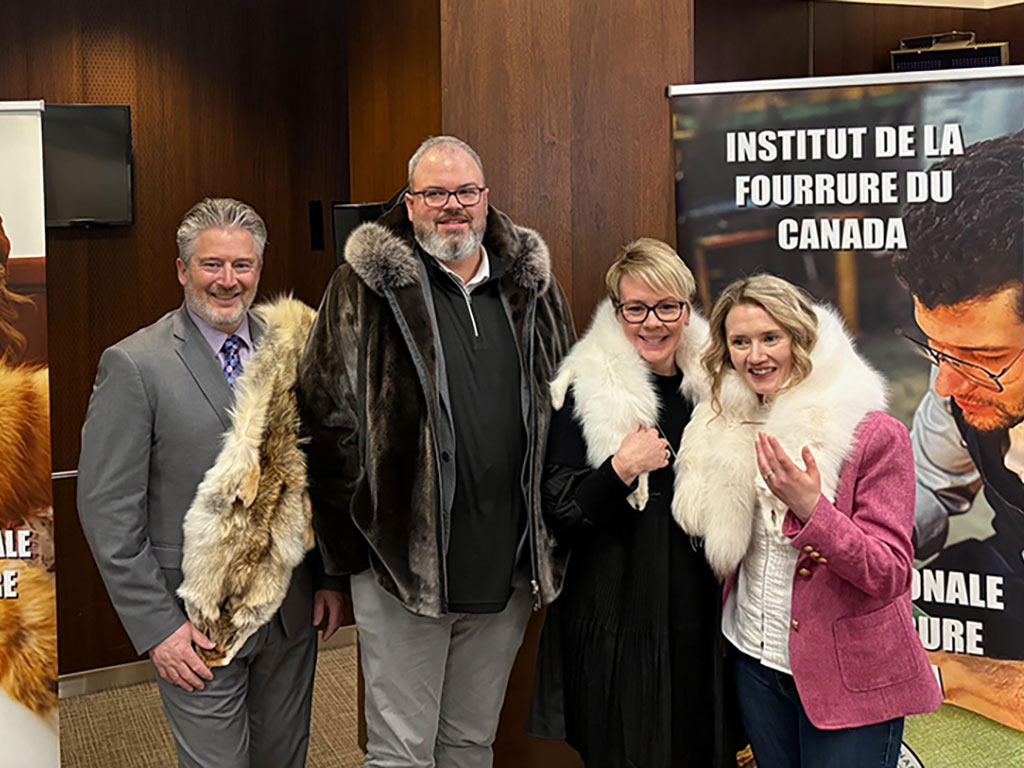
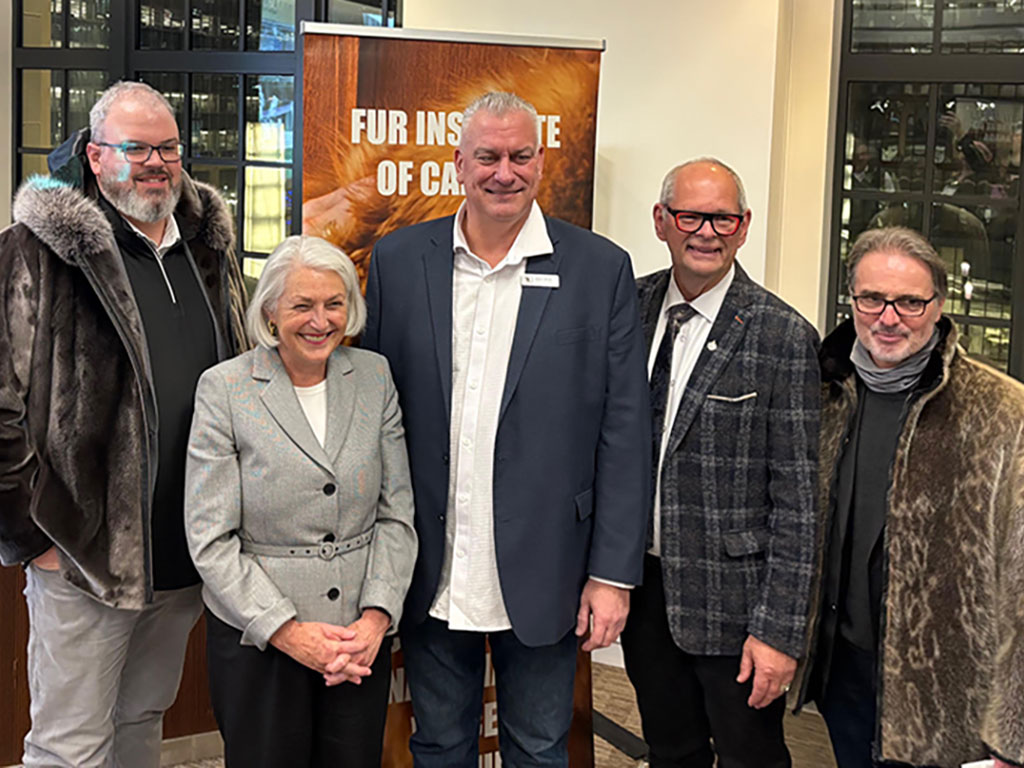
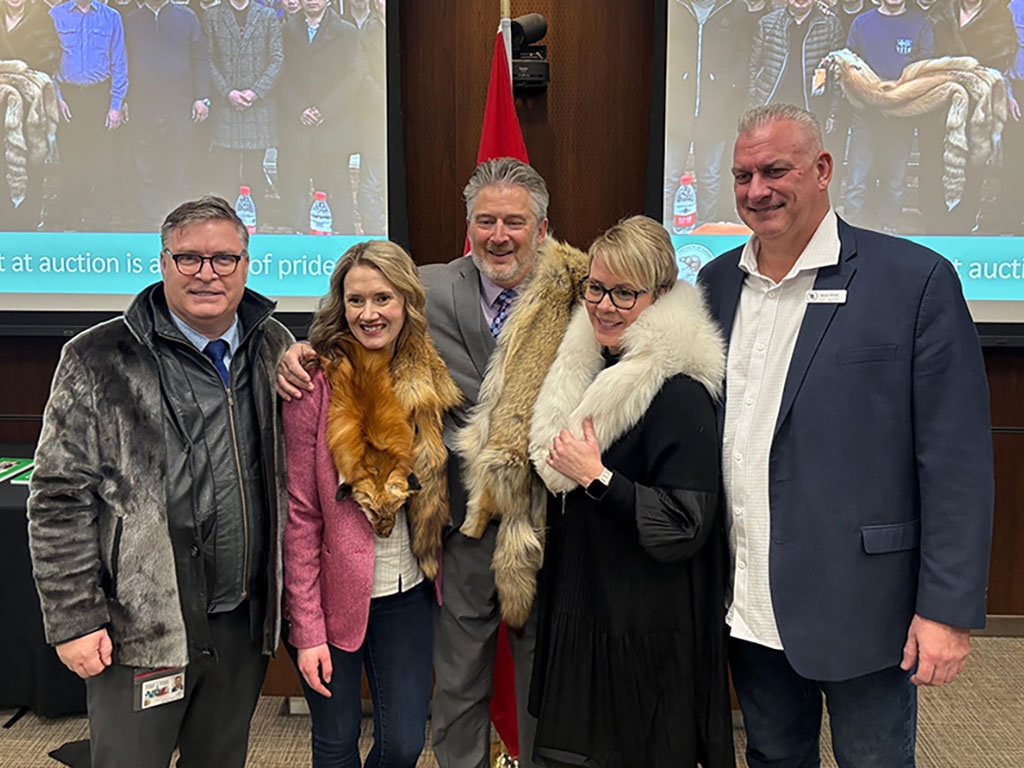
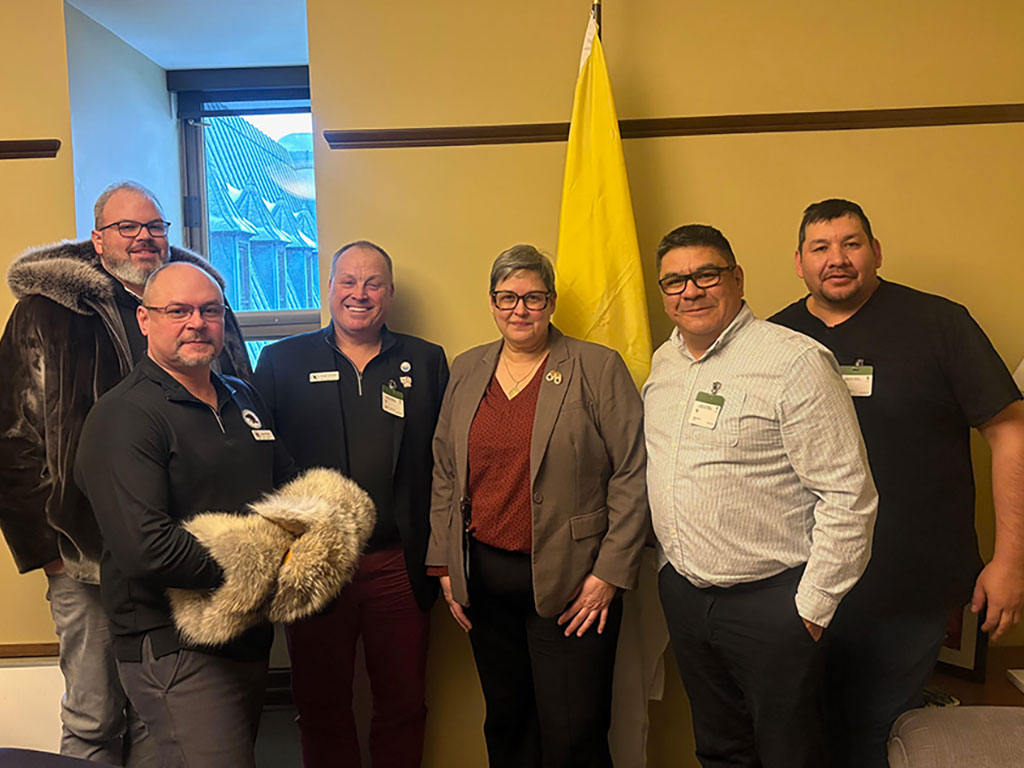
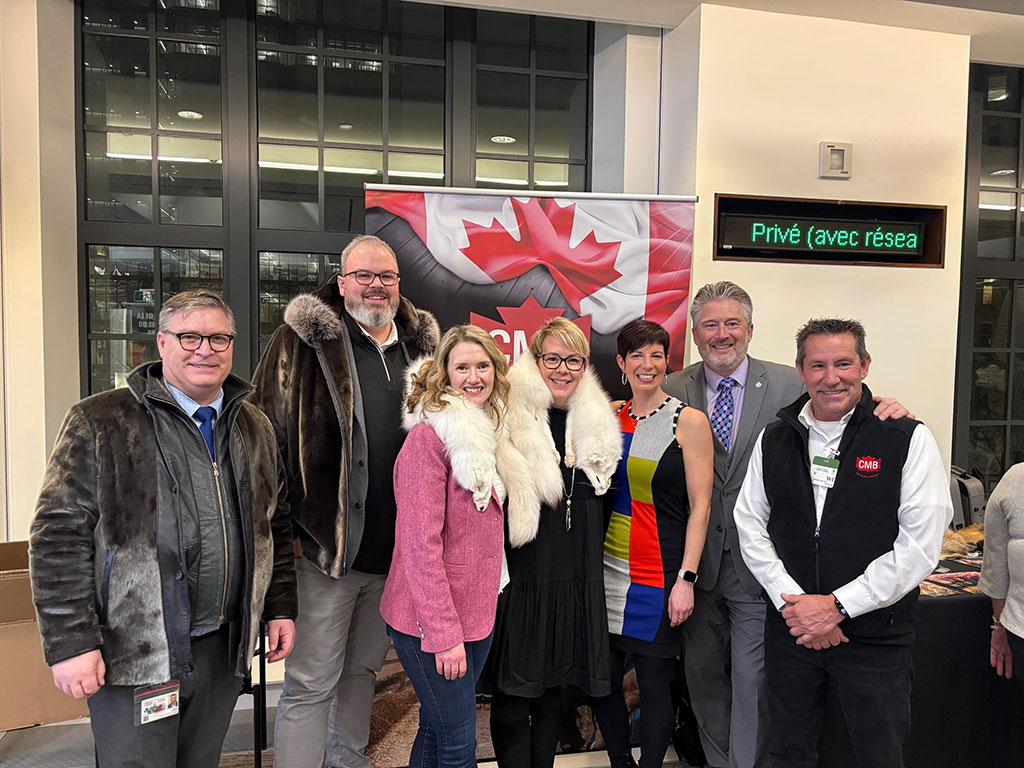
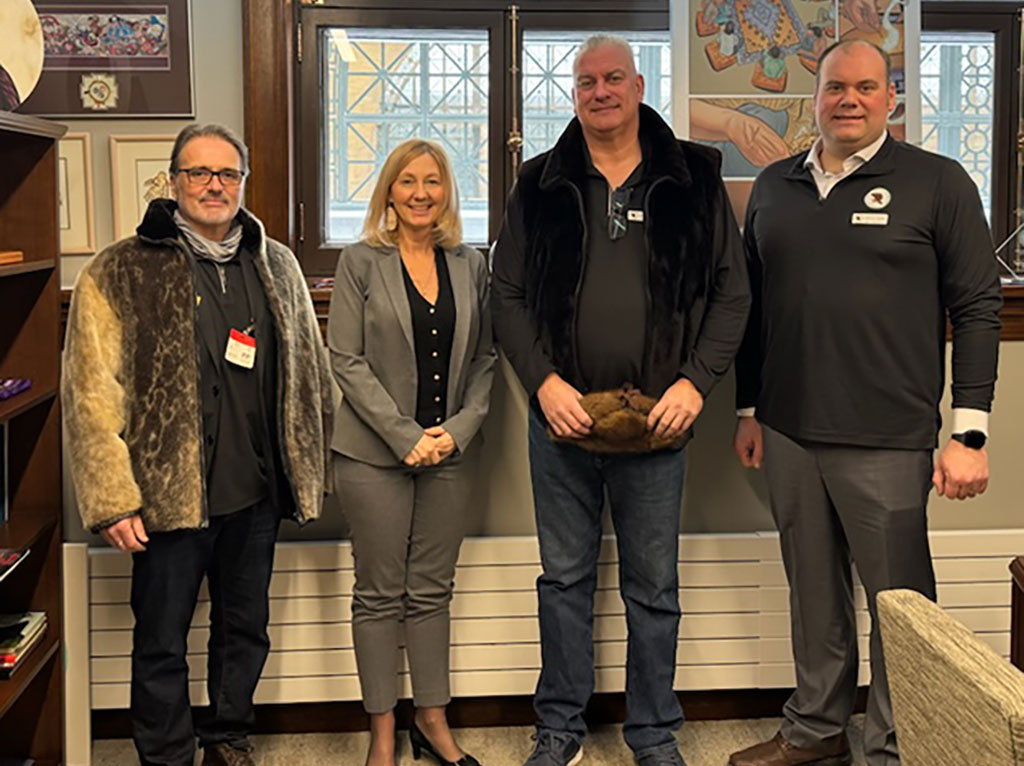
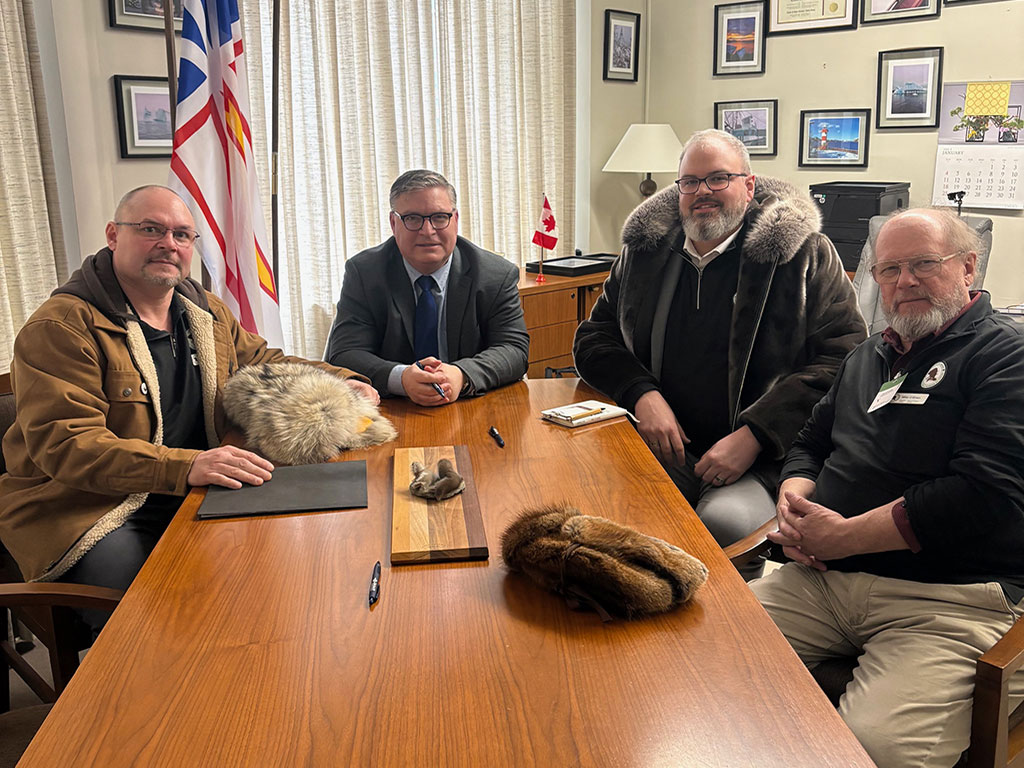
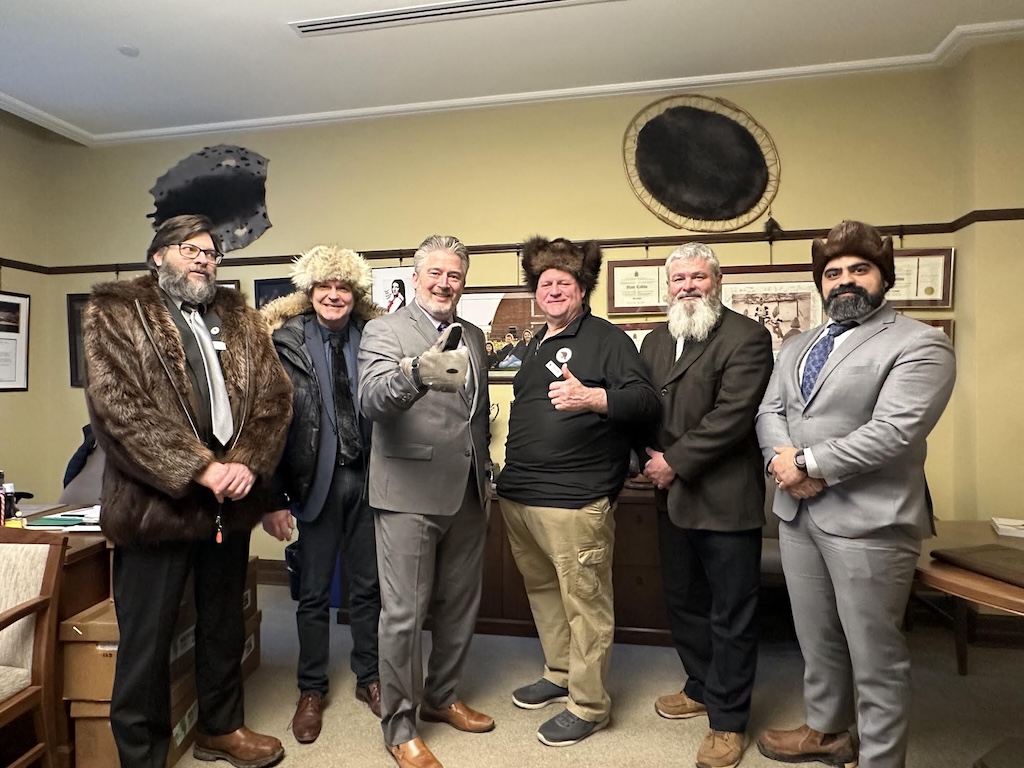
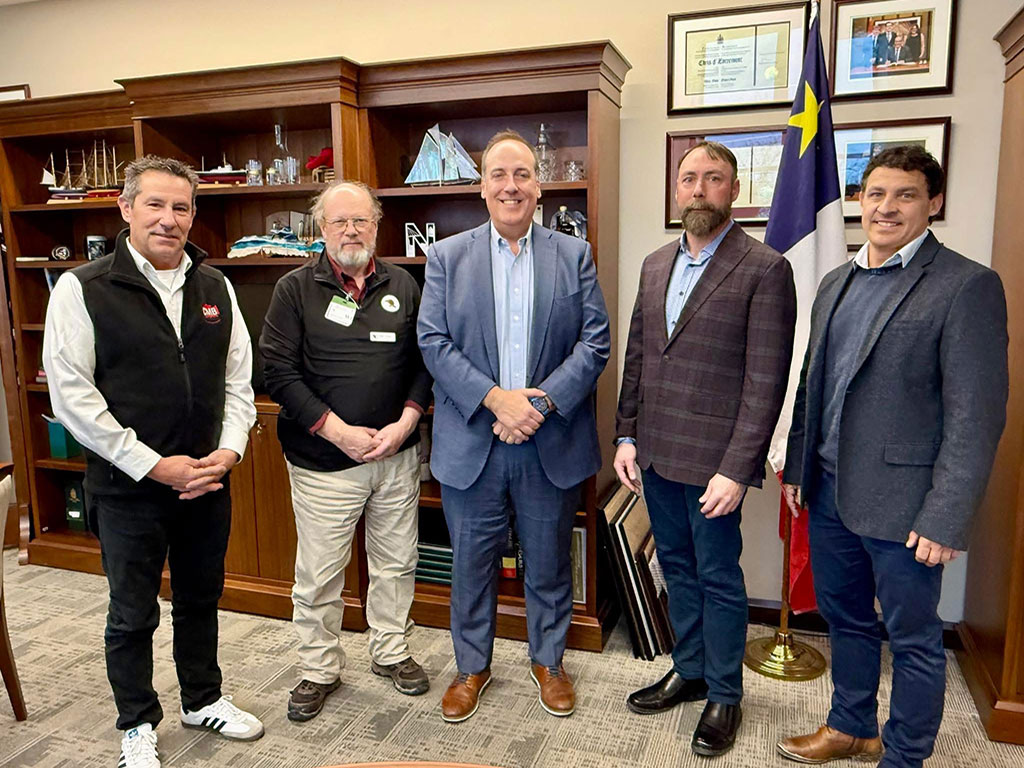
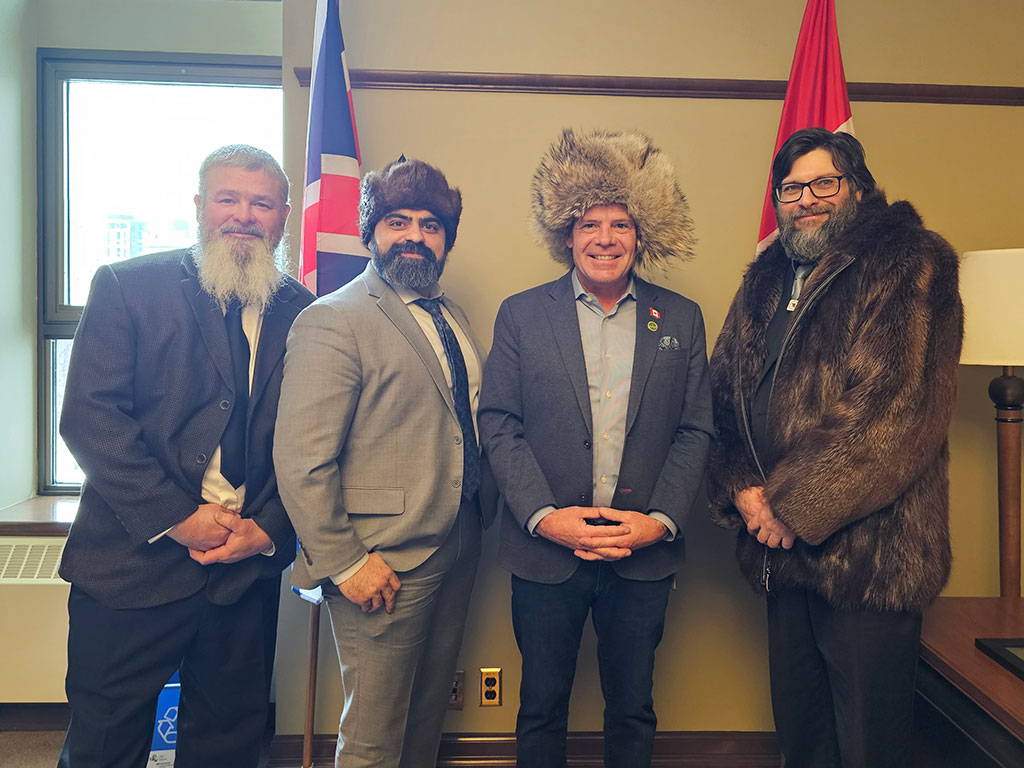
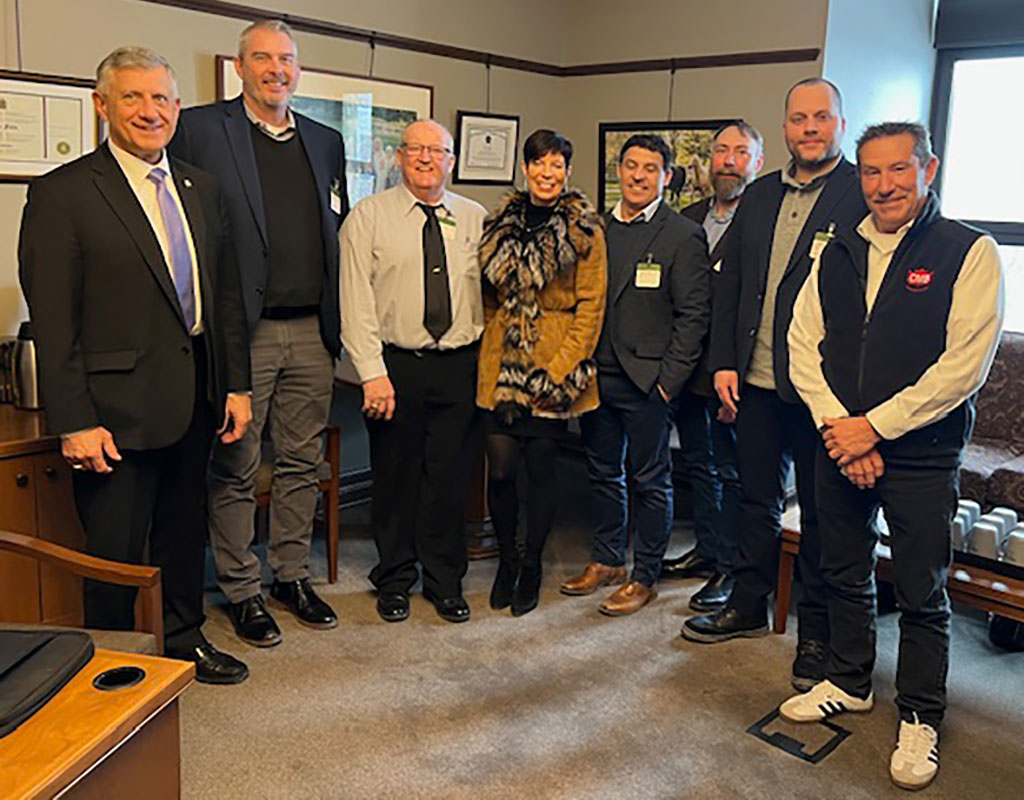
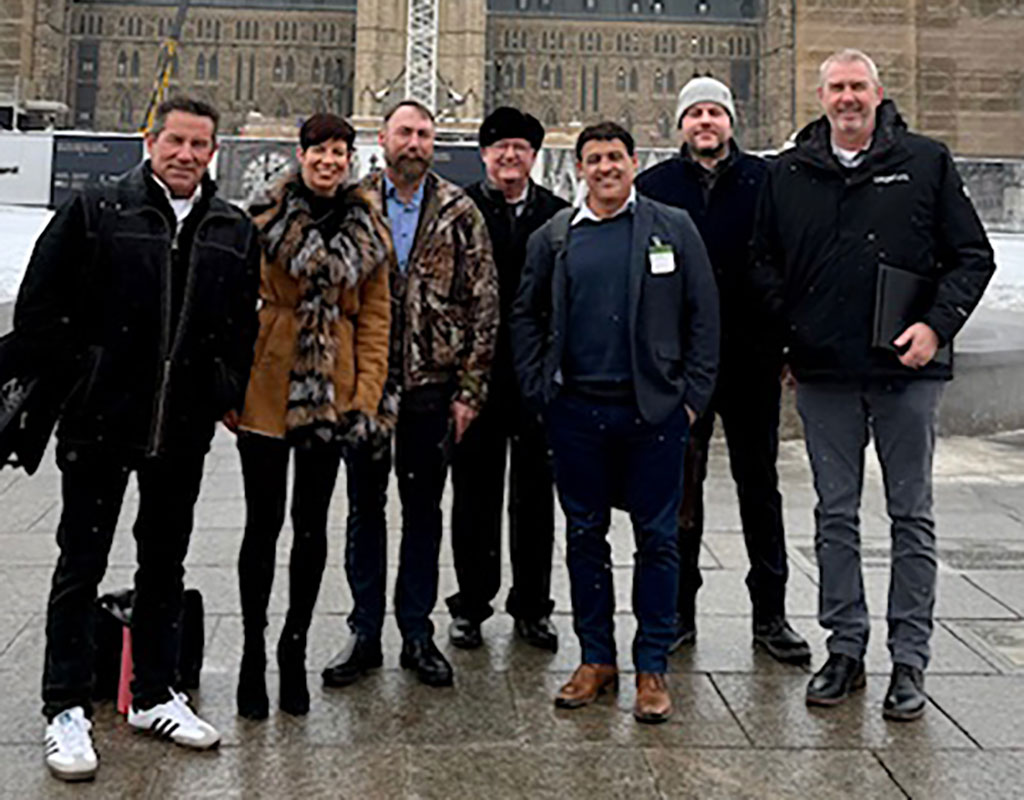
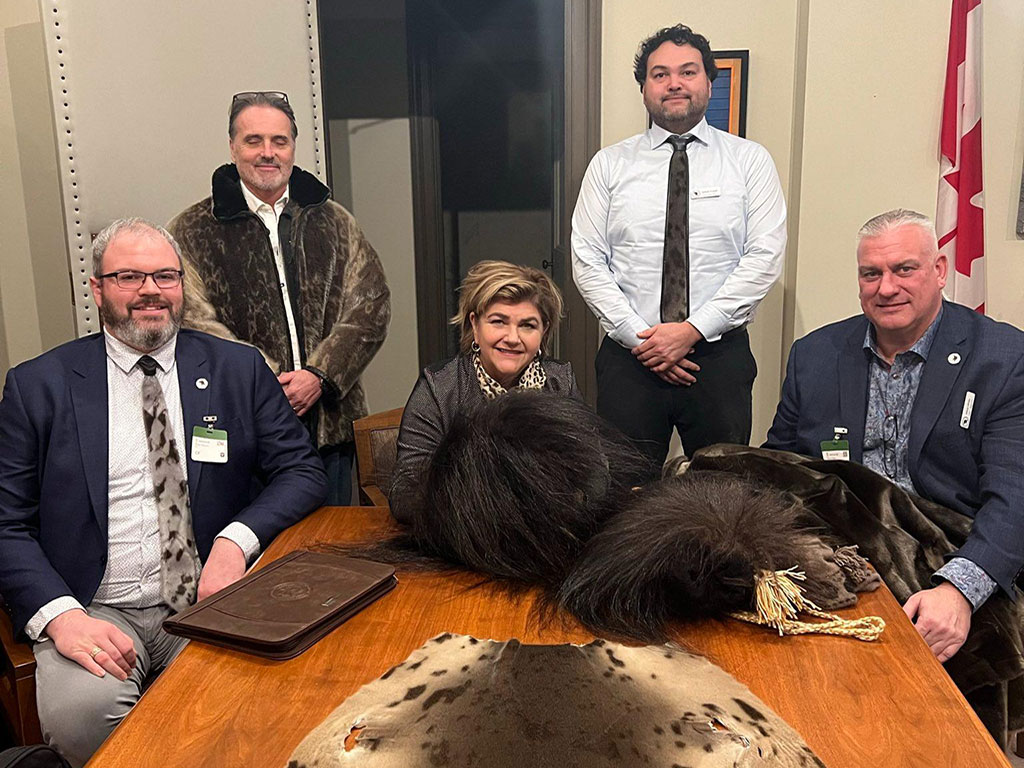
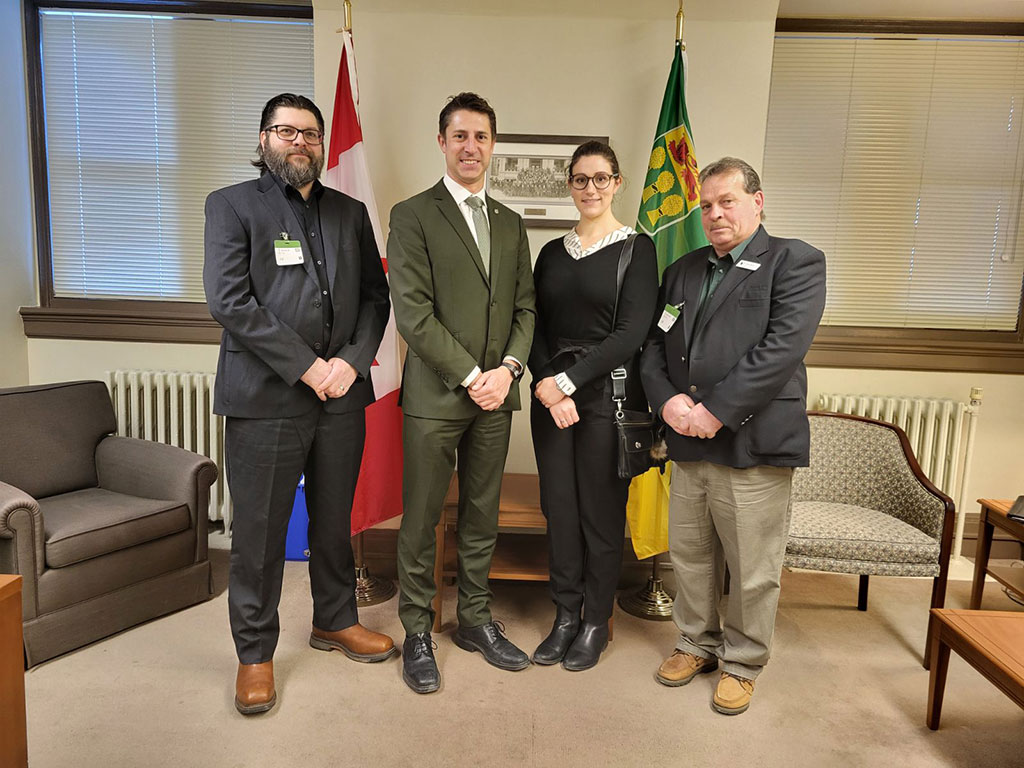
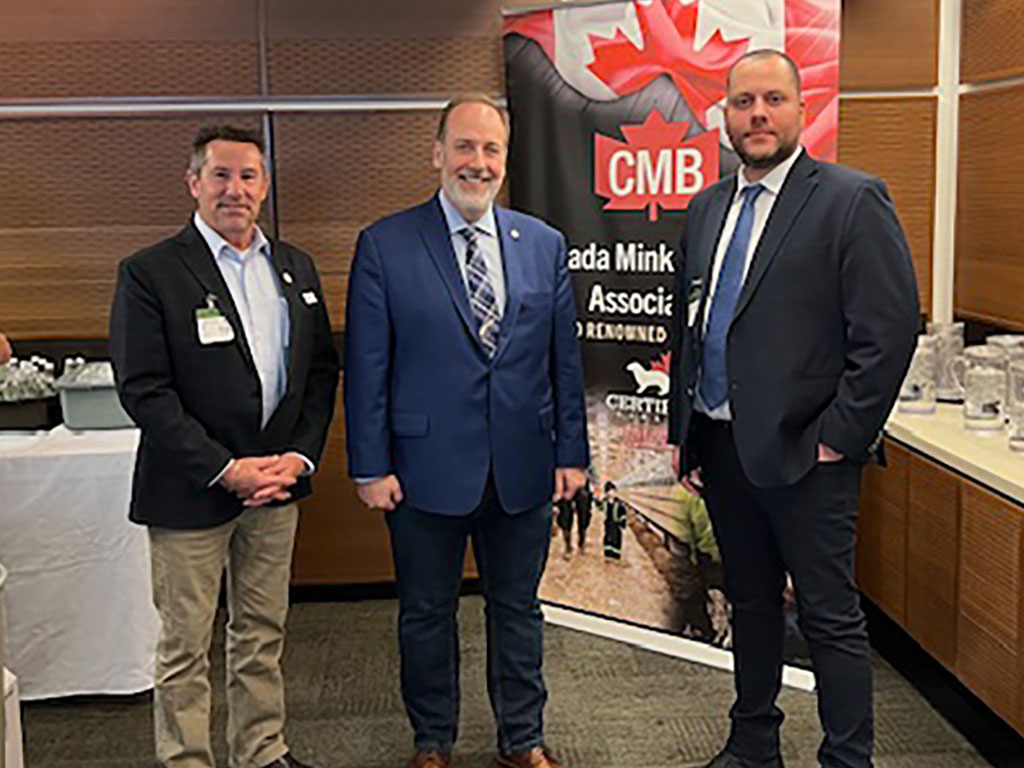
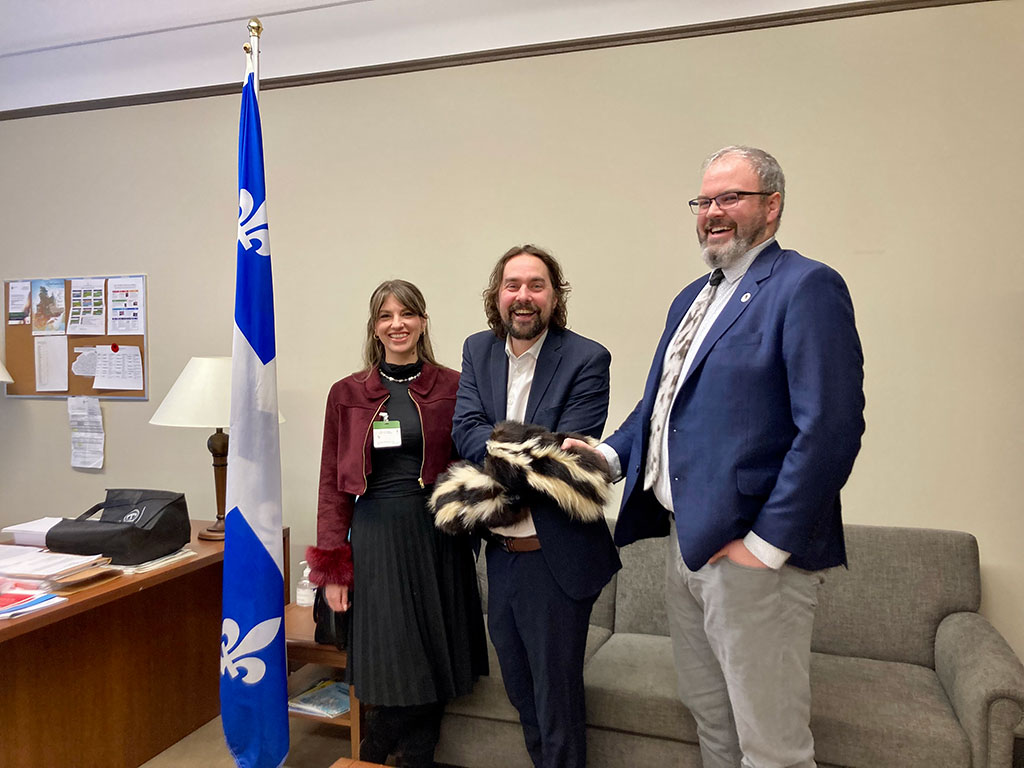
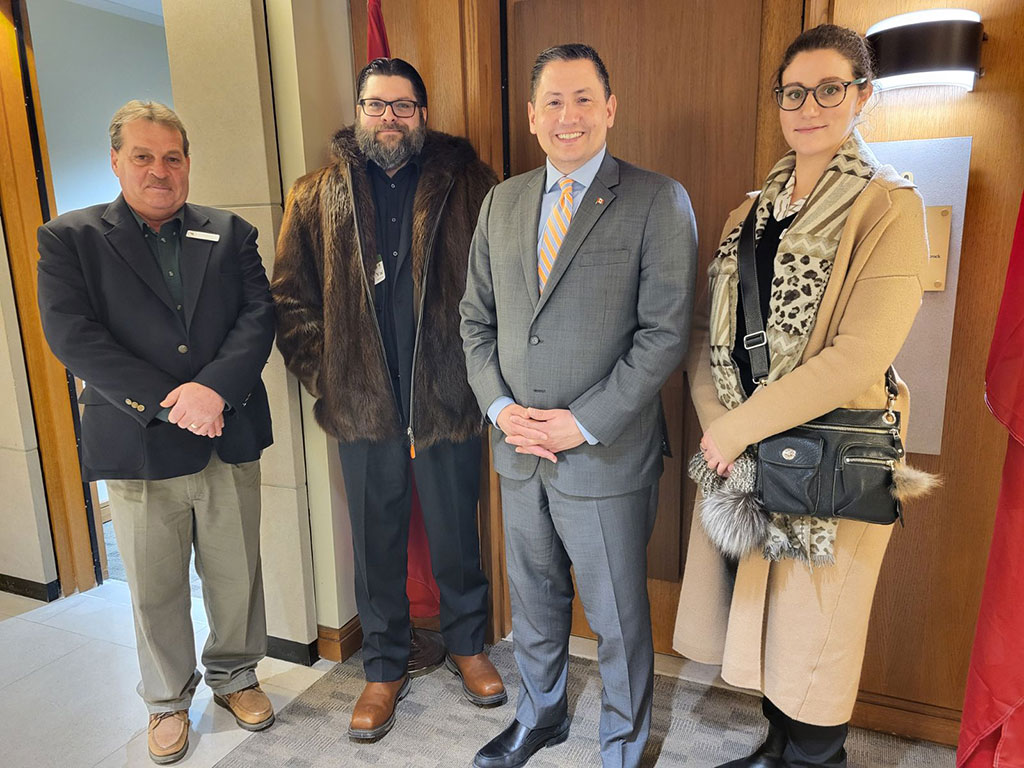
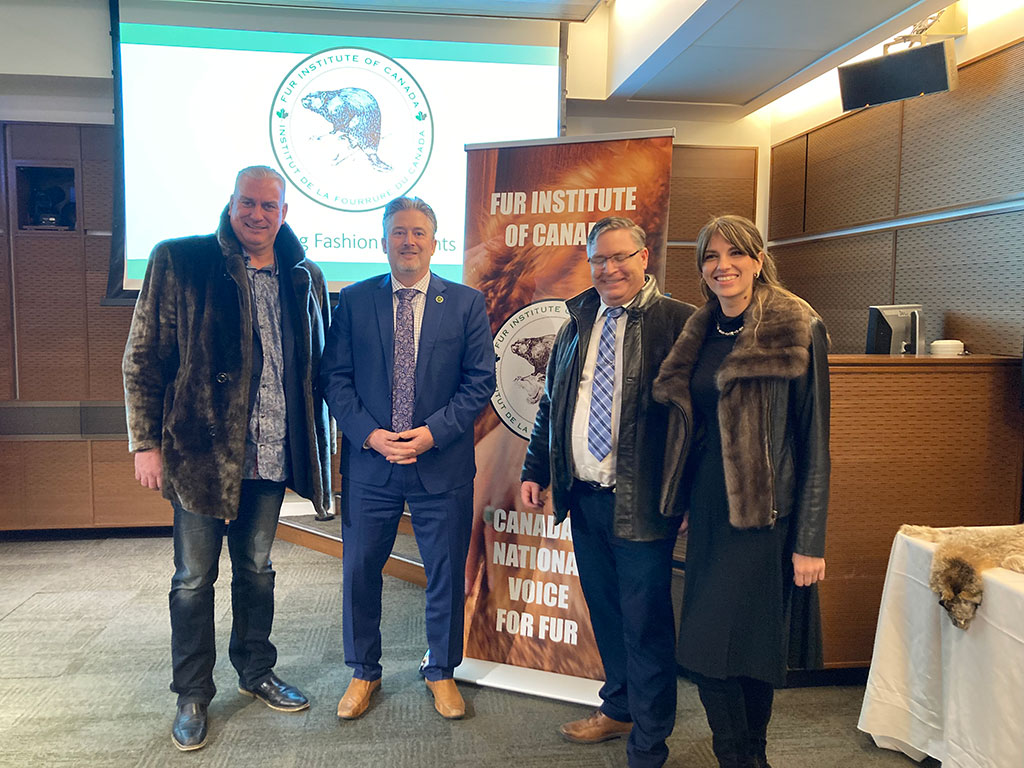
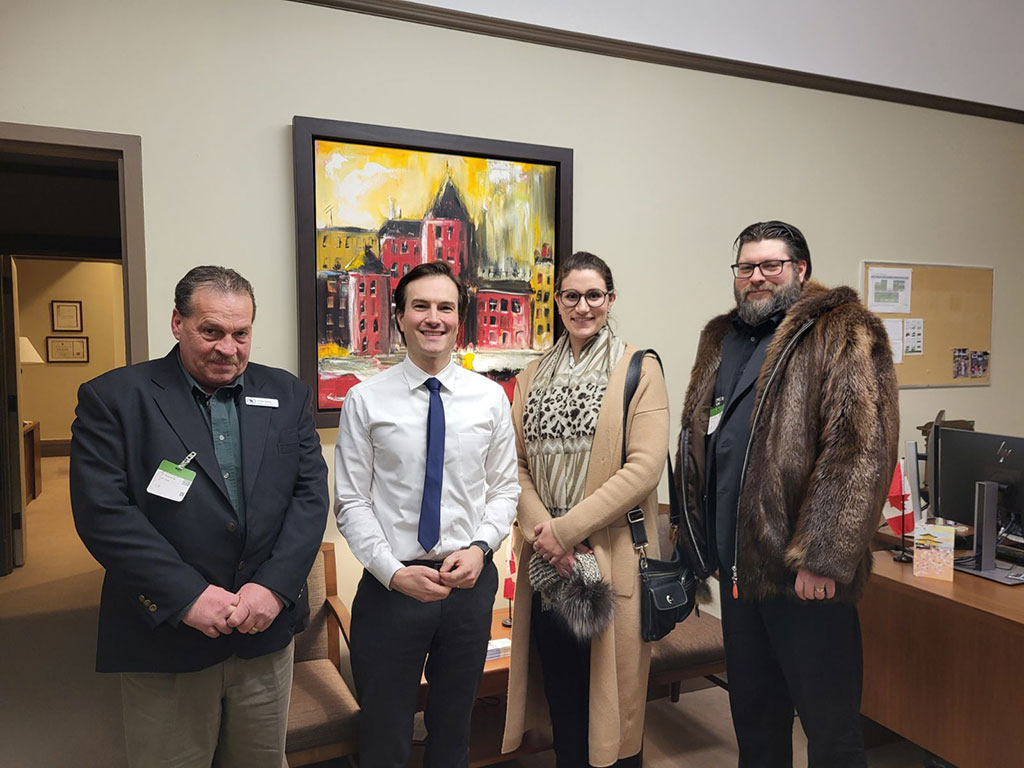
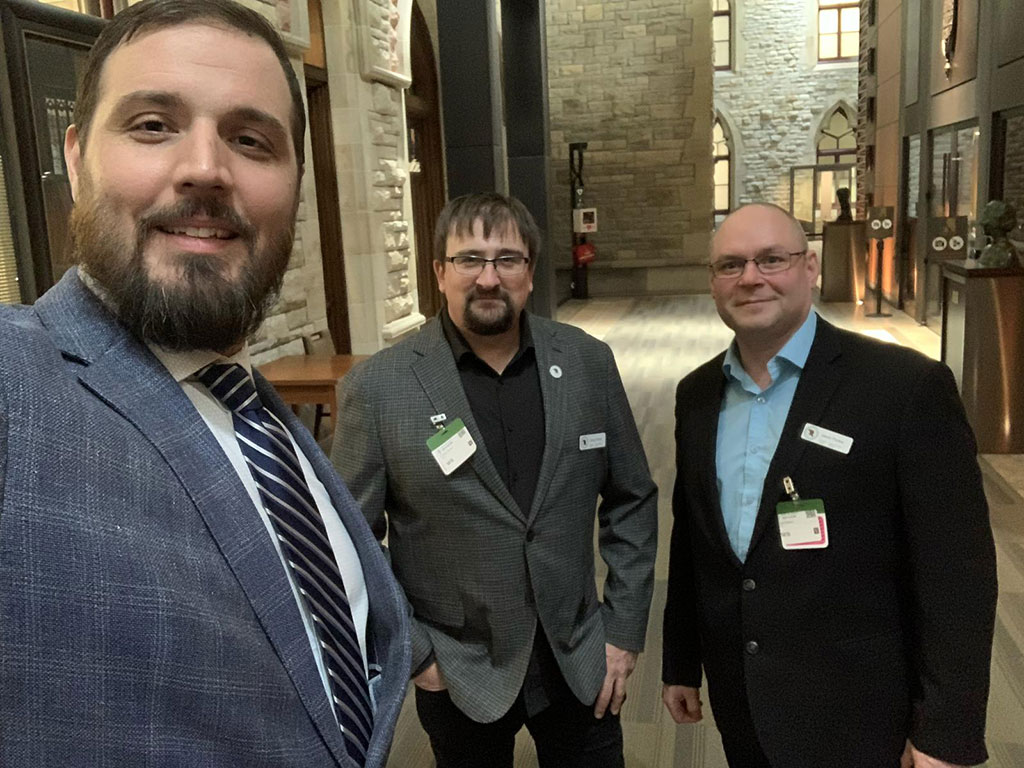
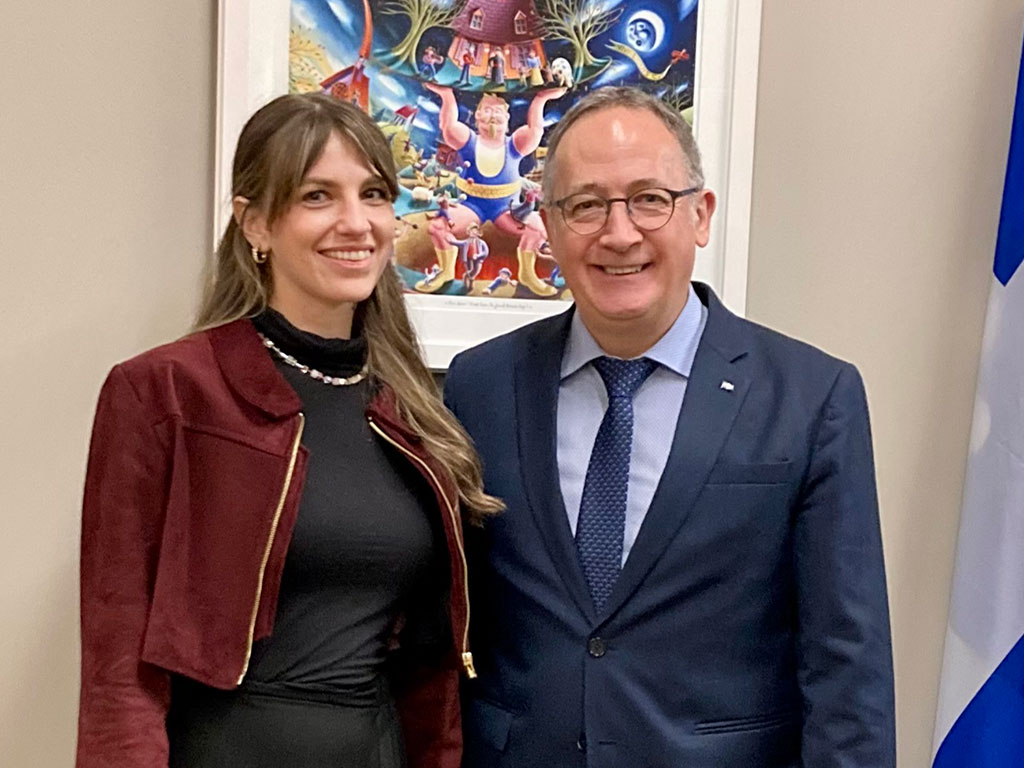
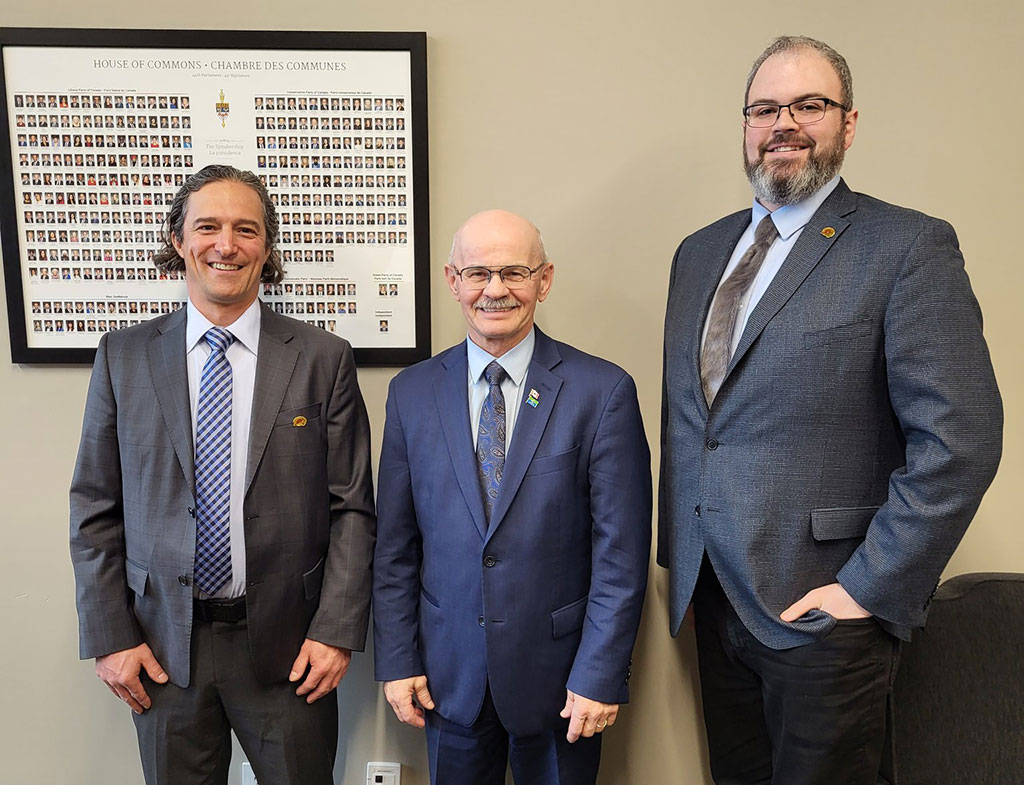
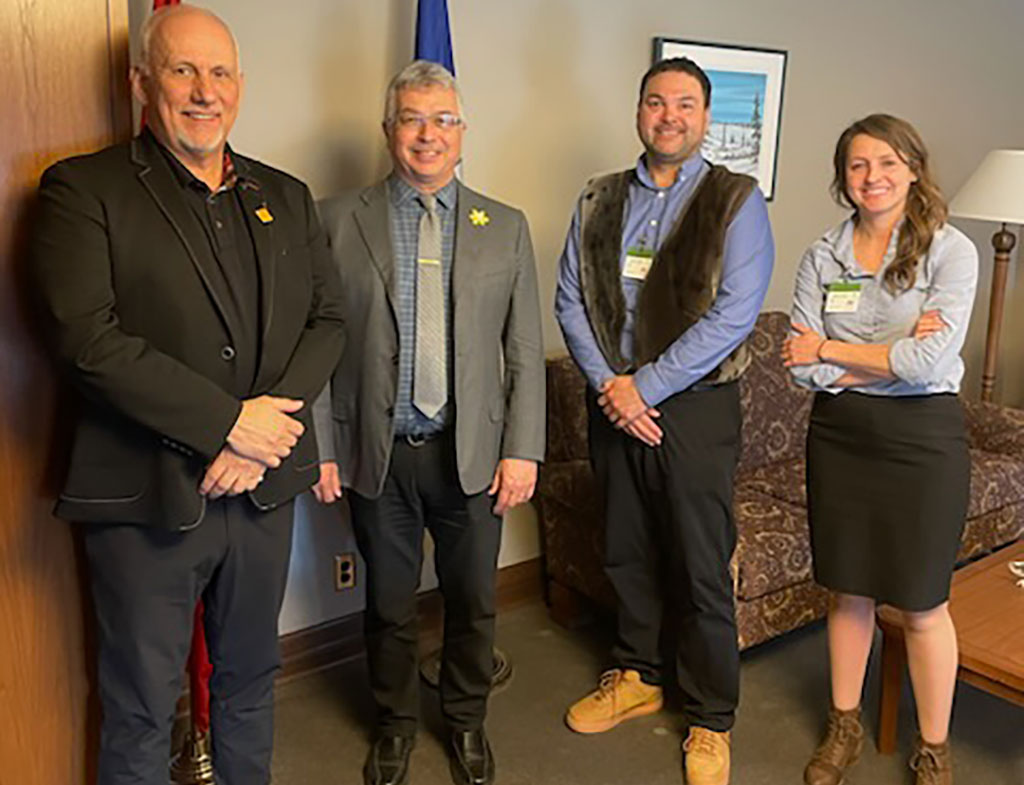
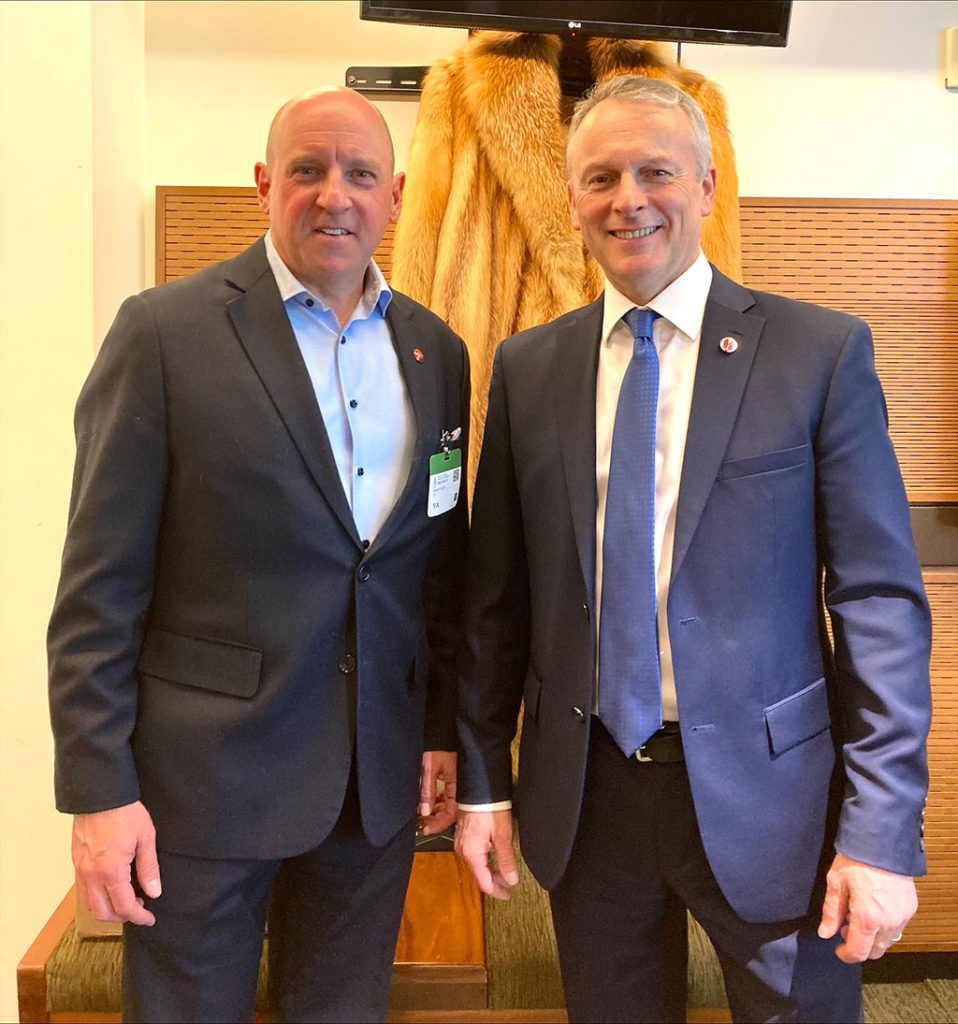
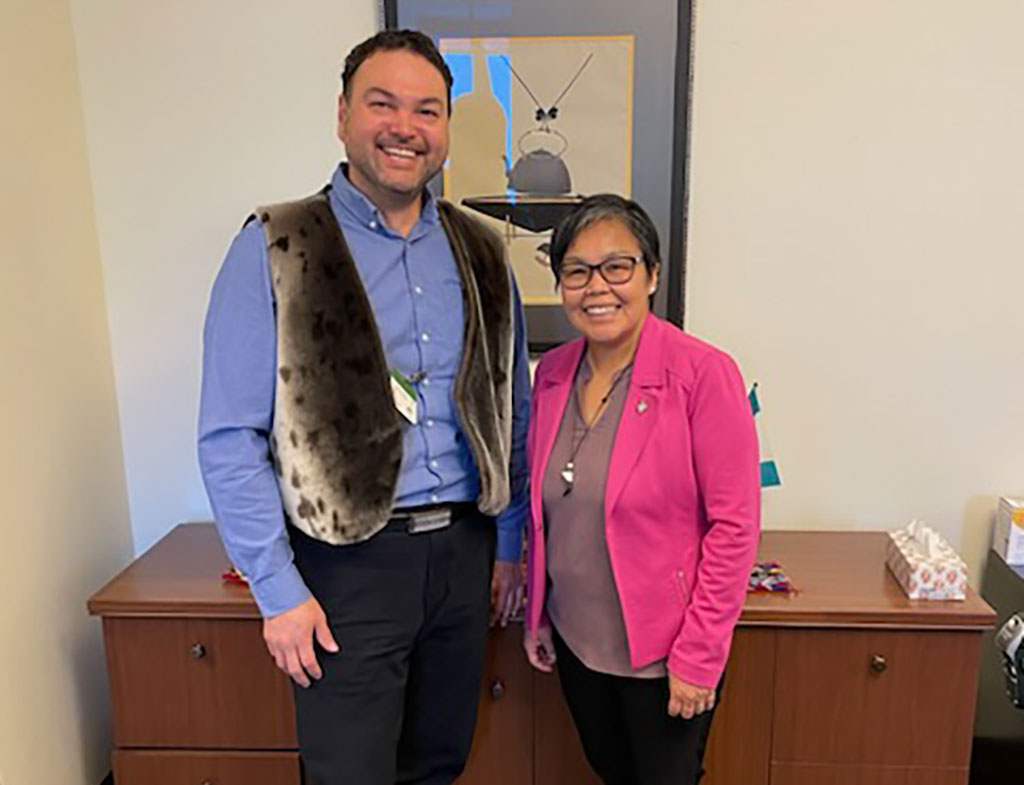
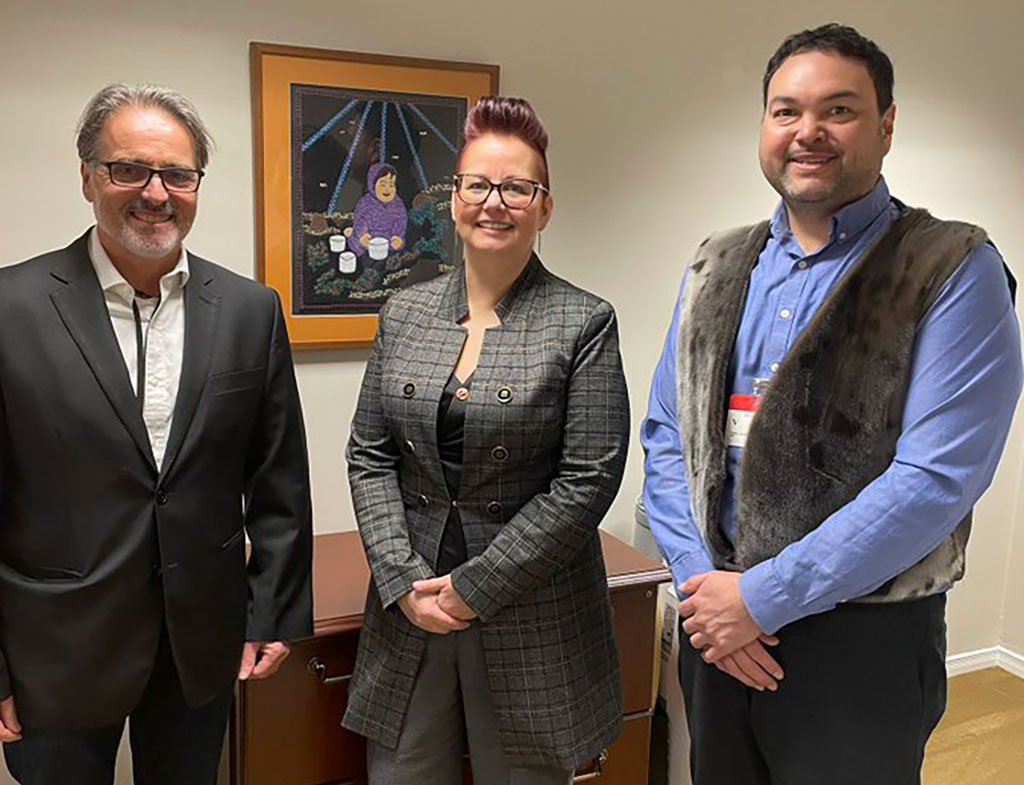
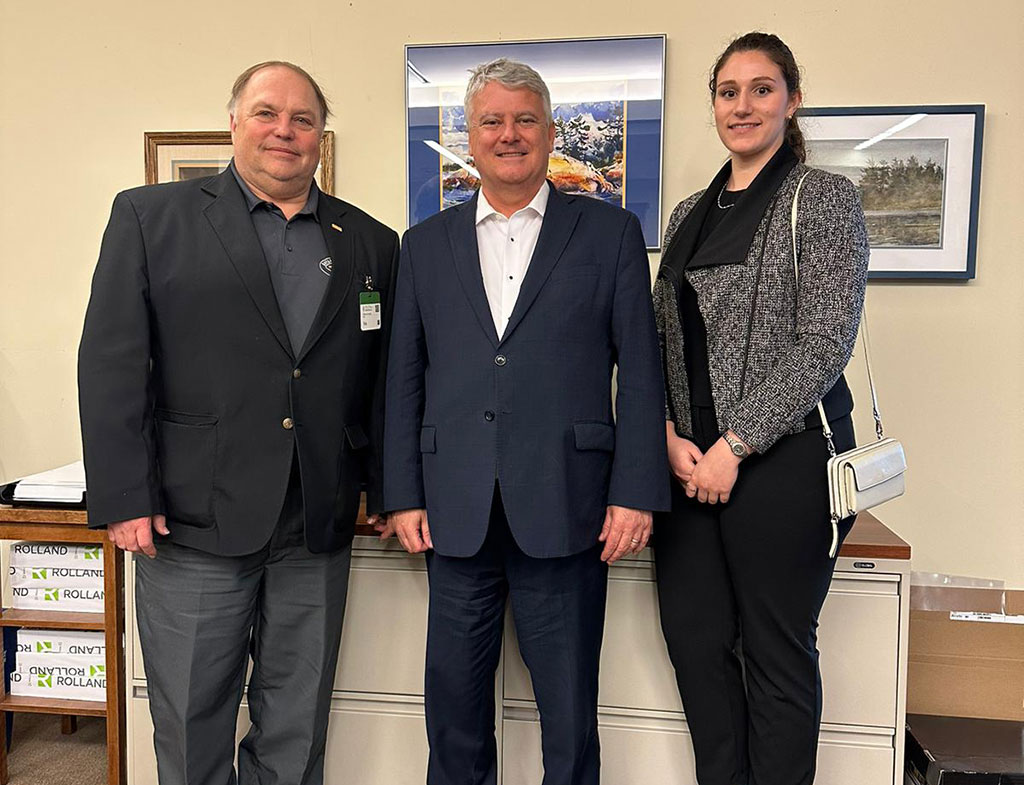
L to R: MP Blaine Calkins; FIC executive director Doug Chiasson; MP Carol Anstey; and MP Laila Goodridge.L to R: FIC executive director Doug Chiasson; Minister of Fisheries Joanne Thompson; FIC chairman Jason White; MP and parliamentary secretary Ernie Klassen; and FIC Board member François Rossouw.L to R: MP Clifford Small; MP Laila Goodridge; MP Blaine Calkins; MP Carol Anstey; and FIC chairman Jason White.L to R: FIC executive director Doug Chiasson; FIC Board members Jason Parker and Serge Larivière; Christine Ackermann (legislative assistant to MP Lori Idlout); and Allan House and Thomas Stevens of the Cree Trappers' Association.L to R: MP Clifford Small; FIC executive director Doug Chiasson; MP Laila Goodridge; MP Carol Anstey; Catherine Moores, executive secretary, Canada Mink Breeders Association; MP Blaine Calkins; and CMBA vice-president Rob Bollert.L to R: FIC Board member François Rossouw; Sen. Patti LaBoucane-Benson; FIC chairman Jason White; and FIC Board member Matthew Stepien.L to R: FIC Board member Jason Parker; MP Clifford Small; FIC executive director Doug Chiasson; and FIC Board member Mike O'Brien.L to R: Chris Vaughn and George Vongas of Saga Furs; Younggi Ahn (chargé d’affaires, Korean Embassy); FIC Board member Serge Larivière; and past FIC chairman and life member David Hutton.L to R: Ontario Fur Managers Federation president Ray Gall; Louis Gagné of Écofaune Boréale; MP Blaine Calkins; FIC Board member Danny Surette; and Jeremy Compeau and Mario Antunes of the OFMF.L to R: FIC Board member François Rossouw; FIC chairman Jason White; Sen. Bev Busson; Catherine Moores, executive secretary, Canada Mink Breeders Association; and FIC Board member Matthew Stepien.L to R: Canada Mink Breeders Association vice-president Rob Bollert; FIC Board member Mike O'Brien; MP Chris d'Entremont; CMBA president Ian Stansell; and Matt Moses of the Nova Scotia Mink Breeders Association.L to R: Jeremy Compeau and Mario Antunes of the Ontario Fur Managers Federation; MP Chris Lewis; and OFMF president Ray Gall.L to R: MP Ted Falk; Chris Vaughn of Saga Furs; Jim Flemming and Catherine Moores (executive secretary) of the Canada Mink Breeders Association; Matt Moses of the Nova Scotia Mink Breeders Association; CMBA president Ian Stansell; George Vongas of Saga Furs; and CMBA vice-president Rob Bollert.L to R: Rob Bollert (vice-president), Catherine Moores (executive secretary), Ian Stansell (president) and Jim Flemming of the Canada Mink Breeders Association; Matt Moses of the Nova Scotia Mink Breeders Association; and George Vongas and Chris Vaughn of Saga Furs.
Last week, the Supreme Court of Canada held a ceremonial opening of the Court, which featured the public debut of… Read More
In 2006, former Chief Justice Beverly McLachlin adjusts the robe of newly appointed Justice Marshall Rothstein. Photo: The Hamilton Spectator/Fred Chartrand/The Canadian Press file photo.
Last week, the Supreme Court of Canada held a ceremonial opening of the Court, which featured the public debut of the Court’s new robes. In June, Chief Justice Richard Wagner went on record saying that new robes were coming that “better reflect Canadian identity”.
The new robes are black with red piping, while the traditional robes were red wool with white mink fur, which had replaced the ermine of the original robes from 1875. The connection between Canadian history and identity and fur is well-known to all Canadians – the Hudson's Bay Company, voyageurs, Indigenous fur trappers, and so much more. Canada is also the birthplace of successful mink and fox farming.
Every corner of our country has been affected in some way by the fur trade. St. John’s, Newfoundland & Labrador, where steamships unloaded sealskins, and the Fur District of Montreal, where the sound of sewing machines once echoed through the streets, are just two examples that come to mind. Today, there are countless towns and villages across Western and Northern Canada that still bear the name “Fort” or “Factory” stemming from outposts of the North West Company or Hudson Bay Company.
Often referred to as Santa outfits, the old robes were trimmed with white mink. Photo: Supreme Court of Canada.
Fur is not some kind of historical artifact. Today, there are innovative and exciting designers across Canada using it. Some are inspired to use fur because it is a biodegradable alternative to synthetic fibres that send microplastics into our rivers and oceans. Others are using fur as a way to reconnect to their Indigenous heritage, which was suppressed by government institutions, including the very Court Wagner sits on. Others wear it because it is warm, fashionable, and accessible.
The Supreme Court has added itself to a list of Canadian institutions that have chosen to wrap themselves in the adulation of foreign-funded animal activists instead of supporting Canada’s fur farmers, trappers and seal hunters who not only support our rural communities but, more often than not, are wholeheartedly supported by everyday Canadians in rural, coastal, northern, and yes, even urban communities.
The new robes "better reflect Canadian identity", says Chief Justice Richard Wagner, so where's the fur? Photo: The Hamilton Spectator/Sean Kilpatrick/The Canadian Press.
Earlier this year, Fairmont, whose hotels were built along the Canadian Pacific rail line which transported furs to auction houses across the country and whose luxury hotels were filled for decades with customers wearing their finest furs, went fur-free. The Hudson's Bay Company, which once gathered furs from across the Canadian hinterland to send to markets in Europe, had announced a fur-free policy not long before their demise. When Canadians tune in to watch our greatest athletes enter the Olympic opening ceremonies in Milan next February, they will see other countries’ athletes wearing Canadian fur, but not Team Canada.
Chief Justice Wagner, on behalf of Canada’s thousands of trappers, seal hunters and fur farmers, as well as the many Canadians who believe in maintaining a connection to our shared history and the role of both the Supreme Court and the fur trade in it, I encourage you to reconsider and refashion your statement. If you are convinced we need to replace the Supreme Court’s traditional Santa Claus robes with something more fashion-forward, there are many designers across Canada who would be more than happy to help you create a design that truly celebrates Canadian identity and heritage – with natural and sustainable Canadian fur.
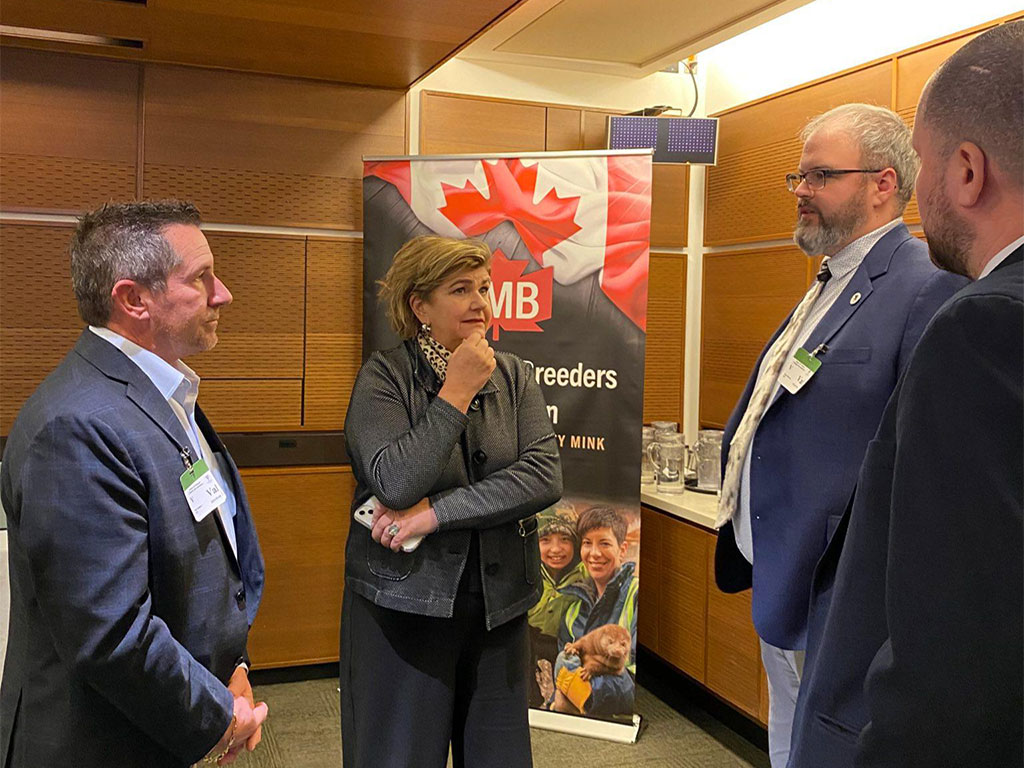
FIC Board members had approximately 30 meetings with Members of Parliament, Senators, representatives of the Prime Minister’s Office and Ministers. Topics covered ranged from re-establishing Canada as a fur leader, supporting Canada’s sustainable and humane seal harvest, and defending the use and trade of fur around the world. Targeted support to promote Canadian fur at home and abroad, continuing the Canadian Seal Products campaign, and a strategy to work collaboratively between the diplomatic corps and the FIC to combat disinformation and trade bans on fur, are all initiatives that the Institute team discussed with decision-makers.
We also hosted Parliamentarians and allies from the nation’s capital for a cocktail reception, where they were able to experience fur garments from Créations GAMA in Montreal and Ottawa’s own Pat Flesher Furs. The chilly February Ottawa weather gave a great opportunity for FIC members to wear their own furs, and for MPs to bring theirs as well.
FIC Executive Director Doug Chiasson, FIC Board Member Francois Rossouw, Minister for Rural Economic Development Gudie Hutchings, FIC Board Member Nathan Kogiak, and FIC Chairman Jason White.OFMF Regional VP Ray Gall, MP Michael Kram, OFMF General Manager Lauren Tonelli, and FIC Board Member and OFMF President Scott Sears.CMBA President and FIC Board Member Rob Bollert, MP Chris D’Entremont, and George Vongas of Saga Furs.Gabrielle Mailhot-Coté of Créations GAMA, MP Sébastien Lemire, and Doug Chiasson.Scott Sears, Ray Gall, MP Jamie Schmale, Shadow Minister for Crown-Indigenous Relations, and Lauren Tonelli.Jason White, MP Blaine Calkins, Shadow Minister for Hunting, Angling and Conservation, MP Clifford Small, Shadow Minister for Fisheries, Oceans and the Canadian Coast Guard, and Gabrielle Mailhot-Coté.Scott Sears, MP Adam Chambers, Shadow Minister for National Revenue, Lauren Tonelli, and Ray Gall.MP Damien Kurek with FIC Board Members Corey Grover and Jason Parker.MP Clifford Small and Gabrielle Mailhot-Coté.Gabrielle Mailhot-Coté and MP Yves Perron.Rob Bollert, Minister Gudie Hutchings, Doug Chiasson, and George Vongas.
Building strong relationships with Parliamentarians and government decision-makers is an essential part of FIC’s mandate to advocate on behalf of Canada’s fur trade. By re-establishing Fur Day on the Hill as an important part of the Ottawa calendar, the Institute is gaining allies of all political stripes, and making sure that more of the people who make decisions that affect our industry are familiar with our organization and our trade.
The FIC staff and Board will continue to engage with governments at the federal, provincial and territorial levels to support and defend Canada’s fur trade throughout the year.
On Nov. 23-24, all the right people – leaders from the European Union and Canada – were gathered in St…. Read More
Photos: Canadian Prime Minister Justin Trudeau by Eurasia Group, CC BY 2.0; European Commission President Ursula von der Leyen by Dirk Vorderstraße, CC BY 3.0; via Wikimedia Commons
On Nov. 23-24, all the right people – leaders from the European Union and Canada – were gathered in St. John’s for the Canada-EU Summit. Those of us representing Canadians who make their livings in remote and rural areas from Prince Rupert to Newfoundland’s outports, by harvesting fur and seals, were hopeful. Meetings such as these provide high-level government representatives with an opportunity to discuss issues that matter to their respective governments behind closed doors and far removed from everyday citizens.
And, this summit was different. Instead of being monitored only by political gadflies and lobbyists, people in remote communities across Eastern and Northern Canada watched closely. They watched because the summit was held in Newfoundland, where the ocean and its bounties have long been the bedrock of the economy and culture.
This, of course, is the same St. John’s that once was home port to steamers, which brought hundreds of Newfoundlanders to the ice of the North Atlantic to harvest seals. The same St. John’s where European celebrities descended to hold press conferences in front of TV cameras to attack the livelihoods of hunters who put their lives on the line on the ice to provide for their families. The same St. John’s where, for over 30 years, the elected officials of the provincial government sat on sealskin chairs as they debated the business of the day.
In 2009, the predecessors of those same EU officials who were fêted in St. John’s banned the trade of Canadian seal products, striking a blow to rural communities across Eastern and Northern Canada that had relied on the hunting of seals for hundreds of years. Regulation No 1007/2009 inflicted untold damage not only to communities in Newfoundland and Labrador and Quebec, but also to Inuit communities across Canada’s North.
The impact on Inuit communities was the genesis of a challenge to the ban in the European Court of Justice, brought by Inuit Tapiriit Kanatami and supported by the Fur Institute of Canada and others. This was followed by a challenge by the Government of Canada at the World Trade Organization. Though it upheld the ban, the WTO challenge forced the EU to allow an exemption for seals harvested by “Inuit and other Indigenous communities”.
This is the exemption that European Commission President Ursula von der Leyen said was “working well” and that a “good balance” had been found on seals. This is completely and unambiguously false. Only two bodies in Canada are recognized as being able to certify that a seal product comes from an Indigenous harvest: the Government of Nunavut and the Government of Northwest Territories. In a report from her own Commission, it shows that Nunavut has only exported two sealskins to Europe, in 2020, and the Northwest Territories exported just two sealskin coats, in 2022.
European Sealers Also Hamstrung
Perhaps even more revealingly, that same report contains four EU member states saying that the ban’s “impact has gone beyond its intended purpose”. These four states – Estonia, Latvia, Finland and Sweden – all still have their own seal hunts but are hamstrung the same way Canadian sealers are when it comes to trading their products.
In terms which would be shockingly familiar to anyone on Canada’s East Coast, these states raise concerns about the impacts of seals eating cod and salmon, about infecting fish with parasites, and impacts on commercial and recreational fisheries.
Unfortunately, EU and Canadian officials did not avail themselves of an ideal opportunity to reverse the historic injustice of the 2009 seal ban when they gathered in St. John’s.
But it’s not too late. The European Commission is launching a review of the Regulation on Trade in Seal Products in 2024. Canada can, should, and must work closely with the EU member states that are unhappy with the ban, supported by Canada’s sealing industry and Indigenous leadership, to overturn the regulation.
We also need European Commission leadership to engage honestly and candidly on the damage done by this ban and chart a course to move beyond the mistakes of the past. This conversation must be elevated to the most senior levels and involve representatives of the industry and Indigenous communities directly impacted, not the extremist animal-activist groups whose goal is to destroy the way of life of people who live close to the land – and sea – and who use renewable natural resources responsibly and sustainably..
It’s been five long years since a team from the Fur Institute of Canada last descended on Parliament Hill, thanks… Read More
It's been five long years since a team from the Fur Institute of Canada last descended on Parliament Hill, thanks in part to travel restrictions during the Covid-19 pandemic. So, the revival of Fur Day on the Hill this April 18 is a cause for celebration! It's also to be hoped that Fur Day becomes an annual event that Members of Parliament, Senators and other senior government officials can mark in their diaries with confidence.
Our delegation this year was impressive, not just in numbers but also in the breadth and depth of knowledge we represented. Leading our group was current FIC Chairman Jason White, supported by Board members Mike O’Brien, Emmanuel Dalpé-Charron, Corey Grover, Nathan Kogiak, Francois Rossouw, Scott Sears, Robin Horwath, Rob Bollert and Brian Dicks.
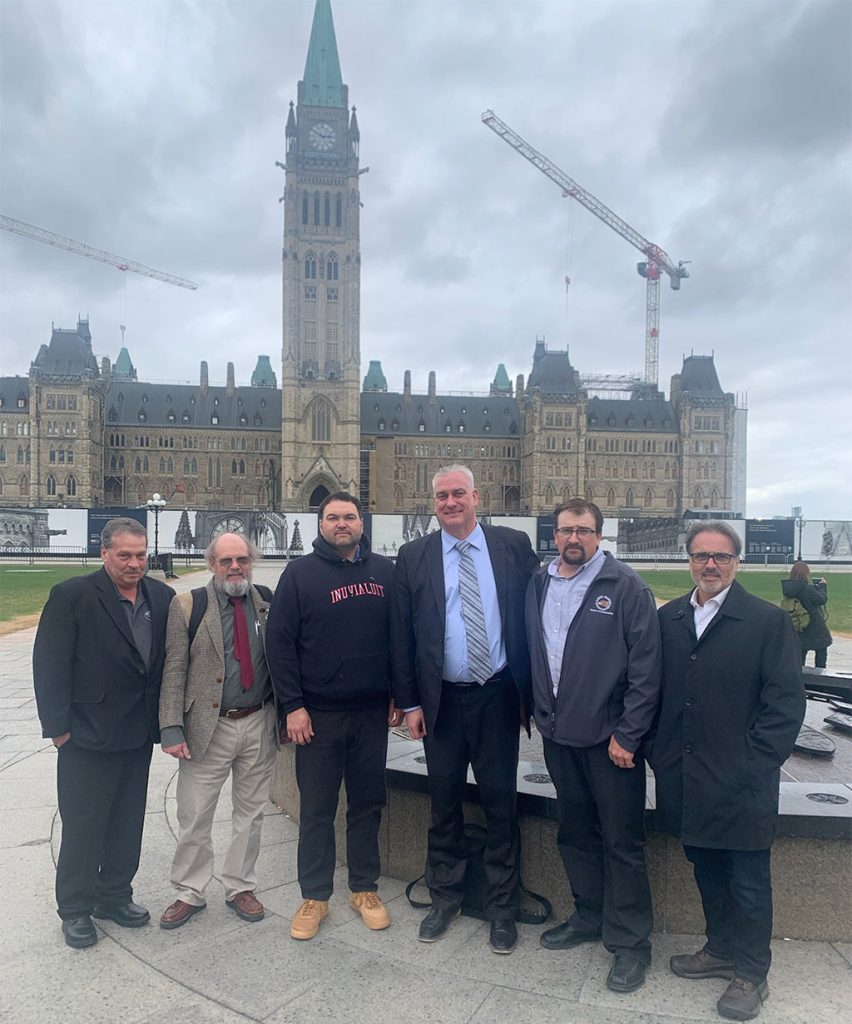
FIC Board members assemble on Parliament Hill (L to R): Scott Sears, Mike O’Brien, Nathan Kogiak, Jason White (Chair), Corey Grover and Francois Rossouw.
The FIC has always had a strong and important relationship with government, going back to our establishment by Wildlife Ministers in 1983. For the last forty years, we have engaged closely with federal, provincial and territorial governments, particularly in fulfilling our mandate to test and certify trap compliance with the Agreement on International Humane Trapping Standards.
But good relationships must be nurtured, and after a five-year absence from Parliament Hill, our reappearance was long overdue. Of course, we wanted to connect with old friends we hadn't seen in a while, but more importantly, we needed to meet a new cadre of MPs and Senators, and identify new champions for Canada’s sustainable, humane fur trade.
Many of these Parliamentarians, and especially those from rural and remote areas, represent communities where trapping plays a vital role in the local economy. So it was important for us to touch base with representatives from across the country, from the West, East and Arctic coasts and many points in between. It was also refreshing to be reminded that Canada’s fur trade is not a partisan issue, with strong support to be found in all the major political parties.
Unified Message
Corey Grover and Jason White flank MP Damien Kurek from Alberta.
There is always room for improvement in the way federal government regulates businesses, and this was the thrust of our unified message on Fur Day.
Under the current arrangement, a long list of departments and agencies are involved in regulating different aspects of the fur trade. These include Environment and Climate Change Canada, Crown-Indigenous Relations and Northern Affairs Canada, Global Affairs Canada, Industry Science and Economic Development Canada, Fisheries & Oceans Canada, Agriculture and Agri-Food Canada, Export Development Canada, and the seven federal Regional Development Agencies.
All these departments and agencies play their own role in determining what form the fur trade takes, and the result is often misalignment and confusion. For example, if a fur business wants to know what federal support exists for them, and how to access it, they can get lost in a bureaucratic maze.
FICBoard Member Emmanuel Dalpé-Charron and Doug Chiasson flank MP Richard Lehoux from Quebec.
Given that the fur sector was, until quite recently, worth more than $1 billion to the Canadian economy, it is unsurprising that we enjoy strong support among politicians at all levels of government. But what is surprising is that there is no one department within the federal government dedicated to providing a home base for the entire fur trade, and acting as our Champion.
Brian Dicks, Nathan Kogiak and Romy Vaugeois meet with MP Michael McLeod from the Northwest Territories.
Such a department would advocate for the fur trade at internal government talks, and just as importantly, point folks in the trade towards the right decision-makers and appropriate pots of funding to support new initiatives for fur.
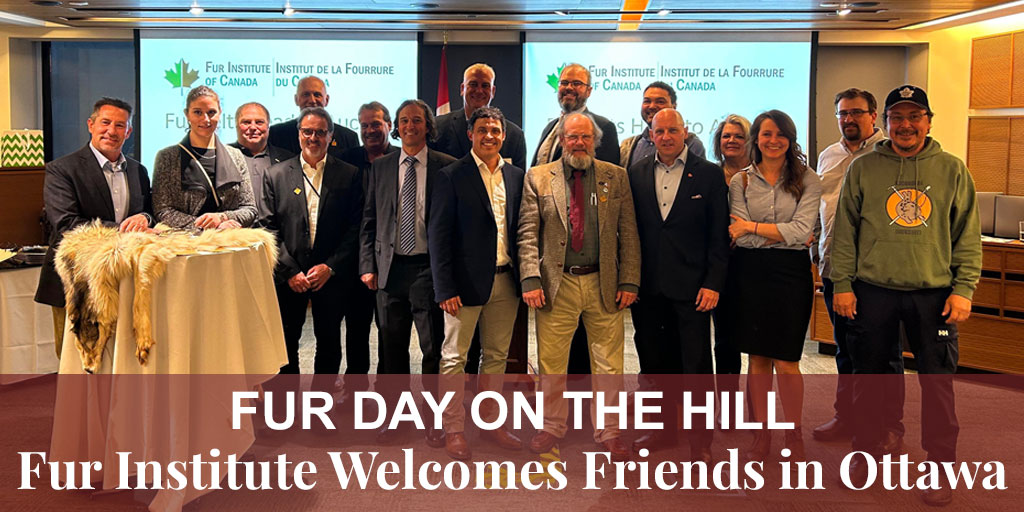
Reception Time
Rob Cahill (left) provided much of the fur display for Fur Day on the Hill. Here he meets with Senator David Wells from Newfoundland and Labrador.
After a long day with many meetings, we held a reception for Parliamentarians and friends of fur from Ottawa and the surrounding area. But this wasn't just a chance to wind down and relax.
Rather, it was an important opportunity to let Parliamentarians meet others from the fur trade, while also giving them a chance to appreciate the unique feel and beauty of natural fur.
To this end, our reception featured a display of fur garments, home décor, and pelts. Most of the garments and décor were provided courtesy of Rob Cahill of Cahill's Furs in Peterborough, from his Further Upcycled line. And FIC Board member Robin Horwath, who was also formerly General Manager of the Ontario Fur Managers Federation, showed dressed pelts of the various furbearers harvested across his province.
Looking Ahead
Senator Margaret Dawn Anderson from the Northwest Territories meets with Francois Rossouw and Nathan Kogiak.
Fur Day on the Hill has just taken place for the first time in five years, and that's far too long. It was always intended to be an essential part of the FIC's lobbying efforts on Parliament Hill, on behalf of the entire fur sector.
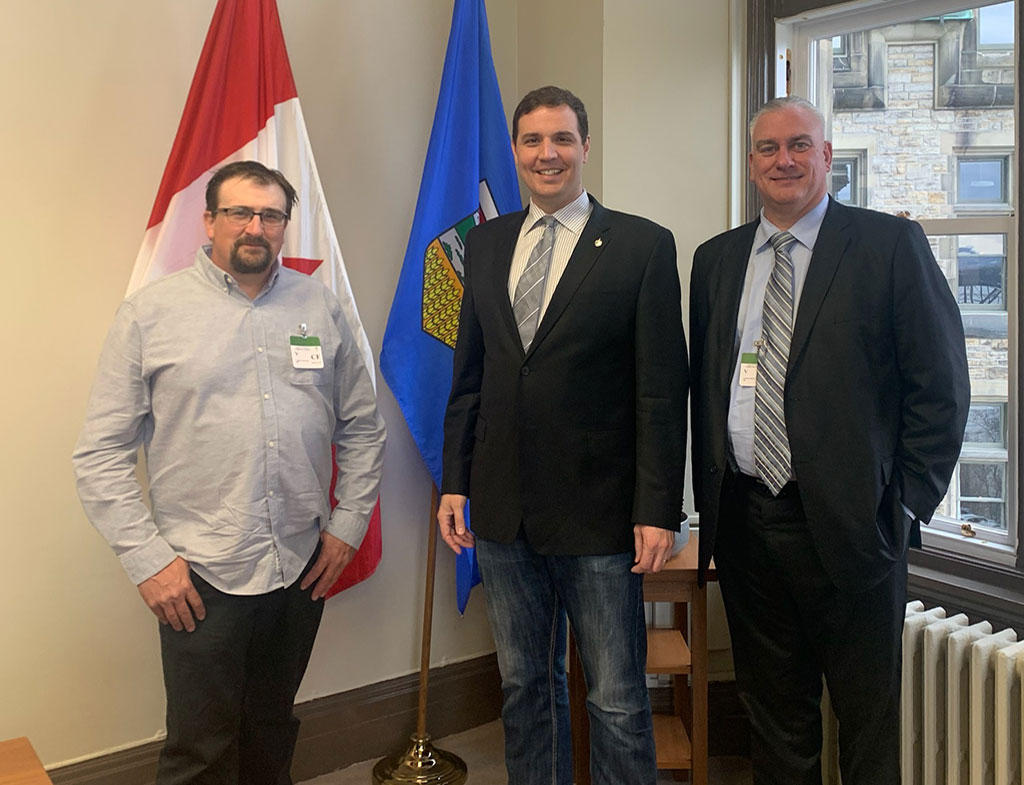
MP Terry Sheehan from Ontario with Robin Horwath and Lauren Tonelli of the OFMF.
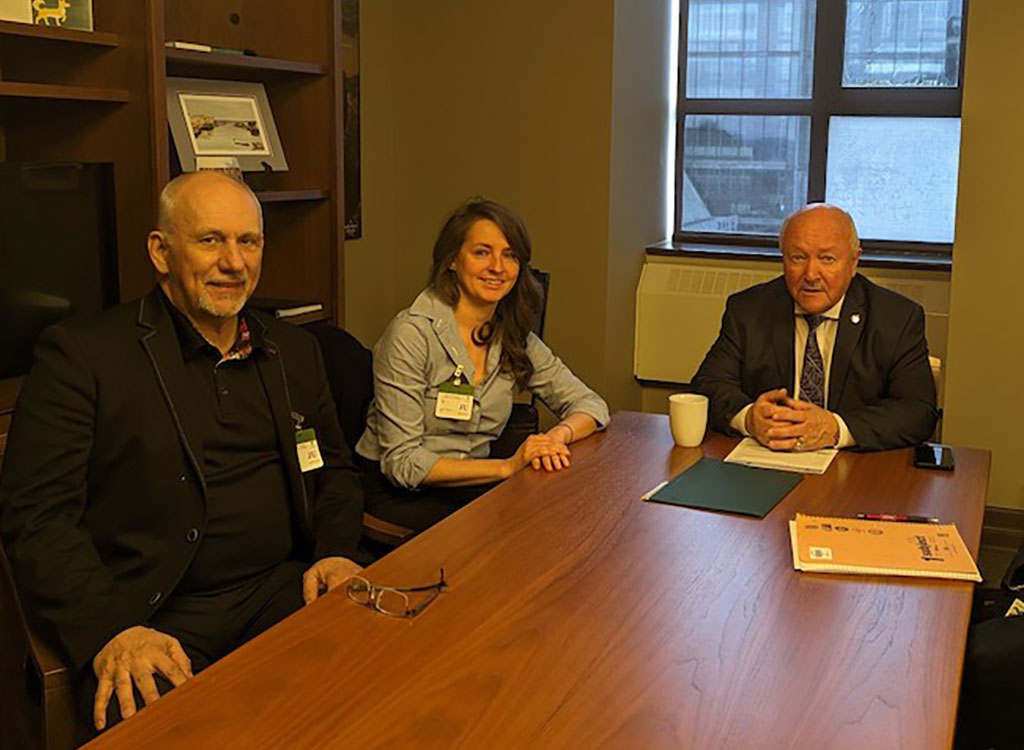
For this reason, it is my hope that Fur Day becomes an annual event, as we strive to bring the full power of the federal government behind the fur sector, where it belongs.
Considering how much trapping of wildlife takes place in Canada, it is very rare for pet dogs to become accidental… Read More
No one wants to see a pet dog caught in a trap, and that includes trappers. Photo: HeartSpoon, CC BY-SA 4.0, via Wikimedia Commons.
Considering how much trapping of wildlife takes place in Canada, it is very rare for pet dogs to become accidental victims. Finding a dog in their trap or snare is not something any trapper wants, but accidents do happen, and they almost always involve someone breaking the law. Maybe a trap was illegally set, or maybe a dog was off-leash where it shouldn't have been. Yet when the media report these stories, they hardly ever investigate the crime that's been committed. Instead they turn the story into an indictment of all trapping, including by licensed, law-abiding trappers.
Why is this imbalance occurring? And what can the trapping community do to encourage more balanced and accurate reporting?
Let's start by looking at two recent stories involving traps catching the wrong animals.
Case Study 1 – Prince Edward Island
Last December on Prince Edward Island, a four-year-old Pyrenean mountain dog called Caspie died in a snare while exercising with her owner, Debbie Travers. The dog was off leash, which was perfectly legal because they were on private property belonging to Travers's family. Authorities investigated and found that the snare had been set illegally by someone who had failed to get the landowner's permission. They also found and removed three other snares nearby.
Local media predictably jumped on this human interest story. Man's best friend had been killed, she had a name, a bereaved owner wanted justice, and there were photos of Caspie in happier times. The story's hook practically wrote itself.
The problem arose in the choice of people interviewed for context.
After covering the human interest angle, it should have been a straightforward crime story. There was a victim, the dog (or, legally, its human owner). And there was a perpetrator, the person who set the illegal trap.
A good reporter would address the legality of pet dogs exercising off-leash on this particular land, and explain how the story could have been different under different circumstances. He or she would also stress that the perpetrator was trespassing, and had set the snare without permission and with intent to poach. And while the dog's death was surely unintentional, she died as a direct result of these illegal acts, not due to legal trapping.
For expert comments, the reporter could then interview law enforcement, the government body regulating trapping, and the local trapping association. Between them, these sources could say exactly what laws had been broken, and make an educated guess as to why.
Instead, Canada's public broadcaster, CBC, devoted a sizeable chunk of its report to the views of an ambulance-chasing anti-trapping group. "These traps are indiscriminate, they injure both the target and non-target animals," said Aaron Hofman, a director of The Fur-Bearers. "Dogs, they have keen senses of smell, so what's gonna stop them from wandering into a trap versus, say, a coyote or fox?"
No representatives of the trapping community were interviewed.
Our second case is different, but hopefully also instructive to reporters looking to ask the right questions.
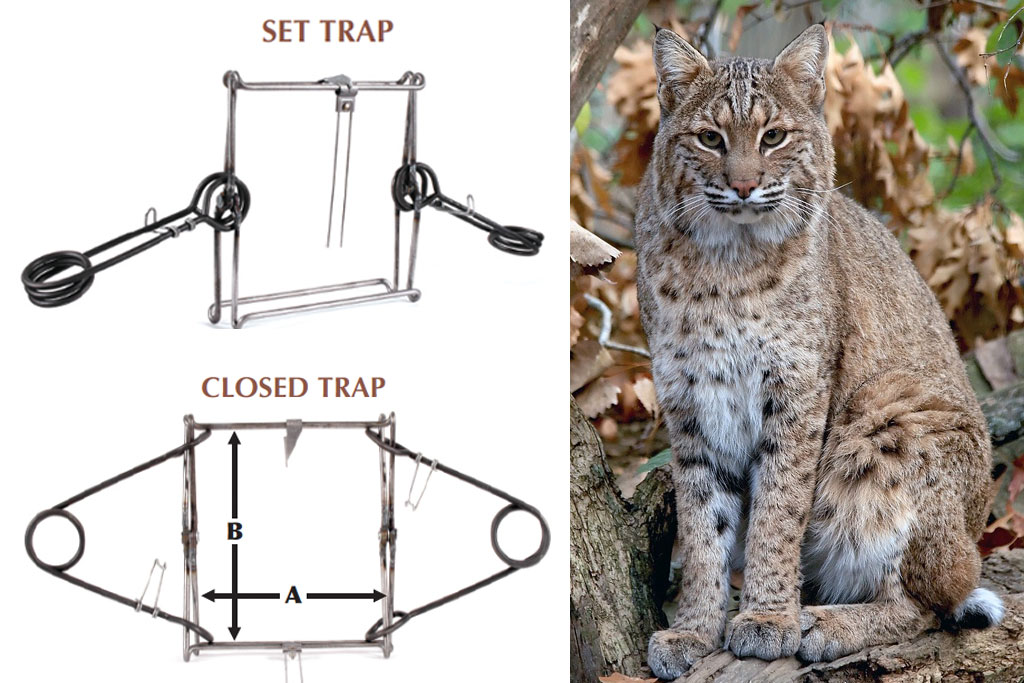
This January, a bobcat in Calgary spent two weeks walking around a community with a small trap on its front paw. Authorities finally caught "Bobby" (as some locals called him), and took him to a wildlife rehabilitation facility, where we understand he's doing fine.
We can't be sure exactly what happened, but if reporters had bothered to ask people who actually know trapping, this is what they'd have heard.
The trap was a Conibear 110, a body-gripping trap designed to instantly kill small animals that enter it head first. It was not a foothold trap, even though it held the bobcat's paw.
We can also say that the trap was almost certainly not set by a licensed commercial trapper. Such a trapper would never use a small trap like this for a bobcat, and if it were set in an open area, he would have placed it in some kind of box to keep larger animals out. He might also have tethered the trap to something like a tree, as an extra precaution against a larger animal wandering off with the trap attached.
So what almost certainly happened was that someone with no trapping experience set the trap to deal with a small animal, and did it wrong. Maybe they were after a rat, or thought it would stop the neighbour's cat pooping in their flower bed.
Unfortunately, once again the CBC reporter did not interview any trapping experts, instead featuring a wildlife rehabilitation expert who said: “the device clamped on the animal's paw was a conibear trap, which is typically used to ensnare skunks, raccoons or foxes.” As trappers reading this know, 110s are only AIHTS-certified for muskrat and weasels, not raccoons or skunks, and it would be too small for fox. This is likely not intentional misinformation, but simply an over-simplification from a non-expert on trapping. A trapper would have been able to tell the reporter that Conibear-style traps come in a wide range of sizes and strengths, and that no trapper worth his salt would set a 110 for a bobcat.
What to Do?
We all want to be fully informed on subjects that matter to us, and seek out media that produce balanced and accurate reporting. But as these examples show, that's not always easy.
To understand why, consider the life of a local news reporter. In this fast-paced world, deadlines are getting ever shorter, plus most local stories have short shelf lives anyway. If a cat gets stuck up a tree, it either makes the evening news or it's forgotten. So reporters bang out their 800 words as fast as they can, and just hope they got the facts as straight as they could.
Anti-trapping groups pander to this weakness. Even though they don't know how to trap, and have no experience in improving trapping technologies, practices, or regulations, they have made themselves go-to sources for comment whenever trapping makes the news. They make themselves very accessible, and have sound bytes and images ready to go.
They're sneaky too. On their websites they're clear about wanting to ban all trapping, but for the media, they take a soft-sell approach to make them sound reasonable. Regulations should be tightened, they say. More safeguards are needed. They may even act like they have a great new idea, though in truth every option to make trapping safer has already been considered somewhere in the country.
And the result, almost always, is a news report that is a one-sided indictment of all trapping, including the legal activities of licensed commercial trappers. We all get tarred with the same brush.
So if we hope to see balanced, objective reports about trapping, we need to be playing this game too. We are the authorities, not them, and we need to make sure reporters know this. But even more important, we need to be accessible, and that's the tricky part.
We can't match the accessibility of anti-trapping groups because we simply don't have the manpower to flood reporters' email or voice mail. Plus we have other work to do – be it actual trapping, or unrelated jobs that most trappers have. In contrast, all anti-trapping groups have to do is make noise.
So we need to work smarter, and to that end I offer these suggestions:
• We must be proactive. Trapping associations must make sure their local reporters know they exist before a story breaks. Call them up, build a rapport, and let them know you are available for comment at any time. Invite them to your events, show them that trapping is alive and well, let them know what your organizations are up to.
• When a story does break and a reporter contacts you for comment, you need to respond as quickly as possible. This may mean establishing a rota at your association so one person is always available. The last thing a reporter with a deadline wants to hear is an automated reply like, "I'm out of the office for the next three days."
• If you see a news report that is negative about trapping and does not include a trapper's perspective, contact the reporter or editor and point out the omission. And, of course, suggest someone they can contact in future. As proof that this approach works, FIC reached out to CBC following its unbalanced report on the PEI incident, and two days later it published a new report which gave top billing to the views of an actual trapper.
• On the other hand, when you see a news report that is positive about trapping, and includes a trapper’s perspective: like, comment, share! Even contact the reporter and let them know that you noticed they provided balanced coverage. If reporters see that stories they write that feature trappers telling the truth about trapping get better feedback than the stories with the anti-trappers, they will be more likely to feature trappers again.
With luck, the next time a dog is caught in a trap, the trapping community will be treated fairly by reporters. And hopefully there will be fewer nasty quotes from anti-trapping groups that don't know what they're talking about.
When it comes to environmental treaties, nothing grabs news headlines these days like those addressing climate change, but there are… Read More
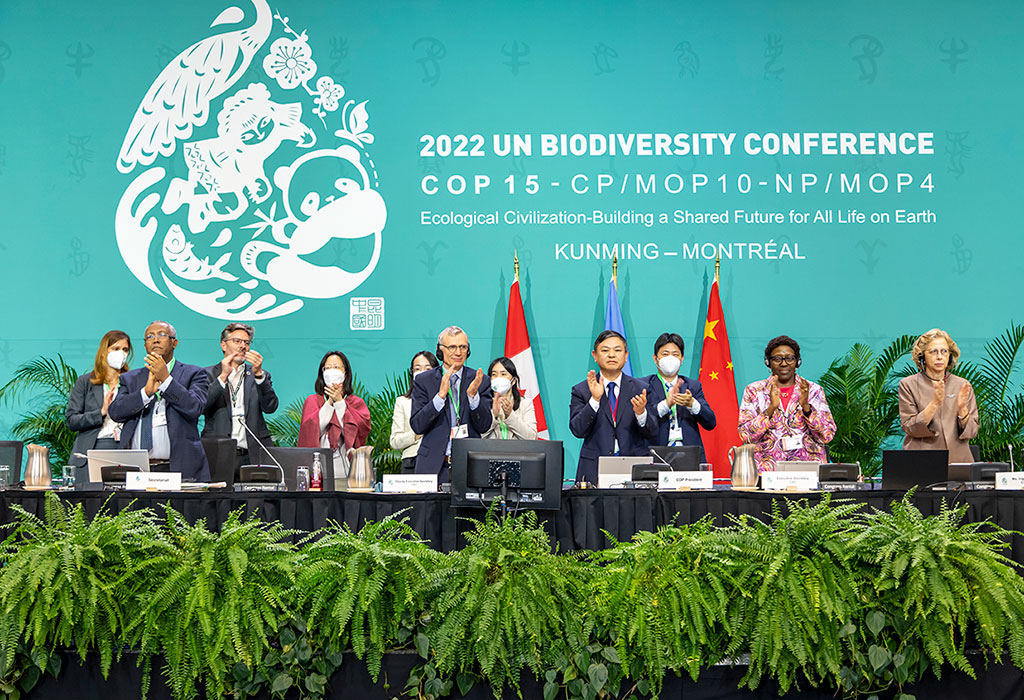
The UN Biodiversity Conference congratulates itself on a job well done. Photo: UN Biodiversity.
When it comes to environmental treaties, nothing grabs news headlines these days like those addressing climate change, but there are other multilateral treaties that also demand our attention, not least the Convention on Biological Diversity. Since entering into force in 1993, the CBD's Parties (now numbering 196) have striven to develop strategies for the conservation and sustainable use of biodiversity, and today the treaty is seen by many as the key document regarding sustainable development.
So it is heartening for Canada's trappers and sealers that the recently concluded 15th Conference of the Parties (COP15) ratified a strategic plan that emphasizes its commitment to the sustainable use of wildlife as a means of arresting biodiversity loss, while stressing the important role to be played by Indigenous and local communities. Indeed, important parts of the Kunming-Montreal Global Biodiversity Framework align closely with the core values advocated by the Fur Institute of Canada and its members.
The Framework is named in part after the Chinese city of Kunming, where COP15 was scheduled to be held in 2020. But the meeting was postponed repeatedly due to Covid-19, and was finally split into two sessions. The first, mostly an online event, took place in October 2021, and saw delegates agree provisionally to draft Global Targets in line with the theme "Ecological Civilization: Building a Shared Future for All Life on Earth". These Targets, to be met by 2030, are intended as stepping stones on the way to achieving Global Goals by 2050.
The second session, held last December 7-19 in Montreal, saw further discussion of the Targets, and finally the adoption – after more than four years of negotiations – of the Framework.
On behalf of the FIC, I attended the meeting in Montreal as a Non-Governmental Organization observer to advocate for the important role of sustainable use of wildlife in biodiversity conservation. Of the 23 Targets identified for urgent action, we should be particularly pleased with the language of three, numbered 5, 9 and 16 (see below).
Targets 5 and 9 are particularly noteworthy for Canada's sealers and trappers because they explicitly endorse the sustainable use of wildlife as an essential component in conserving biodiversity.
"Ensure that the use, harvesting and trade of wild species is sustainable, safe and legal," begins Target 5. It also makes specific reference to "respecting and protecting customary sustainable use by indigenous peoples and local communities."
Target 9 then underscores the importance of "providing social, economic and environmental benefits for people, especially those in vulnerable situations and those most dependent on biodiversity," and "protecting and encouraging customary sustainable use by indigenous peoples and local communities."
Both Targets 5 and 9, therefore, are in perfect alignment with the conservation ethic of Canada’s fur harvesters.
Sustainable Consumption
Canada’s trappers, sealers and furriers can also play a key role in helping to achieve Target 16, which calls on Parties to "Ensure that people are encouraged and enabled to make sustainable consumption choices including by establishing supportive policy, legislative or regulatory frameworks, improving education and access to relevant and accurate information and alternatives, ..."
Everyone in the fur trade must help consumers to make these sustainable consumption choices, in particular by educating them about the environmental benefits of natural fur over fast fashion that relies on synthetics.
Canadian and international consumers should be made to feel confident that by wearing natural fur products, they are contributing to essential wildlife management and supporting biodiversity conservation. We also need to work to ensure that government decision-makers understand the role for fur harvesters in achieving these goals, instead of allowing them to focus on the hobby horses of anti-use environmental groups. The fur trade has long taken this position, and as its latest strategic plan spells out, the CBD agrees.
***
Key Biodiversity Targets for Trappers, Sealers
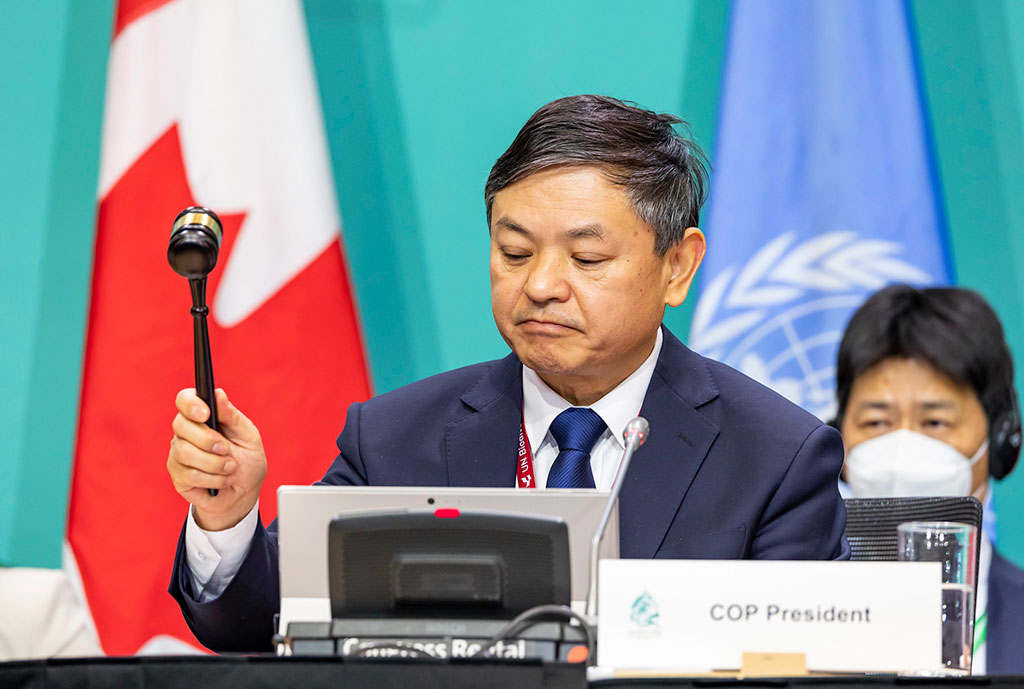
With a bang of his gavel, COP15 president Huang Runqiu brings more than four years of negotiations to a close. Photo: UN Biodiversity.
Target 5: “Ensure that the use, harvesting and trade of wild species is sustainable, safe and legal, preventing overexploitation, minimizing impacts on non-target species and ecosystems, and reducing the risk of pathogen spill-over, applying the ecosystem approach, while respecting and protecting customary sustainable use by indigenous peoples and local communities.”
Target 9: “Ensure that the management and use of wild species are sustainable, thereby providing social, economic and environmental benefits for people, especially those in vulnerable situations and those most dependent on biodiversity, including through sustainable biodiversity-based activities, products and services that enhance biodiversity, and protecting and encouraging customary sustainable use by indigenous peoples and local communities.”
Target 16: “Ensure that people are encouraged and enabled to make sustainable consumption choices including by establishing supportive policy, legislative or regulatory frameworks, improving education and access to relevant and accurate information and alternatives, and by 2030, reduce the global footprint of consumption in an equitable manner, including through halving global food waste, significantly reducing overconsumption and substantially reducing waste generation, in order for all people to live well in harmony with Mother Earth.”
To learn more about donating to Truth About Fur, click here.
Manage Consent
To provide the best experiences, we use technologies like cookies to store and/or access device information. Consenting to these technologies will allow us to process data such as browsing behavior or unique IDs on this site. Not consenting or withdrawing consent, may adversely affect certain features and functions.
Functional
Always active
The technical storage or access is strictly necessary for the legitimate purpose of enabling the use of a specific service explicitly requested by the subscriber or user, or for the sole purpose of carrying out the transmission of a communication over an electronic communications network.
Preferences
The technical storage or access is necessary for the legitimate purpose of storing preferences that are not requested by the subscriber or user.
Statistics
The technical storage or access that is used exclusively for statistical purposes.The technical storage or access that is used exclusively for anonymous statistical purposes. Without a subpoena, voluntary compliance on the part of your Internet Service Provider, or additional records from a third party, information stored or retrieved for this purpose alone cannot usually be used to identify you.
Marketing
The technical storage or access is required to create user profiles to send advertising, or to track the user on a website or across several websites for similar marketing purposes.