The Fur Institute of Canada (FIC) is now an official rodeo sponsor, looking to educate fans about fur in general… Read More
Photo: Jacob Brunette-Savard.
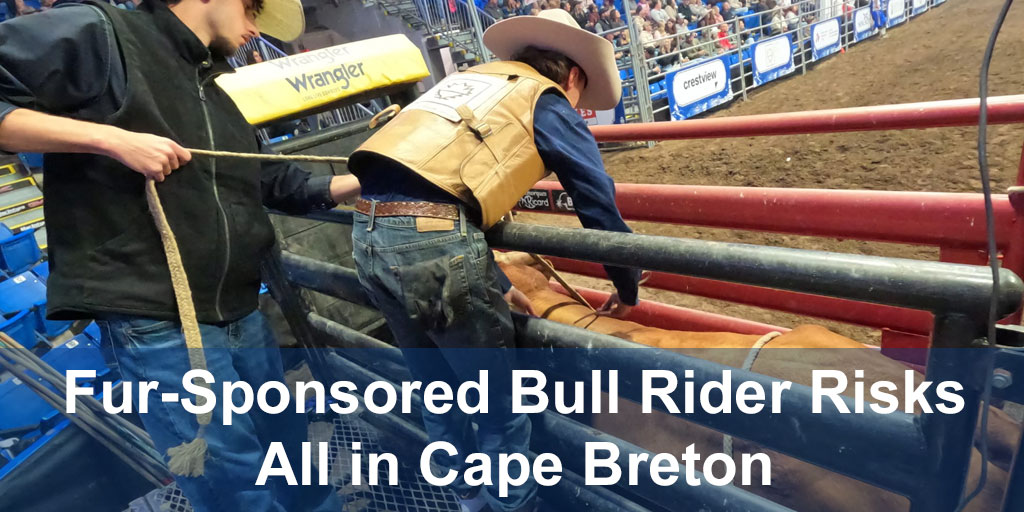
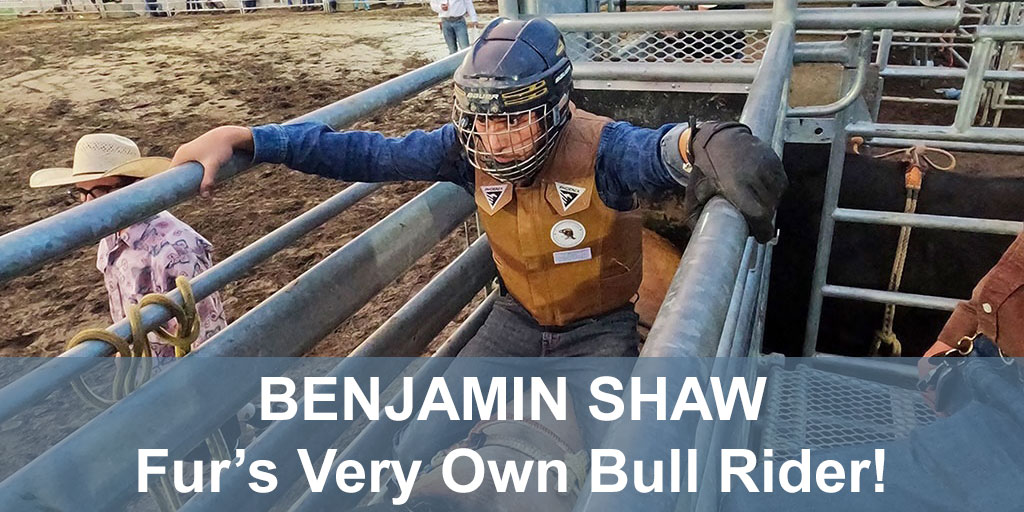
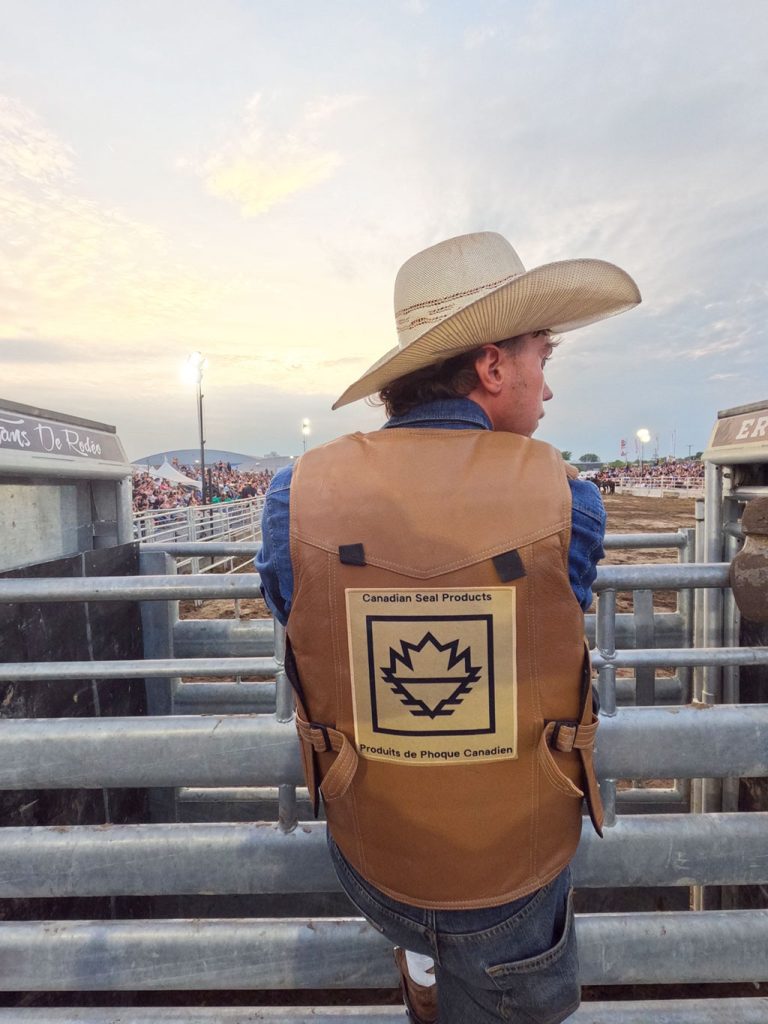
The Fur Institute of Canada (FIC) is now an official rodeo sponsor, looking to educate fans about fur in general and in particular about its brand Canadian Seal Products. In return, bull rider Benjamin Shaw gets to put his life on the line without the added worry of paying to compete and travel between venues.
Widely known as the national voice for Canada's fur sector, the FIC also represents the sealing industry through the Seals & Sealing Network. The SSN unites the country's commercial and Indigenous seal harvesters, processors, manufacturers and retailers to promote high-quality and sustainable seal oil, meat and fur. This it does via its two brands: Canadian Seal Products and Proudly Indigenous Crafts & Designs.
Fixture of Rural Communities
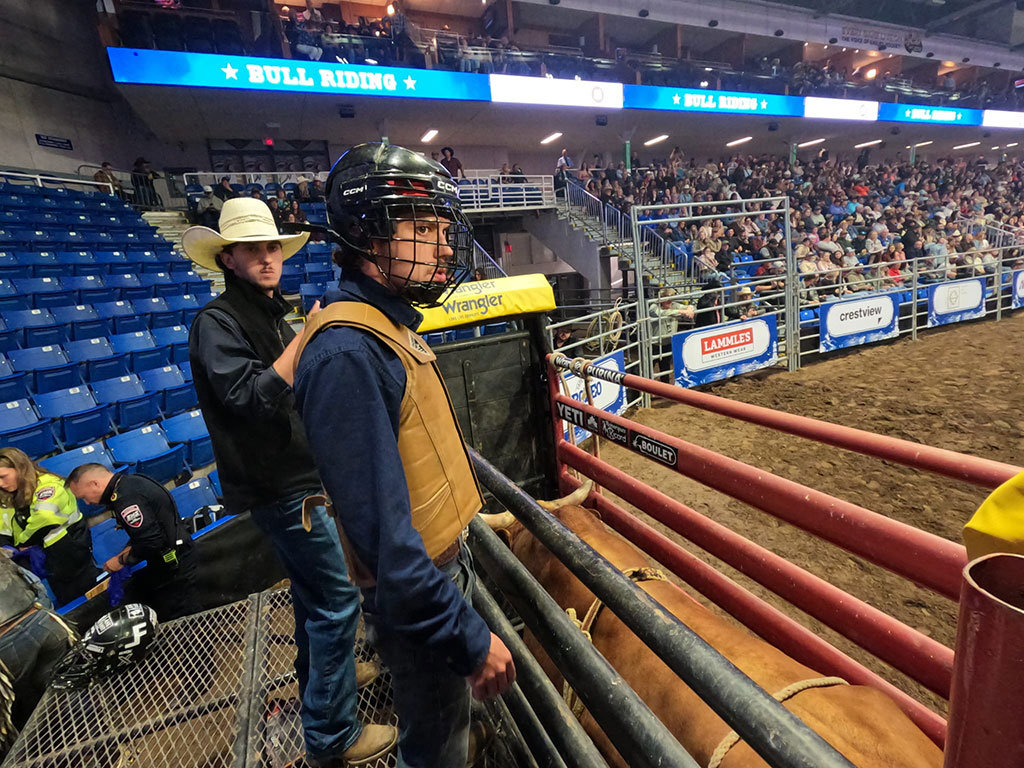
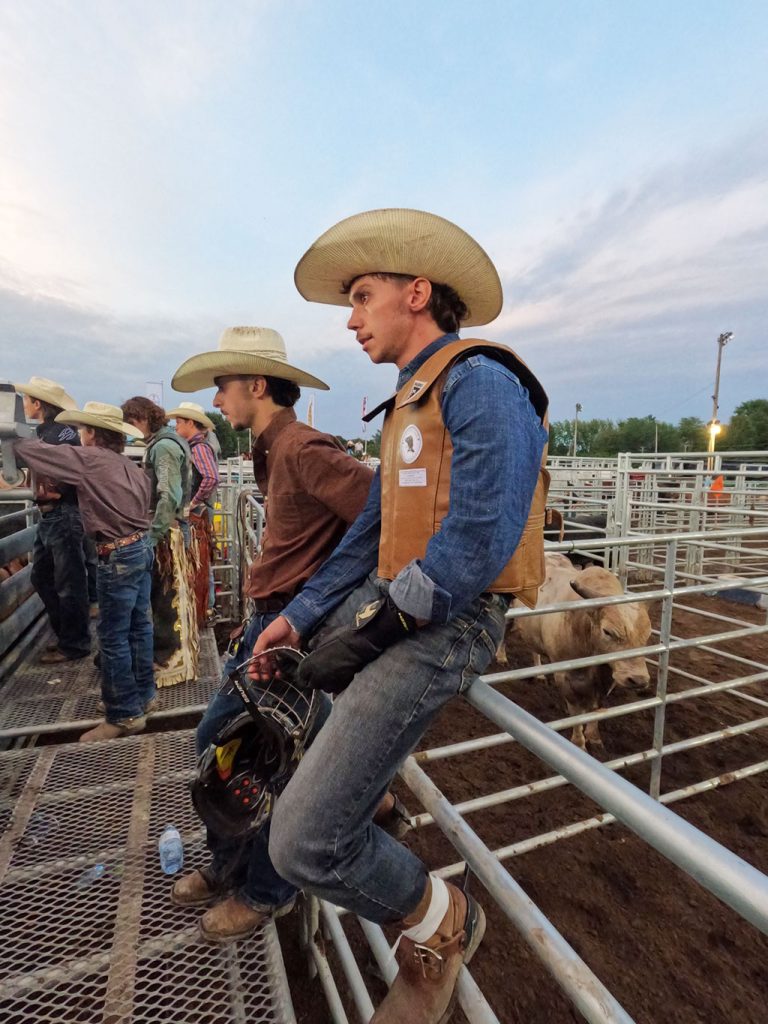
Brother Mathis offers support while bull rider Benjamin ponders his life's choices! Photo: Jacob Brunette-Savard.
Western culture is growing in popularity across Canada, with such events as bull riding, bronco riding (bareback and saddled), and trick riding, against a backdrop of musical performances and kitchen parties.
“Rodeos, agricultural fairs and Western festivals are a fixture of rural communities, much like Canada’s fur and sealing sectors,” says FIC's Executive Director Doug Chiasson. “Benjamin brings determination, discipline and perseverance to his sport – qualities which make us proud to support him while spreading the word about fur and seal products.”
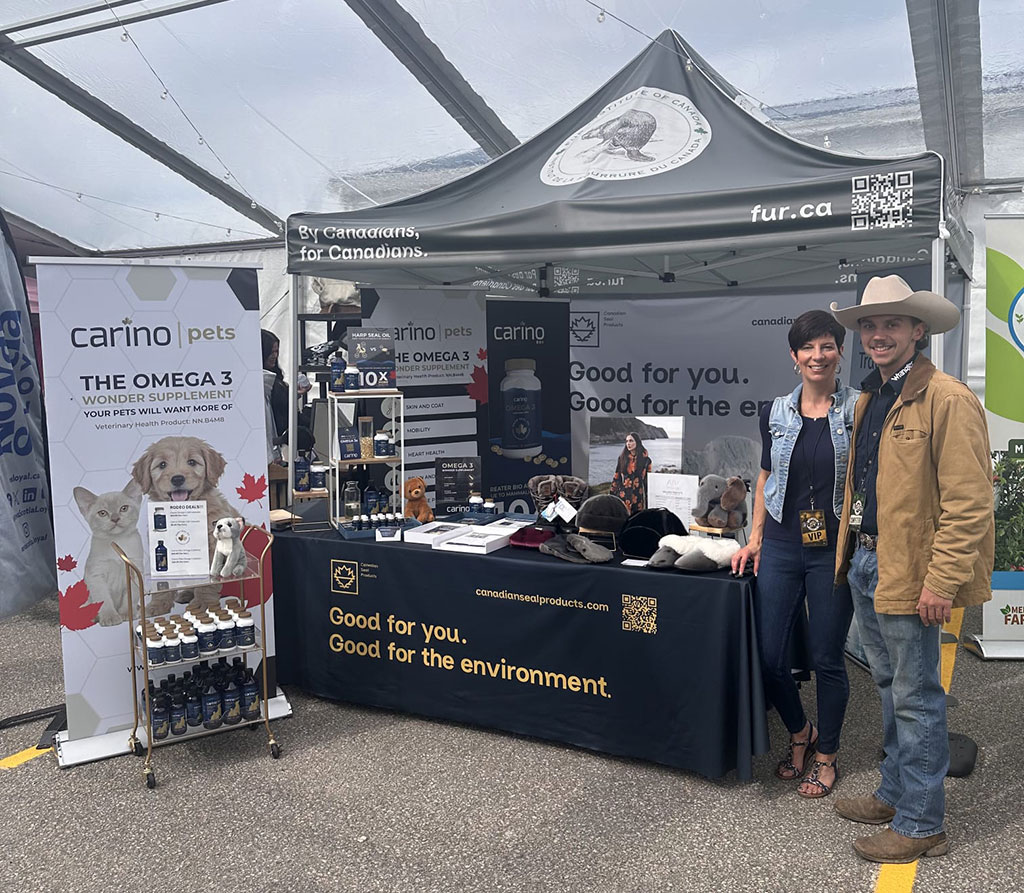
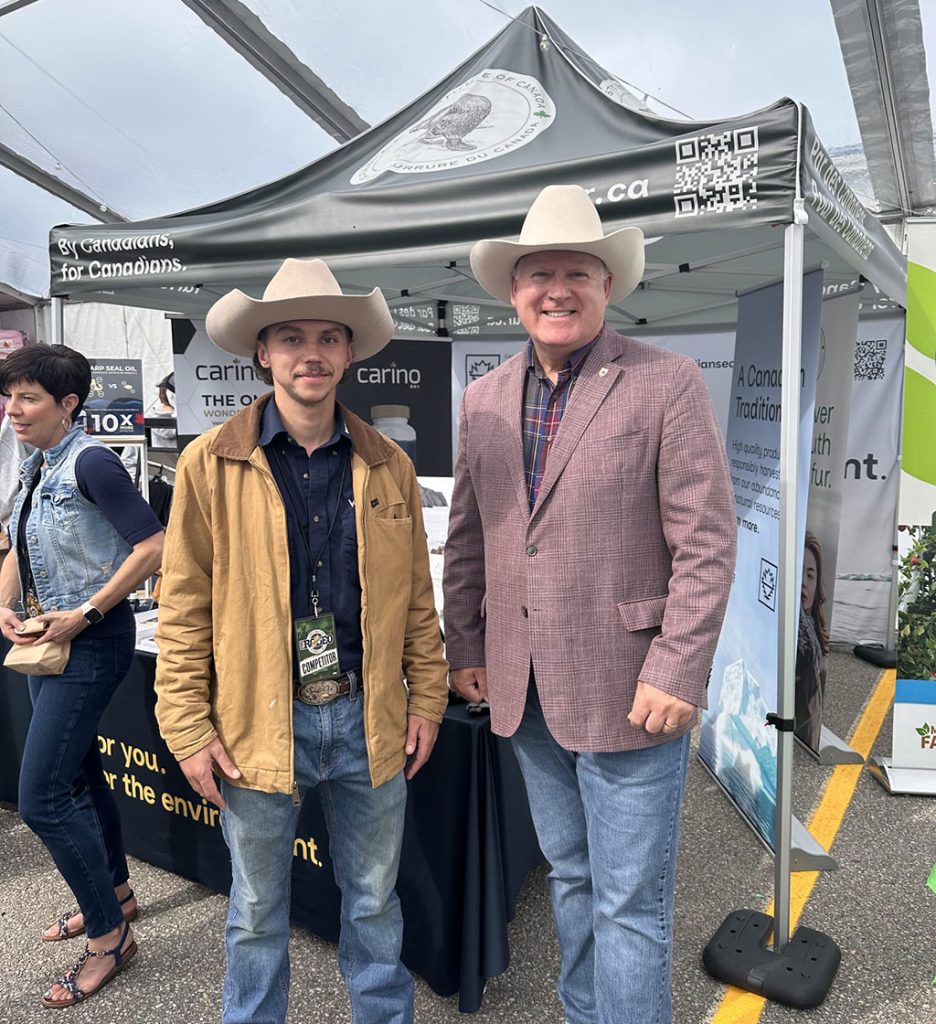
Catherine Moores and Benjamin Shaw stand proudly beside the all-new CSP booth. Photo: Jacob Brunette-Savard.
Aside from providing a change of scenery from Quebec Province, the Cape Breton festival also marked the debut of CSP's very own information booth. Manned by Catherine Moores of Carino, visitors learned all about Canada’s sealing sector, including its communities and their wide range of clothing, oil and food products.
“Cape Breton is a natural place for us to connect with people who understand the importance of rural communities, tradition and the sustainable use of Canada’s natural resources,” says Chiasson. “We’re excited to support the Cape Breton Pro Rodeo, cheer Benjamin on in the arena, and meet people from across Atlantic Canada throughout the weekend.”
By partnering with Benjamin Shaw, CSP will gain visibility at such festivals both through its information booth, and also via its branding on Benjamin's competition vest and trailer, and photos and videos documenting his experiences on the rodeo circuit.
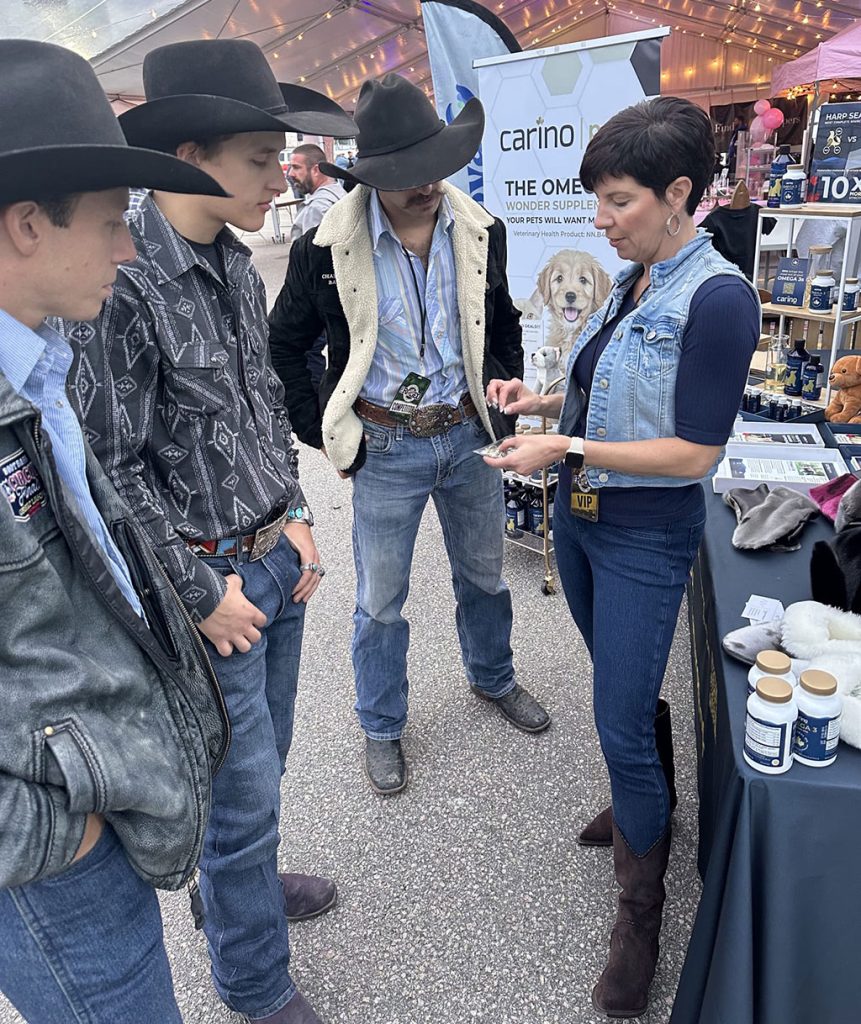
Catherine Moores presents seal oil supplements to three top competitors from the US. Photo: Jacob Brunette-Savard.
L to R: Saddle bronc riders Stephan Graefen from Illinois, and Tate Minor from Oklahoma; and bareback rider Stetson Bierman from Illinois. Photo: Jacob Brunette-Savard.
The Man Himself
https://youtu.be/qQrCIETGPL0
Originally from the Gaspé Peninsular and now based in Montreal, Benjamin, 24, came to bull riding after serving in the Canadian Armed Forces. Drawn to the sport’s intensity and constant demand for improvement, he gained recognition in 2025 by winning the Jackpot at Ranch Gagnon and BullMania in Sorel-Tracy.
“Having the support and trust of the FIC and CSP makes a meaningful difference as I continue competing and developing as an athlete,” says Benjamin. “Rodeo has a long history in Canada, and so do the fur and sealing sectors, so this is a great opportunity to bring these two parts of our heritage together.”
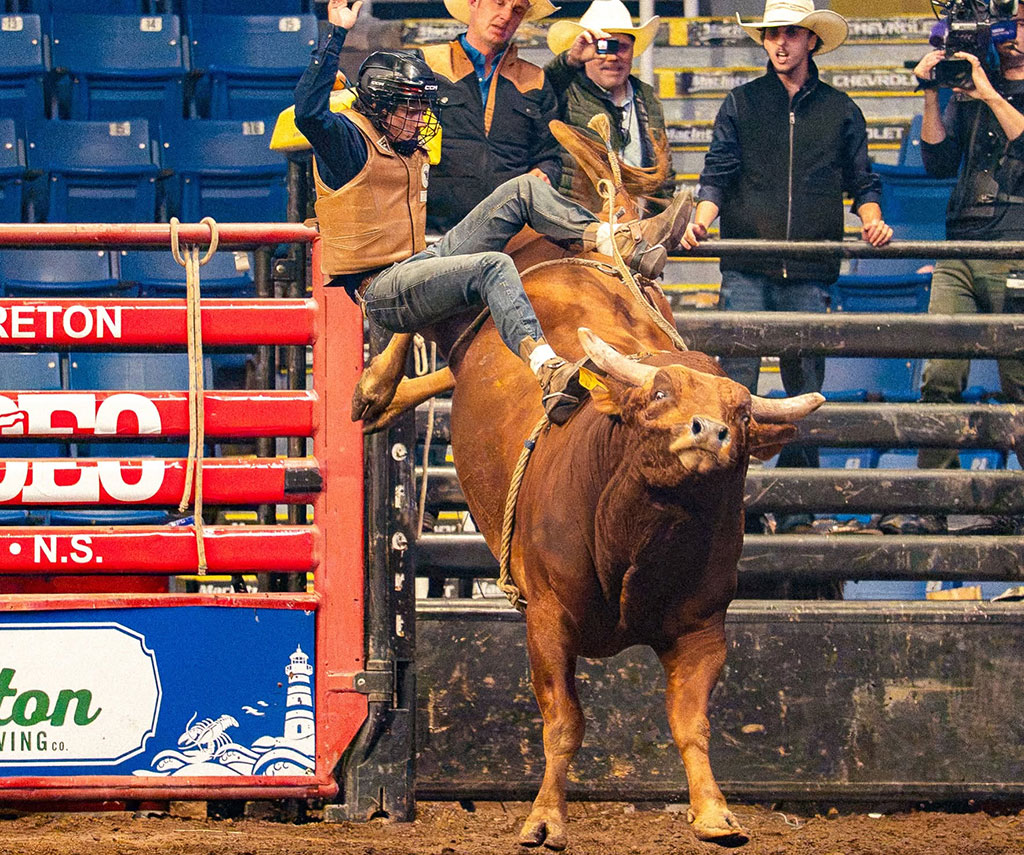
"Chilly" the bull clearly doesn't want Benjamin Shaw on his back! Photo: Cape Breton Pro Rodeo.
Benjamin rode twice in Cape Breton, on 1,800-lb bulls called "Chilly" and "Equalizer". In what was just another day at the office for a bull rider, Chilly managed to smash his free hand against the chute before the gate had even been opened!
Truly, bull riding is not a sport for the faint of heart, so we hope the celebrities Benjamin got to rub shoulders with helped make up for it!
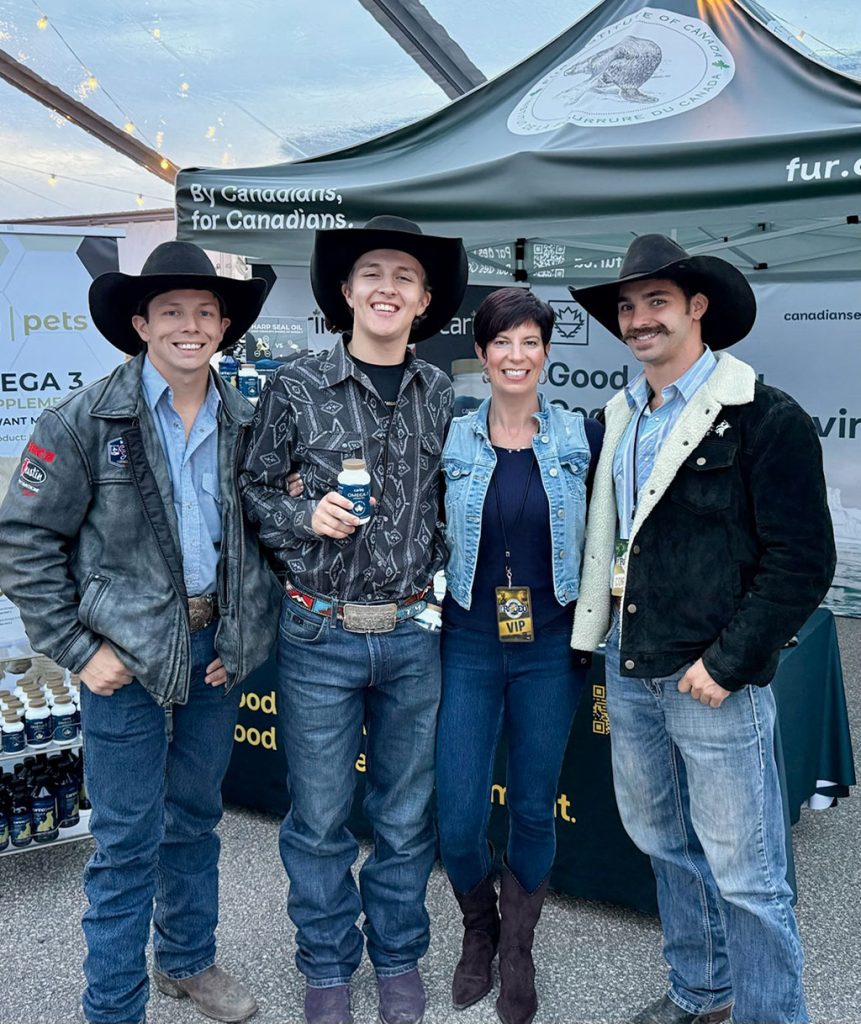
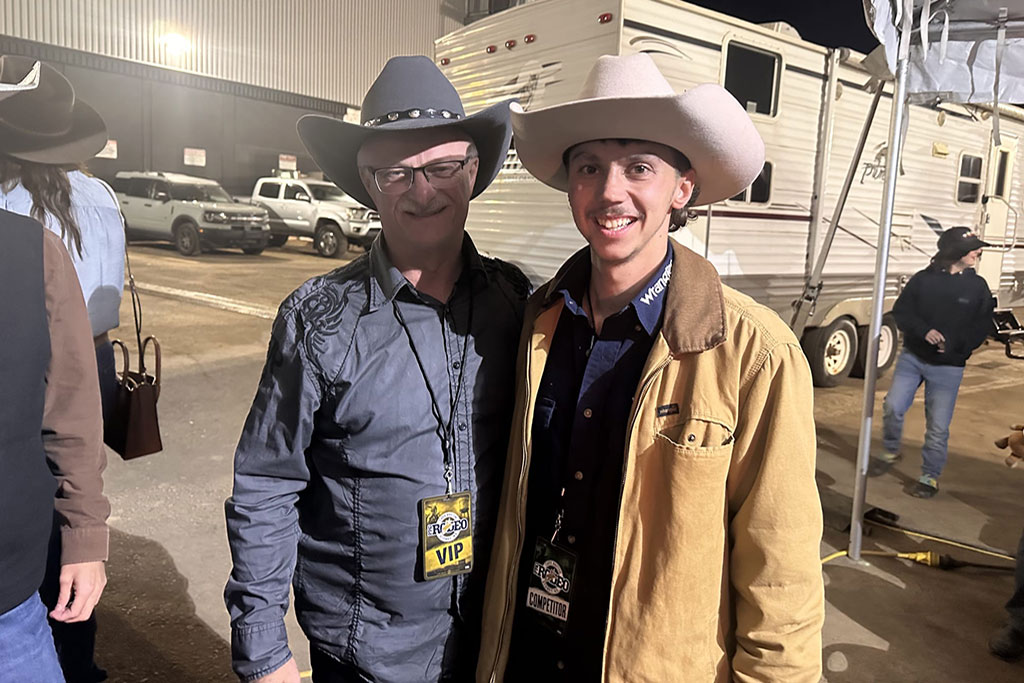
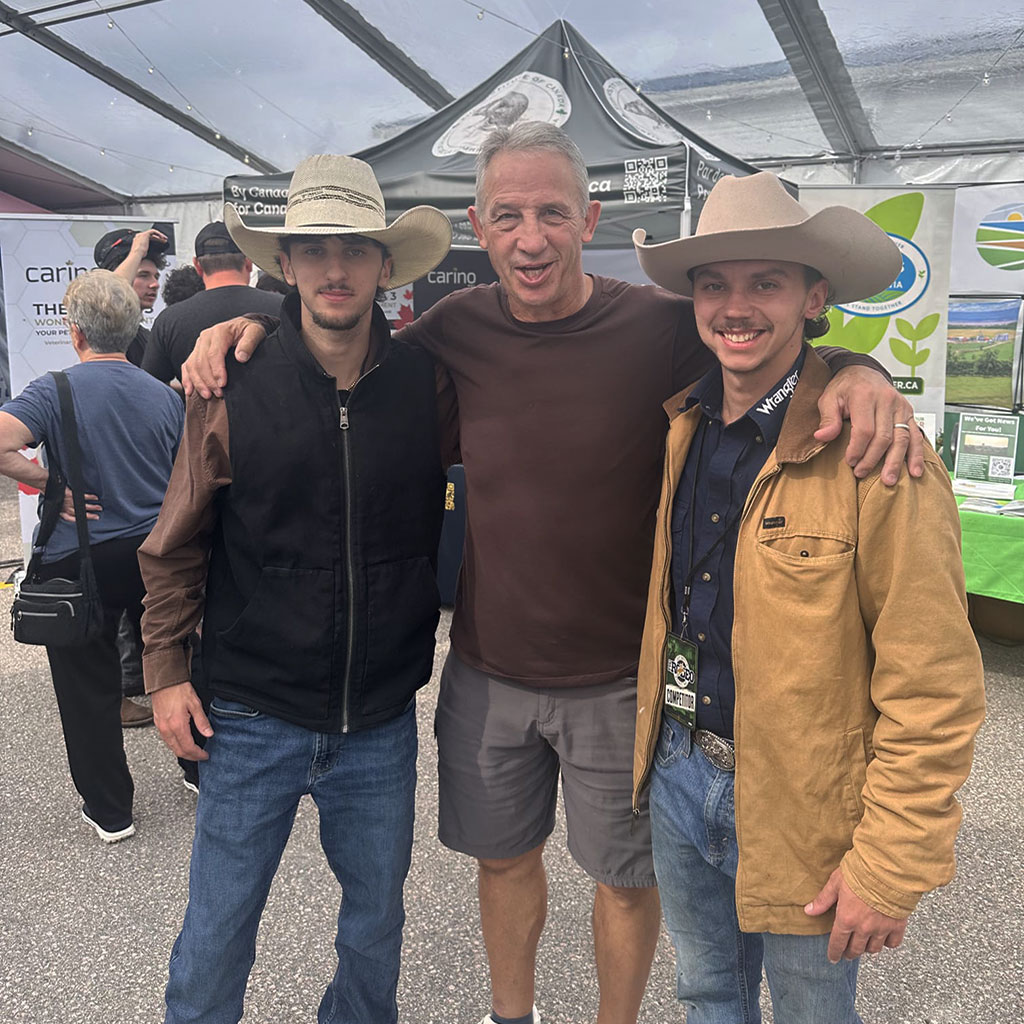
Nova Scotia Minister of Housing John White received a "VIP" badge, while Benjamin Shaw was a "competitor", which we found just as impressive! Photo: Jacob Brunette-Savard.Benjamin Shaw rubs shoulders with Cecil Clarke, Mayor of Cape Breton Regional Municipality. Photo: Jacob Brunette-Savard.Here the Shaw brothers pose with former National Hockey League player Ron Sutter. Photo: Jacob Brunette-Savard.
***
To learn more about donating to Truth About Fur, click here.
Sometimes called “the most dangerous eight seconds in sports”, bull riding at Western-themed events is growing in popularity across Canada…. Read More
Staying on a bucking bull, even for just eight seconds, is no small feat! Photo: Jacob Brunette-Savard.
Sometimes called "the most dangerous eight seconds in sports", bull riding at Western-themed events is growing in popularity across Canada. Now sponsoring bull rider Benjamin Shaw, the Fur Institute of Canada hopes to educate rodeo fans about fur in general and in particular about its brand Canadian Seal Products.
By the time the Fur Institute of Canada (FIC) and Canadian Seal Products (CSP) came into my life this summer, my rodeo season was already well underway. I had already been travelling, riding, falling, learning and trying to establish myself on the circuit.
So the sponsorship did not start my season. It arrived right in the middle of it, when I was already deep into the grind.
And from that point on, things got pretty eventful.
My brother has been beside me through almost all of it. Rodeo can look like an individual sport because there is only one rider sitting on the bull, but there is a lot that happens before and after those eight seconds. There are long drives, hours of waiting, equipment to deal with, injuries, disappointment and then another long drive to the next rodeo. Having my brother there every weekend has been a huge source of support.
In the Slack
With my brother Mathis in support, I get into the right frame of mind. Photo: Jacob Brunette-Savard.
The first stop after the sponsorship came together was Le Rodéo Pont-Château in Quebec, on July 17-18.
The new competition vest with the FIC and CSP logos was not ready yet, but the partnership was underway. Jacob from Torchia Communications came out to see me and we spent part of the day together at the rodeo.
There was just one problem. There were too many riders for everyone to compete during the main evening performance. I had insisted on riding that day because I already had another rodeo the next day, so when the draw was made, I ended up in the slack.
Instead of competing during the main evening performance in front of the crowd, I had to ride during the daytime competition. When you are trying to build yourself as a bull rider and now also represent sponsors, you want to be under the lights. You want the crowd. You want to be part of the show.
It was frustrating, but that is rodeo. You take the ride you are given.
The Vest Was Ready ... But
By the Festival Western de Saint-André-Avellin on July 23-25, the vest was ready. For the first time, I could climb onto a bull while sporting the FIC and CSP logos – except that I never got the chance!
There was a required equipment inspection before the rodeo, and while it was taking place, I was still on the road driving to Saint-André-Avellin. I got a call telling me I had missed the inspection. Because my equipment had not been inspected, I could not compete. I was disqualified before I ever got on the bull.
I had finally received the new vest. I was ready to represent my new sponsors in the arena for the first time. And instead, I had to watch.
It was another frustrating lesson in rodeo. There is a lot more to getting those eight seconds than simply being willing to climb onto the bull.
At Last
In Saint Hyacinthe, I could finally mount a bull while sporting the FIC and CSP logos. Photo: Jacob Brunette-Savard.
Before the competition began, as we do at every rodeo, we gathered for the cowboy’s prayer.
There were around 20,000 people there that evening. For a moment, with our cowboy hats held over our hearts and that enormous crowd around us, everything became still.
We do the prayer everywhere we ride, but that one felt different. There was something solemn about standing there together before the rodeo began, knowing that in a few minutes all the noise, movement and adrenaline would take over.
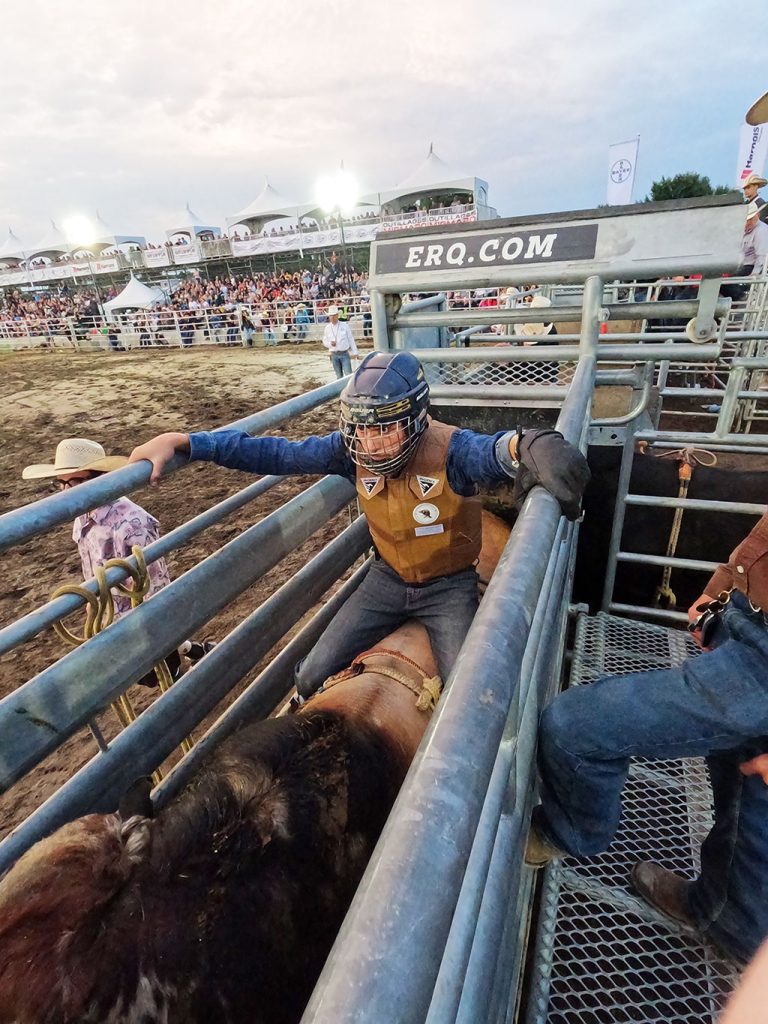
Then it was time to get ready. For the first time, Jacob came behind the chutes with me.
That is the part of the rodeo most people in the stands never really see. The bucking chutes are the steel enclosures where the bulls are held and where we climb onto them before the gate opens. Behind them, riders are getting ready, checking equipment, concentrating and preparing themselves for what is about to happen.
Jacob came right in beside me with his camera and started taking pictures while I prepared.
He was trying to get as close as he could without getting in my way or breaking my concentration. He was taking pictures of the preparation, the bull, the vest and everything happening around us.
Then somebody warned him that he should not be back there without a cowboy hat. I was about to put my helmet on anyway, so I handed him mine.
For the next few minutes, while I prepared to ride in my helmet, Jacob stood behind the chutes wearing my cowboy hat and taking pictures.
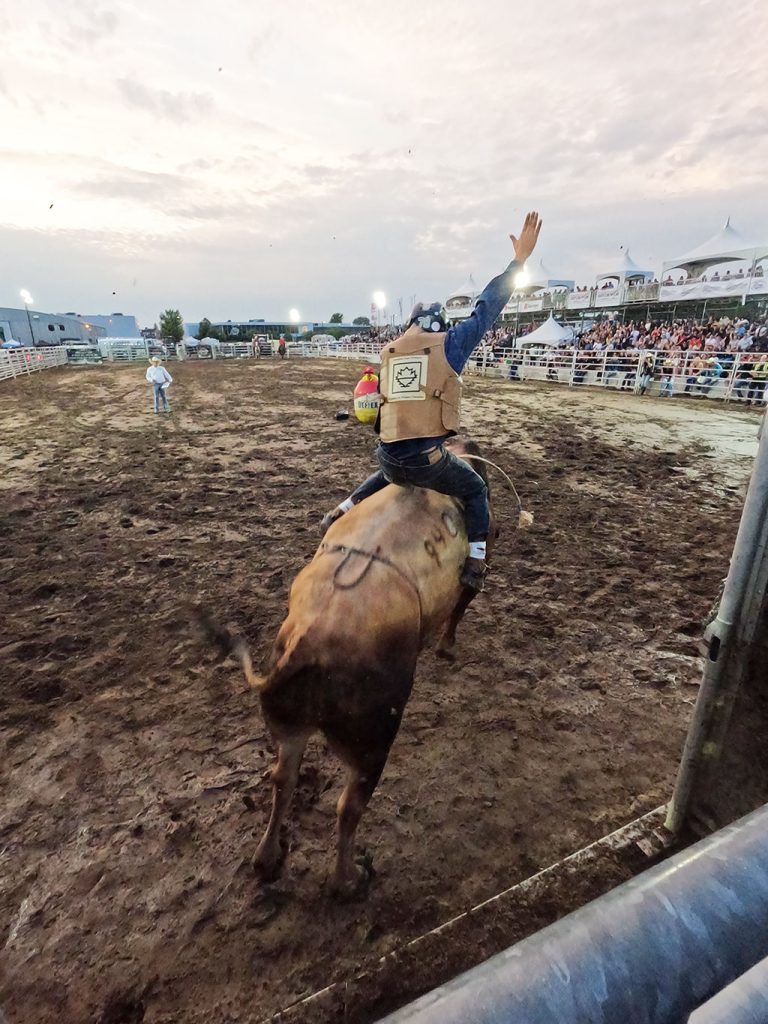
Just seconds after I came out of the chute, we had the photo we had been looking for – the one that really announced our partnership. My free hand is held high above me. Underneath me is this enormous bull, exploding out into the arena. The CSP logo is visible on the back of my vest, and behind us the sky is glowing with the last light of the evening.
We did not know it when Jacob pressed the shutter, but we had our picture.
I remember the bull in that photo very well. Before my ride, he was in the holding area trying to dominate the other bulls around him. He was huge, aggressive and clearly wanted every other animal there to know he was in charge.
And somehow, I seem to get those bulls all the time.
That is part of rodeo. You do not simply walk through the pens and choose the bull you want. It literally comes down to the luck of the draw. The riders’ names go into one hat and the bulls’ names go into another. A rider is drawn, a bull is drawn, and that matchup also helps determine the order in which everyone will ride.
Once your name comes out beside that bull’s name, that is your bull.
For me, the luck of the draw seems to have a sense of humour. It has become a bit of a running theme. I look at the bulls around me and there always seems to be one that is bigger, stronger or meaner than the others. Then I find out that one is mine.
Off to Hospital
This one photo truly announced my new partnership with the FIC. Photo: Jacob Brunette-Savard.
If Saint Hyacinthe gave us a great picture, the Festival du Cowboy de Chambord (July 30 to August 2) gave us a trip to the hospital!
I came down hard and injured my jaw. I knew immediately that something was wrong. I ended up at the hospital, and at that point I was worried that I had broken it. A broken jaw could have changed the rest of my season.
Then the doctors told me it was dislocated. I was happy.
That might sound ridiculous to most people. I had just dislocated my jaw riding a bull and somehow the diagnosis felt like good news. It was not broken, and that meant I could keep riding.
They put my jaw back into place, and almost immediately I was thinking about the next weekend.
I also needed a new helmet after the accident. I managed to get one just in time for my next ride. There was not much time to recover.
At the Festival du Cochon de Sainte-Perpétue, on August 1, I once again drew one of the toughest bulls there. Once again, the luck of the draw had put me on an enormous animal weighing around 1,800 pounds.
But that is also the point. You do not get better by riding easy bulls. You get better by getting on the bull they give you.
And sometimes that improvement comes with a price. Over the course of the following rides, I took more falls. My arm was hurting. My leg was hurting. My jaw was still recovering.
Then Monday morning came and I had to go back to work.
I work construction during the week. That creates a strange rhythm to my life during rodeo season. I spend the weekend getting thrown around by bulls, then I spend the week doing physical work while my body is trying to recover, then as soon as the weekend comes, my brother and I get back on the road and I do it again.
Seal Oil Supplements
Seal oil supplements have helped me manage the soreness and pain. Photo: Jacob Brunette-Savard.
Canadian Seal Products has also been helping me with that part of the journey. As part of the sponsorship, they provided me with seal oil supplements, a complete source of omega 3 with DPA, DHA and EPA. I have been taking them through this stretch of the season, and I feel they have helped me manage some of the soreness and pain that comes with riding and with trying to recover while still working construction during the week.
When your weekends involve getting thrown off animals that weigh around 1,800 pounds, and your weekdays involve physical labour, anything that helps you feel better and keep going matters.
There were more stops along the way, including the Festival Western Malartic (August 14-15). And through all of it, I kept riding with the FIC and CSP logos on my vest.
Feeling Accepted
Then came the Rodéo MSA on August 21-23, at Sainte Anne de Beaupré. That one stands out.
First, there is the setting. You are riding with the Saint Lawrence River stretching out nearby. The enormous Basilica of Sainte Anne de Beaupré rises beside you. In the other direction are the mountains, with Mont Sainte Anne in the background. It is hard to imagine a better place for a rodeo.
And I had a very good ride there.
I could feel that all those weekends were starting to add up. My riding was improving. I was staying with the bull better. I was learning how to react to what the animal was doing instead of simply hanging on and hoping.
But something else happened at Sainte Anne de Beaupré that probably meant just as much to me. I finally started to feel accepted.
The year before, some of the other bull riders had given me a hard time. I was still new. I was trying to find my place in a very particular world, and some guys did not make that easy.
You cannot really ask people in rodeo to respect you. You have to earn it.
By Sainte Anne de Beaupré, I had been showing up weekend after weekend. They had seen me take the big bulls. They had seen me get thrown. They had seen me get hurt. They had seen me come back.
For the first time, I felt like some of the riders who had been against me the year before were starting to see me differently. I was becoming one of them.
The following weekend (August 28–29) brought us to the Grand Rodéo in Saint Calixte.
I did not make the full eight seconds. But I rode better. And sometimes that is the part of bull riding that people watching from the stands do not necessarily see.
Eight seconds is the objective, but there are a hundred smaller victories on the way there. Staying centred a little longer. Reacting properly when the bull turns. Recovering your position when you start to lose it. Making it another second. Feeling more in control.
At Saint Calixte, even without the eight-second score, there was clear progress. That is really what these first weeks of the sponsorship have been about.
Having that kind of backing means a lot to me. Real sponsorship is not something that is easy to find in this sport, especially when you are still trying to establish yourself. Knowing that there are people genuinely behind me gives me confidence, but it also gives me opportunities I would not otherwise have. Their support allows me to spend more time practising on bulls, keep travelling to rodeos, and put more into becoming a better rider.
They are not just logos on my vest. They have become part of the journey.
Since the sponsorship began, there has been a frustrating daytime ride, a new competition vest, a disqualification before I could wear it in competition for the first time, a massive bull at Saint Hyacinthe, a great photograph, a dislocated jaw, a hospital visit, a new helmet, sore arms and legs, construction work between rodeos, thousands of kilometres on the road with my brother, some very difficult bulls, and a growing sense that maybe I am starting to earn my place among the other riders.
I am still chasing eight seconds. But I am getting closer.
On May 28, representatives of Canadian sealing communities descended on Ottawa’s Parliament Hill to mark National Seal Products Day, and… Read More
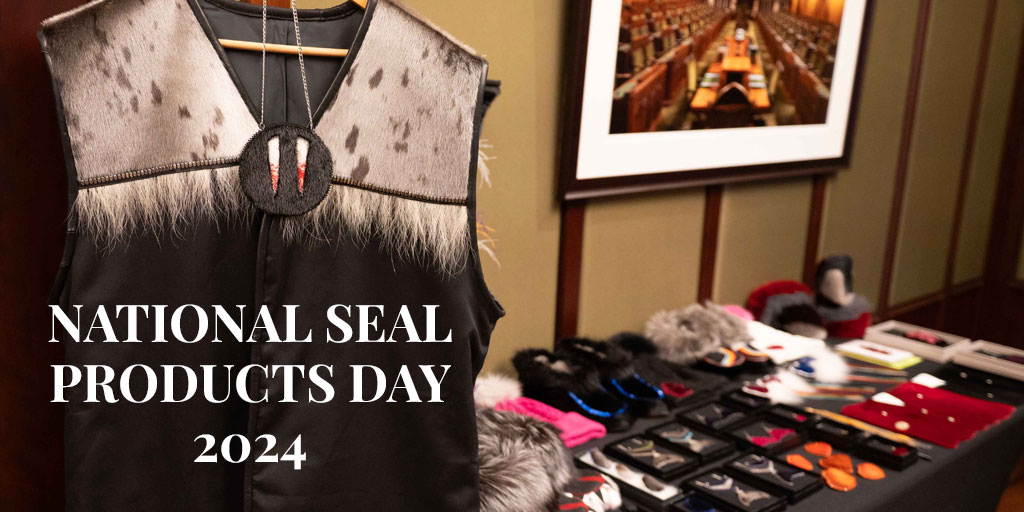
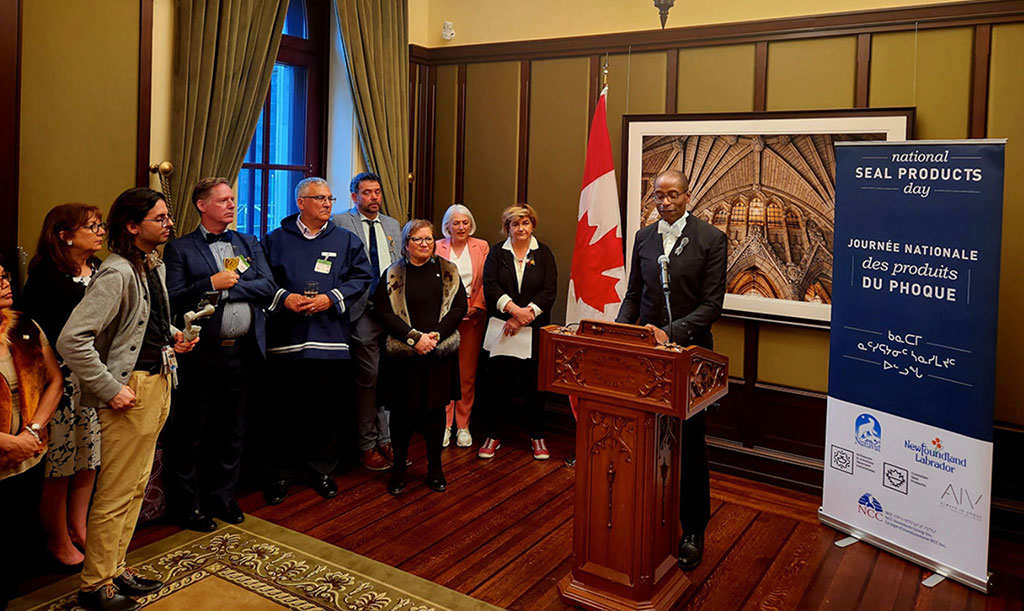
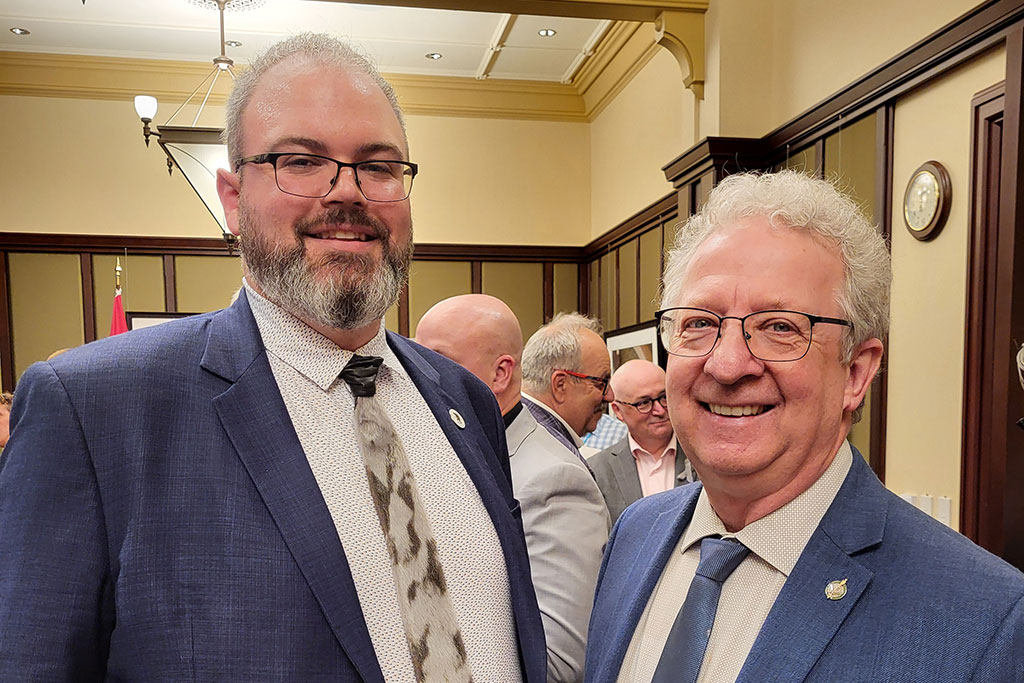
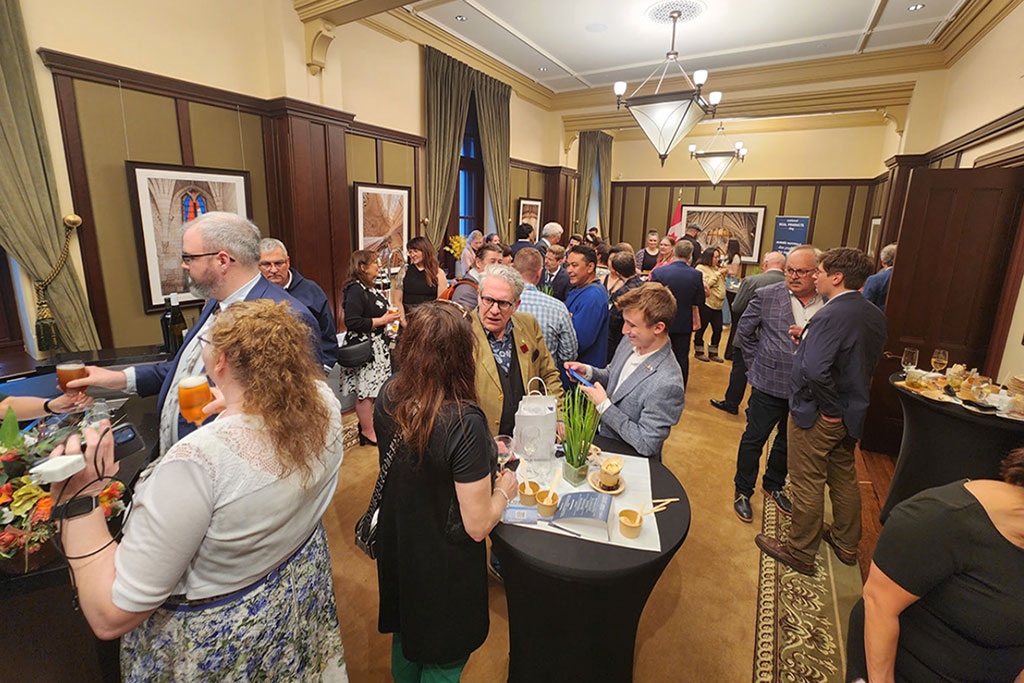
On May 28, representatives of Canadian sealing communities descended on Ottawa’s Parliament Hill to mark National Seal Products Day, and discuss the future of sealing with Ministers, Senators and MPs. Inaugurated in 2017, this event is a celebration of the cultural traditions, economic importance and sustainability of sealing in the lives of coastal communities.
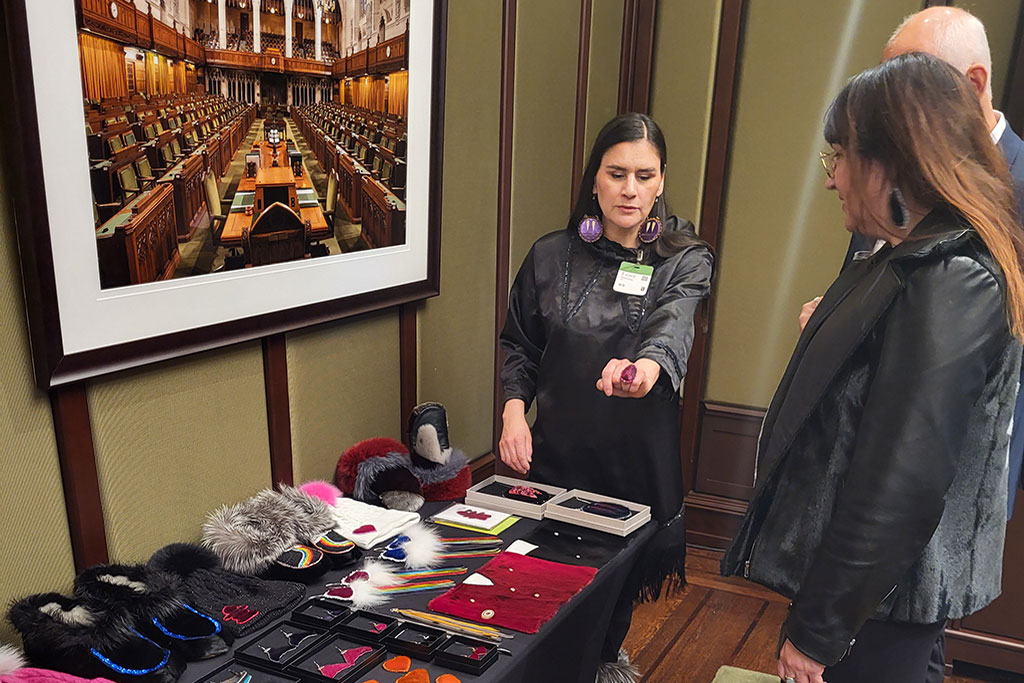
Inuvialuk fashion designer Taalrumiq shows off her wares.
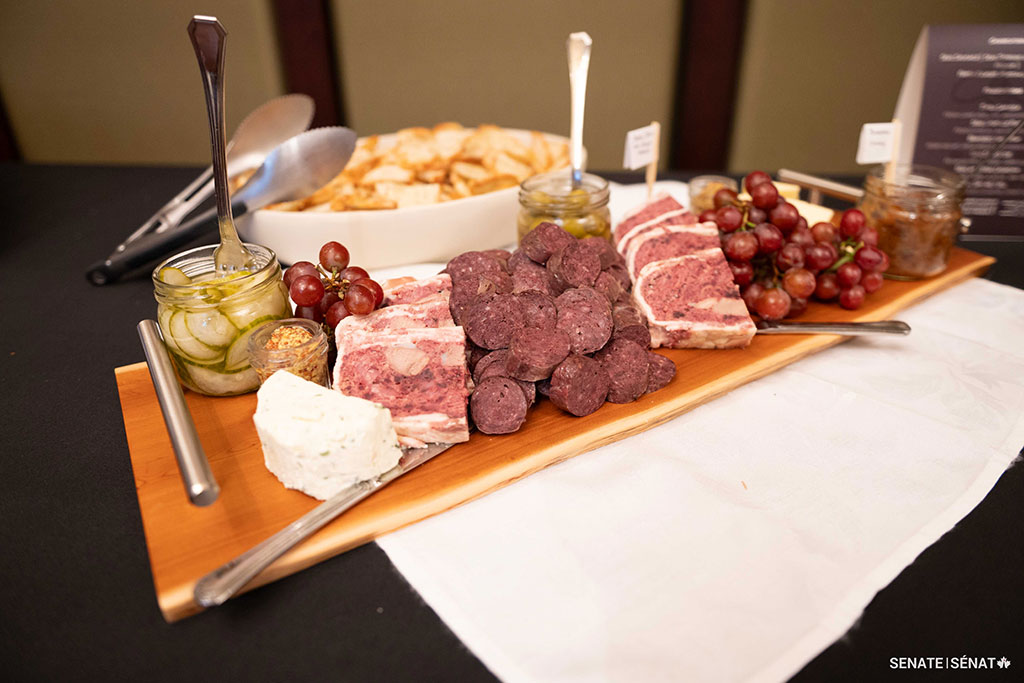
A delicious spread of seal charcuterie was provided by Pollen Nation.
Centre stage went to a wide range of seal products, from fur garments and accessories, to healthy and delicious foods and omega-3 oil supplements for both humans and pets. But National Seal Products Day is also an important opportunity for representatives of Canada’s sealing communities to discuss pressing issues with the country’s political leaders.
Greg Fergus, Speaker of the House of Commons, officially opened proceedings.
“In all our meetings with government representatives, we emphasized our consistent dedication to environmental stewardship,” says Doug Chiasson, Executive Director of the FIC. “This commitment is vital for the well-being of sealing communities, both environmentally and economically.”
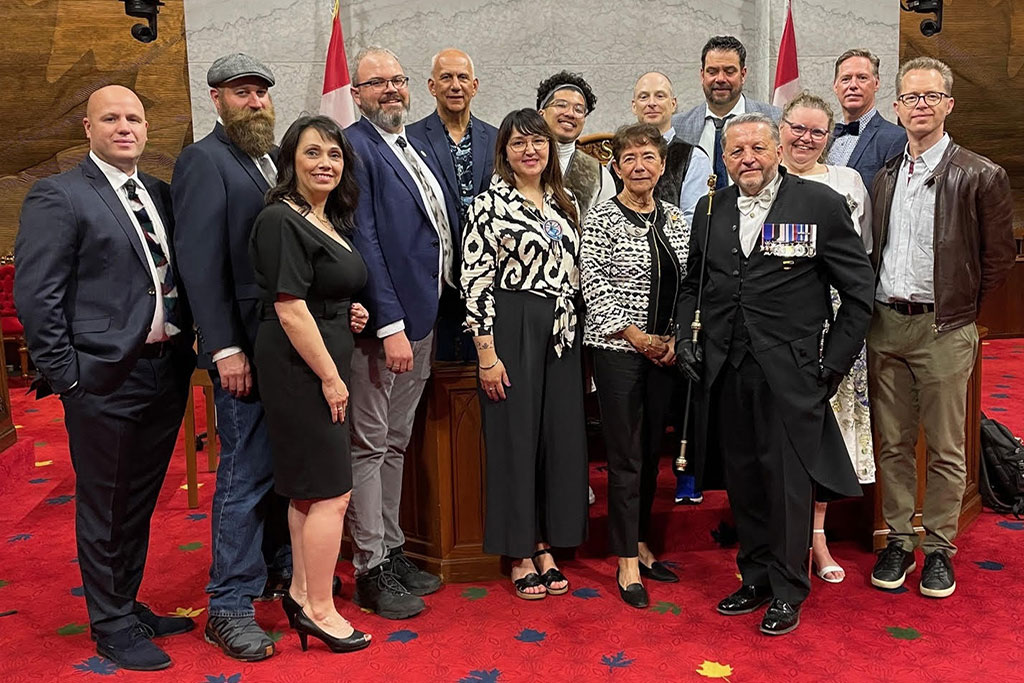
L to R: Darren Halloran (Always in Vogue); Kendall Flood (Ár n-oileán Resources); Charlene Penney (Timeless North Designs); Doug Chiasson; Brian Dicks (FIC Board member); Chief Jenny Brake (Qalipu First Nation); Jose Atienza (Government of Nunavut); Sen. Bev Busson (Deputy Chair, Senate Fisheries Committee); Lance Charlton (Government of Nunavut); Clarence Synard (NCC Investment Group); J. Greg Peters (Usher of the Black Rod); Rowena House (NCC Investment Group); Les Hickey (Government of Nunavut), Patrick Duxbury (Inuit Development Corporation Association). Photo: Senate of Canada.
In practical terms, what are these gatherings intended to achieve?
“Our main objective is to grow existing markets for seal products, both in Canada and overseas, and hopefully open up new ones,” explains Chiasson. “These markets suffered terribly from animal rights campaigns starting as long ago as the 1960s, and for decades it was a question of whether they could even survive. But at long last, we believe we’ve turned a corner on the road to recovery.”
FIC Executive Director Doug Chiasson talking with MP Mel Arnold, member of the House of Commons Standing Committee on Fisheries and Oceans.
“Our political leaders have a vital role to play in this, and it’s for this reason that we gather each year in Ottawa for National Seal Products Day. As this year’s attendance showed, many politicians share our commitment to promoting seal products, so the domestic market at least faces a brighter future. Whether we can persuade international markets to share our vision, that’s the biggest challenge facing us all.”
Where does this optimism – for the domestic market at least – stem from? Above all, it is society’s growing preference for products that are both healthy and good for the planet.
“More than ever, consumers are demanding food and clothing products that are natural, healthy, and sustainable,” says Chiasson. “Seal products fit the bill perfectly, and it’s our mission to spread this message.”
The Canadian Sealers Association has lost one of its major figures and a courageous champion with the death of past… Read More
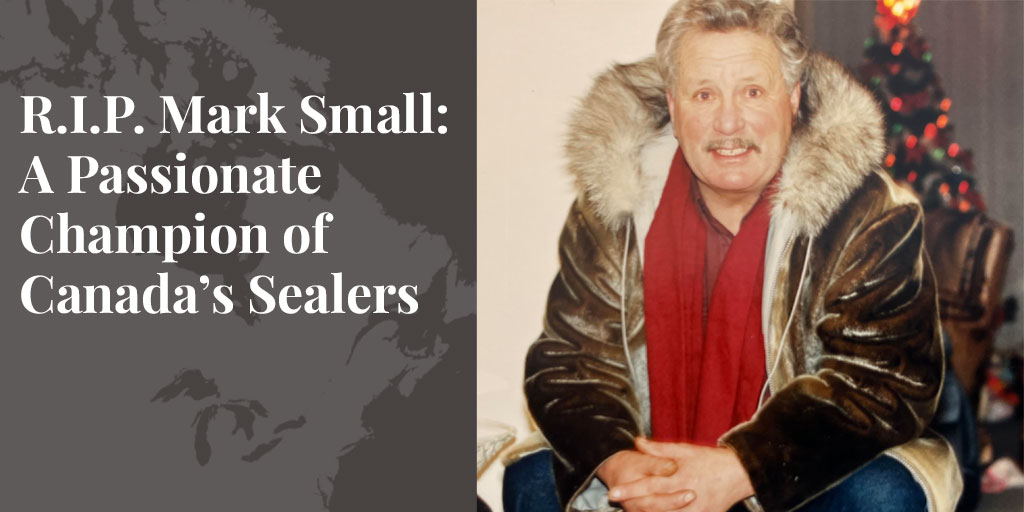
Mark in his favourite sealskin jacket.
The Canadian Sealers Association has lost one of its major figures and a courageous champion with the death of past president Mark Small, on January 18. He was 83 years old.
To show respect for Mark's contributions to the CSA, to our home province, and to sealing communities across Canada, Jim Winter, founding CSA president, Eldred Woodford, current president, and Albert Newhook, an earlier president, were present for the celebration of Mark's life at Trinity Pentecostal Church, in Baie Verte, on the remote northeast peninsula of Newfoundland.
For decades Mark was a major figure in the association's efforts to counter the propaganda of animal rights corporations and remove the politically motivated bans on Canadian seal products in many countries.
Mark cared. More importantly, he acted on his caring. What more can you ask of a person?
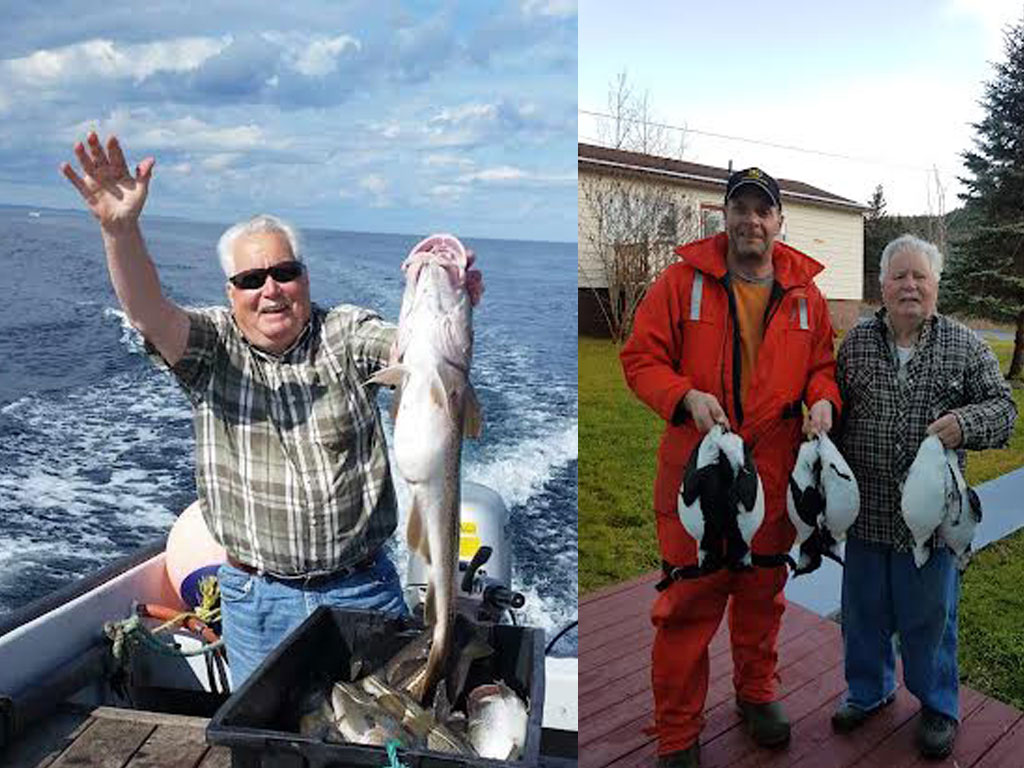
Left: Excited at the thought of fish and brewis for supper. Right: Father and son with their catch of turrs (to use the local lingo). You may know them as common murres or guillemots.
Caring is one thing, but taking action is a much harder thing to do. For decades Mark took action. He took action on behalf of all sealers throughout Canada. His presence made a difference. His presence at events was the presence of the people, in the midst of various Canadian government politicians and bureaucrats. In fact, often his presence was to spur those entities into taking concrete positive steps to resolve the issues that plague the Canadian sealing industry – issues that also plague rural coastal communities like his beloved Baie Verte.
Mark saw the sealing industry not only as a 400-year-old tradition throughout coastal communities in Atlantic Canada, but also as an important contributor today to the continued existence of those rural communities dependent on the mosaic of incomes that provide a living for their citizens. Sealing, fishing, hunting, farming, being a "jack of all trades" – all pieces in the financial mosaic that rural coastal communities depend on for survival. Mark spoke our facts, our realities, in Canada and to foreign politicians and media. He did so clearly, passionately, and concisely.
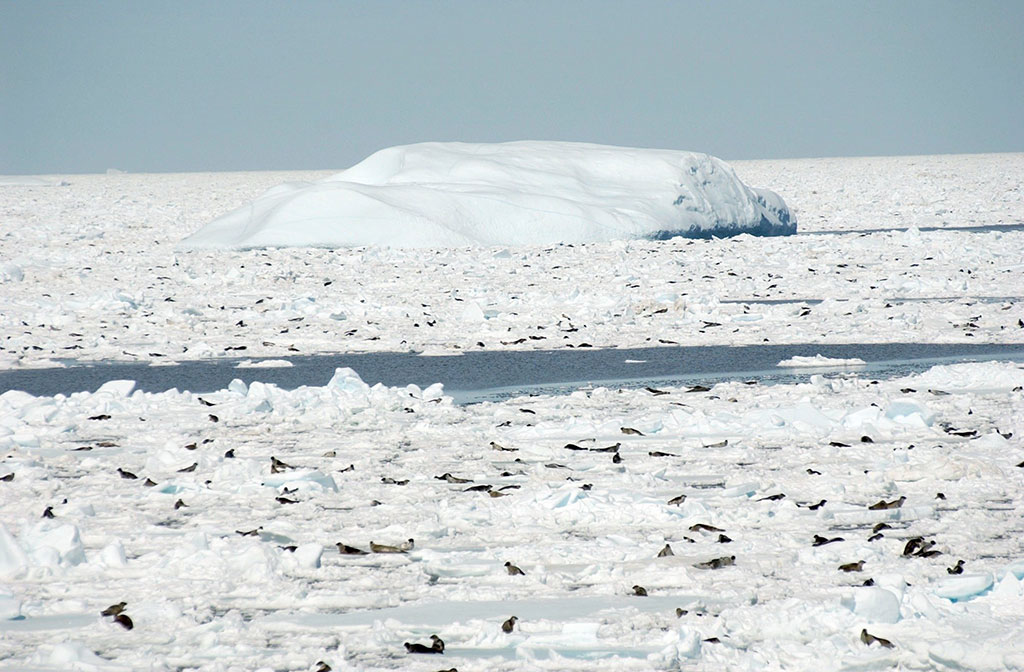
Harp seals as far as the eye can see – a view that Mark Small loved. Photo: Jim Winter
Mark was a man of great caring, and that caring was rooted in his faith as a pastor in the Pentecostal church. His faith infused everything he did. It made him the man he was.
He was not only an activist for the sealing industry, he was equally active in the fishery and in his community.
Despite the challenges of all those activities, his prime focus was always on his wife, Patricia, and their three sons. As time passed he became a loving grandfather, uncle, and great uncle.
Mark, as you set sail on this new voyage may you have fair winds, full holds and bloody decks. R.I.P.
https://www.youtube.com/watch?v=WcypI9yHxiY
Mark Small is featured in this old episode of CBC TV's series Land & Sea.
On Nov. 23-24, all the right people – leaders from the European Union and Canada – were gathered in St…. Read More
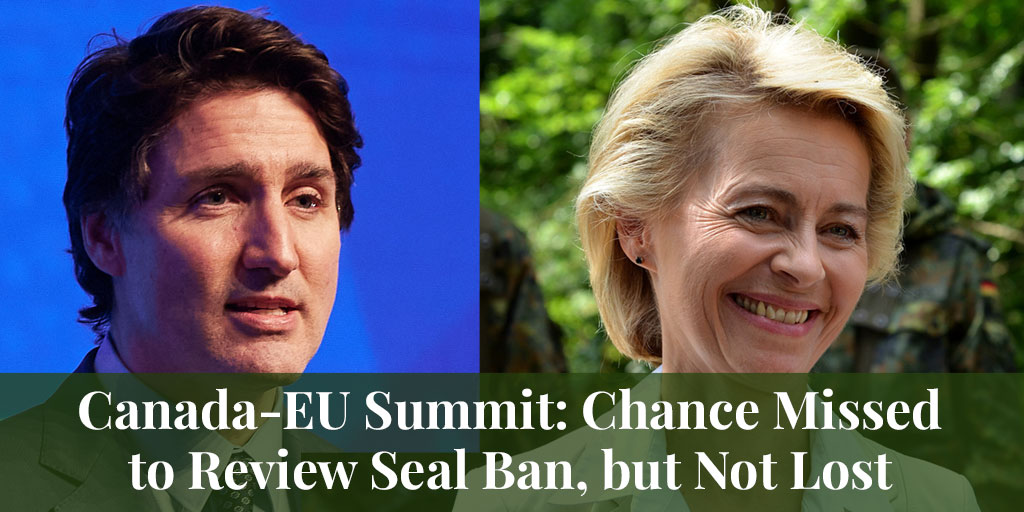
Photos: Canadian Prime Minister Justin Trudeau by Eurasia Group, CC BY 2.0; European Commission President Ursula von der Leyen by Dirk Vorderstraße, CC BY 3.0; via Wikimedia Commons
On Nov. 23-24, all the right people – leaders from the European Union and Canada – were gathered in St. John’s for the Canada-EU Summit. Those of us representing Canadians who make their livings in remote and rural areas from Prince Rupert to Newfoundland’s outports, by harvesting fur and seals, were hopeful. Meetings such as these provide high-level government representatives with an opportunity to discuss issues that matter to their respective governments behind closed doors and far removed from everyday citizens.
And, this summit was different. Instead of being monitored only by political gadflies and lobbyists, people in remote communities across Eastern and Northern Canada watched closely. They watched because the summit was held in Newfoundland, where the ocean and its bounties have long been the bedrock of the economy and culture.
This, of course, is the same St. John’s that once was home port to steamers, which brought hundreds of Newfoundlanders to the ice of the North Atlantic to harvest seals. The same St. John’s where European celebrities descended to hold press conferences in front of TV cameras to attack the livelihoods of hunters who put their lives on the line on the ice to provide for their families. The same St. John’s where, for over 30 years, the elected officials of the provincial government sat on sealskin chairs as they debated the business of the day.
In 2009, the predecessors of those same EU officials who were fêted in St. John’s banned the trade of Canadian seal products, striking a blow to rural communities across Eastern and Northern Canada that had relied on the hunting of seals for hundreds of years. Regulation No 1007/2009 inflicted untold damage not only to communities in Newfoundland and Labrador and Quebec, but also to Inuit communities across Canada’s North.
The impact on Inuit communities was the genesis of a challenge to the ban in the European Court of Justice, brought by Inuit Tapiriit Kanatami and supported by the Fur Institute of Canada and others. This was followed by a challenge by the Government of Canada at the World Trade Organization. Though it upheld the ban, the WTO challenge forced the EU to allow an exemption for seals harvested by “Inuit and other Indigenous communities”.
This is the exemption that European Commission President Ursula von der Leyen said was “working well” and that a “good balance” had been found on seals. This is completely and unambiguously false. Only two bodies in Canada are recognized as being able to certify that a seal product comes from an Indigenous harvest: the Government of Nunavut and the Government of Northwest Territories. In a report from her own Commission, it shows that Nunavut has only exported two sealskins to Europe, in 2020, and the Northwest Territories exported just two sealskin coats, in 2022.
European Sealers Also Hamstrung
Perhaps even more revealingly, that same report contains four EU member states saying that the ban’s “impact has gone beyond its intended purpose”. These four states – Estonia, Latvia, Finland and Sweden – all still have their own seal hunts but are hamstrung the same way Canadian sealers are when it comes to trading their products.
In terms which would be shockingly familiar to anyone on Canada’s East Coast, these states raise concerns about the impacts of seals eating cod and salmon, about infecting fish with parasites, and impacts on commercial and recreational fisheries.
Unfortunately, EU and Canadian officials did not avail themselves of an ideal opportunity to reverse the historic injustice of the 2009 seal ban when they gathered in St. John’s.
But it’s not too late. The European Commission is launching a review of the Regulation on Trade in Seal Products in 2024. Canada can, should, and must work closely with the EU member states that are unhappy with the ban, supported by Canada’s sealing industry and Indigenous leadership, to overturn the regulation.
We also need European Commission leadership to engage honestly and candidly on the damage done by this ban and chart a course to move beyond the mistakes of the past. This conversation must be elevated to the most senior levels and involve representatives of the industry and Indigenous communities directly impacted, not the extremist animal-activist groups whose goal is to destroy the way of life of people who live close to the land – and sea – and who use renewable natural resources responsibly and sustainably..
Manage Consent
To provide the best experiences, we use technologies like cookies to store and/or access device information. Consenting to these technologies will allow us to process data such as browsing behavior or unique IDs on this site. Not consenting or withdrawing consent, may adversely affect certain features and functions.
Functional
Always active
The technical storage or access is strictly necessary for the legitimate purpose of enabling the use of a specific service explicitly requested by the subscriber or user, or for the sole purpose of carrying out the transmission of a communication over an electronic communications network.
Preferences
The technical storage or access is necessary for the legitimate purpose of storing preferences that are not requested by the subscriber or user.
Statistics
The technical storage or access that is used exclusively for statistical purposes.The technical storage or access that is used exclusively for anonymous statistical purposes. Without a subpoena, voluntary compliance on the part of your Internet Service Provider, or additional records from a third party, information stored or retrieved for this purpose alone cannot usually be used to identify you.
Marketing
The technical storage or access is required to create user profiles to send advertising, or to track the user on a website or across several websites for similar marketing purposes.