Fur-Sponsored Bull Rider Risks All in Cape Breton
by Truth About Fur, voice of the North American fur tradeThe Fur Institute of Canada (FIC) is now an official rodeo sponsor, looking to educate fans about fur in general…
Read More



Truth About Fur – The Blog is an opinionated and free-wheeling new voice for the North American fur trade. This blog is a place for open discussions about the ecological, social and even philosophical dimensions of fur in our society. We will also address criticisms head-on, challenging some of the unfair misconceptions about our trade that some animal activists continue to propagate. All our guest bloggers are real people who make their living in the modern fur trade – as farmers and trappers, or in auctions, processing, design and fabrication or marketing. Please read, share and comment. We only ask that if you comment on the post, please do so with respect. We hope you enjoy Truth About Fur – The Blog. For more information about the North American fur trade, please visit our website, Truth About Fur. – Alan Herscovici, Senior Researcher, Truth About Fur
The Fur Institute of Canada (FIC) is now an official rodeo sponsor, looking to educate fans about fur in general…
Read More
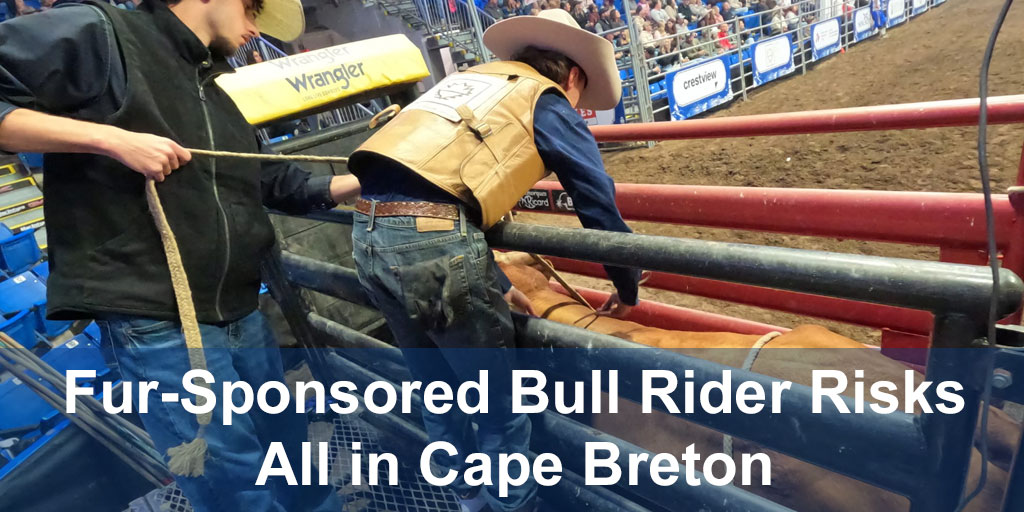
The Fur Institute of Canada (FIC) is now an official rodeo sponsor, looking to educate fans about fur in general and in particular about its brand Canadian Seal Products. In return, bull rider Benjamin Shaw gets to put his life on the line without the added worry of paying to compete and travel between venues.
Widely known as the national voice for Canada's fur sector, the FIC also represents the sealing industry through the Seals & Sealing Network. The SSN unites the country's commercial and Indigenous seal harvesters, processors, manufacturers and retailers to promote high-quality and sustainable seal oil, meat and fur. This it does via its two brands: Canadian Seal Products and Proudly Indigenous Crafts & Designs.
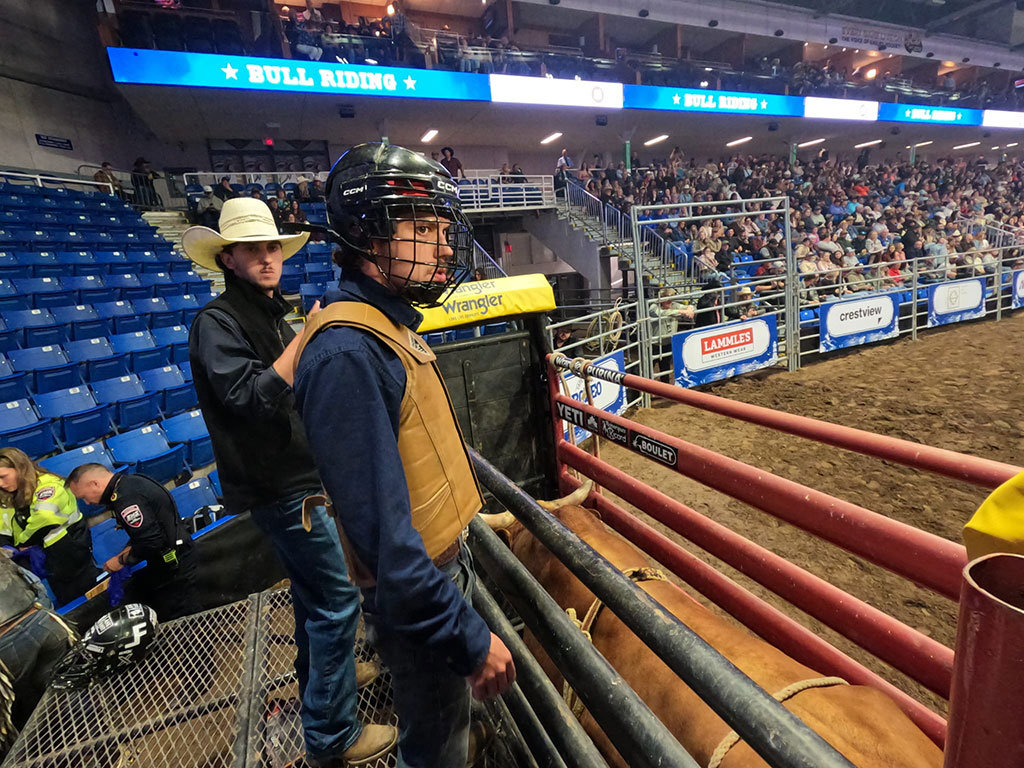
Western culture is growing in popularity across Canada, with such events as bull riding, bronco riding (bareback and saddled), and trick riding, against a backdrop of musical performances and kitchen parties.
“Rodeos, agricultural fairs and Western festivals are a fixture of rural communities, much like Canada’s fur and sealing sectors,” says FIC's Executive Director Doug Chiasson. “Benjamin brings determination, discipline and perseverance to his sport – qualities which make us proud to support him while spreading the word about fur and seal products.”
FIC's sponsorship deal kicked off on July 29 at the Expo agricole de Saint-Hyacinthe in Quebec, and most recently came to Nova Scotia for the Sept. 24-27 Cape Breton Pro Rodeo in Sydney.
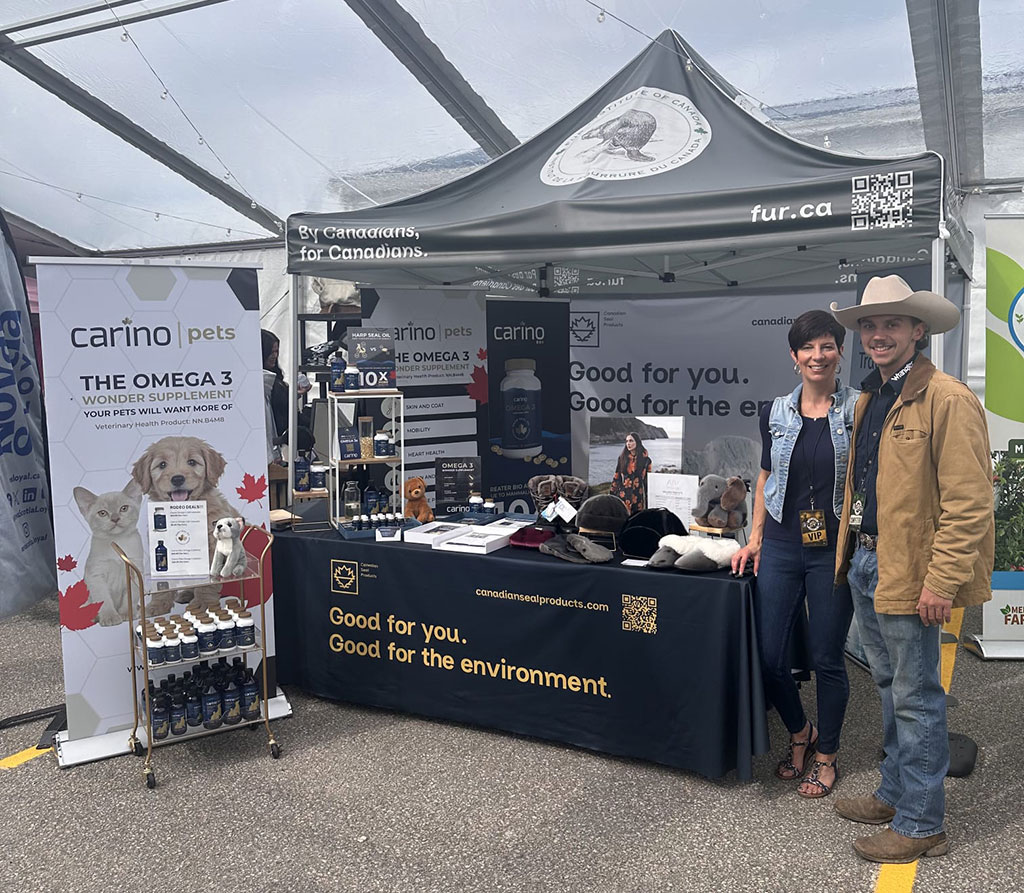
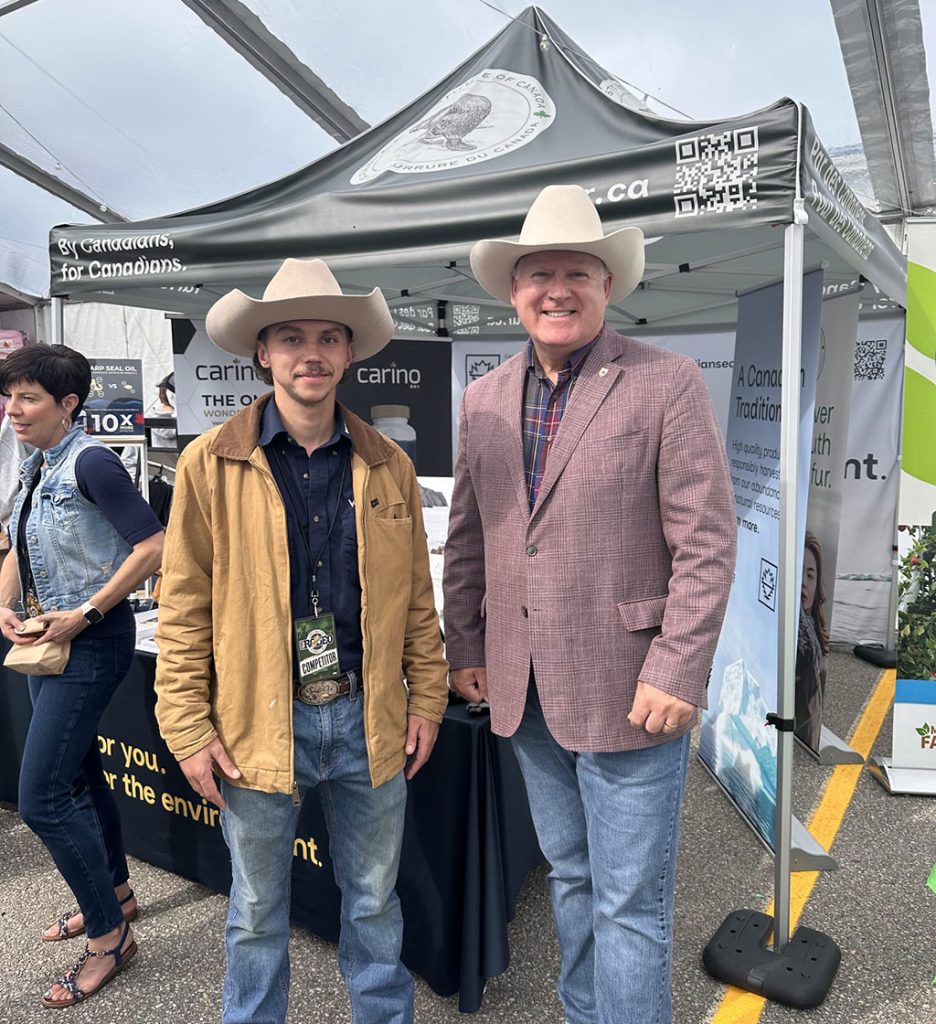
Aside from providing a change of scenery from Quebec Province, the Cape Breton festival also marked the debut of CSP's very own information booth. Manned by Catherine Moores of Carino, visitors learned all about Canada’s sealing sector, including its communities and their wide range of clothing, oil and food products.
“Cape Breton is a natural place for us to connect with people who understand the importance of rural communities, tradition and the sustainable use of Canada’s natural resources,” says Chiasson. “We’re excited to support the Cape Breton Pro Rodeo, cheer Benjamin on in the arena, and meet people from across Atlantic Canada throughout the weekend.”
By partnering with Benjamin Shaw, CSP will gain visibility at such festivals both through its information booth, and also via its branding on Benjamin's competition vest and trailer, and photos and videos documenting his experiences on the rodeo circuit.
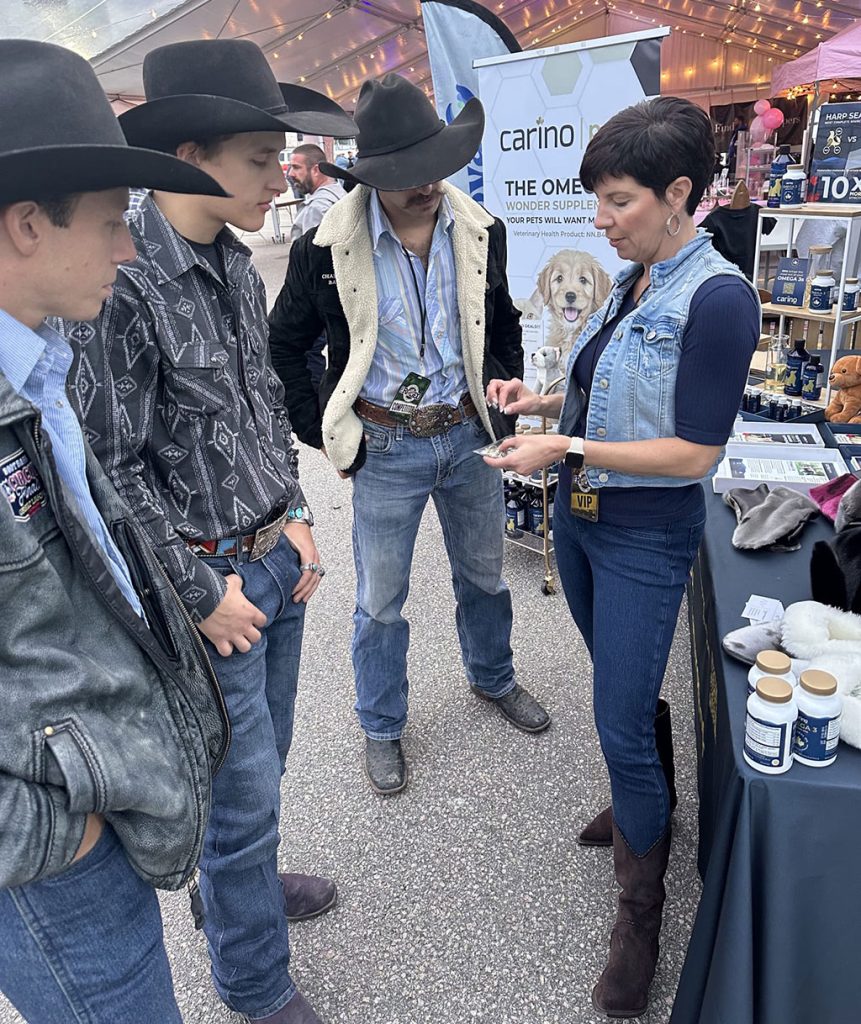
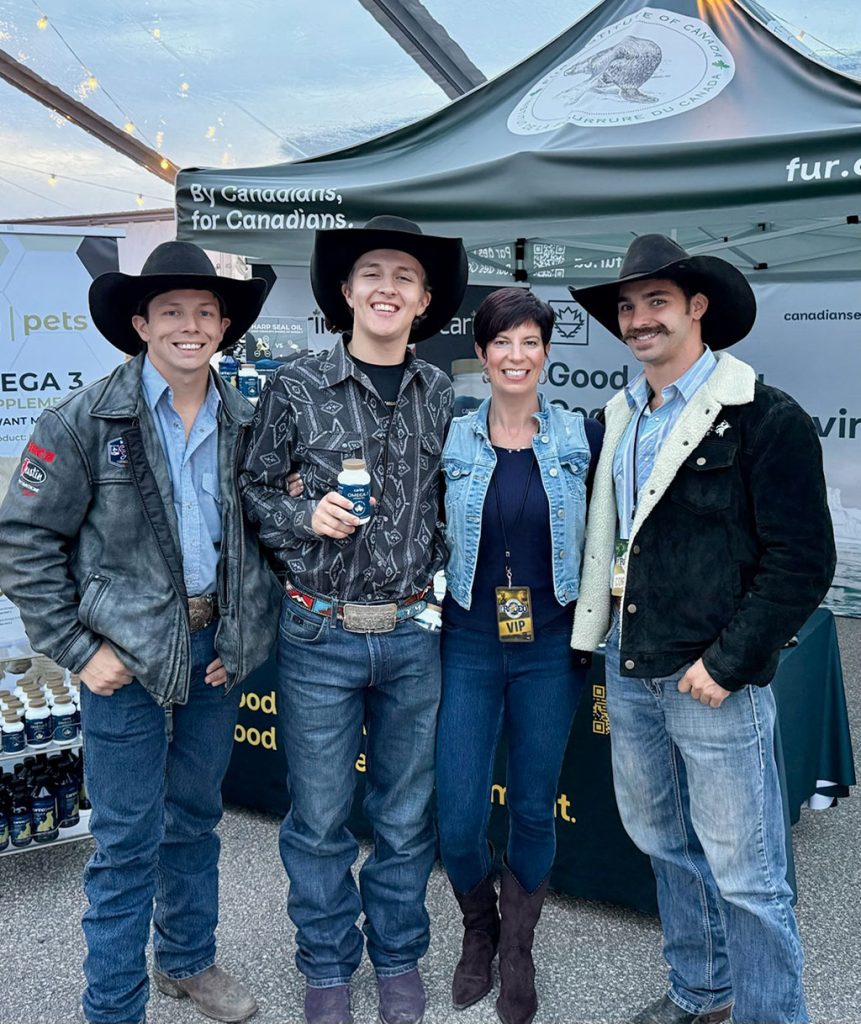
Originally from the Gaspé Peninsular and now based in Montreal, Benjamin, 24, came to bull riding after serving in the Canadian Armed Forces. Drawn to the sport’s intensity and constant demand for improvement, he gained recognition in 2025 by winning the Jackpot at Ranch Gagnon and BullMania in Sorel-Tracy.
“Having the support and trust of the FIC and CSP makes a meaningful difference as I continue competing and developing as an athlete,” says Benjamin. “Rodeo has a long history in Canada, and so do the fur and sealing sectors, so this is a great opportunity to bring these two parts of our heritage together.”
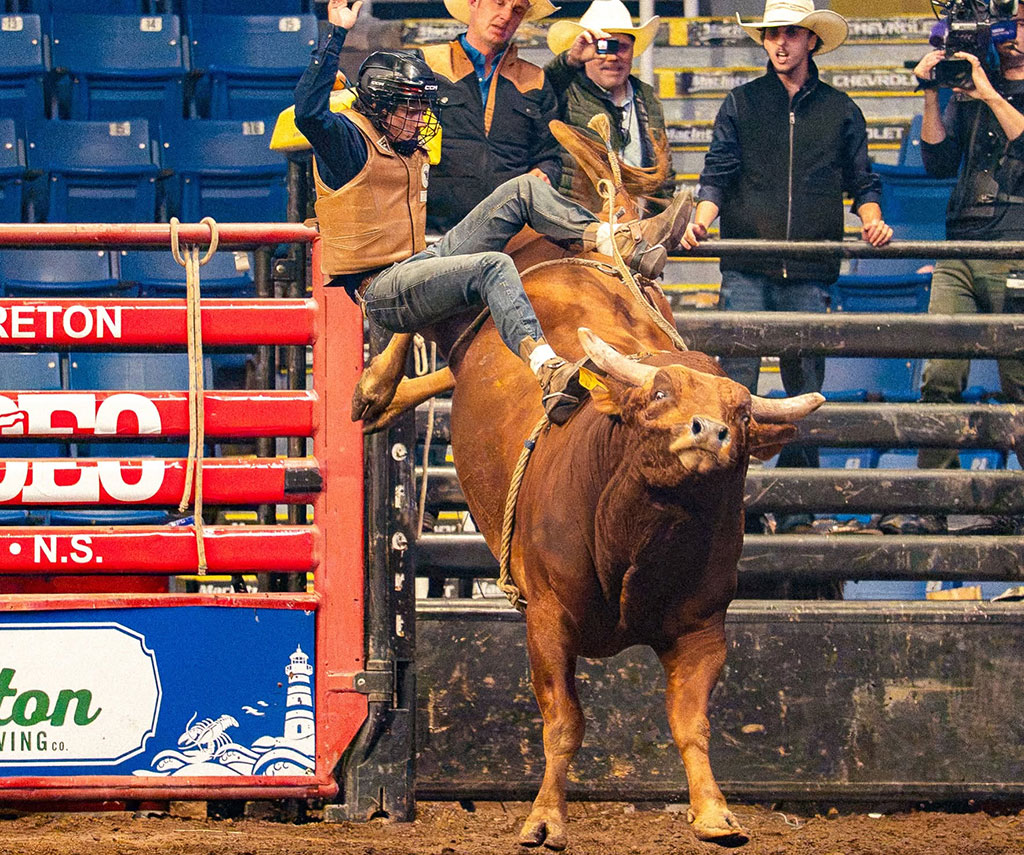
Benjamin rode twice in Cape Breton, on 1,800-lb bulls called "Chilly" and "Equalizer". In what was just another day at the office for a bull rider, Chilly managed to smash his free hand against the chute before the gate had even been opened!
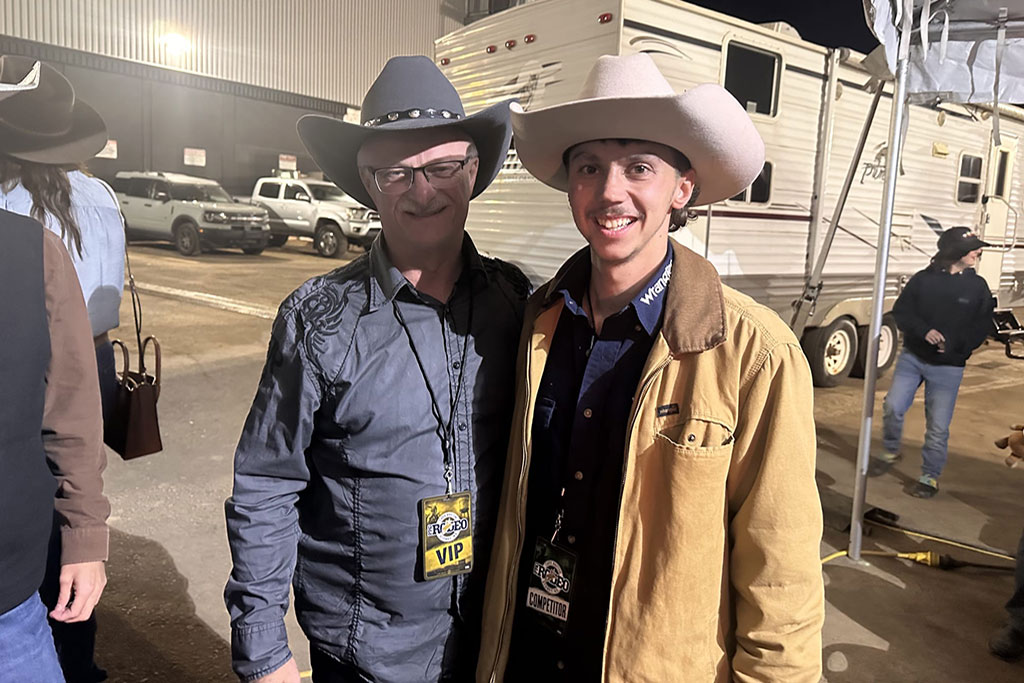
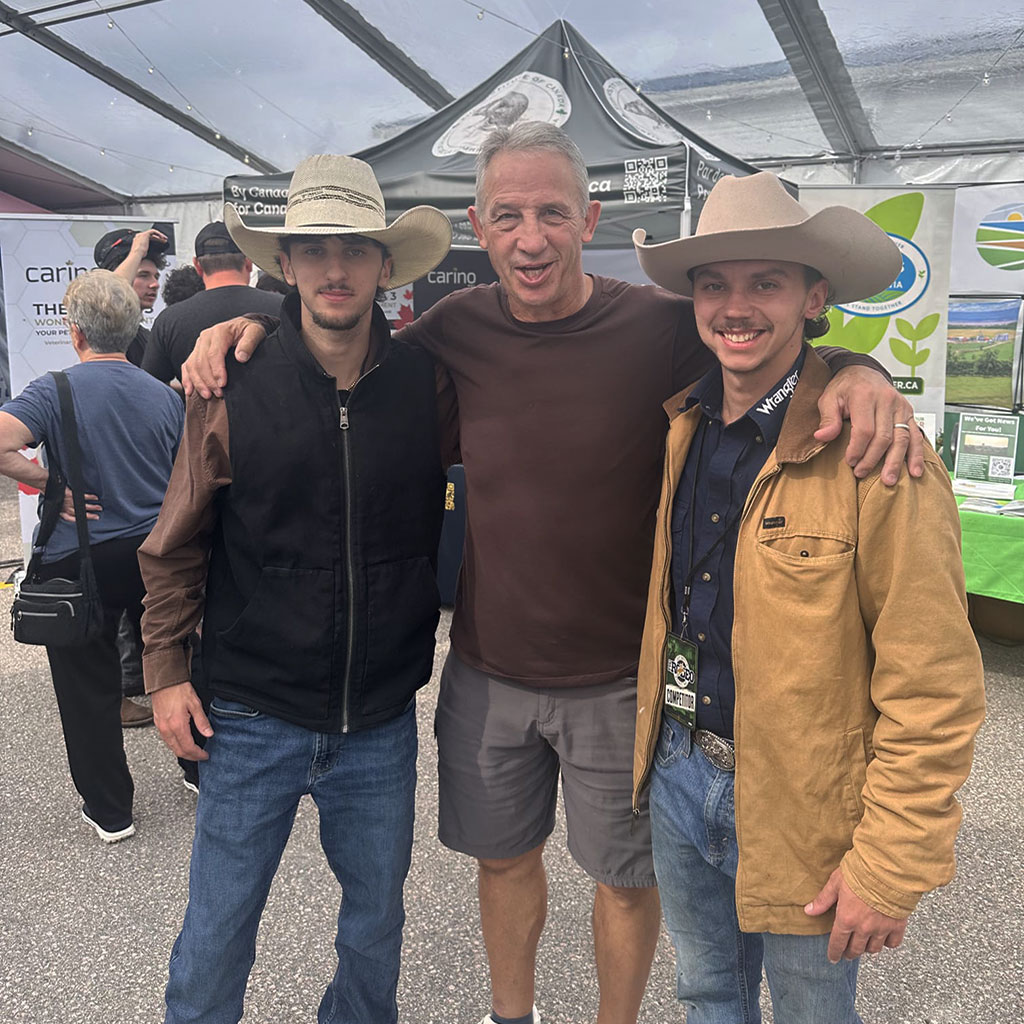
Truly, bull riding is not a sport for the faint of heart, so we hope the celebrities Benjamin got to rub shoulders with helped make up for it!
***
To learn more about donating to Truth About Fur, click here.
In early June, the Canadian Wildlife Conservation Partners (CWCP) held its first in-person meeting, in Ottawa, to discuss the new…
Read More
In early June, the Canadian Wildlife Conservation Partners (CWCP) held its first in-person meeting, in Ottawa, to discuss the new consortium's rapid growth, and how it plans to be a powerful advocate for hunters and trappers.
The CWCP was launched on September 20 last year – a day which, not coincidentally, was also National Hunting, Trapping and Fishing Heritage Day. Four organizations were responsible for its founding: the Fur Institute of Canada (FIC), Delta Waterfowl, Safari Club International-Canada, and the Wild Sheep Society of British Columbia.
All organizations participating in the CWCP share the goals of wanting to conserve wildlife and their habitats through science-based management, safeguarding biodiversity, and defending the rights and traditions of Canada's hunters, trappers, and other outdoor enthusiasts. Its guiding principles and rules of engagement respect the autonomy of each organization while coordinating advocacy efforts on issues of national and provincial importance.
Chairing the Steering Committee is Chris Everett, Chapter/Advocacy Services Specialist-Canada for Safari Club International-Canada. Assisting her as vice-chair is Brian McCrae, Director of Government Affairs-Canada for Delta Waterfowl, joined by Kyle Stelter, CEO of the Wild Sheep Society, and Doug Chiasson, Executive Director of the FIC.
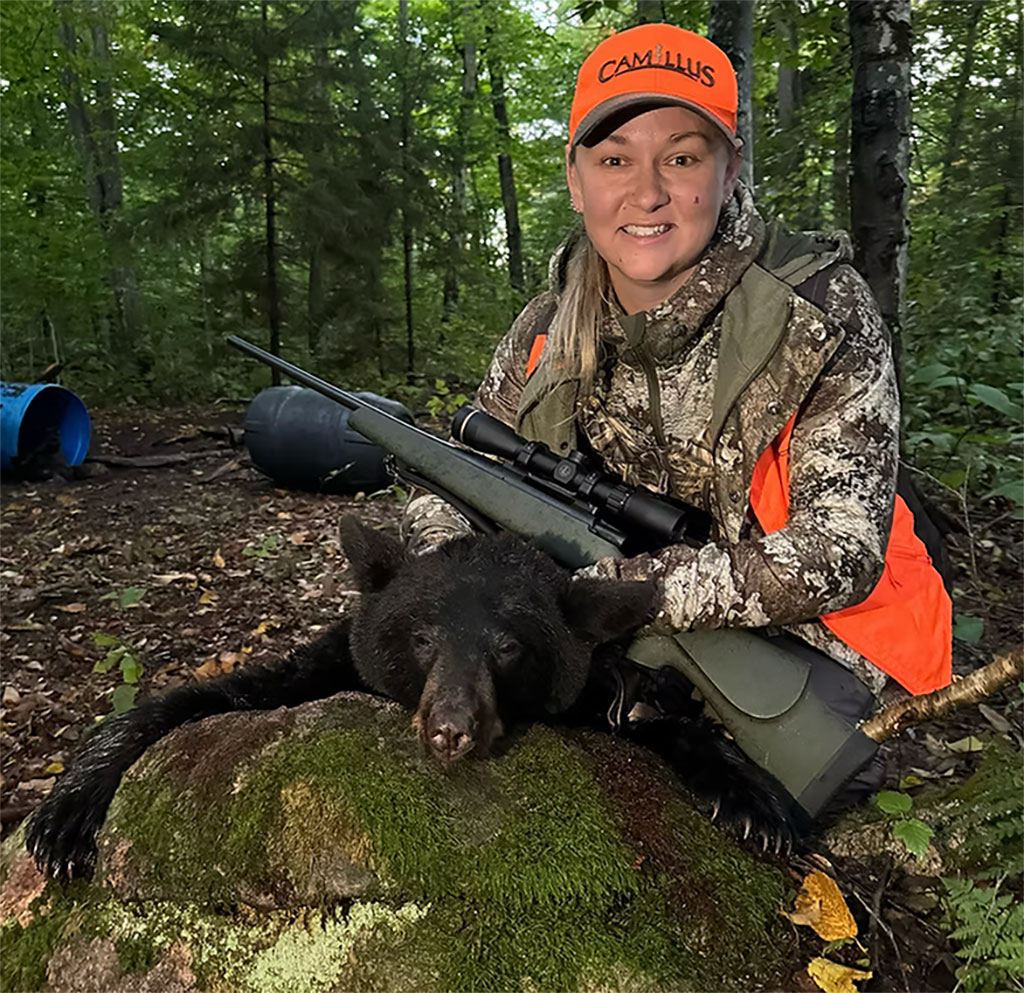
In just nine months, membership has grown from these four founding organizations to 24 partners and five affiliates today (see below). Not only are they spread across the land, they are also diverse, including trapping and hunting organizations, outfitters, and wildlife federations.
“The need for outdoors advocacy organizations to band together to stand up for our outdoors heritage is bigger than ever," says Chris Everett. "I’m proud to be part of a team that is turning ideas and words into action. The CWCP collectively represents over 1 million Canadians, and will continue to encourage governments to ensure conservation of wildlife and respect for our heritage activities is top of mind when making policy decisions.”
Brian McRae is totally on-board. “Delta Waterfowl is proud to be one of the founding members of the CWCP, uniting hunting, trapping and conservation organizations from coast to coast to coast," he says. "Through collaboration, the CWCP will continue to engage with our governments on topics of provincial and national importance to ensure the voices of our communities are heard as it relates to our outdoor heritage activities.”
Kyle Stelter is also committed. “As a founding member of the CWCP, the Wild Sheep Society of British Columbia is proud to stand alongside like-minded organizations from across the country," says Kyle. "CWCP, as Canada’s largest conservation collaborative, works to advance science-based wildlife conservation, protect our outdoor heritage, and develop practical solutions for habitat, hunting, trapping, and the outdoor community."
And Doug Chiasson is a firm believer. "The CWCP is an exciting forum through which organizations from across the sustainable use space in Canada will be able to collaborate and cooperate," he says. "By working together, I think we can really start to finally make sure that hunting, trapping and sustainable use of wildlife issues punch through to the forefront for federal and provincial decision-makers, instead of being stuck on the edge of someone’s desk."
Partner organizations are cordially invited to join the CWCP, providing only that they share its values. Following are its current partners and associates. If your organization is not among them, now is the time to join!
Partners: Alberta Professional Outfitters Society; Alberta Trappers Association; BC Trappers Association; BC Wildlife Federation; Big Game Records Club of British Columbia; Canadian Wild Turkey Federation; Delta Waterfowl; Fur Institute of Canada; Grand Slam Club Ovis Canada; Guide Outfitters Association of British Columbia; Hunters for BC; Manitoba Lodges and Outfitters Association; Manitoba Wildlife Federation; Newfoundland and Labrador Outfitters Association; North American Falconers Association; Northern Ontario Tourist Outfitters Association; Northwestern Ontario Sportsmen's Alliance; Québec Outfitters Federation; SCI – Canada; The Veteran Hunters; Trappers Association of Nova Scotia; United Guides and Outfitters of New Brunswick; University of Victoria Fish and Game Club; and Wild Sheep Society of British Columbia.
Affiliates: Born To Hunt, It's a Lifestyle; Canadian Coalition for Firearm Rights; Canadian Federation of Outfitters Association; Canada in the Rough; and Wild Origins Canada.
A billboard campaign by Ontario trappers to raise public appreciation of their role in wildlife management has so far been…
Read More
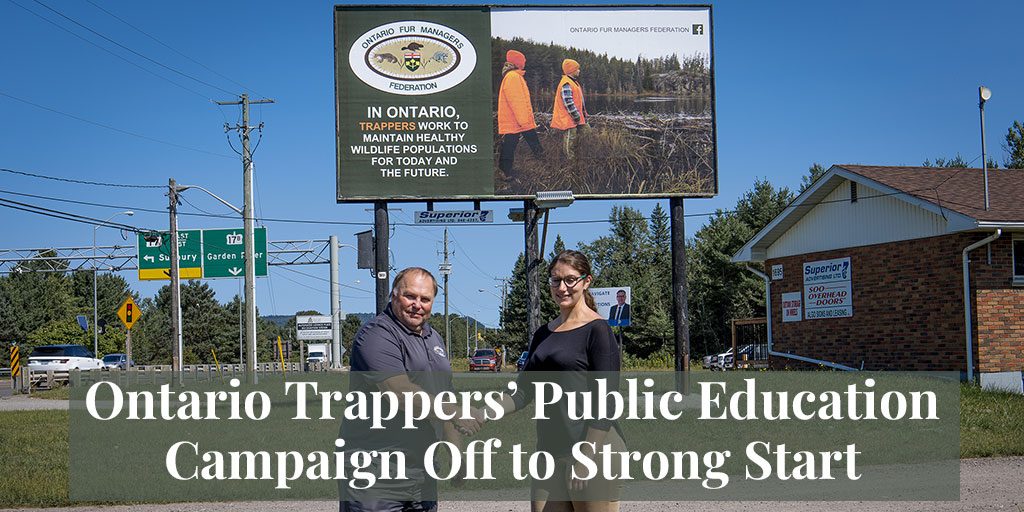
A billboard campaign by Ontario trappers to raise public appreciation of their role in wildlife management has so far been well received. Now the organisation behind the campaign, the Ontario Fur Managers Federation (OFMF), is optimistic a national campaign can follow.
From September 5 to October 14, the OFMF has six billboards on show near high-traffic border crossings to the US. The message on the billboards is simple, but thought-provoking: “In Ontario, trappers work to maintain healthy wildlife populations for today and the future.”
The idea, explains Robin Horwath, who retired this August after 12 years as OFMF’s general manager, is that discussion of this key message will lead to discussion of other important aspects of trapping. These include protecting habitat, property and infrastructure, controlling the spread of diseases, and of course, supplying consumers with beautiful, sustainable and natural furs.
SEE ALSO: Robin Horwath – Trappers are “great stewards of the land”. Truth About Fur.
“Wildlife managers and conservationists have always appreciated the important work trappers do, and call on us to help all the time,” explains Horwath, a third-generation trapper from Blind River. “But among the general public, there are many misunderstandings about what we do. In the first stage of this campaign, we hope to generate interest in local media, and use that as a platform to explain ourselves better.”
The response so far has been encouraging. As of this writing, the campaign has been covered by SooToday of Sault Ste. Marie, Windsor News Today, TBnewswatch of Thunder Bay, Timmins Today, the program Superior Morning on CBC Radio, and CTV News (click on the image below to view).
“If this campaign succeeds in raising the understanding and acceptance of trapping among Ontarians, we hope other trapping associations will be inspired to follow suit, and we’ll have a national campaign going,” says Horwath.
So in what ways are trappers currently misunderstood?
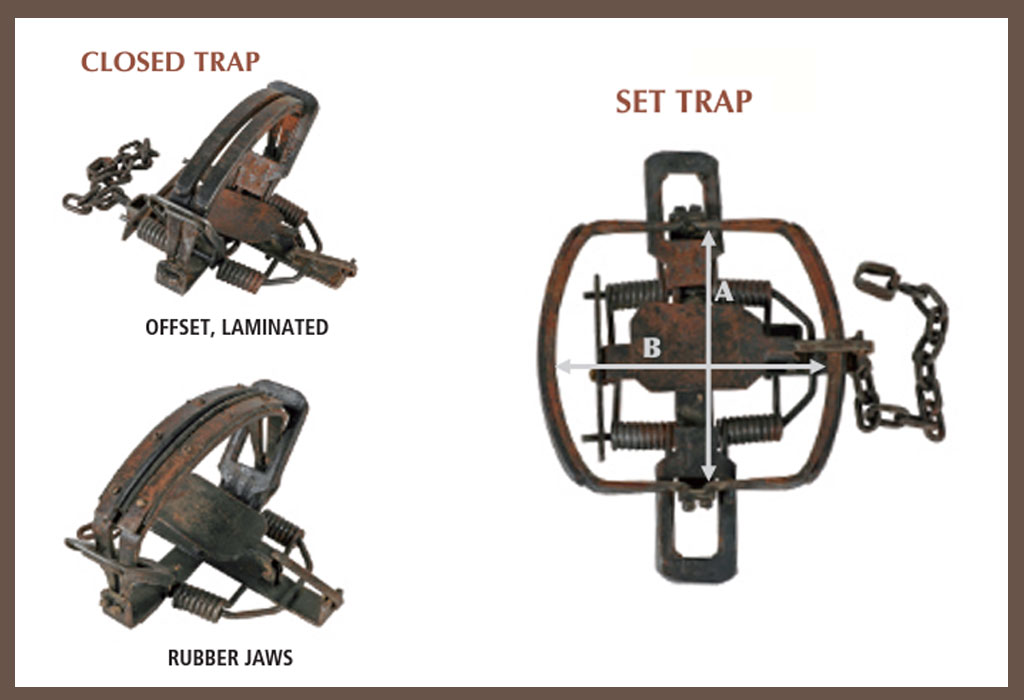
“Over the years, many misconceptions and outdated information have been spread when it comes to trapping,” explains Lauren Tonelli, also a third-generation trapper and Horwath’s replacement as general manager of the OFMF. “A lot of this comes from a place of ignorance about trapping, which is what we are trying to correct. However, there are groups that are anti-trapping that spread this misinformation in an attempt to sway people’s opinions against trappers. One of the major pieces of misinformation being spread around is that trappers still use inhumane steel-jawed leghold traps, and that animals lose feet in them trying to escape. This is simply not true.”
“Steel-jawed legholds have been banned for decades,” she continues. “In fact, the modern equivalents are foothold traps, with padded offset jaws and swivels that can also be used for relocating live animals.”
In support of her claim, she points to the website of the Fur Institute of Canada, which has been at the forefront of developing humane traps since it was established in 1983. Here can be found illustrated lists of all the trap types currently certified under the Agreement on International Humane Trapping Standards (AIHTS).
“Canadian trappers are bound by AIHTS on what types of traps they can use,” says Tonelli, “which are certified and specifically designed to restrain an animal humanely, until the trapper arrives, or designed to kill the animal instantly. What you will not find are the steel-jawed leghold traps described by anti-trapping groups.”
Another misconception that the OFMF wants to dispel is that all wildlife populations are just fine on their own and don’t need any sort of management.
Wildlife populations fluctuate in response to several factors, including changes in food supply, how many predators there are, habitat and climate, and without human intervention, these fluctuations can be extreme.
“The way that populations regulate themselves without intervention consists of starvation, predation, and disease,” says Tonelli. “When wildlife populations become overabundant, they are much more prone to disease outbreaks. We all understand how crowded groups of people lead to spread of disease, and it is no different in animals. This can lead to massive die-offs and significant population declines. Additionally, animal populations can grow to a point where there is not enough available food to go around, which also leads to crashes in the population. Trappers help to maintain consistent, sustainable populations that are not reaching levels where disease spread is rampant, and starvation occurs.”
SEE ALSO: Does wildlife need to be managed? Ontario Fur Managers Federation.
Other key points the OFMF is keen to discuss are:
For further information, or to arrange an interview with an OFMF representative, please contact general manager Lauren Tonelli at 705-542-4017 or [email protected].
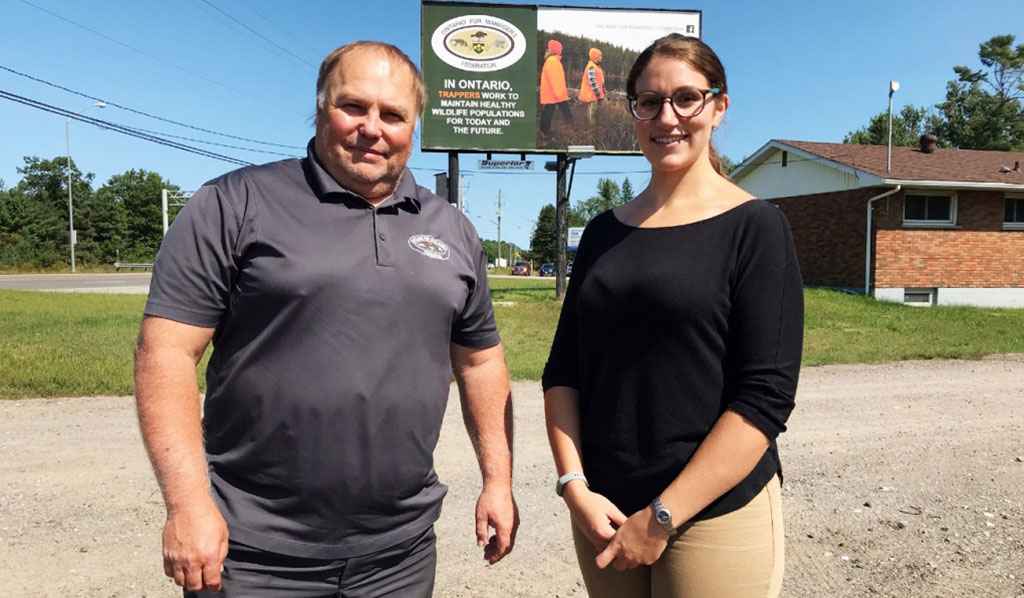
SEE ALSO: Fur fights back. Ontario trappers launch new public education campaign. Truth About Fur.
***
To learn more about donating to Truth About Fur, click here.
Hoping that trapping associations across Canada will be inspired to follow suit, the Ontario Fur Managers Federation (OFMF) is launching…
Read More
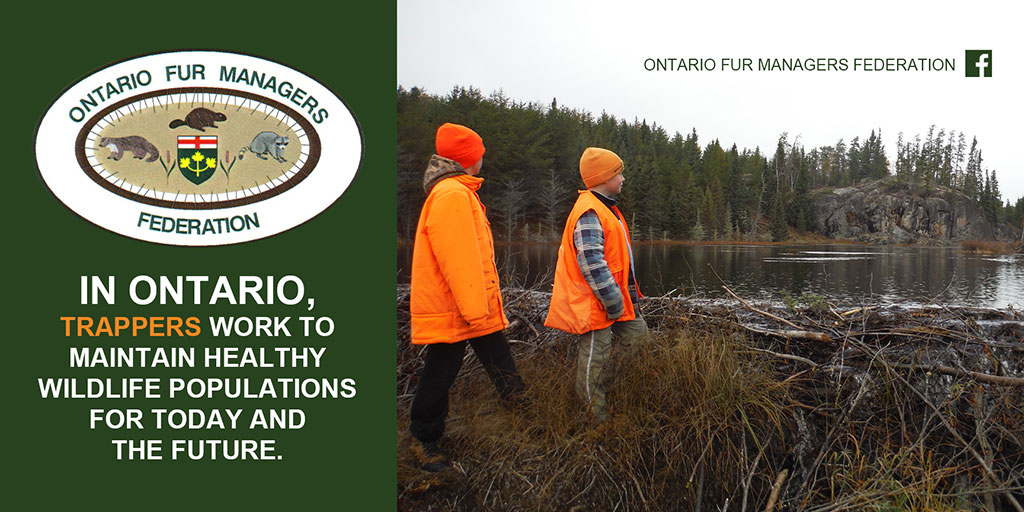
Hoping that trapping associations across Canada will be inspired to follow suit, the Ontario Fur Managers Federation (OFMF) is launching a billboard campaign to raise public awareness of the roles trappers play in wildlife management and pest control. It also hopes to correct misunderstandings about trapping created intentionally by animal activists.
Animal rights groups have long been spreading falsehoods about the trapping of furbearers, in particular that it is unnecessary and cruel. Trappers have defended themselves, with support from wildlife managers, conservationists, and consumers who appreciate the unique qualities of fur. However, some people – in particular those living in cities with limited access to nature – continue to be misled by activist misinformation. It is against this backdrop that the billboard campaign kicks off this September.
In the first wave of the campaign, the OFMF will erect six billboards at border crossings between Ontario and the US, strategically selected for their heavy traffic. (Slow-moving drivers have more time to look!)
The OFMF hopes to generate media interest in telling stories that reflect the truth about trapping, and that this will inspire other trapping associations across Canada to follow suit, turning it into a national campaign. If all goes well, the Fur Institute of Canada – a leader in research on humane traps and an authority on furbearer conservation – will be standing by to provide coordination as needed.
There are many positive stories to tell about trapping, but the opening salvo in this campaign will focus on one in particular. The message on the billboards is simple, but hopefully thought-provoking: “In Ontario, trappers work to maintain healthy wildlife populations for today and the future.” The OFMF hopes discussion of this key message will then lead to discussion of related topics like protecting property, habitat, and public health.
Ontario trappers assist in the management of many furbearing species, among them the large populations of beavers and raccoons, and the far scarcer wolverines.
Beavers: There are now believed to be more beavers in Ontario than ever before, but this success story has a downside: the dams of over-populated beavers can flood homes, roads, fields, and forest habitat. Managing beavers is complex, and involves the co-operation of trappers, private landowners and government agencies.
Raccoons: Raccoons are found in most parts of Ontario where the habitat is suitable and winters are shorter. Managers rely on hunters and trappers to keep the numbers at an optimum level, and thereby minimise two particular problems associated with over-populated raccoons: damage to crops, notably corn; and rabies. Both raccoons and foxes carry this deadly disease, and can pass it on not only to humans, but also livestock and pets.
Wolverines: Trappers are often called upon to assist in conservation efforts, such as for wolverines. These solitary carnivores are listed as a threatened species in Ontario, and so cannot be killed or captured. Among the threats wolverines face are degraded or fragmented habitat, and falling prey to wolves and mountain lions. Trappers assist wildlife managers by keeping a close eye on the health of wolverine habitat, and by controlling predators.
Other key talking points the OFMF is keen to discuss are:
SEE ALSO: Reasons we trap. Truth About Fur.
Three Ontario trappers are on standby to handle media inquiries.
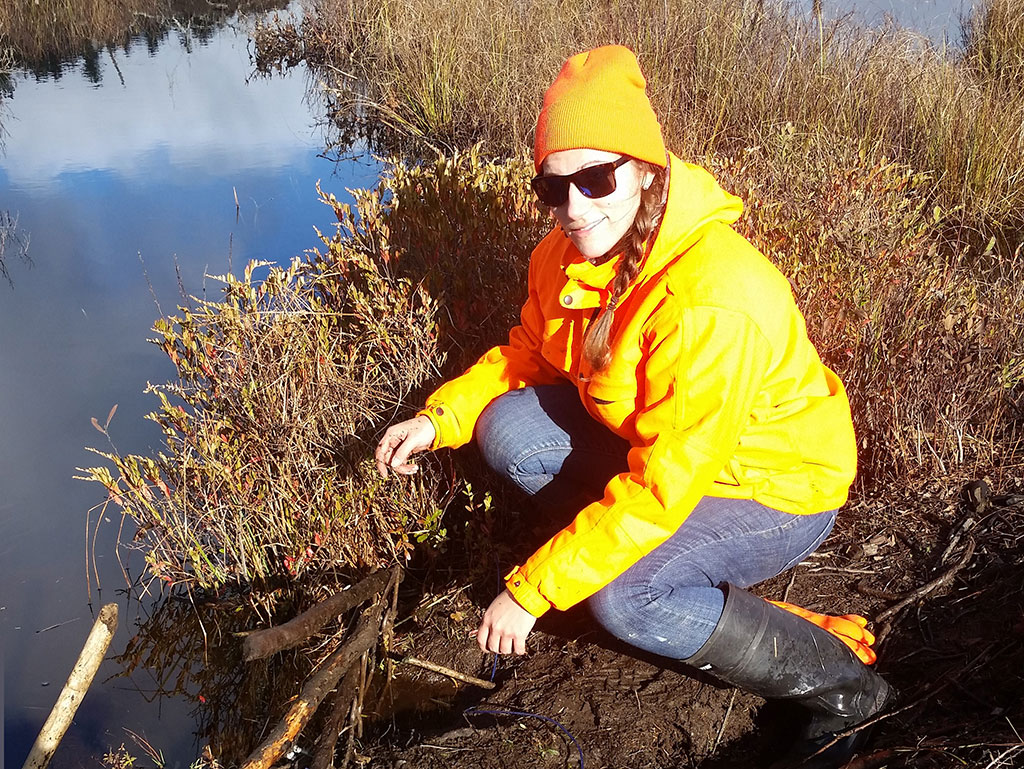
Lauren Tonelli is a third-generation trapper from Iron Bridge, currently living in Sault Ste Marie. She holds a Bachelor of Science in Biology and has worked in the environmental/wildlife management field for almost a decade. This August, she took over as the new general manager of the OFMF.
“I am a passionate angler, hunter, and trapper,” says Lauren, “and I want to ensure that the opportunities and experiences I have had are available for generations to come. Teaching the public to understand and appreciate the importance of trappers will go a very long way to securing the traditions of trapping in Ontario for all current and future trappers.”
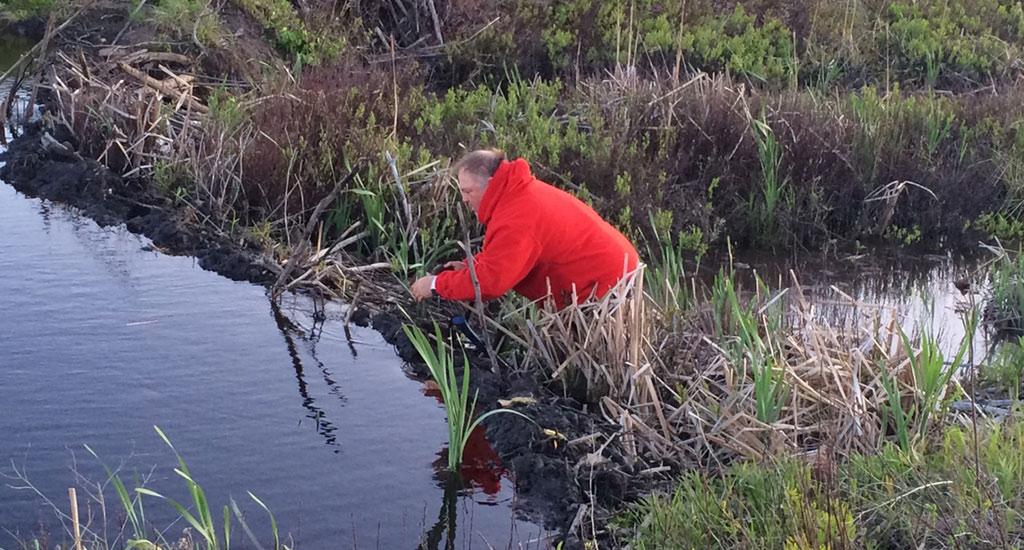
Robin Horwath hails from Blind River, and continues a family trapping tradition that started with his two grandfathers. From 2010 until this August, he was general manager of the OFMF, and until this June he was also chairman of the Fur Institute of Canada.
“I dream of the day when trappers once again are recognized and valued by the general public as great stewards of the land,” says Robin. “Trapping is a vital tool for managing furbearers to achieve healthy sustainable populations, to protect infrastructure, and control the spread of disease, which is important not just for the animals but also for humans.”
SEE ALSO: Robin Horwath – Trappers are “great stewards of the land”. Truth About Fur.
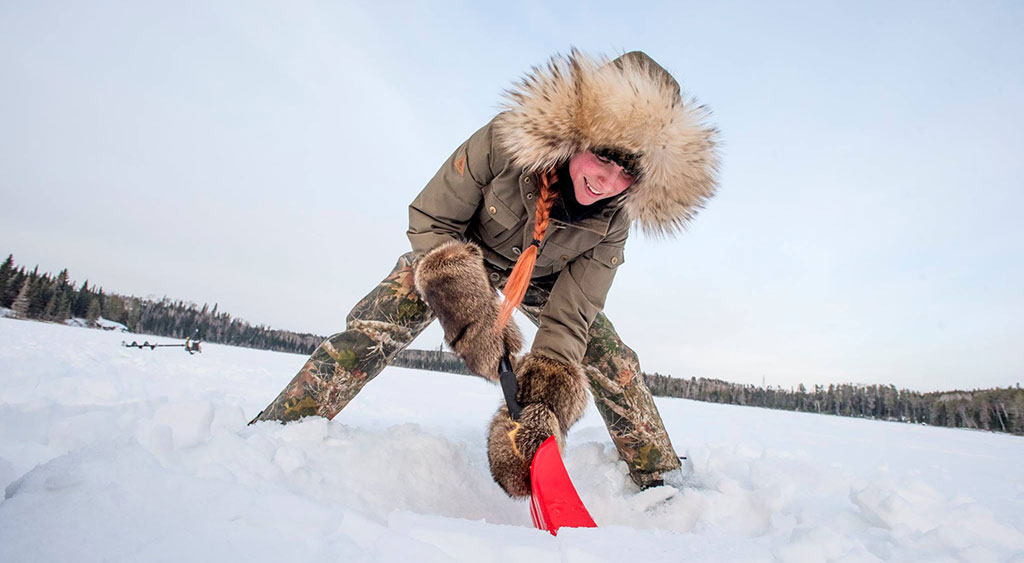
Katie Ball is a trapper from Thunder Bay, who also runs Silver Cedar Studio, designing and making fur garments. In addition to being a director of the OFMF, she also represents the Northwestern Fur Trappers Association, the Northwestern Ontario Sportsmen’s Alliance, and Fur Harvesters Auction.
Katie is a firm believer in explaining to non-trappers why the work of trappers is so important. “I have found that by talking to the public, educating individuals on our regulations, and standing behind our ethical practices, most get a bigger picture and realize that we are not out to destroy animal populations with archaic trapping methods. We are out helping maintain a healthy balance in nature.”
SEE ALSO: “Fur is in my blood” says Katie Ball, trapper, designer, advocate. Truth About Fur.
If you would like to see one of the OFMF’s billboards for yourself, they will be up from September 5 to October 14, and come in two formats: traditional, and digital or virtual. Traditional boards will be placed in Sarnia on Nelson Street, and in Sault Ste Marie on Trunk Road. Digital boards will be displayed in Kingston on Gardiners Road heading to Highway 401; Fort Erie on Queen Elizabeth Way, 100 metres from the Peace Bridge; Windsor on Gayeau Street; and Thunder Bay on the corner of Memorial Avenue and Harbour Expressway.
For further information, or to arrange an interview with any of OFMF’s spokespeople, please contact general manager Lauren Tonelli at 705-542-4017 or [email protected].
***
To learn more about donating to Truth About Fur, click here.
The proposed fur ban in Rhode Island has been defeated. The bill, HB7361/SB246, which, if passed, would have banned the…
Read More
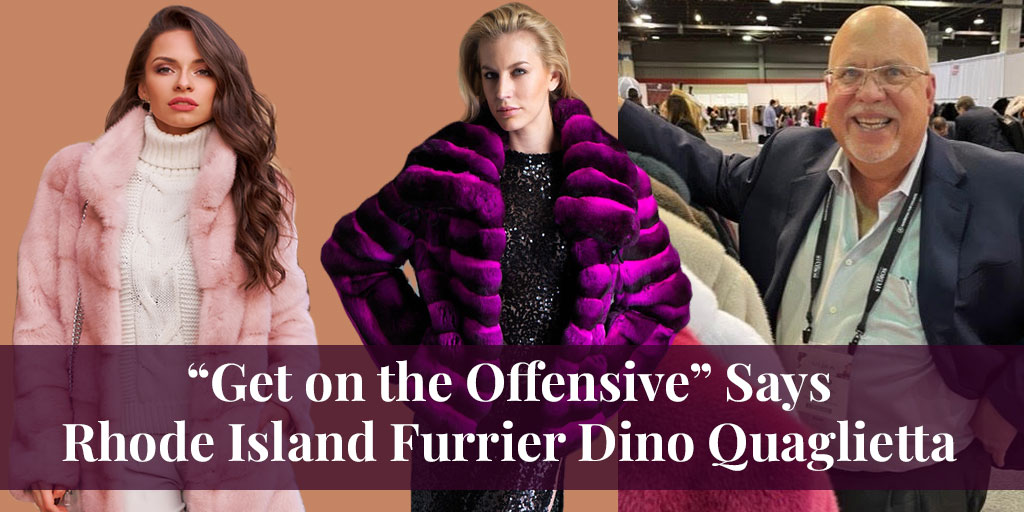
The proposed fur ban in Rhode Island has been defeated. The bill, HB7361/SB246, which, if passed, would have banned the retail sale of fur, was defeated last week when the Rhode Island legislature convened.
Even in light of the industry being outspent by the Animal Legal Defense Fund, the Humane Society and other groups, as well as a digital campaign and the overwhelming support the bill received in the house, it was not enough to get the bill passed.
SEE ALSO: US legislators should be promoting natural fur, not seeking to ban it. Truth About Fur.
Dino Quaglietta of Northeast Furs, a local retailer in Warwick, has been engaged in fighting the ban since it was first proposed. Upon learning of the ban’s defeat, Quaglietta said, “It’s great that we won, for sure! It was a hard-fought battle. Good news for Rhode Island, but outside of the industry, who knows about this?
“The industry needs to band together and get on the offensive. We need a spokesperson to get the word out to the public, not just talk to ourselves. We must convey all the positives of fur and show the public that animal welfare includes all animals and point to the hypocrisy of this movement; that putting on a fur coat is no different than putting on a pair of shoes.
“The industry has had so much negative press, we must do damage control to get to the minds of our customers. This is a quintessential freedom of choice issue. This bill will come up again next year when we’ll have to fight it again. At least we got through this year.”
The International Fur Federation-Americas, who spearheaded the fight, will continue to be engaged in Rhode Island with the unwavering support of Quaglietta and Northeast Furs.
Similar bills have been defeated in Connecticut, Massachusetts and New York – in both the House and the Senate.
SEE ALSO: “Fur Fights Back!” It’s time for a strong industry communications campaign. Truth About Fur.
***
To learn more about donating to Truth About Fur, click here.
Last April 4, Doug Chiasson assumed the post of executive director of the Fur Institute of Canada, an independent entity founded…
Read More
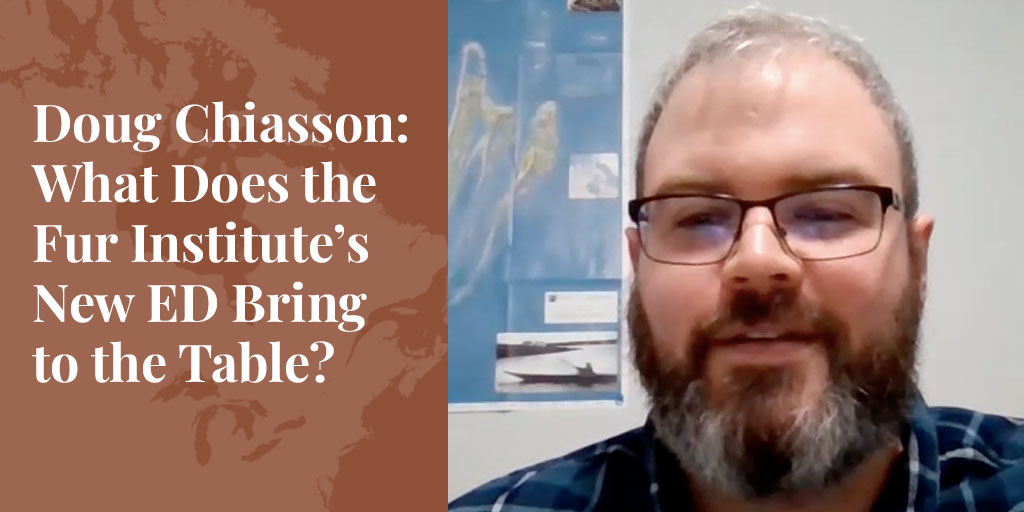
Last April 4, Doug Chiasson assumed the post of executive director of the Fur Institute of Canada, an independent entity founded by the government in 1983 to lead research on humane traps. Since then, it has also become a recognised authority on the conservation of wild furbearers, and a promoter of sustainable sealing.
SEE ALSO: Fur Institute of Canada champions humane and sustainable fur production. Truth About Fur.
Born and raised on Cape Breton Island, Nova Scotia, Doug spent 13 years studying and working in Ottawa, and is now back in his home province, residing outside of Halifax. In this time of unprecedented challenges in the fur trade, let’s find out what Doug brings to the table.
Truth About Fur: Canadians always have interesting roots. Tell us about your own mixed-up lineage.
Doug Chiasson: My ancestors came to Canada in three waves. The first wave arrived in the 1600s, from French-speaking Switzerland, and settled in the former French colony of Acadia, a term still used today for parts of the Maritimes. So I’m part Acadian. Then I’m part Clan Munro from the Scottish Highlands, with my ancestors coming here in the 1700s as part of the Highland clearances. And then there’s some Irish Catholic mixed in too.
TAF: You don’t have a background in fur, so how did your experiences prepare you for your new position with the FIC?
DC: I have over 10 years of experience in marine resource management and environmental sustainability at provincial, territorial, national and international levels. After graduating from the University of Ottawa, I spent two years as a senior policy advisor to the federal Fisheries Minister, and one of my responsibilities was advising on the seal hunt, in which the FIC is an important stakeholder. So I worked with the FIC on a range of issues, notably on the government’s response to the WTO appeal of the European ban on Canadian seal products. I then spent some time advising the Premier of the Province of Manitoba on sustainable development.
From there I moved to WWF-Canada to head its Arctic fisheries program. WWF-Canada has always been an outspoken supporter of sustainable use, including on such controversial issues as sealing and polar bear hunting. In a few other countries, WWF is sometimes perceived as being anti-use, but that is not true for the WWF family as a whole. In fact, WWF International has cautioned against letting animal welfare groups hijack important conversations about conservation.
And in my capacity with WWF, I also served as co-chair of the Green Budget Coalition. The GBC is a coalition of national-level environmental organisations that provides annual recommendations to the Canadian government about what to fund in pursuit of greater sustainability.

TAF: How do you see your role as executive director of the FIC?
DC: The FIC is a membership organisation, so my job is to work with the Board and members to set goals and find ways to reach them. We need to be ambitious, and if we don’t always reach our goals, we should at least come close.
I have no shortage of ideas of my own, but I must also draw on the institutional knowledge of the Board, many of whom have been in the industry far longer than I will ever be. They are not just the present moment in time; there’s a lot of experience and memory that I need to tap into. As a new executive director, I may have what I think are great ideas, but maybe they’ve been tried before and didn’t work out. The Board can tell me how and why.
TAF: The FIC is well known for its work on testing trap designs, but less well-known as a promoter of sealing. How does sealing fit into the FIC’s mandate?
SEE ALSO: Humane trapping research program leads the world. Truth About Fur interviews Pierre Canac-Marquis.
DC: Originally our mandate was for trap research, which then expanded to include furbearer conservation, which led to sealing and the launch of the Seals and Sealing Network program. From this have sprung two marketing projects for seal products: Canadian Seal Products, and Proudly Indigenous Crafts & Designs.
Some people see a divide between fur and seals, but from the FIC’s perspective it is largely artificial. Obviously fur is one of the main products of sealing, and sealers face the same opposition from anti-fur campaigners as anyone else in the industry. But why, they ask, is the FIC also promoting seal oil and meat? The reason is because this falls under our mandate of furbearer conservation. A cornerstone of modern conservation, for all except endangered species, is sustainable use, and part of sustainable use is ensuring maximum utilisation of any animals harvested. So in the case of seals, this means not just the fur, but also the meat and oil.

TAF: How well are the various sectors of the industry currently represented in the FIC’s membership, and what improvements are you hoping for?
DC: Our membership is already broad in the sense that we represent all sectors to an extent, but we certainly don’t have everyone in every sector. So the task ahead for me is not necessarily to broaden our membership, but to deepen it. Wild fur is our strong suit, with members including trapping associations, brokers, Fur Harvesters Auction, and so on. Sealers and fur farming associations are also represented. Areas where I’d particularly like us to expand our membership include design, retail, and primary and secondary processing industries.
Also I hope to expand our engagement with Indigenous people across Canada, whether it’s businesses, regional organisations, or local governments with communities that are reliant on fur. Indigenous people are thought to account for 25-30% of Canada’s fur production, so that gives us a target to aim for; Indigenous representation should at least be in line with their participation in the industry.
TAF: Let’s talk more about Indigenous representation in the context of Reconciliation. The FIC inevitably has a role to play because fur is so important in Indigenous cultures, and by extension in their cultural industries.
DC: There are a lot of things to unpack in the national discourse about Reconciliation. There are sensitivities that must be respected, particularly involving cultural industries. There are cases of Indigenous people being excluded in the past from an industry by non-Indigenous people, who then tried to do it themselves. We have to work to be respectful and inclusive of everyone who has a connection to fur, so that we can all work together.
Reconciliation is a journey that all Canadians are taking, and it won’t just end one day when we’ll say, “Ok, Reconciliation is done!” But I’m optimistic. I have been lucky enough to work closely with Indigenous harvesters and communities in the past. The majority of people, Indigenous and non-Indigenous alike, are not interested in building walls. They want to share their cultures, and have them appreciated.
TAF: The fur industry today is facing an existential threat from animal rights groups. This has prompted some Canadian participants to call for a unified strategy coordinated by a single national organisation. Should the FIC assume this role?
DC: I agree that a unified strategy is needed, and also believe the FIC is the obvious choice to coordinate it. Building another organisation from scratch to represent the industry, when we already have the FIC, makes no sense. By serving as a central clearing house for the entire industry, we will be able to walk into any meeting with the government and say, “We represent the Canadian fur sector.”
TAF: If the FIC assumes this role of a central clearing house, how should it handle disagreements among parties?
DC: I see the FIC as a forum for candid discussions involving all parts of the fur industry, as we find ways forward that keep everyone happy. I don’t think there need to be any either/or situations in the fur trade. We all need to be pulling in the same direction in a way that benefits everyone.
Of course, there are some conversations that have no end, and I’m not saying there will never be hurt feelings. But at least let’s talk about these issues among ourselves, on friendly terms, not in the newspapers.
That said, I don’t want to turn the FIC into a debate club! I want us to be action-oriented, and results-targetted, to do things that help everyone.
TAF: So what messages should the fur trade be focusing on? Some people favour old-school messages: responding to the lies and misrepresentations of animal rights groups, while reminding consumers of the beauty and luxury of fur. Others now see engaging with animal rights groups as a waste of time, and instead want to focus on positive messages about fur that reflect current interest in environmental issues, notably its sustainability compared with synthetics.
DC: I’d prefer us to be in a position where telling the good stories is all we have to do, but at least it should be the first thing we do. So let’s start by telling people that fur is warm, looks great, is good for the planet, helps the economies of remote communities, and is central to the cultures of many people. Let’s not start with, “We’re only saying this so you stop listening to animal rights groups.” Our first message should be, “We’re going to sell you this world-class product.”
***
To learn more about donating to Truth About Fur, click here.
Jane Avery is a couture designer from Dunedin, New Zealand, known for her bespoke garments combining exotic fabrics with wild…
Read More
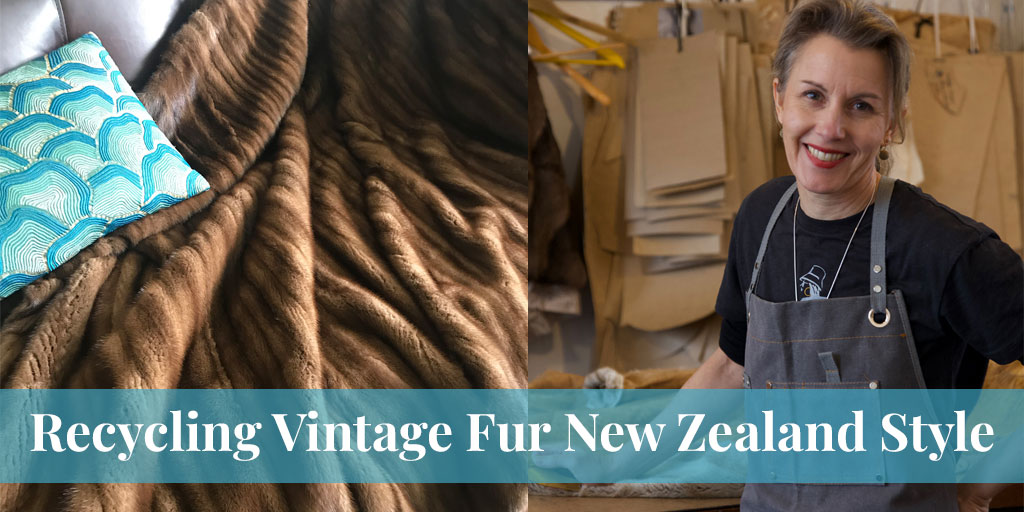
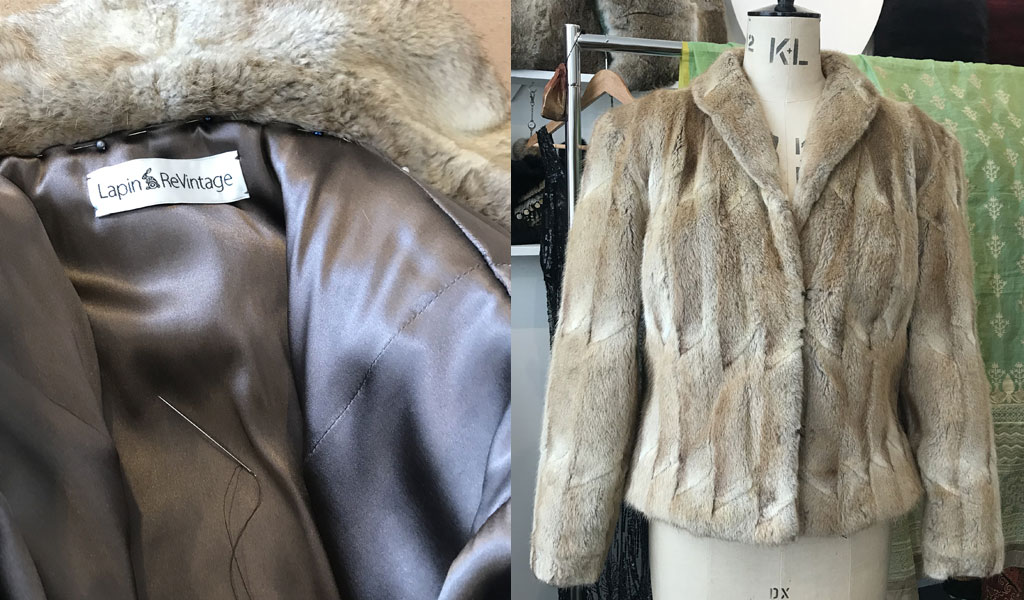
Jane Avery is a couture designer from Dunedin, New Zealand, known for her bespoke garments combining exotic fabrics with wild rabbit fur. Her label is Lapin (French for rabbit), and her ethos is “eco-couture”, reflecting the fact that rabbits are a major pest in her part of the world. Now she has launched a new label, Lapin ReVintage, which is all about repairing, restyling and repurposing vintage fur. Since so little has been written about this niche market, Truth About Fur set out to learn more.
SEE ALSO: New Zealand designer embraces wild rabbit “eco-fur”. Truth About Fur.
Truth About Fur: Are Lapin and ReVintage two separate lines, or do they dovetail together?
Jane Avery: They are both meaningful to me in their own ways, but they sit comfortably together. For example, when I receive a ReVintage commission, I may be repairing the garment in its original form, or I may be taking parts of the fur and incorporating them into a new Lapin ReVintage design. There’s enough fur in a vintage cape or stole to make a collar and cuffs for a coat of merino wool, Indian silk or another beautiful textile.
Prolonging the life of any garment is good for the environment, just as using the fur of pests is. So it’s all “eco-couture”.
TAF: Bloggers say that recycling old furs took off in the first Covid-19 lockdown, when we all decided to clean out our wardrobes. But now all our wardrobes are clean, so is it a passing trend?
JA: No, it’s more than a trend. It’s part of a groundswell of people wanting lifestyles that are kinder to our planet. That started before Covid and will outlast it too.
People have various reasons to extend the lives of vintage furs, not always related to lifestyle. Of course they appreciate the beauty, resilience and warmth of fur, and a vintage piece can be a great reminder of its original owner, perhaps a beloved grandmother. But there are other motivations that reflect our changing attitudes towards the planet.
Seeking sustainability is one. We are increasingly rejecting wasteful consumerism, and that includes “fast fashion”. We want to buy fewer clothes, better quality, and make them last. The “Three R’s” – repair, restyle, and repurpose – are part of this, and are in vogue!
SEE ALSO: The sustainability of fur. Truth About Fur.
Another motivation concerns the morality of taking animal life for food and clothing. Some people, for example, consider it abhorrent to farm new fur, but hate to waste the fur of an animal that’s already died. I see something similar working with wild rabbit fur; some people won’t wear farmed mink, but are happy to wear the fur of pests that are being eradicated anyway.
And some people, like me, have a cultural motivation. Every vintage fur that lands on my work bench has a story, and is its own tutorial on garment construction. As I dismantle it, it reveals secrets of the furrier’s craft, honed over hundreds of years. So we are driven to preserve the craftsmanship that goes into working with fur.
TAF: So is there such a thing as a typical ReVintage customer?
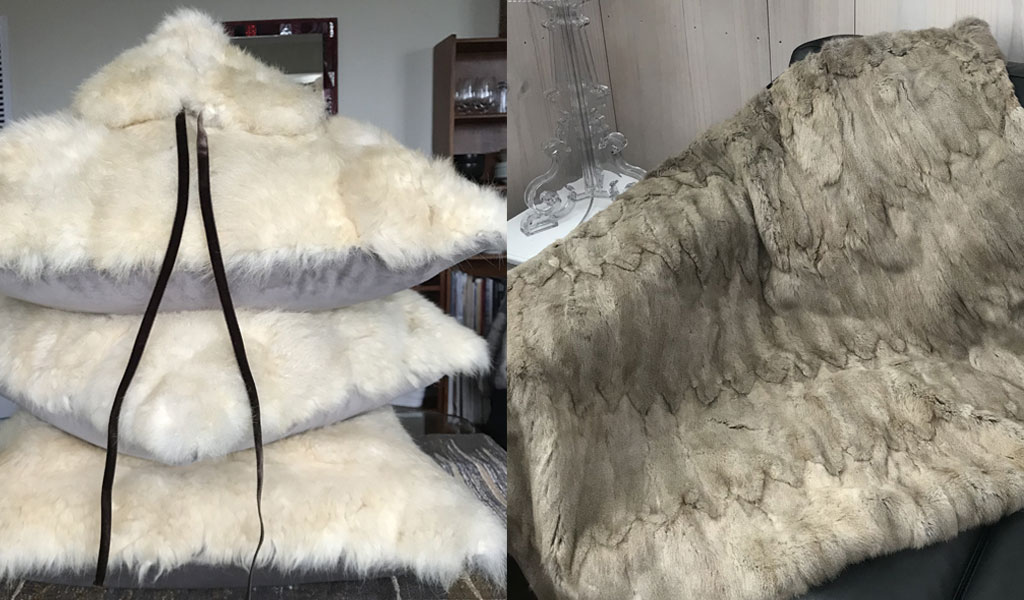
JA: Perhaps the most common motivation of customers is wanting to display an heirloom fur they received from their mother or grandmother. They may want to wear it or repurpose it as a couch throw or cushions, but the important thing is to feel connected to a loved one. For these people, it’s all about remembrance and emotion.
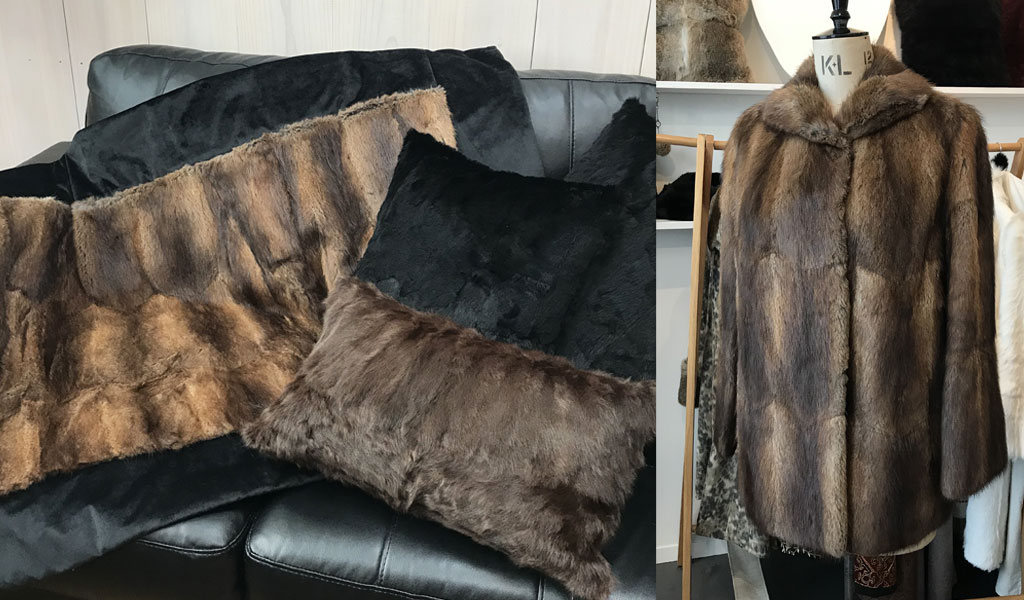
But that’s not always the case. For example, a man brought in a pristine, full-length ranch mink coat he’d picked up at an estate sale for $150, and wanted it turned into a couch throw. It was a beautiful flared coat with very skilful stranding work extending from neck to mid-calf, and a lady’s name sewn into the silk lining. The hems were full of sawdust, a sign it had been drum-cleaned, and judging by the perfect condition, temperature-stored. A part of me felt mortified to be carving into this work of art, but unless it went to a museum or couture collector, it had outlived its usefulness as a coat. Sadly this is the fate of some vintage furs these days. But the throw I made from it was gorgeous, so I hope it’s being enjoyed!
TAF: What problems do you face most when working with vintage furs?
JA: New or old, fur is a forgiving material. New fur can be deftly manipulated if there is damage or there’s a mistake during the making process. And if you find a disaster zone in an old fur, it usually just requires a bit more negotiation.
Plus, fur garments are built to last, so most vintage furs are perfectly useable, even after spending decades in the back of a wardrobe.
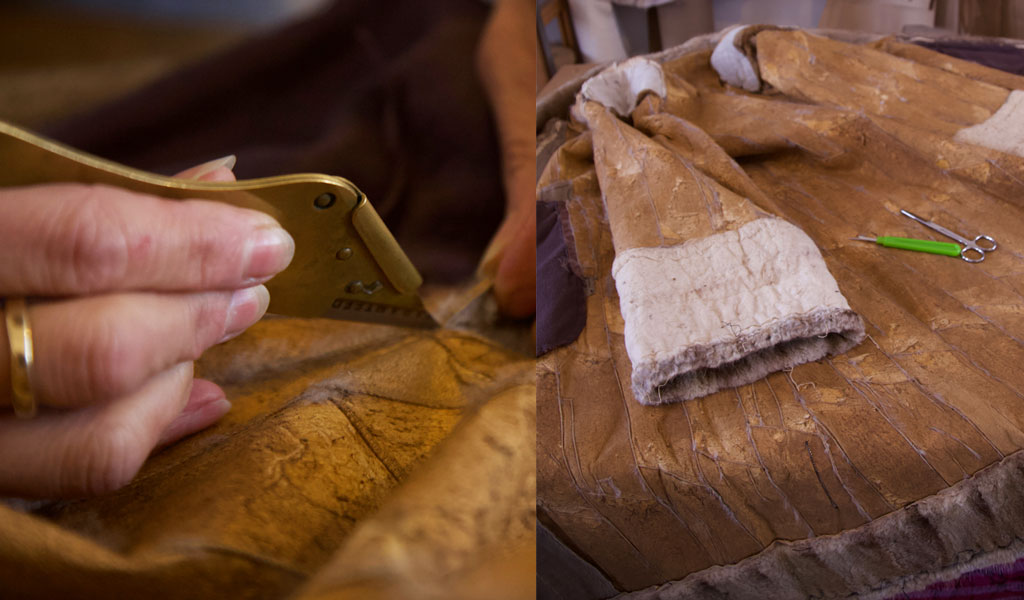
But of course they do get damaged, and a common problem is tearing, either along stitched seams or in the general skin area. Some tears are nice, straight lines, while others are messy affairs going in several directions. How to deal with them depends on the condition of the skin. It may be hard and brittle, or soft and disintegrating.
Separated seams are the other common damage. When possible, I’ll stitch them back up by machine, but sometimes the needle perforations just create a new line that tears readily. Then it’s out with the needle and thread, pulling the edges gently together with big stitches, and then sports tape, which is made to stick to skin, after all.
When I return a coat to its owner, it may appear like I’ve worked a little magic. But perhaps – and this is a last resort! – I just pinched a bit of fur from an unseen part of the coat and literally pasted it with fabric glue onto a disintegrated section that’s been reinforced from behind. It’s a methodical and intuitive process that involves judgement, an experienced eye, and a certain amount of chutzpah.
TAF: So can all furs be saved?
JA: If a coat is shedding badly, there’s not much that can be done. So now and then I have to tell a customer they’re dreaming, and all we can do is turn the best bits into cushions. But my motto is “work with what’s in front of you”, so I rarely turn a job down. If a person is emotionally attached to a fur, then it’s worth restoring or repurposing as best I can.
That said, I sometimes restore a coat and return it with strict instructions on how to wear it. Sit and stand in it nicely, I say, and do not wear it while driving or lounging on the sofa!
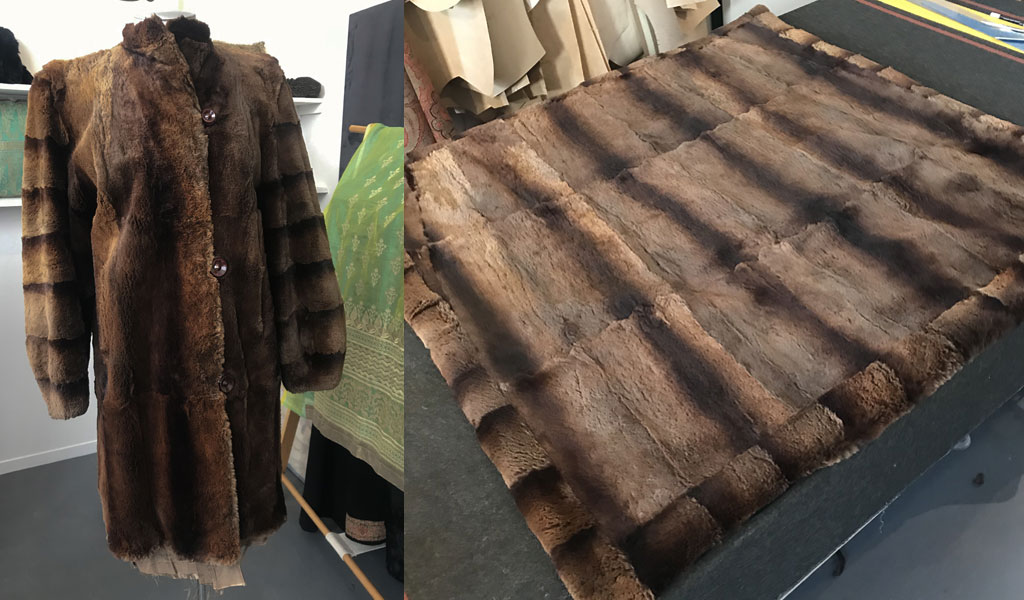
TAF: How about the different fur types you commonly see? Are some easier to work with than others?
JA: I see a lot of vintage rabbit since it was so popular here in the past, often cut and dyed to mimic other fur types. Old rabbit skin is surely not the most robust and is frequently delicate, but it can still be beautifully supple and suitable for machine-stitching. I’ll probably tape the repaired seams and some of the original ones for safety, and instruct the owner to “handle gently”.
Muskrat fur was also popular before, but it doesn’t survive the years well. It’s very likely to be brittle and ripping, and only salvageable with hand-stitching and tape.
Vintage mink skin is often in very good condition and easy to handle, but fox can be very thin and rips easily.
I’ve also worked with vintage chinchilla rabbit, fitch, weasel, marten and possum, but perhaps my favourite were three gorgeous coats, over 70 years old, that I think were Siberian flying squirrel. They were delicate in places, but the skin was supple and the lustrous fur all intact.
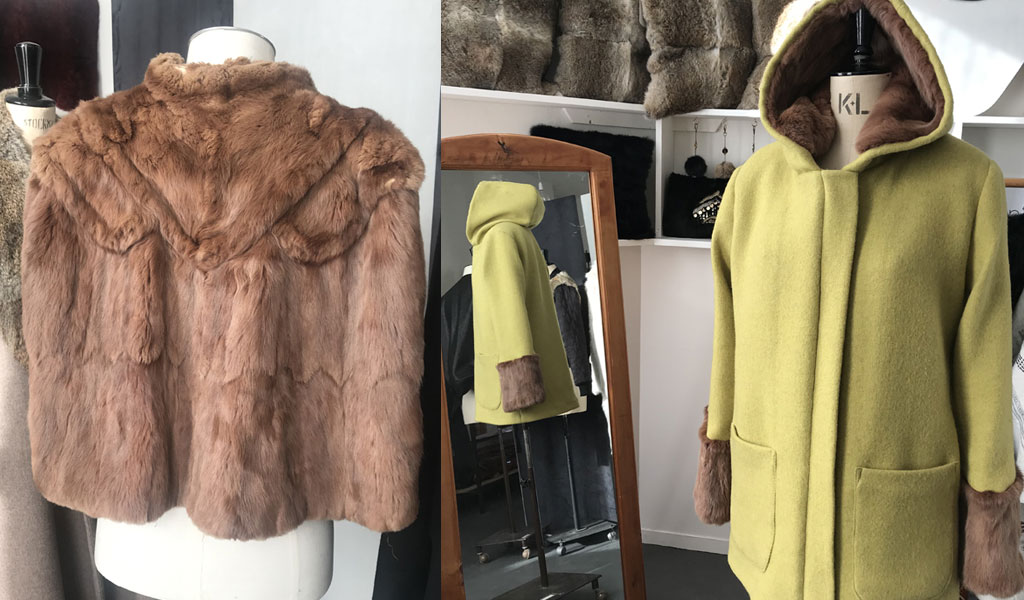
TAF: How about the future? You describe interest in recycling vintage fur as part of a “groundswell”. So can we expect growth?
JA: For clothing in general, the “Three R’s” – repair, restyle, and repurpose – are already growing fast as part of a shift to more sustainable living. But in New Zealand at least, using fur for clothing is just a small part of this. It’s not cold enough, plus the anti-fur lobby has been quite effective. There’s only a small market here now. The last traditional furrier in the entire country, and my teachers, Mooneys Furs of Dunedin (est. 1912), closed in 2020. As a result, craftspeople skilled in working with vintage fur coats are now a rare breed. As one of those rare artisans, I encourage anyone to ReVintage their furs. The results are very satisfying.
In colder countries, where fur is a way of life and there’s a steady supply of vintage materials to work with, the outcome could be very different. If you have the skills, setting up as a recycler of vintage furs could be a really good business opportunity!
***
To learn more about donating to Truth About Fur, click here.
On November 5, Lana Popham, British Columbia’s Minister of Agriculture, Food and Fisheries, announced that the province “is beginning a…
Read More
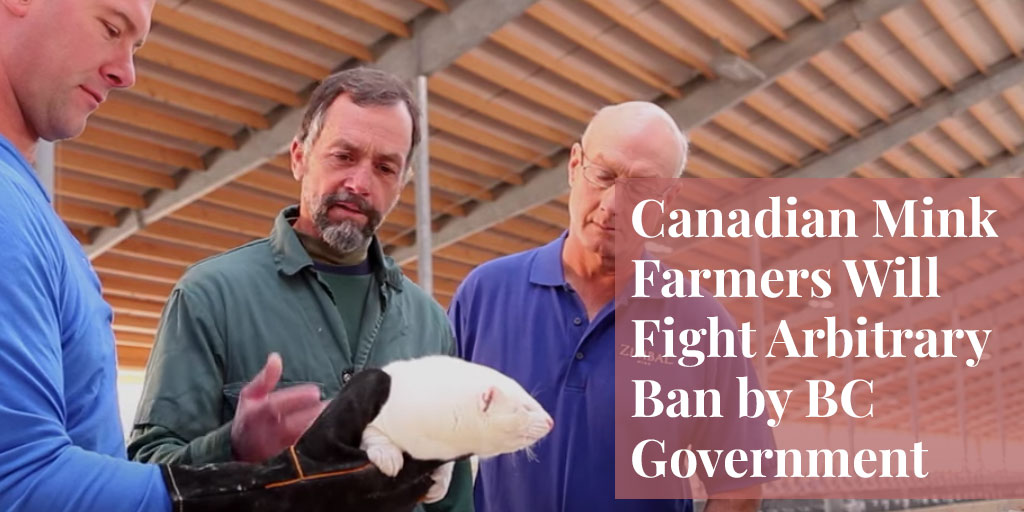
On November 5, Lana Popham, British Columbia’s Minister of Agriculture, Food and Fisheries, announced that the province “is beginning a process to phase out B.C.’s mink-farming industry due to ongoing public-health risks associated with COVID-19.” But one of North America’s most respected veterinary experts has denounced this arbitrary ban as an “overreaction” that is “not supported by science”.
“The British Columbia government’s declaration to end the livelihood of these farm families does not seem to be supported by the current scientific knowledge and appears to be an overreaction to a situation with very limited health risk to the general human population,” says Dr. John Easley, director of research for Fur Commission USA. (See his full statement, below.)
The government’s decision seems especially unjustified now that a new vaccine has been developed to protect mink from the Sars-CoV-2 virus, he says.
While the Sars-CoV-2 virus has been detected on mink farms in many countries over the past 18 months, “the vast majority of these infections have been self-limiting, and posed very limited risk to the caretakers of the livestock,” he continues. No Variants of Concern have developed on mink farms, according to the World Health Organisation.
Most viral mutations are species-specific in their pathology, so the virus circulating in the human population – especially the unvaccinated population – presents by far the greatest risk to produce a Variant of Concern. “So, if the governmental agencies’ goal is to reduce the risk of a new Variant of Concern being developed, why haven’t they already mandated that all the citizens be vaccinated?” asks Dr. Easley.
“And how are they going to address the risk due to the domestic cat population’s susceptibility to the virus – or all the other animal species [including hamsters, ferrets, and white-tailed deer] that we now know can be infected and reproduce the virus?”
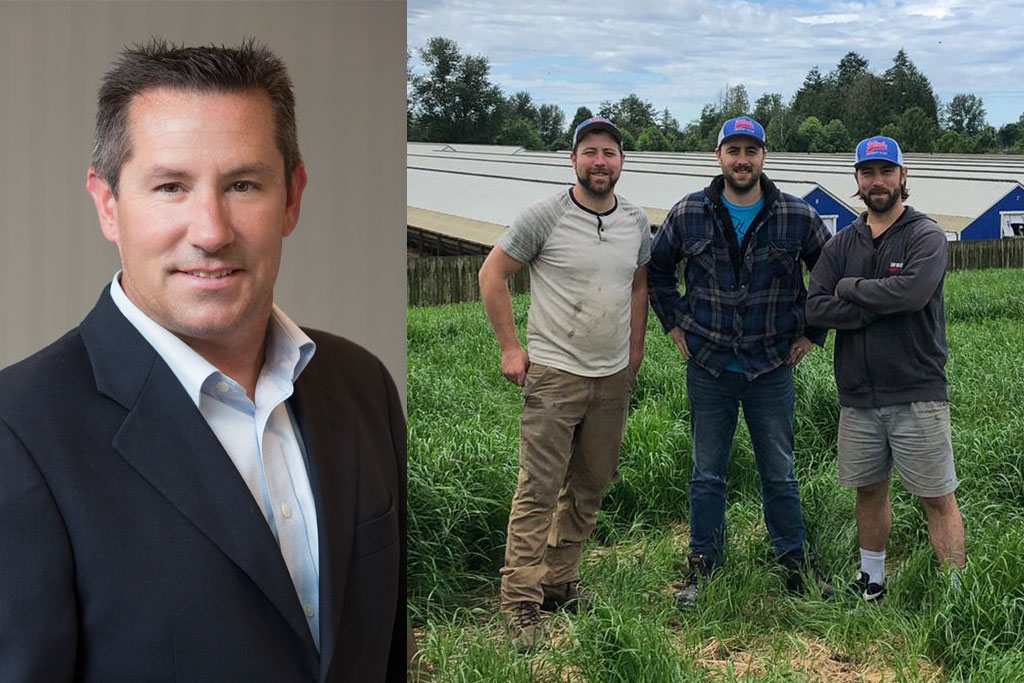
“Since we learned that mink can contract Covid-19 from humans, Canadian mink farmers have worked with government agencies to implement strict biosecurity protocols,” says Rob Bollert, a mink farmer and president of the Canada Mink Breeders Association (CMBA). “As proof of how conscientiously these measures have been applied, the Sars-CoV-2 virus has been detected on only three of our farms – just 5% of the 60 Canadian mink farms situated across the country.”
“This arbitrary and radical decision by the BC government is simply devastating for farm families,” says Bollert. “It takes generations of work, including excellent nutrition and care as set out in Canada’s comprehensive codes of practice, to develop the quality of mink that Canada is famous for – and these bureaucrats are destroying all that effort, without any real scientific justification. With only one Sars-CoV-2 positive farm in BC at the present time, this will mean that farmers will be forced to kill perfectly healthy herds of animals. This is unprecedented.”
SEE ALSO: With proper precautions, mink farms don’t pose Covid-19 risk. By Alan Herscovici, Truth About Fur.
“We know that animal activist groups in BC have been campaigning against mink farming for years, as the thin edge of the wedge in their efforts to eliminate all animal agriculture. They have been fanning Covid fears to further that agenda. But it is shocking that the BC government would surrender to activist pressure tactics, rather than basing policy on science and proven good practice,” says Bollert.
In the US, Sars-CoV-2 has been detected on 16 farms in four states, but the Centers for Disease Control (CDC) and the US Department of Agriculture have not recommended culling healthy animals or banning mink farms. Dr. Anthony Fauci, director of the National Institute of Allergy and Infectious Diseases in Maryland and Chief Medical Advisor to the US President, has stated that, with proper biosecurity measures in place, the CDC considers the Covid risk that mink farms represent for the general public to be low.
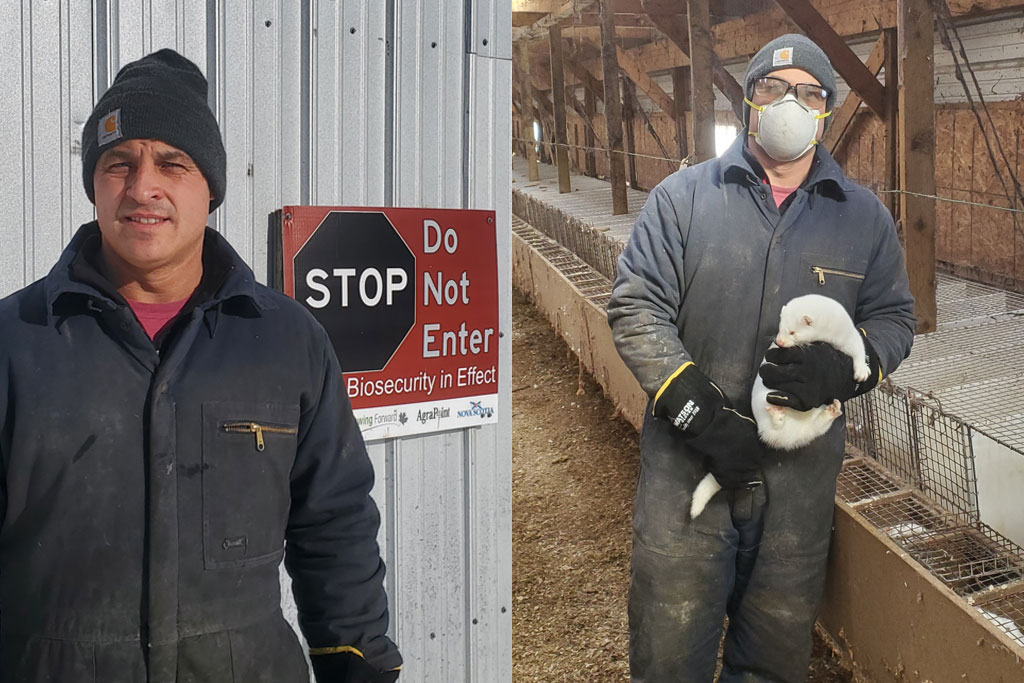
“When cases of Swine Flu or Avian Flu emerged in this country, the government didn’t shut down pork or chicken production – although that’s exactly what animal activists were calling for,” says mink farmer Matthew Moses, president of the Nova Scotia Mink Breeders Association and past president of the CMBA. “Instead, government agencies worked with producers to responsibly manage the situations.”
SEE ALSO: David Suzuki got it wrong; mink farming makes sense. By Matt Moses, former president, CMBA.
“BC mink farmers have implemented all the security measures requested by the BC health and agriculture officials, but it looks like the BC government in this case is more interested in pandering to animal activists. Is it because we are a very small sector, with only nine farms in BC? Is that why they are ready to destroy the work and livelihoods of these farm families?” asks Moses.
“The proof that the BC government does not really believe mink farming to be a public health risk is the fact that they are permitting producers to keep live mink on their farms for another 18 months, and to sell or transport them to other provinces,” states Moses.
“The BC government’s knee-jerk decision is especially disappointing because mink fur is a sustainably produced, long lasting, and biodegradable, natural clothing material – exactly what environmentalists are saying we should be choosing instead of petrochemical-based, throwaway, ‘fast fashion’,” says Bollert.
“We are looking at all our options to fight this arbitrary decision. Animal activists are saying openly that this is just the first step in their campaign to eliminate all production of animal products, including meat and dairy. This is a wake-up call for all agriculture, and for everyone who believes that government policy should be based on science, not activist propaganda.”
* * *
This is an unfortunate decision that doesn’t seem to be supported by the experience and knowledge we have gained during the last 18 months since the North American farmed mink industry started to address the mink’s susceptibility to the Sars –CoV-2 virus.
Over that period many counties have experienced infections in their farmed mink operations and the vast majority of these infections have been self-limiting and posed very limited risk to the care takers of the livestock. No Variants of Concern have ever been developed due to the viral replication in mink according to the WHO. Many viral mutations are species specific in their pathology; so, the virus circulating in the human population, especially the unvaccinated population, is by far the greatest risk to produce a Variant of Concern that would put the general population at risk. So, if the governmental agencies’ goal is to reduce the risk of a new Variant of Concern being developed, why haven’t they already mandated that all the citizens be vaccinated? How are they going to address the risk due to the domestic cat population’s susceptibility to the virus and/or all the other animal species that can be infected and reproduce the virus, thusly, potentially producing a new Variant of Concern?
The North American farmed mink industry has worked collaboratively with many governmental agencies to develop effective biosecurity protocols for the farms and their employees. They have also supported the development and the utilization of a Sars-CoV-2 vaccination for the mink. This vaccine was granted experimental approval by USDA and was tested in 90% of the mink in the United States, over 3.2 million doses were utilized. It was proven to be extremely safe. Since the enactment of the enhanced farm biosecurity measures, the farm animal caretakers being vaccinated and the mink themselves being vaccinated, there have been no new diagnosed farm infections in the USA.
The British Columbia government’s declaration to end the livelihood of these farm families does not seem to be supported by the current scientific knowledge and appears to be an overreaction to a situation with very limited health risk to the general human population.
John Easley DVM
Director of Research
Fur Commission USA
SEE ALSO: Covid and mink: Resources. Fur Commission USA.
***
To learn more about donating to Truth About Fur, click here.
The International Fur Federation (IFF) has appointed a range of fur industry “Ambassadors” as well as retained the services of…
Read More
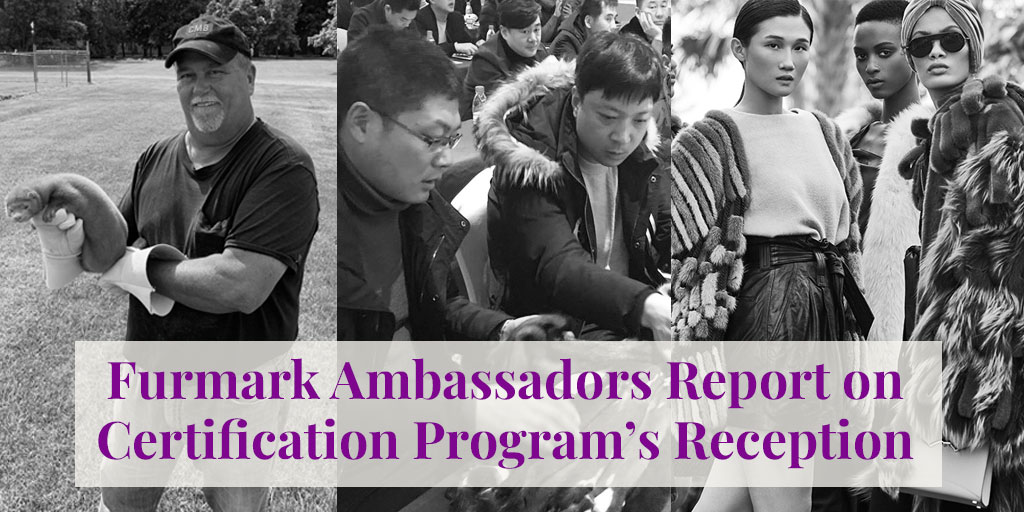
The International Fur Federation (IFF) has appointed a range of fur industry “Ambassadors” as well as retained the services of outside industry consultants to market, promote and provide information on the Furmark® certification. The Ambassadors represent their respective regions and will be responsible to outreach to a range of firms and contacts to share the merits of – and encourage inclusion in – the Furmark certification program.
Sandy Reports reached out to several of the Ambassadors provided by the IFF and asked them to share feedback they have received to date from their respective regional outreach.
In their own words …
SEE ALSO: North American fur trade – ahead of the curve on traceability. Truth About Fur.
Regarding Furmark, I had conversations with fur people on my previous two trips in China this month. In general, bigger manufacturers for domestic market and exporters for Russia are viewing Furmark as a very positive tool either for increasing their revenue or simply for their own publicities use. For those manufacturers who do OEM fur garments for fashion brands and for Russian market, they believe that if their clients accept Furmark, then they should join as quickly as possible, so they will be receiving more orders than those who don’t. That’s why they want to know how Russians are truly viewing Furmark.
The smaller ones are definitely showing interests on Furmark as well but given that they don’t buy as many skins from auction houses as the bigger companies, so at the moment, instead of applying immediately, they’d rather take wait-and-see attitude to see how things are going with bigger ones. (For exporters, they also comment that they want to know how Russians react to Furmark, which I think is reasonable.)
Retailers, we have a well-known brand in China who take initiatives to have included Furmark as part of their own marketing strategies in the coming retail season, really move fast and even push IFF to provide more marketing toolkit for them.
As for Chinese domestic market, if Furmark will be known and accepted by Chinese consumers, it for sure will help a brand to sell more garments over others who don’t use … what Furmark stands for, such as sustainability, traceability system, green materials etc.
These ideas are very popular in the fashion world in China in recent years, you can hear these talks, discussions on almost every fashion-related Seminar or Forum in China. LV and Fendi’s joining in has become an endorsement for Furmark in the fashion world.
I have been working as a freelance consultant for IFF for more than a year now, with a focus on developing and implementing the Furmark system in the fur trade and fashion industry. Acting as an ambassador in the outreach to the fashion brands in Europe is a natural extension of my assignment.
Behind the handful of much publicised brands that have said no to natural fur, I still find a genuine interest in fur. I would even say that in the post-covid markets there will be an increased interest in materials that are authentic and sustainable. Natural fur actually ticks all the boxes in this respect, and the Furmark system can provide the assurance and confidence that consumers need to buy natural fur.
Both my personal contacts in the fashion industry and the extensive research that has been conducted globally in B2B [business-to-business] and B2C [business to consumer] segments by IFF, points to the fact that Furmark is the right concept at the right time. Most companies in the fashion industry do understand that they need a new strong tool to be able to promote and sell natural fur. Although fake fur is an alternative, there is no way around the fact that it is a plastic product that does not add any value to their products/brands compared to natural fur.
Having worked intensely with Furmark for more than a year, I am left with a feeling that there is a future for the fur trade. Although we have had some setbacks in recent time, I still experience that natural fur has a unique cachet and the material is aspirational for many designers and consumers. The high level of interest in signing up to the Furmark system across the markets is a good indication for the future!
The designers that I am concentrating my Furmark efforts are fur-friendly and sell to boutiques and direct to consumers. They are, of course, disappointed that department stores will not buy, but many of the mid-level designers do not sell to department stores. I did not ask any questions about their reaction to fur. I have been mostly targeting designers in New York. They are all suffering in their business with decreased sales, so they did not bring up a change of attitude to fur. To be honest, I have been speaking to fur-friendly designers. They have been busy with their spring collections, and we are doing a Blackglama project, so they seem happy. I think that Furmark will provide additional confidence, but without the department stores the fur business will be smaller in the future.
The designers that I have reached are very supportive of the Furmark concept but they are waiting for the program to launch in Q4. The designers think that an organized and common language of selling certified furs is important in light of department stores that have stopped selling fur. The actual language is still being discussed but the concept has been very well received. I think after the September shows this will be a more relevant conversation as the designers will think about fall and fur. I will have a Furmark presentation during Fur Vision this year to really bring the message to the trade. The IFF wants to do the designer outreach before the trade.
The fur farmers seem to understand that the manufacturers and retailers need a concept to provide confidence to their customers. The trade in New York has not really commented on the Furmark program since it launches the end of the year. The IFF would need to do some outreach to the trade to try to get the information about Furmark to the trade. This has not started and is a program for the fall.
The big brands in Europe are also supportive about Furmark because they feel it is a way to give confidence to the consumer and the program covers a lot of fur types which they sell.
I think the lack of action about the loss of department stores is shocking. We won the political battle in some states, but we lost Saks and Neiman.
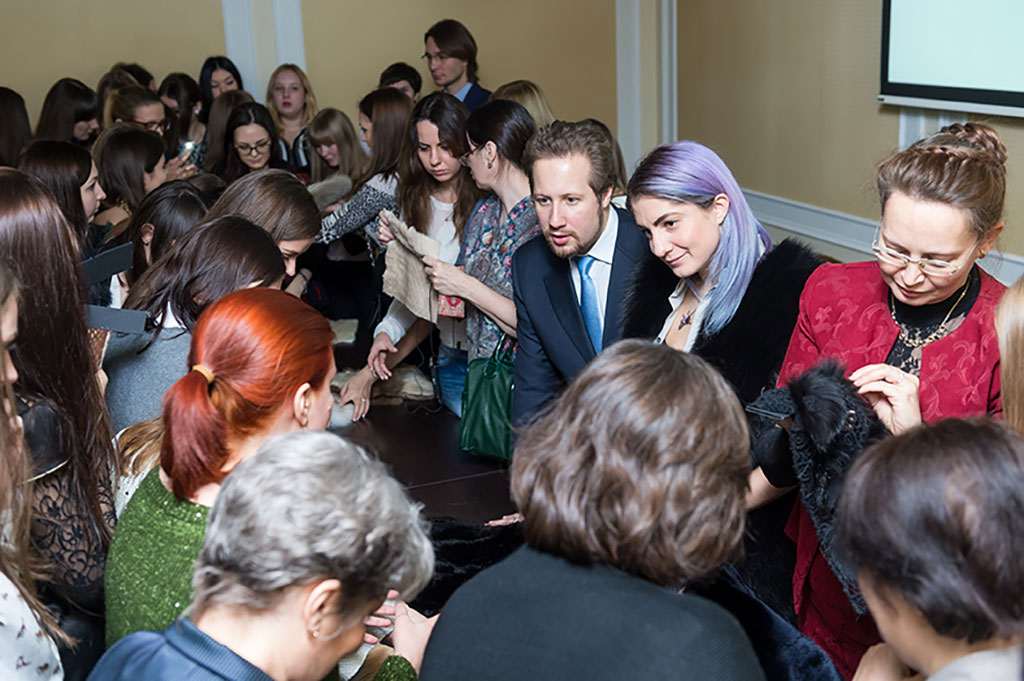
The reaction to Furmark in Russia and Eurasia is positive, Turkish brands are already joining the project and there is interest from major players from Russia, Kazakhstan, Belarus. As in fact the Eurasian Economic Union has a mandatory traceability and labelling system in place by law since 2016, many players are interested in how technically the Furmark project can integrate into the existing system. We continue to negotiate with key industry players about joining the Furmark project.
The response to the Furmark project concept has also been received positively by almost all sectors of the fur industry. Proof of this: most sable fur farms in Russia have already joined the project and have been certified by independent inspectors from the Research Institute for Animal and Rabbit Breeding, two major auctions Sojuzpushnina and Ruspushnina, which sell Russian sable skins, have also been assessed for compliance with the Furmark project by independent experts from the Federal Centre for Hunting Development and, starting in 2021, all furs sold in Russia are certified. Plans for the near future include the inclusion of Uzbekistan and Uzbek Karakul in the Furmark project.
The main drivers of the fur trade are still China and Russia. In Russia, the turnover of fur goods is about US$3 billion, and compared to 2020, there is a noticeable revival of the market, sales growth, and a systematic return of business indicators to the pre-pandemic level.
***
To learn more about donating to Truth About Fur, click here.
Animal rightists have been badgering the UK government to ban the fur retail trade for years, and with their country…
Read More
Animal rightists have been badgering the UK government to ban the fur retail trade for years, and with their country now out of the EU and no longer bound by its laws, the government is seriously considering giving them what they want. Such a precedent would give a major boost to animal rights activists lobbying for similar restrictions in other European countries, and even the US and Canada. So while the UK may not be a major consumer market, it is imperative that anyone who supports the responsible use of animals should now take action to ensure that a UK fur-sales ban doesn't happen.
Of course, it's easy to feel jaded when it comes to the UK, and even write it off as a lost cause. After all, despite a long and noble history of championing responsible animal welfare, this tiny island is now a breeding ground for virulent animal rightists, right up there with California. Plus, few British people wear fur anyway, so does it really matter?
The answer is yes, it matters. Courtesy of its language, its history, the Beatles, and a host of other factors, the UK's influence on global trends is unquestionably profound. If the British decide to ban fur retail sales, animal rights campaigners will surely hold it up as a model for other countries – and their legions of Anglophiles – to follow.
The danger is especially evident when we consider who now has the ear of Prime Minister Boris Johnson. On May 29, he married Carrie Symonds. Who is Ms. Symonds? Well, for one thing she believes that "Anyone that wants to buy fur really is sick." She was also PETA UK's 2020 Person of the Year. And she's sleeping with the PM...
Now for the "good" news. Rather than just diving in head first with a ban, the government's Department for Environment, Food and Rural Affairs (DEFRA) is testing the water thoroughly first. This it is doing by inviting everyone – including foreigners – to partake in a "call for evidence", with a deadline of June 28. The process is easy too: just click on DEFRA's online questionnaire and let your voice be heard. And as an added bonus, it will send you a link to download a PDF of your responses once you're done.
(Note: Don't be confused by the questionnaire's reference to Great Britain, rather than the UK. GB refers to England, Scotland and Wales, as the other UK member, Northern Ireland, remains in the EU Customs Union and will be unaffected by a ban.)
The questionnaire is also refreshingly different from previous polls on the fur trade. Rather than asking how we feel about fur, with multiple choices ranging from "Strongly approve" to "Strongly disapprove", almost all the 39 questions are looking for solid information. And there's something for everyone, so ignore the ones that don't apply, and let rip on the others.
Question 11, for example, is for ranting, if you so choose. "What is your attitude towards the import and/or sale and/or export of fur or fur products in GB?" it asks. TAF, however, opted for restraint, given our status as a voice for the trade. "It's a legal, regulated activity that should be allowed to continue," we wrote. "The government should always be vigilant about sources of fur to ensure only fur that is harvested humanely exists in the marketplace. However, it would be overreach on the part of government to ban all trade in fur, as this would be forcing the views of one sector of society on everyone. The UK is supposed to be a democracy in which everyone's views are respected. Banning fur would be a move in the wrong direction."
SEE ALSO: The Fur Truth: How a UK fur ban would damage and set back animal welfare. British Fur Trade Association.
Then there are a few "fun" questions to test your knowledge, like Question 12. "Other than for clothing and apparel, what uses of fur should we be aware of?" TAF came up with the obvious furnishings like pillows, rugs, etc., and the always-overlooked use of fur in fishing flies. Are there others DEFRA should know about? Are the markets for mink eyelashes and calligraphy brushes too small to mention?
Of course you might also find a couple of questions rather stupid, like Question 27: "What do you consider to be the total value (in £ sterling) of imports to and exports from GB in relation to (i) raw furskins; (ii) tanned or dressed furskins; (iii) articles of apparel and clothing; (iv) artificial fur?" We suggest a politely worded response like, "Look them up yourself. The UK government – which you represent – publishes these stats. It is irrelevant what anyone 'considers' them to be."
And then there are some great questions, including Question 38, which is just perfect for North Americans. Asks DEFRA, "We are interested in finding out more about other countries’ existing or planned restrictions on fur. Please provide any information and/or evidence that you are aware of."
Of course, TAF went to town describing the divisive, arbitrary, and counter-productive nature of fur retail bans in the US, especially in California. If you don't already know our myriad objections, here is just a sampling:
US legislators should be promoting natural fur, not seeking to ban it. April 22, 2021.
There's no justification for banning the sale of fur. February 17, 2020.
Fur industry sues San Francisco. January 15, 2020.
Fur ban proposals are based on a dangerous fiction. September 25, 2019.
6 reasons why banning fur sales is a very bad idea. April 11, 2019.
So whether you think it will make a difference or not, please do take the time to fill out this questionnaire. Because, as sure as the sun rises each day, animal rights groups will be giving it their full attention.
And as your parting shot, here's an idea for your answer to the final question, number 39. DEFRA asks: "Please provide any other relevant evidence you would like to include to inform decisions on the GB fur trade." TAF took the high road, and referred the UK government to our website. But we were sorely tempted to write, "We are concerned that Prime Minister Boris Johnson may be swayed by the fact his wife is rabidly anti-fur. Can DEFRA assure us that Mrs. Johnson will not unduly influence government policy going forward?"
***
To learn more about donating to Truth About Fur, click here.
Late last year, the Fur Council of Canada launched the inaugural Fur Design Competition for young designers residing in Canada,…
Read More
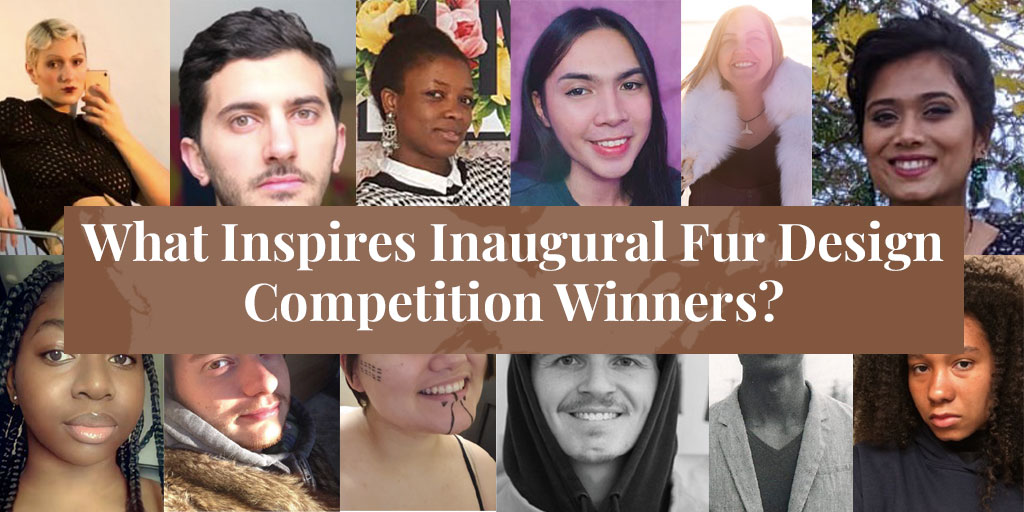
Late last year, the Fur Council of Canada launched the inaugural Fur Design Competition for young designers residing in Canada, and in February the 12 winners were announced. These talented youngsters will shortly be attending a week-long, all-inclusive workshop hosted at Ryerson University in Toronto, under the expert tutelage of designer Farley Chatto.
So what inspires these fledgling designers? Truth About Fur fired the same three questions at each to see what we could learn. Maybe their answers will, in turn, inspire entrants in next year's competition, who should also read our post Insider Tips from Fur Competition Judges.
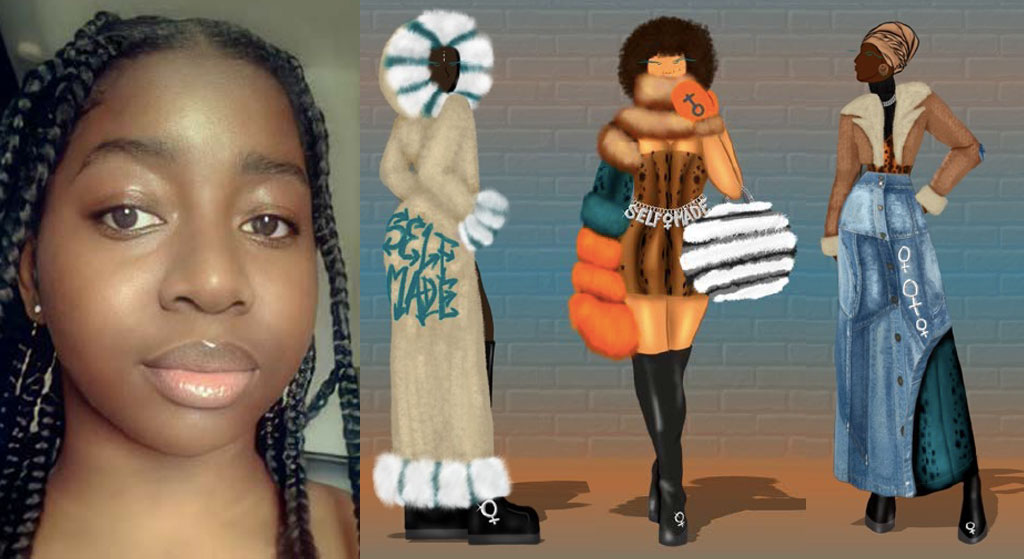
Who are you in terms of design?
I am an innovative artist who always tries to put my culture forward in every design that I make. In this way I make every garment that I design personal to me, no matter what the project is.
What do you love most about design, and how do you think fur can elevate your work?
I love design because it tells a story and helps bring out a person’s character. Whether it be your mood for the day or your overall aesthetic, how we dress is an expression, and it's amazing to see how different we all are when expressing ourselves.
What inspired you to enter the Fur Design Competition?
I always like to try new things, and before this competition, I have never worked with fur, nor have I ever designed a fur garment. But I was up for the challenge, and the outcome was more than amazing.
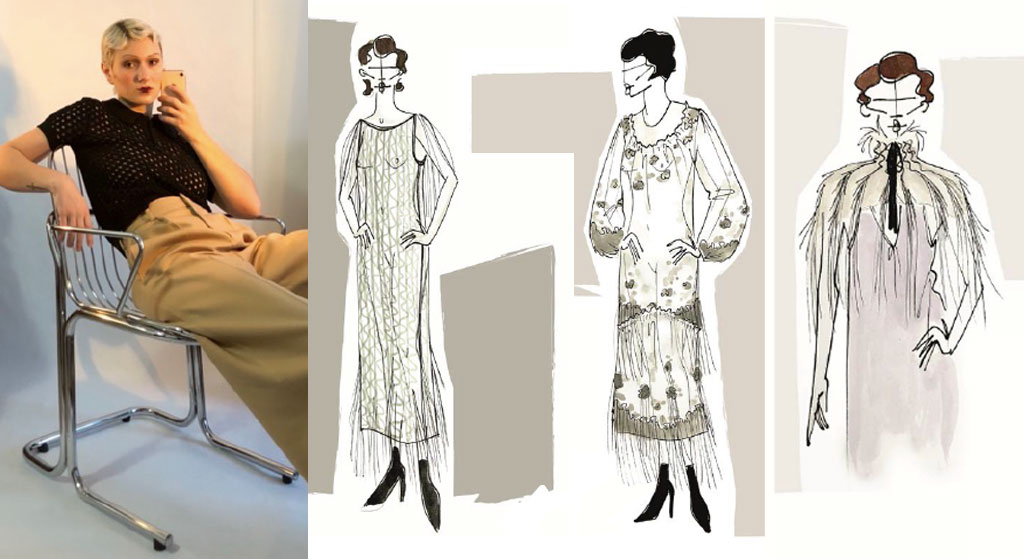
Who are you in terms of design?
I design feminine clothing for all people who desire to stand out.
What do you love most about design, and how do you think fur can elevate your work?
Fashion has a way of communicating who I am without having to speak. Authenticity and sustainability are at the heart of my designs. I create pieces focusing on garment structure and material manipulation, with the goal of conveying emotion. I often use fur to add uniqueness to a garment, and because it can be recycled many times.
What inspired you to enter the Fur Design Competition?
I entered the contest wanting to challenge myself to create ready-to-wear garments that would please many people while using fur in unconventional ways. To me, natural materials are one of the many solutions to tackle the fashion industry’s climate impact. As a young designer, I acknowledge my responsibility to create clothing that is long-lasting, of good quality and easily upcycled.
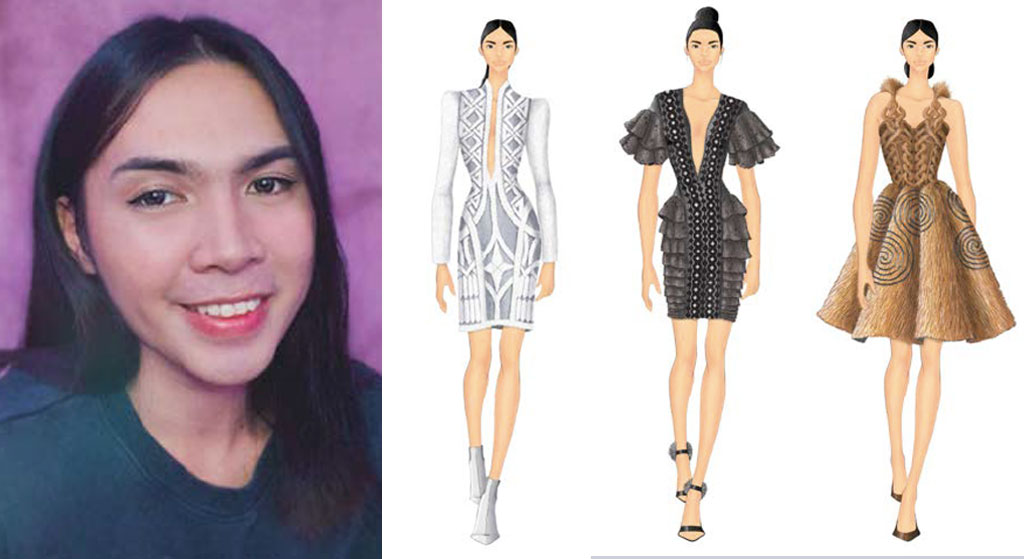
Who are you in terms of design?
In terms of design, I am more into haute couture designs where manipulations, embroideries and embellishments are my kind of detailed finishing.
What do you love most about design, and how do you think fur can elevate your work?
Everything around us can be an inspiration in creating our own designs, and that’s what I love about designing. It brings out the beauty in everything and I think the fur itself will give an extra detail to our designs.
What inspired you to enter the Fur Design Competition?
I joined the Fur Design Competition because I want to explore things about fur. I think it has a lot of things to offer, not just about designs but on how to create pieces into it from illustration to construction.
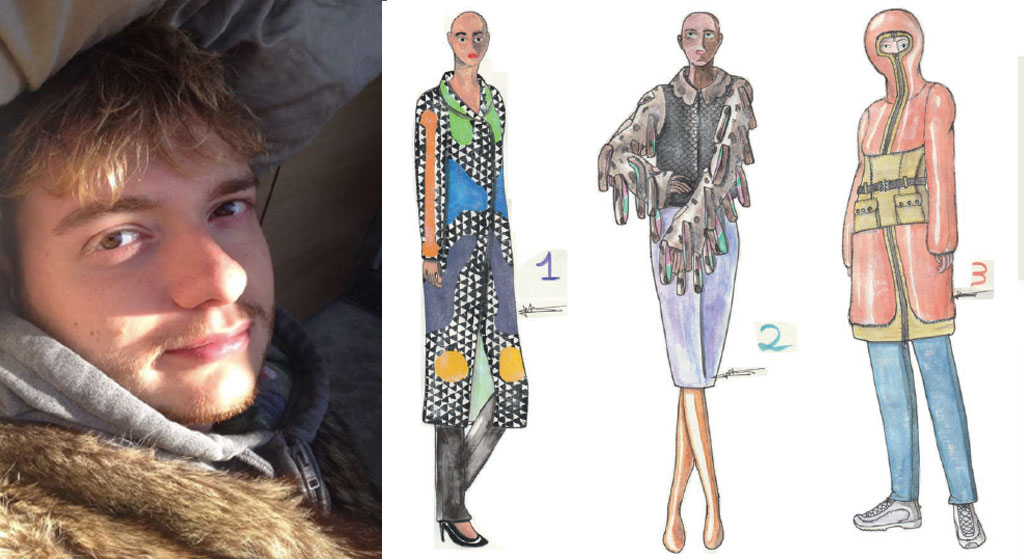
Who are you in terms of design?
Futurism, avant-garde, exoticism, empowerment and seduction usually inspire my designs.
What do you love most about design, and how do you think fur can elevate your work?
Fashion and design in general always reflected the Zeitgeist. Through time, designers of the world have shown their culture through their own hands and eyes. I believe that we are now living in a world that is finally focusing on its problematics. There is now a bright light shining on our over-consuming habits and their effects on nature. I believe as an aspiring designer that it is finally time to understand the ravaging effects of massive production and start to slow down. Future Fashion needs to be more ecofriendly, more valuable, and more inclusive. Fur is an amazing material to achieve these goals.
Furthermore, one can always work with old fur to regenerate another completely different product. There is no waste because it is possible to work with leftovers to create jewelry, accessories or make a completely new fur plate that can be used to cut another garment later. For all these reasons and for its unique softness and warmth, I believe fur is one of the best sustainable materials to design with.
What inspired you to enter the Fur Design Competition?
Working already with fur for about a year, I have learned to make designs with it. I wanted to show my own vision of the theme “Future Heritage”, that inspired me a lot. In addition, the reward really convinced me to participate. Indeed, it is not so difficult to include fur in my garments, but it has important inherent characteristics to think of. I really wanted to be invited to the intensive practice in Toronto not only to get better at sewing and crafting fur, but also to learn tips from professionals on how to cut it, how to spot flaws, and how to improve the quality of the product in general to avoid using too much.
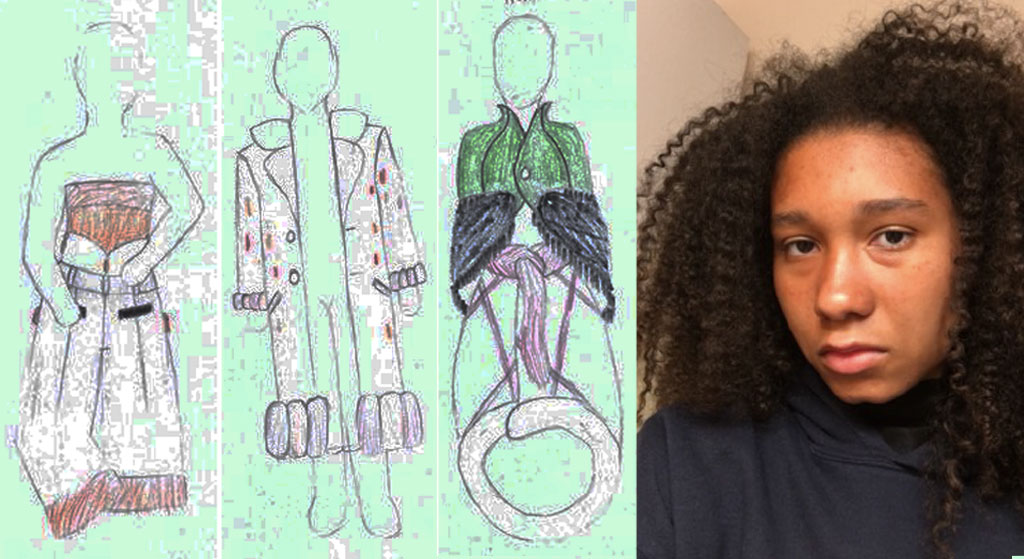
Who are you in terms of design?
I am someone who likes to explore the natural aspects of design and integrate nature into my designs.
What do you love most about design, and how do you think fur can elevate your work?
I love the freedom to make my visions and contemplate how I can make my vision a reality. I think fur would add a flair to my designs, and I would try to expand my natural designs to have a more animalistic side to them.
What inspired you to enter the Fur Design Competition?
I wanted to partake in the competition because I have always wanted to learn about different types of furs and try and bring back the use of fur into everyday life.
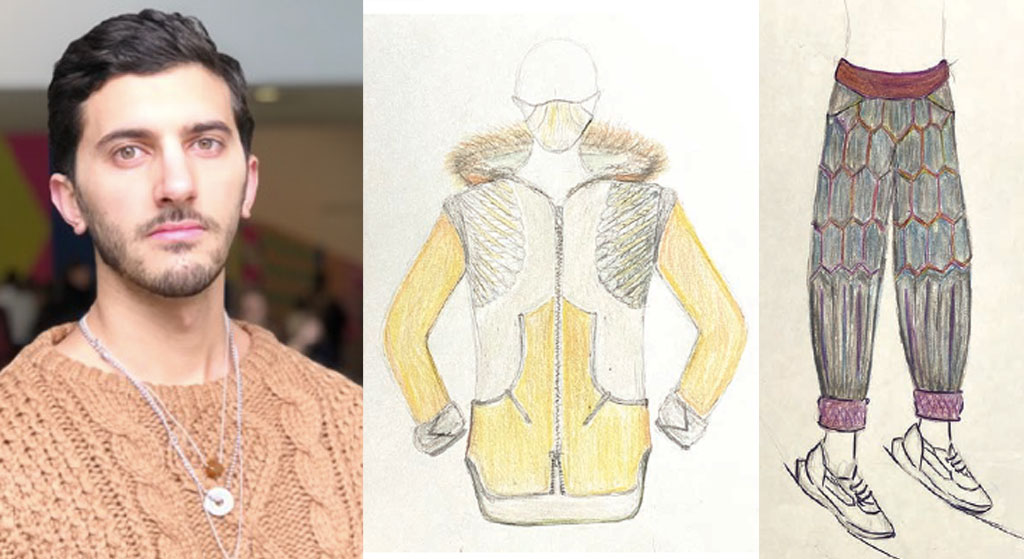
Who are you in terms of design?
I am an accessories and jewelry designer. My design emanates from three essential elements: passion for the material, power of the color, and structure of the shape/symbolic of the pattern. It marries craftsmanship and technology, finding innovative ways to shape and sculpt the primary medium, always conscious of its fascinating physical properties and cultural dimensions.
What do you love most about design, and how do you think fur can elevate your work?
I love the creative process of bringing to life ideas and designs with all the challenges and excitement of innovation. I enjoy creating a story and stepping outside of my comfort zone. Fur, its history, and heritage have inspired me. My primary working medium is leather in all its diversity and potential, and spontaneously I sensed a form of a natural dialogue between leather and fur. Fur is the continuation of my journey working with beautiful, sustainable raw materials. Fur is changing my design approach, my understanding of 3D modeling. I have reached excellence in leather, and I would like to achieve that in fur and marry the two materials together in beautifully crafted and designed winter accessories.
What inspired you to enter the Fur Design Competition?
I have always been fascinated with fur as a material, and I admired the late genius, Karl Lagerfeld. He marveled with fur design for over 50 years at Fendi. As a young designer who recently moved to Montreal, when I read about the Fur Council of Canada competition, I decided to submit my candidacy as a new adventure and a daring opportunity to create and innovate using fur. Despite the challenging times around the world and the fur industry's uncertain future, I have tremendous faith in the future laying ahead for fur design in technology and innovation and the fur industry in business development and especially sustainability. Fur will remain as emblematic of Canada and Canadian heritage as the maple leaf/syrup. I aspire to carry out creativity and innovation in fur design for my generation as a Canadian haute couture, artisanal and prestigious industry.
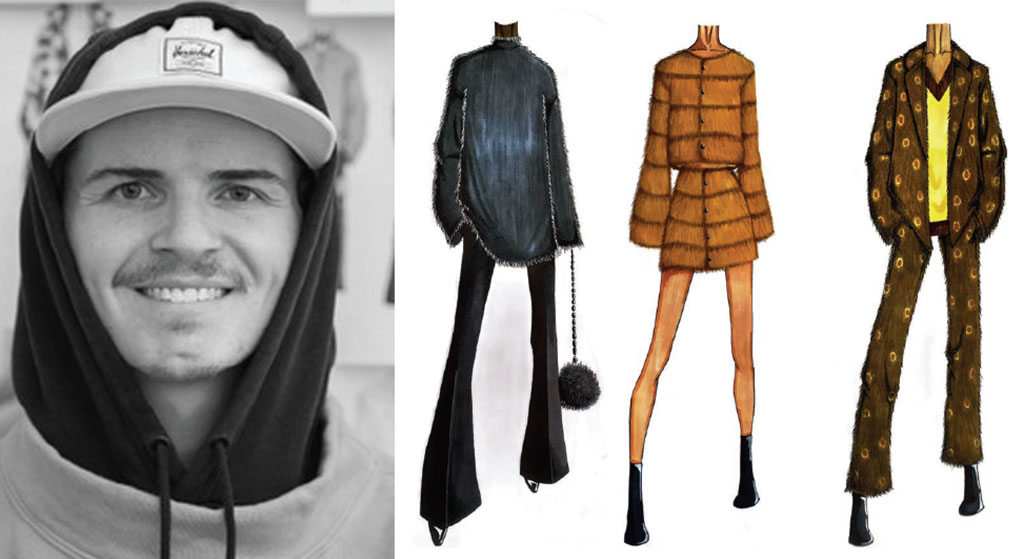
Who are you in terms of design?
I am constantly focused on shape, fit and silhouette. Proposing new shapes and silhouettes is the only thing that fuels my need and desire to design. To be honest, it’s the only reason I’m here, because it’s the one main aspect of design that I’m good at.
What do you love most about design, and how do you think fur can elevate your work?
Design gives us an opportunity to reinterpret how we, as humans, represent ourselves. This is one of the reasons why I love design. We get to infuse our feelings and emotions into our designs which help us incapsulate a certain shape or feel. Fur represents an array of these different feelings and emotions, warmth, luxury, comfort, etc. Therefore, designing with fur opens the door to new schools of thought.
What inspired you to enter the Fur Design Competition?
Design competitions give students an opportunity to showcase their skills and I wanted to showcase mine. Although I’ve never worked with fur, I felt that it was an interesting design element, and it sparked a lot of inspiration within me. I’m extremely happy that I entered the Canadian Fur Atelier design competition and look forward to entering more in the future.
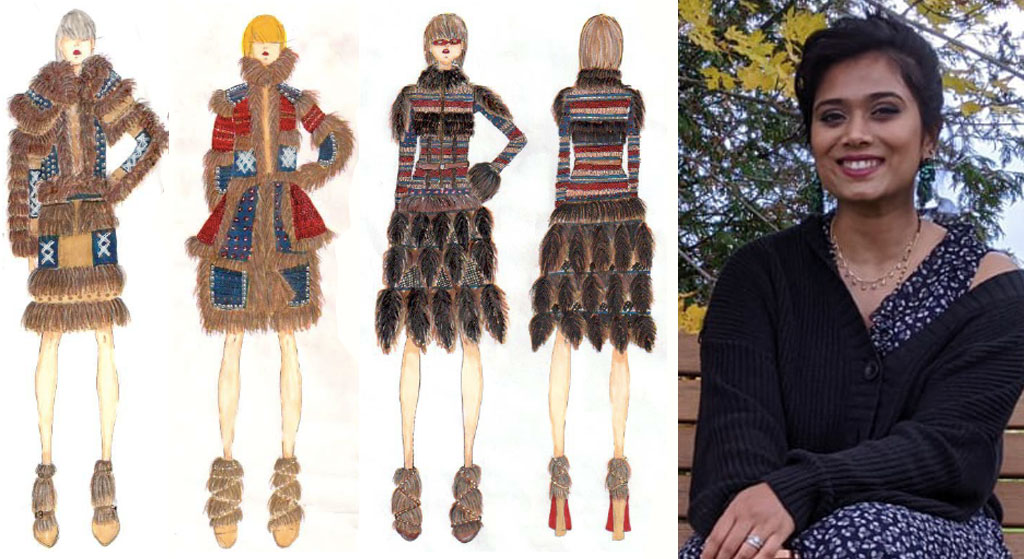
Who are you in terms of design?
I am an aspiring designer looking forward to learning and creating new innovations.
What do you love most about design, and how do you think fur can elevate your work?
Designing makes me feel alive and powerful. Putting my ideas and thoughts together inspires me to thrive more. Designing and creating garments taught me to be patient; all good things take time to make, like how it takes nine months for a baby to come out. It takes time. Every time I make something, I feel like I am giving birth to a baby; I thoroughly enjoy every process and aspect of my creation. Moreover, I think using fur gives dimension and interesting texture to my ideas. It also elevates the look of my design and brings luxury with a timeless look.
What inspired you to enter the Fur Design Competition?
The challenge and complexity of the competition attracted me to do research. As a student, I have significantly fewer possibilities to work with fur and do research about it. This competition gave me a chance to do so. While participating in this competition, I had an excellent opportunity to learn about different techniques and finish of fur. I was also excited about the workshop to learn about fur; knowledge of working with skin can improve my garment skills.
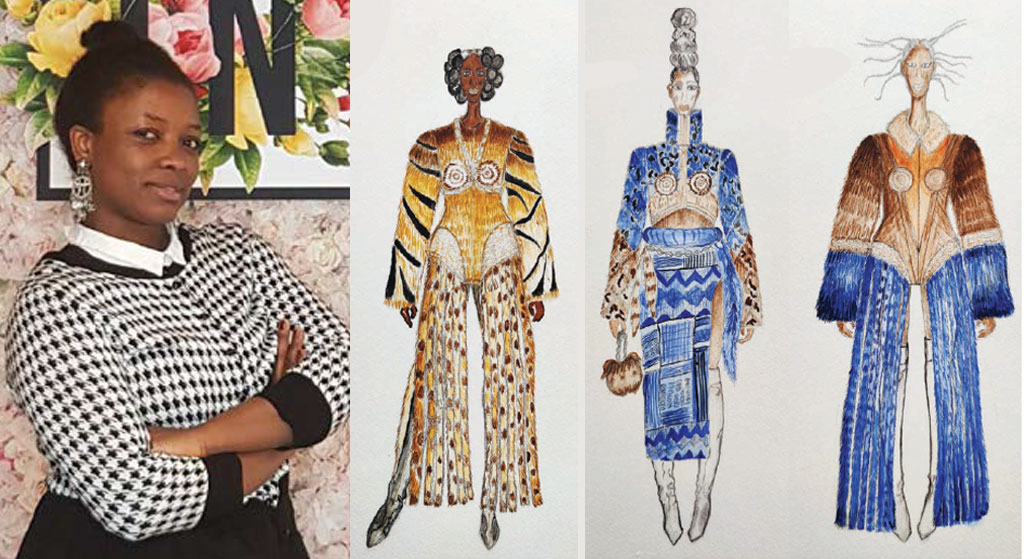
Who are you in terms of design?
I am a designer who loves creating classic looks while incorporating sustainable fashion, be it through upcycling or recycling materials.
What do you love most about design, and how do you think fur can elevate your work?
Design is a form of expression. While its an outlet, my design process is a chaotic space where I get to learn something new and challenge myself.
What inspired you to enter the Fur Design Competition?
Firstly, I love fur because it reminds me of my heritage. The competition gave me room to translate why I love fur by using the theme "Future Heritage". I therefore entered the competition because this theme redefines what I interpreted as purposeful design for the future.
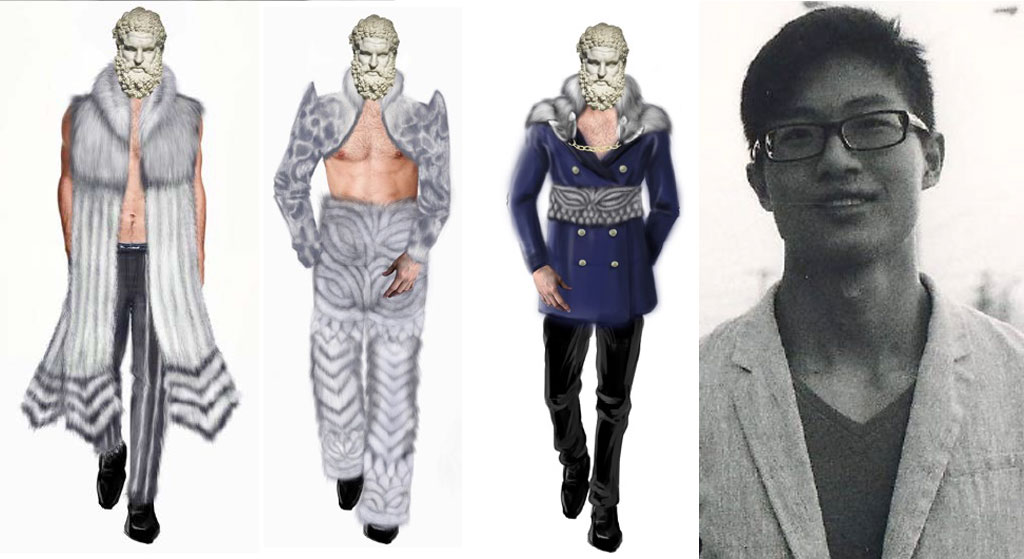
Who are you in terms of design?
I am a designer that focuses on modern silhouettes that balance simple elegance with creative intricacy.
What do you love most about design, and how do you think fur can elevate your work?
I love solving problems through design and being able to bring my imagination into reality. This is especially true for fashion design. Working with fur makes me more sustainably-conscious, being more considerate of fashion’s impact on our planet and how we as young designers intend to navigate this problem.
What inspired you to enter the Fur Design Competition?
Fur is a unique textile that is important to Canadian ancestry, and I wanted to prove my skills as a Canadian designer.
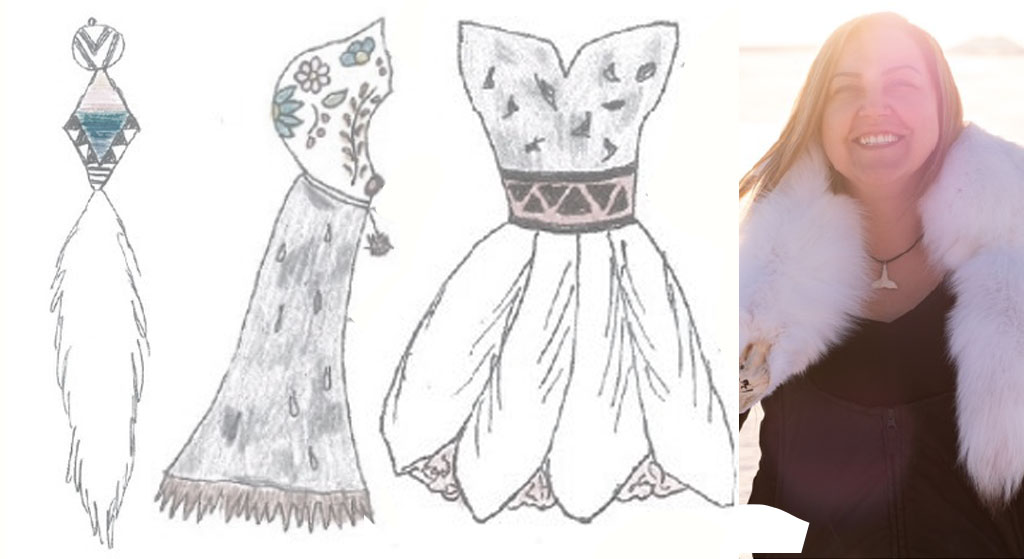
Who are you in terms of design?
I am resilient, healing doing my part reconciling through the love of indigenous fashion!
What do you love most about design, and how do you think fur can elevate your work?
Fur is sexy; imagine tying in your ancestral designs with a modern twist!
What inspired you to enter the Fur Design Competition?
To gain skills to create modern sustainable clothing while inspired by our traditional designs.
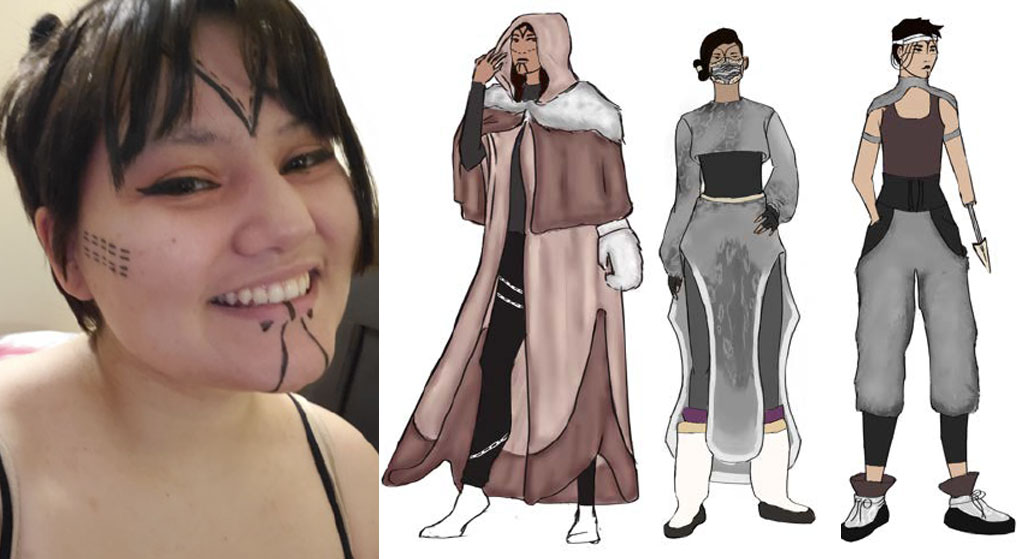
Who are you in terms of design?
I am 23 and up till now have only done designs for fun, heavily based around my culture.
What do you love most about design, and how do you think fur can elevate your work?
I love the different ways you can express beauty and ideas with designs, and the sheer amount of variety that comes when people of different backgrounds are able to share their designs. Nature has made such beautiful and unique things through fur, and fur is so deeply steeped in many cultures' traditional clothing. Adding fur adds a sense of quality, beauty, and comfort to the clothing.
What inspired you to enter the Fur Design Competition?
I'm always very excited about indigenous futurism, and loved the idea of sharing some designs. I figured it wouldn't hurt to give things a shot and share some designs.
***
To learn more about donating to Truth About Fur, click here.
Last month, the 12 winners were announced of Canada’s inaugural National Fur Designers Competition, judged by four Canadians all with…
Read More
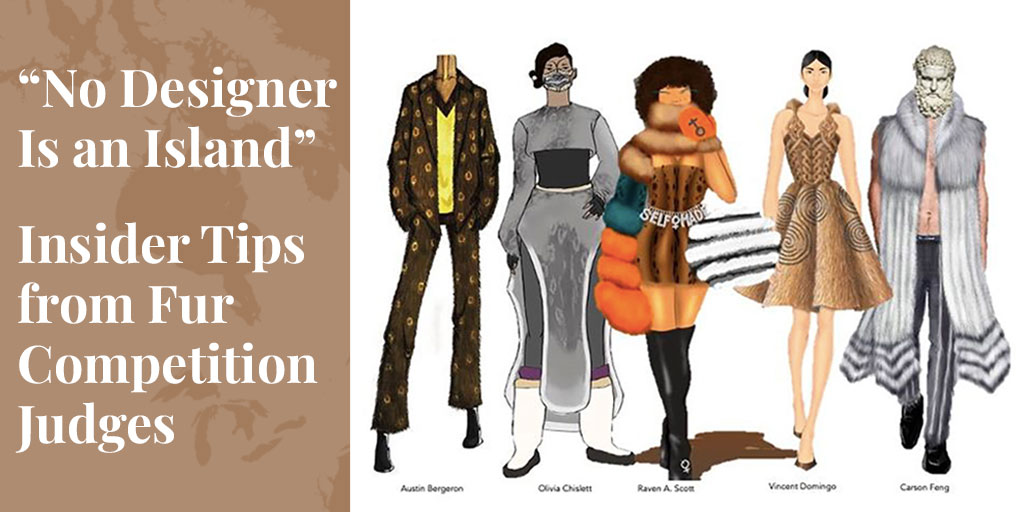
Last month, the 12 winners were announced of Canada's inaugural National Fur Designers Competition, judged by four Canadians all with their fingers firmly on the pulse of the fashion business: stylist Shea Hurley, designers D'Arcy Moses and Sage Paul, and model Stacey McKenzie. Later this year – Covid permitting – the fur competition winners will enjoy an all-inclusive workshop in Toronto under the expert tutelage of stylist to the stars Farley Chatto.
So how did the judges get to where they are today, and what advice do they have for the next generation? Truth About Fur found out.
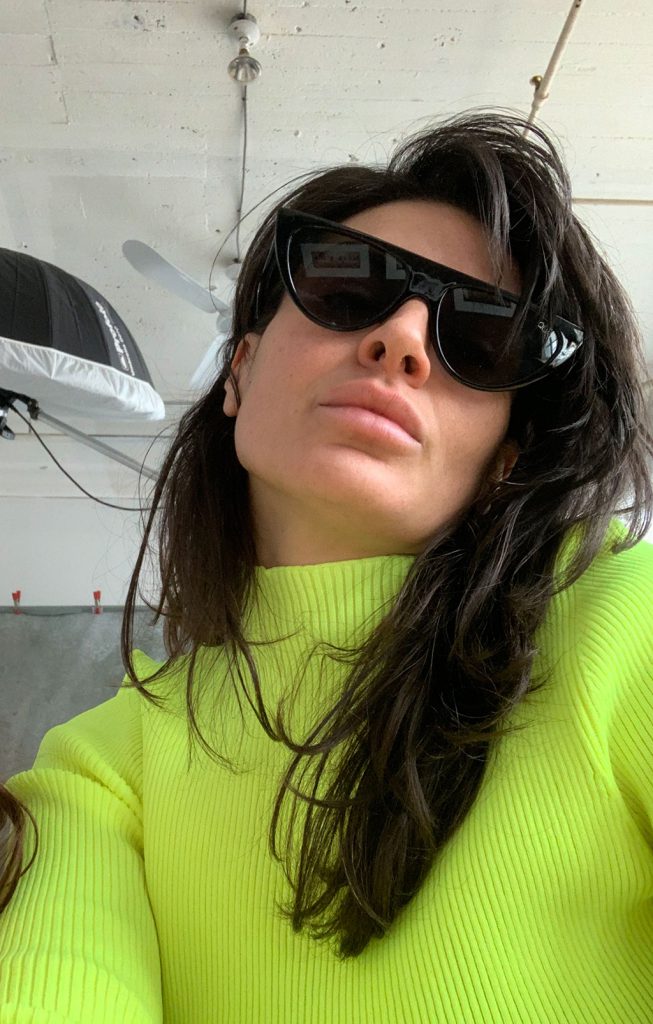
Grounded in fashion communications, buying, design and sales, Shea is now a sought-after fashion stylist. Her sense of style has helped top-tier advertisers and brands retain their edge as she strives to create value, inspire trends, and drive growth. To learn more, visit Shea's agency, Plutino Group, and her Instagram account sheahurley, or drop her a line at [email protected].
Truth About Fur: If you could give one piece of advice to aspiring young designers, what would it be?
Shea Hurley: Be professional. Respect yourself enough to know your vision, what you're trying to say with your offering, and stay consistent with that message. This, with proper business management, will give your brand integrity. Fashion and apparel design is a long game – you learn with every garment, every collection, every season. Constantly.
With that, do your homework, know your market, competitors and potential collaborators. No designer is an island. Have grit, and humility, be tenacious with flexibility and malleability. Build your network wisely.
TAF: When did you know you wanted to be a stylist?
Shea: Ha, I still don't know that I want to be a stylist! It has been 15-plus years that I have absolutely loved and hated, but that's part of it. It's a part of me.
Seriously though, I fell into styling from wanting to be an agent or buyer, and was really great at it right out the gate. I have learned so much, seen so many places, met so many incredible people, all while playing dress up and creating so many different stories along the way.
TAF: Tell us about your life as a stylist.
Shea: Well, to be honest it's quite a balancing act. As much as it is about the clothes, it's more about the vision and players in each project. Lots of different personalities and tons of work, from sending pull requests to designers, showroom pulls, in store and online shopping to packing and unpacking, just to pack and unpack again. Writing carnets for customs, waiting on deliveries, pick ups, etc. Laying everything out neatly and safely, to then build looks. Steaming those looks for them to be wrinkled and steamed again, taping shoes to save the soles, pinning and clipping clothes to fit and/or hang properly, cleaning makeup off clothing and accessories. Chasing photographers who waltz models through fields, dirty alleys, puddles, mud, the list goes on. Dry-cleaning, mending rips, tears, button loss, etc. Organizing all the receipts and balancing budgets to fit the sometimes four-page expense reports. Keeping clients as well as merchants happy and satisfied on the same project can be a very difficult task that requires lots of tact, thank you cards and bottles of wine as gifts for everyone's special occasions. And then onto the next project. The stress truly never ends. But all in all it is very fulfilling and I do love it.
There are plenty of perks too. Working with incredible pieces of clothing that are history in the making, alongside dynamic people (models, celebrities, personalities, designers, creatives, photographers), to build an idea from the ground up fuels me. Fashion shows are a tremendous amount of work but also can be so magical and inspiring to attend and work on. Same for events. The networking never ends, so as enjoyable as it is to socialise within the industry, it is still and always will be work. Needless to say, I love what I do.

As an infant, D’Arcy was adopted by a white family in Alberta, and didn't learn he was Slavey Indian until he was 18. He has since reconnected with his roots, while going from starving artist to celebrated designer, with a passion for trendy clothes incorporating First Nations elements. For more on his remarkable journey, read "D'Arcy's big bet" by Up Here magazine.
Truth About Fur: What advice would you give to aspiring designers?
D'Arcy Moses: Be yourself. If you have a great design concept – one that's honest, from the heart – then use it. Work hard toward this. There is no free easy street with design; it takes dedication and hard work.
TAF: When did you know you wanted to be a fashion designer?
D'Arcy: I was about 12 years old and I was leafing through one of my mother's Harper's Bazaar magazines. It was a photograph of Yves Saint Laurent with Catherine Deneuve. A black velvet dress with a huge pink bow, back of the dress. Iconic. There was an energy there. I knew that this was what I wanted to do. Couture.
TAF: How did you get to where you are today?
D'Arcy: It all started in Vancouver. I was a young Dene man – 19 years old – who wanted to design. I bought my first sewing machine from a pawnshop on East Hastings Street for $60. I felt freedom for the first time. After that, I could only afford to buy beautiful cloth (pure silks) at about 10 centimetres at a time. I was a waiter at a Whitespot Restaurant, and saved every dime. There is no shame in being a waiter. It's honest, hard work, and I kind of loved that job.
Then I got a grant from the then Canadian Native Arts Foundation [renamed the National Aboriginal Achievement Foundation in 1997 and Indspire in 2012] of $1,600 - a king's ransom for a young designer. So I used this to build a collection that was shown at the Four Seasons Hotel.
Then I decided to move to Toronto, and driving across Canada was beautiful. I got to Toronto and was poor, poor, poor! But a new life lay ahead!
I was making stretchy tube dresses to sell on the streets of Toronto. I was looking for a label manufacturer and accidentally dialled the Toronto Fashion Incubator. I remember asking the woman on the phone – her name was Mimi – for a label manufacturer. She said no, but put me in touch with the Incubator's director at the time, Carol Outram. I met her, she looked through my drawings of my designs, and then slammed my portfolio shut. I was terrified. She told me, "In a few years, you will be famous."
After that, I applied to the Toronto Festival of Fashion / New Labels, and was accepted. More hard work followed, and I was still buying fabrics by the centimetre. I was working at the then Simpsons department store in the basement at minimum wage.
Then my collection took off and the press took notice, plus very good friends supported me. And then came licenses. The retail landscape has changed, but it's looking good so far!
SEE ALSO: D'Arcy Moses: First Nations heritage inspires modern fur designs. Truth About Fur.

Sage is a member of the English River First Nation, based in Toronto. She is an award-winning artist and designer, and artistic director of Indigenous Fashion Week Toronto. See her full bio at Sagepaul.com.
Truth About Fur: If you could give one piece of advice to aspiring designers, what would it be?
Sage Paul: Keep at it! It’s a challenging road to making a career in fashion, but it is totally realistic and possible if you keep at it.
TAF: When did you know you wanted to be a designer?
Sage: When I was just a little girl! I was inspired and encouraged by the women in my community to create, and so I did, because I loved it.
TAF: Tell us something about your designer life.
Sage: My designer life has shifted these days to focusing on Indigenous Fashion Week Toronto (IFWTO). It’s important to me to create this space for Indigenous designers before I can get back to design.
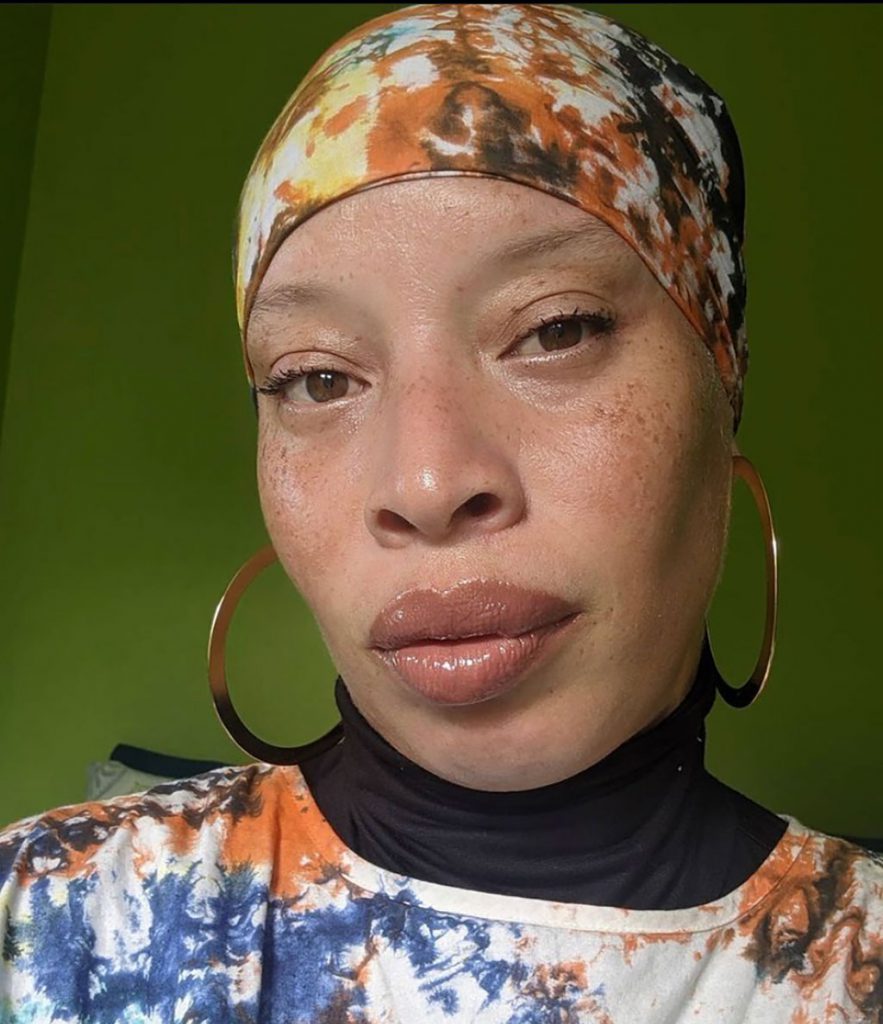
Born in Jamaica, Stacey is a model, TV personality and motivational speaker. She has appeared in Vogue, Harper's Bazaar, Interview, Essence and Flare, and in ad campaigns for Calvin Klein, Jean Paul Gaultier and MAC Cosmetics. She has been a judge on both America's and Canada’s Next Top Model. To learn more, visit her on staceymckenzie.com, Instagram, Facebook, and Twitter.
Truth About Fur: If you could give one piece of advice to young designers, what would it be?
Stacey McKenzie: My advice to aspiring designers is to never give up. I've met quite a lot of aspiring fashion designers within Canada and they focus on making it in Canada, but when it doesn't happen, they give up. They need to push themselves by not being so comfortable, try other cities/countries, try to get people to rock their clothing, put themselves out there and don't give up on making it.
TAF: When did you know you wanted to be a model?
Stacey: At the age of nine I learned that modelling is a career, and I learned what it takes to be a model and knew right away that's what I wanted to be. I felt within my heart I was meant to be a model, and was persistent because I felt so strongly about it. I was different looking, and even though I got a lot of negative attention, I realised I was getting attention which I took as a positive thing and that it could work in my best interest becoming a model. When I moved to Toronto, I learned more about fashion through shows like FashionTelevision and Fashion File, plus I had the opportunity to see and buy fashion magazines which doesn't exist in my country.
TAF: Tell us about the Walk Camp.
Stacey: The Walk Camp is a camp I started for young girls within inner city neighbourhoods who wouldn't necessarily have the opportunity to be mentored by the likes of certain people within their respective fields. I grew up in these same communities and know what it felt like to not have someone or people guide me the right way, so I wanted to create a day camp giving the 30 girls I choose every summer the opportunity to be mentored by professionals. Some of the mentors include the former High Commissioner of Canada Laurie Ann Peters, host of Toronto's Breakfast Television Dina Pugliese, host of CityLine Tracy Moore, fashion designers Sunny Fong and Farley Chatto, singer Liberty Silver, plus many more. The Walk Camp recently launched in Jamaica, the country of my birth, which I am really excited about because that's where my journey began. It's been a blessing.
***
To learn more about donating to Truth About Fur, click here.