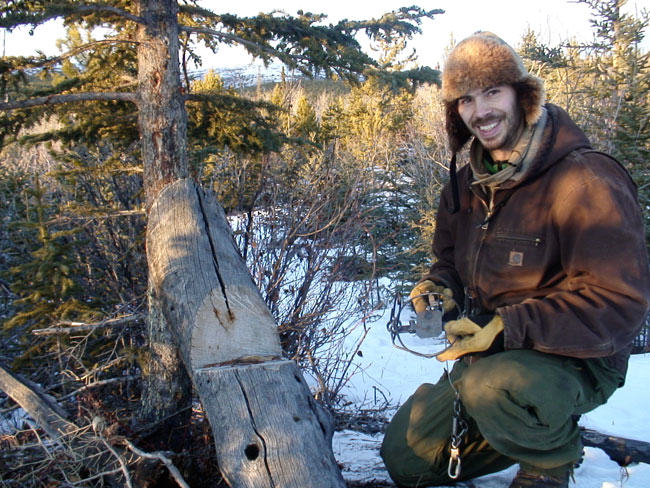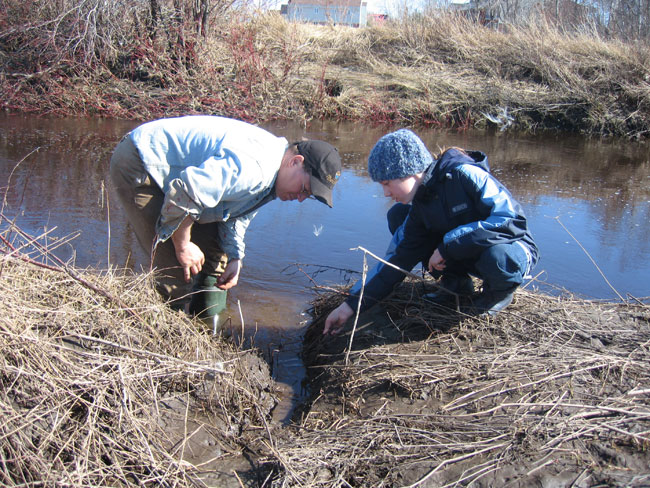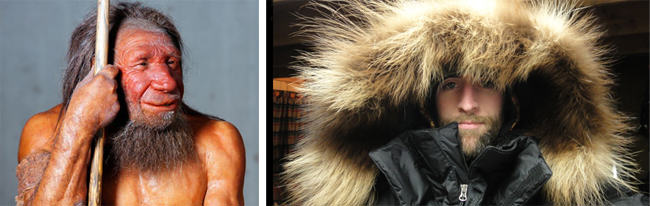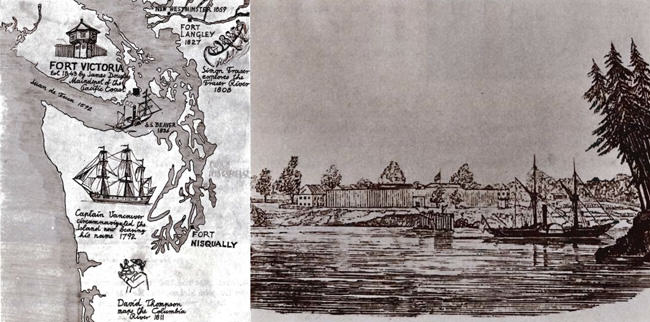
COOL FACT #1: Fur may have saved the human race New research suggests humans (Homo sapiens) survived the last Ice…
Read More
Trapping & Hunting
Sportsmen’s Alliance on Today’s Trapping Challenges
by Alexandra Suhner Isenberg, former Online Communications Director, Truth About FurThe Sportsmen’s Alliance is a US organisation that protects the outdoor heritage of hunting, fishing, trapping and shooting in all…
Read More
The Sportsmen’s Alliance is a US organisation that protects the outdoor heritage of hunting, fishing, trapping and shooting in all 50 states. Between fighting in the courts, political lobbying, and countering campaigns by animal activists, they are kept busy. We talked to Vice President Marketing and Communications Brian Lynn about trappers, hipsters and sound bytes.

Alexandra: What percentage of your members are trappers versus hunters and fishermen?
Brian: I’d say somewhere between 10 and 20%. It’s not a huge number, but the trappers are the most active, passionate, and engaged audience there is.
Alexandra: Interesting you say that, because we think that too.
Brian: Trappers are the ones on the front lines. They are constantly under attack.
Alexandra: Are you referring to the amount of legislation that people are trying to put into place to try and ban trapping?
Brian: Yes. Animal rights organisations, legislation, the ballot box – trappers are constantly under attack. Whether it is changing the seasons, eliminating the seasons, or regulating traps, they are getting hammered left and right.
Alexandra: Do you think that trappers are getting attacked more because they are fewer in number? Or perhaps because in the US hunting is more associated with a weekend pastime?
Brian: It is both. There aren’t as many trappers, so it is more of a fringe endeavour. Also it lacks the idea of a sport – of you versus the animal. To the uninitiated, it just seems like you are going out there, putting some bait out, and whether a wolf, bobcat, bear, or your dog comes along, they get snapped up and killed cruelly. It looks barbaric, and it is a hard sell for us to protect. It is an easier sell to misrepresent. People already are ignorant about it; urban people are like, “You do what?” It is a harder thing to protect because of the ignorance, and it lacks the perception of sport and the “you versus the animal.”

Active or Passive Management
Alexandra: It's interesting how urban folk don’t mind trapping when there’s a coyote eating their cats, or beavers flooding their home.
Brian: That’s the whole thing. People say, “This doesn’t seem fair, that doesn’t sound right,” until it impacts them. Once the deer come in and start eating their petunias, now they're mad. Or they're hitting deer with their car. Now they want something done. Don't kill the bears until the bears start eating your kids. It boils down to active management versus passive management.
We did a piece on defensive trapping a couple of months ago in our newsletter, and without trapping, state agencies will spend hundreds of millions of dollars on trapping nuisance animals and flooding. Nobody understands that until it happens. The animal rights activists try to couch it as, “We don't need to manage populations." They try to pass off the Disney idea that “nature will balance itself”, which never really happens. But even they are saying passive management is ok. When the mountain lion becomes overpopulated and one starts eating their cats, then it's ok for the state to come in and kill that one lion. Well, it costs a ton of money, and it's not fixing the problem. With active management, you are mitigating the booms and busts and managing them actively with hunting and trapping. The animal rights groups just want to let everything go wild, and passively manage it when it becomes an issue with humans, which is just not going to work because we see disease, starvation, plus human-wildlife conflicts.
Alexandra: What are some of the biggest issues that you are dealing with right now, and have the kinds of issues evolved much over the past 20 years?
Brian: They go in waves and trends. In the 1980s, animal rights groups went after bow hunting, in the ’90s they went for mountain lions and some bear-hunting tactics. Last year we saw a lot of dog-related activity: kenneling, breeding, selling legislation. A lot of it is aimed at puppy mills, but if enforced to the letter of the law, it will stop hound hunting, kenneling, or selling those dogs.
We also saw a lot of apex predator issues – black bears and wolves. And now we are seeing them setting the table to come back for more of what they attacked in the ’90s - black bears and mountain lions in the west, and the Great Lakes wolves.
They hit something hard, in multiple states, for a couple of years, then let it rest. They let the social consciousness of the non-hunters absorb it a bit, they’ve made it an issue. Then they let their fundraising base rest, then come back and hammer it again several years later. It makes for a better news story again. Then it seems like a big issue that keeps coming out so they can get more funding, and it psychologically resounds with the public. “Oh, this is an issue, we need to do something about this!”
Great Lakes Wolves, Maine Bears
Alexandra: What are some of the activities that you do to fight the activists, and which campaigns have been successful?
Brian: Right now we are the lead on the Great Lakes wolves lawsuit. It is the Humane Society of the United States vs. the Sportsmen’s Alliance, the Department of the Interior, and the State of Wisconsin. So that is one we have been fighting for several years, and that should be moving through the court system, and we are appealing the last decision that was made in December 2014.
One of our more successful campaigns was the Maine Bear Ballot issue in 2014. The HSUS decided to go after bear hunting in Maine and hired a California firm to collect signatures and force it onto the ballot. The HSUS just self-funded the whole thing. If that had been successful, it would have basically put an end to bear hunting in Maine. It would have removed the use of traps, bait, and hounds to hunt bears, and that is 93% of the harvest. We went in, organised the grass roots groups, bought air time, created the messaging, and we ended up beating them by 8 points. And there was a couple of lawsuits out of that, that we fought and were successful in. We were successful all the way around and have a good base set up to protect it again, should they come back, and they have stated they are coming back again to stop it.
The thought is that they will just go after hounds and traps, because few people use these, so most people don’t care. This is when we get into apathy within our own ranks. If HSUS removes 85% of its opposition and 85% of its opposition’s funding, those who remain make easier targets.
"Sticking Up for One Another"
Alexandra: Some graphics in your social media send a message about uniting hunters, fishermen and trappers. What is the thinking here?
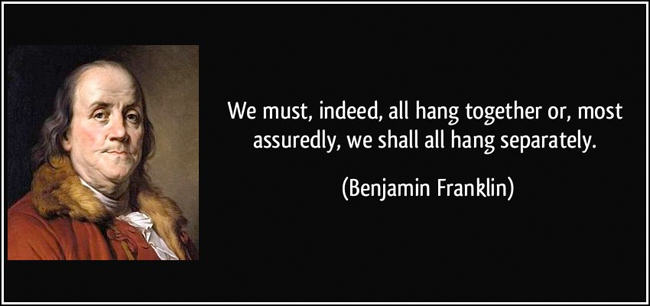
Brian: We need to be sticking up for one another, despite method of take. Even if you don’t participate in trapping and you don’t use bait, we can’t stand around and say, “That’s doesn’t affect me.” Once hound hunting falls, once bait hunting falls, once trapping falls, they are coming after what you do want to do. We need to be united regardless of how we are participating in these activities.
Alexandra: What percentage of Americans do you believe support hunting, trapping and fishing, and how many are opposed?
Brian: Hunters and anti-hunters are about the same size, 5-10% of the population. And all of the polls show that 75-80% of the general public support hunting as a management tool. That’s great. But the problem is that all that support goes right out the window as soon as emotion gets into it. People's minds are changed really quickly if they are shown an animal flopping around in a trap or a dead trophy shot. We move from the logical “That makes sense, I support hunting,” to the emotional “Oh, but I don't support it in this instance. It seems cruel.”
The other side can just throw words around like “slaughter” and sway those non-hunting voters.
Our biggest challenge is telling our story, why we have to do it, why it makes things better, the funding of conservation, managing populations, habitat, carrying capacity of the land. That’s a long story which can be boring if you aren’t into it, and if there is legislation or a ballot initiative, and a news anchor puts a microphone in your face and you try and explain carrying capacity of the land and funding of conservation, it is long, boring, and not sound-byte stuff. Then they ask the other side why we need to stop it and they say, “It's cruel, they are slaughtering animals with babies.” There’s your sound byte.
"Hipster Deal Big Move Forward"
Alexandra: Have the demographics of your supporters and members changed? There is a hipster trend now, with people doing things themselves, growing their own food and maybe hunting. They were traditionally more on the left of the political spectrum, whereas hunters tend to be on the conservative side. Do you see this new demographic supporting outdoor activities?
Brian: We are seeing a bit of a bump, which is great from a branding and messaging perspective. This is important for the hunting and trapping industry in general, but here at the Sportsmen’s Alliance we are very engaged, political, more hardcore. The new people coming in are a more holistic type of person, who may not be political.
For the broader industry, though, the whole hipster deal has been good. From the perspective of acceptance within the mainstream, those people are sharing with other people, within city life. It is about taking responsibility for their food, and them relaying their message in a way that their friends can understand. That’s where I see it as being the biggest move forward for the industry. How do you reach someone in LA? We aren't going to reach some hipster in LA, but some guy at an LA party who went out, harvested his own food and killed a deer, that is going to do more good than anything we are doing as an industry to disseminate the proper message.

Alexandra: Do you cooperate with a Canadian counterpart?
Brian: There is some run-over, but nothing official. In Maine, we are involved in two lawsuits on trapping Canadian lynx. In Maine, Canadian lynx are on the Endangered Species List, but north of the border they are not.
There are incidental take permits, and a certain number of Canadian lynx can be caught in traps without the trapper or the state being in violation of the Endangered Species Act. The HSUS is trying to stop that; they are trying to get the incidental take permits revoked. If they succeed, that would mean that anywhere there is an endangered species of any kind, trapping can be stopped. If you take it a step further, anywhere there is an endangered fish in a river, you could apply the same logic. You can’t fully control what steps into a trap, therefore you can’t trap anywhere there is an endangered species, just like you can’t always control what is going to bite your hook, therefore no one can fish anywhere there is an endangered fish. So that’s a lawsuit we are involved in in Maine.
"Educate Those Not Within Your Group"
Alexandra: Is there any advice you have for trappers about protecting their rights, proactively?
Brian: They need to educate non-trappers about what they do: about how trapping is regulated, how hard it is, what you do to prevent non-target by-catch. People need to understand that, and it is not the people that are already in your social groups, it needs to be the non-trapper or the hunter that doesn’t understand it, so you can help eliminate that issue of hunters not caring. For example, there are a lot of bird dog hunters that hate trapping because traps will be out during grouse season and they are worried their dogs might get snagged up in them. We need to try and educate those people. It is all about educating those not within your group.
As for state and provincial organisations, they need to start collecting funds and putting these aside. This is something we are saying in Maine, start a war chest, because the attack is coming, it is just a matter of time. The HSUS is so rich they can self-fund any campaign they want to. They are a $130-150 million a year organisation, so they can just decide “this is where we are going to go, and we will spend $3 million.” If HSUS comes and you sit there fundraising for the first six months, that's a six-month head start they have in swaying public opinion. If you can hit the ground running, and you already have a war chest, you are better off. That’s hard for groups to do, though, because unless there is a bogeyman right there, those funds start to look very attractive to dip into and use for other things.
Alexandra: Thank you for taking the time to speak to us!
For further reading, check out this great Sportsmen's Alliance content:
The Anti-Hunter’s Playbook
A Defense of Trapping (full issue)
A Defense of Trapping (article)
Why All Sportsmen Need to Defend Trapping
Introducing Youth to Trapping
And connect with them on their website, Facebook page, Twitter, and Youtube.
Alcide Giroux: My First 60 Years Enjoying Nature as a Trapper
by Alan Herscovici, Senior Researcher, Truth About FurTrue life stories of a Métis trapper and his love for the land, his family and friends A primary goal…
Read More
True life stories of a Métis trapper and his love for the land, his family and friends

A primary goal of Truth About Fur is to give a voice to the real people of the fur trade. So what a pleasure it is to tell you about a newly published autobiography by one of Canada’s foremost trappers and trapping advocates, the legendary Alcide Giroux.
My First Sixty Years Enjoying Nature as a Trapper promises, and delivers, a passionate and epic tale of a life lived in close harmony with the land: hunting, fishing and trapping. And thanks to Alcide's extraordinary memory, he shares many wonderful adventures with us in vivid detail.
God's Country
The story begins in December 1951, near Sturgeon Falls, Ontario. Alcide was just six years old when his father moved their family onto the old homestead his grandfather had cleared and built in the early 1920s. There was no electricity or indoor plumbing, and young Alcide and his siblings had to cross the Sturgeon River in a small homemade boat before walking to school – a walk that provided opportunities for the young Alcide to snare rabbits to complement the moose and beaver in his mother’s stew pot. It was God’s Country back then, Alcide tells us, with wilderness and wildlife all around. Their trap lines began at the farmhouse door.
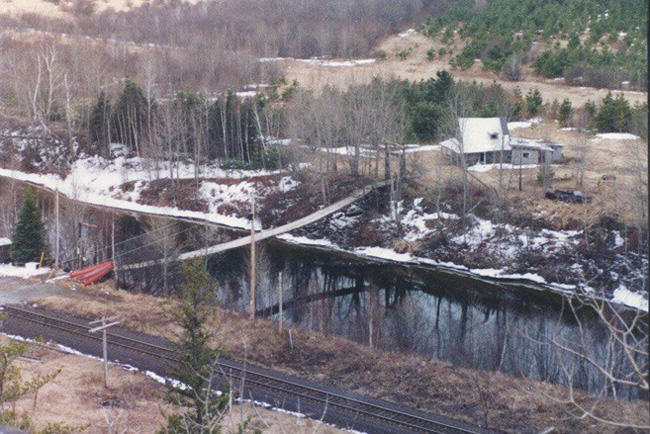
A few years later, Alcide’s Dad built a remarkable suspension bridge to facilitate the family’s commuting. “We had so many curious and nosy visitors; they all came to see the 8th Wonder of the World ... well the 8th wonder of River Valley!” Alcide recalls.
I enjoyed reading about this remarkable DIY engineering feat all the more because I walked across this same bridge many years later when I visited Alcide’s trapline, in the 1980s.

In the pages of his new book, Alcide pays tribute to many kind and talented woodsmen, but none more than his own father, “a great trapper with a built-in GPS in his brain.” Philippe Giroux was a Métis who instilled in his sons the importance of respecting the animals they depended upon, which meant trapping as humanely as possible. “Because we only had leg-hold traps back then, Dad showed us how to build underwater sets that ensured a quicker death for muskrats, mink and beaver.”
Alcide Giroux clearly learned his Dad’s lessons well; he became one of Canada’s foremost advocates for humane trapping. By the time he was 30, in 1975, he was writing articles in trappers’ magazines and leading workshops across Ontario and beyond, promoting the importance of researching and implementing better trapping techniques.
"I Had Gained Their Trust"
In 1980, as newly-elected president of the Ontario Trappers Association (OTA), his first speech called on trappers to take the lead in humane trapping, rather than have changes imposed on them by others. He remembers that his beloved wife, Pat, sitting at the back of the hall, was worried about how this call for change would be received. But Alcide’s sincerity and straight talk won the day.
“There were no hard feelings, no arrows thrown, but lots of applause and many handshakes," recalls Alcide. "I could breathe again; I had gained the trust and confidence of my fellow trappers.”

When the Fur Institute of Canada was created in 1982, to implement recommendations of the Federal-Provincial Committee on Humane Trapping (1974-1981), Alcide became a founding member, and later vice-chair. Accompanied by Pat, he travelled the world to lend his expertise to trap-research and conservation meetings in New Zealand, Europe, Louisiana, Australia and elsewhere. When scientists, politicians or journalists wanted to see a trap line first-hand, more often than not it was Alcide and Pat who received them.
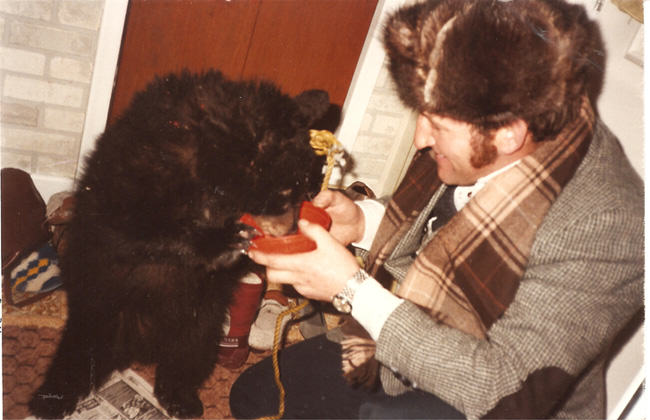
Alcide’s story bursts with good humour and a passion for life, whether he’s describing the orphaned bear cub, Ben, that his family adopted, or the time that famed country singer Murray McLauchlan came for a visit and wrote a song about Alcide for his 1984 album about true Canadian heroes. The song, Little Brothers of the Wood, includes the lines:
I only take what I need, don’t take no more
The woods ain’t a shelf in a grocery store.
I only take what I need because come the spring
I want to see beaver cubs in that pond again.

Alcide’s strength of character is also evident as he faces life’s more difficult moments: political battles in the OTA, a fire that destroys the old family farmhouse, and especially Pat’s courageous battle with cancer.
Front-Line Defenders
In recognition of Alcide’s outstanding contributions, in May 2005 he was presented with the Fur Council of Canada’s “Furrier of the Year” award, at the North American Fur & Fashion Exposition in Montreal (NAFFEM). In his speech to more than 600 fur manufacturers, designers, retailers and government officials, Alcide reminded them that trappers did more than provide the beautiful furs on display in the hall. They were also front-line defenders of the industry, using responsible practices and educating the urban population – including furriers – about the importance of using nature's gifts sustainably.

Speaking of nature’s gifts, for the gala fashion show that evening we had arranged for Alcide and Pat to sit with another celebrity: Miss Universe Canada, the beautiful Natalie Glebova. “Since trapping is always on my mind, I looked at Natalie and thought she would be good in the snow with legs like that!” Alcide remembers, with a chuckle.
The setting for most of this book, however, is in the bush, and anyone who enjoys the outdoors will appreciate Alcide’s keen observations about nature and wildlife.
To order your copy of My First Sixty Years Enjoying Nature as a Trapper, by Alcide P. Giroux (AKA “Ti-Lou”), please email [email protected]. Include your phone number and mailing address so we can send you an invoice to prepay before the publication is shipped to you. The price is $25CAD plus shipping and handling. Please contact us at [email protected] for US or international shipping rates.
Le livre d’Alcide Giroux est aussi disponible en français.
SEE ALSO: NEAL JOTHAM: A LIFE DEDICATED TO HUMANE TRAPPING
(Editor's note: Alcide Giroux passed away on February 20, 2018. Read his obituary from the Fur Institute of Canada.)
An Eye-Opening Fur Workshop with Gordy Klassen and Friends
by Derek Martel, Communications Director, Fur Institute of CanadaAs the communications coordinator for the Fur Institute of Canada I sometimes spend more time in the office than I…
Read More

As the communications coordinator for the Fur Institute of Canada I sometimes spend more time in the office than I do out on the land with the wonderful people I work for. So when I do get a chance to get out there, I make sure to really appreciate and absorb the experience. Being offered the opportunity to go to the rural Alberta homestead of renowned trapper and wildlife advocate Gordy Klassen is just about as good as it gets.
The man they call “Trapper Gord” is well known in our industry. And yet I’d only been lucky enough to meet him face to face once, during the Fur Institute's 2015 annual meeting in Saskatoon.
I came into the fur industry as an outsider, but with an open mind. What I’ve learned is that the industry is driven by incredible people doing incredible work and providing an incredible service to wildlife conservation and sustainable resource use in Canada. The fur industry is essentially why Canada came into being, and remains a critical part of the economic, cultural and environmental tapestry going forward.
As I boarded the plane bound for Alberta on March 15, I found I was excited to go to Gordy’s ranch and see more of his and the Fur Institute’s work up close.
The visit to Gordy’s was the second half of a weeklong event hosted by the Fur Institute with a Russian delegation of four representing the fur industry and environment sector of the Russian Federation. The Russians made the trip to Canada in order to better understand the Agreement on International Humane Trapping Standards (AIHTS). It seems like the interest to further improve their hunting and trapping standards is a top priority for the Russians and they came to Canada to learn from the leading experts in the field. This week was made possible by the sponsorship of the International Fur Federation.

As I piled into the car bound for Gordy’s and slowly left the urban sprawl of Edmonton behind, the thing that struck me most was the feeling of being in a truly rural setting. Gordy lives in Debolt, near Grande Prairie. His ranch is just off the highway, shrouded in woods near a place that you could easily miss if you blinked.
The natural setting of being in western Canada where everything is bigger rang true. His ranch had many buildings on it and everywhere you looked there was something different to see. This was a large place, for a man with a large personality who has been a lifelong advocate for trappers and the Canadian fur trade.
Gordy welcomed us and the Russian delegation and, wasting very little time, we were soon in his legendary workshop discussing issues around trapping and, particularly, wolves.
As we got out of the car was the flat land then nothing but trees. It was as if Gordy just built his homestead in the middle of nowhere for the sole purpose of being completely enveloped in nature. It truly felt like we were at the homestead of a trapper.
The first thing we did was get welcomed by Gordy, his two young students and his many dogs. The students were like Gordy’s understudies, teenagers who participate in the Trapper Gord Wilderness College, and were completely unafraid of anything. They handled themselves like you’d expect any veteran outdoorsman to carry himself, they knew their stuff, and at times they performed like Gordy’s second set of hands.
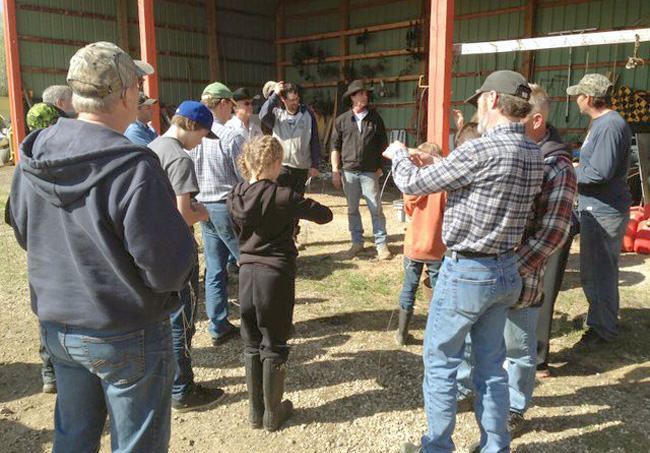
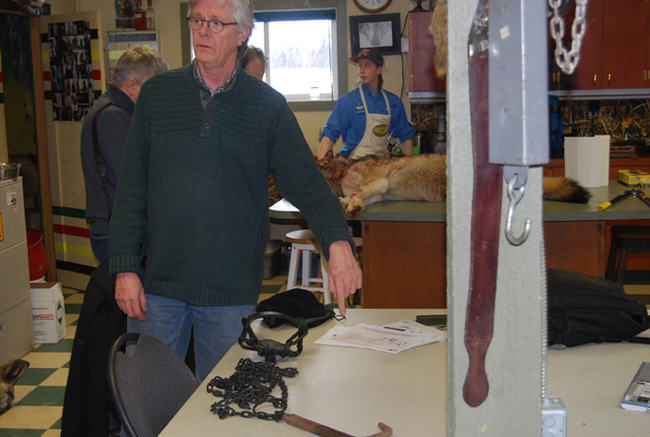
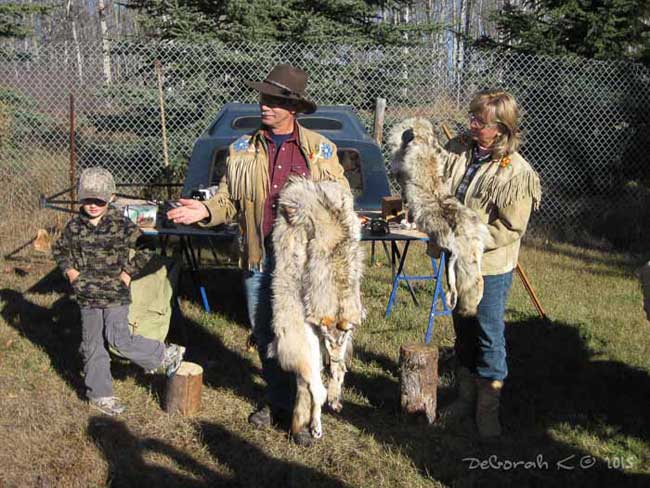
We were ushered into his converted barn which was where we’d spend most of the next two days. This was Gordy’s chance to do what he does best: discussing trapping and the research done by the Fur Institute. Gordy’s homestead was chosen because he is a lifelong hunter and trapper and has lived it his whole life. He was able to trap and when we got there he had dispatched wolves on hand which he normally traps for clients and sells oftentimes to taxidermists.
Gordy’s expertise in trapping and wildlife management made him a great source of information, along with researchers like veterinary pathologist Dr. Rudi Mueller, Pierre Canac-Marquis (a retired Quebec Government wildlife biologist and trapper, as well as coordinator of the Fur Institute's trap research), and the rest of the Institute's Trap Research and Development Committee. They began discussing the work they do with the Russian delegation, talking about the various traps, and how best to use them and set them.

Dr. Mueller allowed everyone access to his vast expertise by way of a necropsy on a wolf. He was demonstrating specifically the workings of the trap on the animal and the cause of death. This process is obviously key in helping better understand the workings of traps and to understand the animal itself; this allows researchers to continuously improve the methods used to humanely trap and hunt these large predators.
Coming from somebody who has never really experienced this type of thing before, the opportunity was incredible. The experience was a first of many for me; I experienced some of the key parts of the fur industry. I was able to view the skinning and necropsy work being done on a wolf, showing me that it isn’t as scary as some want you to believe. The process is not bloody and the craftsmanship it takes is incredible. The care and time trappers like Gordy take to do it right is impressive and reaffirms my belief that trappers care for the animal more than anyone. This is a way of life and, for a lot of them, their livelihood, so they have far more at stake than anyone attached to these animals.

Understanding what a trapper does, through Gordy’s point of view, was an extremely worthwhile and impactful learning experience.
All in all, the trip was an opportunity to personally experience what it is I advocate for on a daily basis here at the Fur Institute. I can honestly say it has further solidified my belief in this industry and makes me want to get these great stories across to more people.
SEE ALSO: NEAL JOTHAM: A LIFE DEDICATED TO HUMANE TRAPPING
The work and care that go into it is impressive and it is clear the people in this industry care far more about the animals than any anti-use group or city dweller. They do it with respect for the environment, the animals and for the rural lifestyle they live.
It’s no wonder they are so passionate about it, and based on the few days I spent in Alberta, I can assure you it’s a passion that catches on to those who experience it.
***
RECOMMENDED READ: Trapper Gordy Klassen practises his own "brand of activism" building awareness about Canada's oldest economic endeavor. By Jodie Sinnema, Edmonton Journal, Dec. 26, 2014.
The Modern Trapper: Champion of Wild Resources
by Jeff Traynor, trapper and editor, Furbearer ConservationThe morning started just like any other during my fall trapping season this past November. I fumbled about as I awoke…
Read More

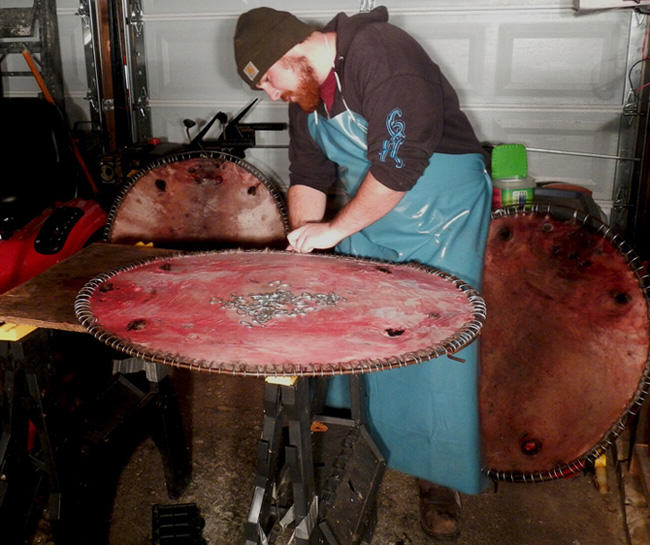
The morning started just like any other during my fall trapping season this past November. I fumbled about as I awoke to the sound of my alarm clock just before sunrise. I didn’t really want to get up; I had spent several hours in the fur shed the night before, processing otter and beaver hides and, frankly, I felt as if I had just put my head on the pillow. So goes the life of the modern trapper.
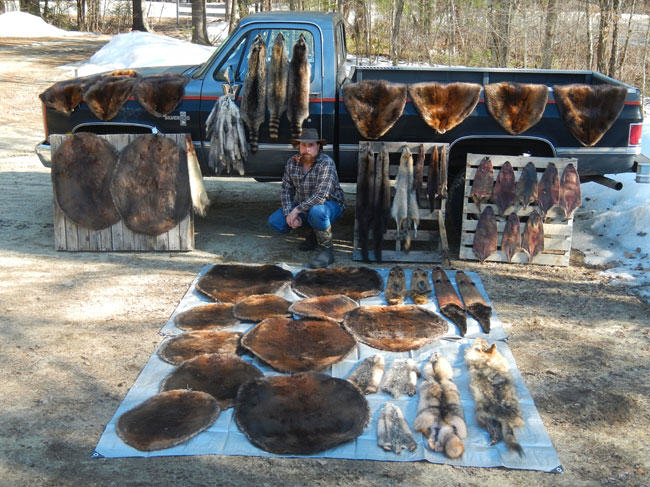
The majority of trappers in the “lower 48” nowadays are part-time fur harvesters, holding down regular day jobs while juggling activities like fur trapping. We bare the same grit as the long-line mountain men of the northern wilderness, but return to civilization after running the trapline. If you work hard enough, chances are pretty good you could make a mortgage payment with the stack of fur pelts harvested at the end of the season. Some years, when the fur market is down, you’re lucky to recoup your cost for fuel and supplies. I harvest a modest and diverse collection of prime pelts each season, and rather than send to the overseas fur markets, I sell tanned finished pelts locally in the form of crafts, garments like mittens and hats, or as unaltered skins ready for locals to make their own natural garments out of. Most modern trappers aren’t in it solely for a few extra bucks – conservation, heritage, family-tradition, exercise, insight, an escape outside, take your pick; there’s millions of reasons why modern trapping is alive and well in North America. We’re not quite Hugh Glass material, but we sure aren’t “flatlanders” either!
Senses on High Alert
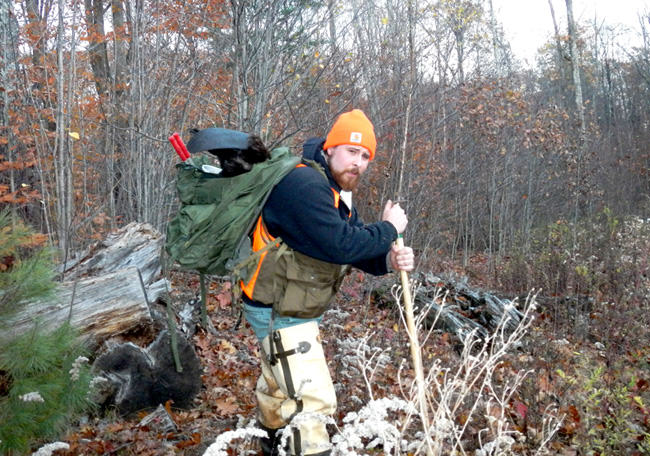
With the alarm clock still buzzing, and before my conscious self could protest, I found myself already in yesterday’s pair of flannel-lined jeans, and in my truck. The drive down off the hill and into the valley is a ride I know all too well, especially during trapping season. I arrived at my first chunk of land on the trapline; a winding maze of hills, valleys, brush, and swampland carved into the side of a southern New Hampshire mountain range. I strapped on my hip-waders and slid my arms through the damp Alice pack filled with trapping supplies as I follow my bushwhacked trail through the dense Alder brush. I trekked into the still and dense forest as the sun began to break, putting a slight end to the constant hum of the pitch-black hillside.
The sights, the sounds, and the smells put my senses on high alert. What I see, touch, feel, and experience, you can’t acquire on a simple weekend hike through the woods on a walking trail. It’s something that can only be experienced when you fully immerse yourself into your natural environment and fulfill the role as a fixture of that environment, rather than a visitor. It’s real, raw, and organic, and it’s something only another trapper can fully understand. As I walked the same stretch of stream bank I’ve walked for the last thirty days, I stopped to take notice of a fresh mound of mud and stream debris piled high in a stumpy pile on the bank. It was clear these were fresh territorial markings from a beaver - markings that were not present during the previous day’s trek.
Suspicions are confirmed as I come upon my first trap lying on the river bottom, with a prime beaver lying motionless in the 330 Conibear trap’s strong and efficient grip. I take a moment with every creature I trap to reflect. I study the animal from top to bottom, noting any odd characteristics to its appearance. I give a brief "thanks" to the forest, reset the trap, and stash my gift from the woods on the river bank to be picked up on the return trip. Two beaver would be hauled out that morning and I would readily admit there are some days I get pretty tired of hauling 60 to 120 pounds of dead weight up the brushy hillside. The cycle repeats itself every morning before I head to my job back in civilization.
No "Wait Until the Weekend"
The day’s catch is left on the cool floor of my garage, as I get changed and suited up to start my workday. I return home in the evening to skin and process the furbearers I trapped that morning. There’s no "wait until the weekend" when it comes to trapping. Your catch must be handled quickly to keep up with the season’s demands. The animals are skinned and the hides are fleshed, stretched and dried. I remove any edible meat, useful bones, and glands from the remaining carcass. I take a moment to envision the usage for each pelt; which ones will make mittens, and which ones are better suited for blankets or hats. Some pelts may provide relief for a mortgage payment, and others may pay for fuel during the long Northeast winter.
This is the life of many trappers – cut from the same loins as the Alaskan and Canadian fur trappers of the uncharted lands, except our trade is carried out on the fringes of modern society and civilization. For many of us, the lifestyles of characters like Jeremiah Johnson and Hugh Glass are a prideful glimpse into a simpler time in America’s history. I consider myself fairly self-reliant by today’s standards. I’ll admit however, I’m far from the homesteading mountain men of the far north that so many of us envision. It’s the duality of being able to run a wilderness trap-line, brave the harshest of natural elements, and work a full-time job afterwards that I think makes the modern trapper such an interesting element in today’s overworked society.

The majority of my trap-line is carved along borderlines of modern metropolitan areas. The modern trapper utilizes culverts and freeway bridges to our advantage, stacking up catches that would make any 1800’s pioneer blush. Much like the furbearers we seek, we have adapted and learned to co-exist with modern society nipping at our heels. We stubbornly cling to traditions passed on from generation to generation. I find immense beauty in the fact that I can harvest my fair share of otter and fisher in the undisturbed wild mountains, and, in the next breath, head 25 minutes east and stack up a modest catch of muskrat and mink from the spillways behind the local strip-malls.
When I was younger, I scoffed at the idea of running an “urban trap-line”. I always felt wild critters could only be caught in wild places, well off the beaten path. Raccoons and opossums are synonymous with the urban setting, but in the early years, my naive thought process pictured most critters to be bound to the remote stretches of New Hampshire. For years I always sought the darkest, thickest hillsides I could find in my area. It wasn’t until I dove head-first into the world of Wildlife Damage Control that I realized just how close these creatures lived to the human populous; or should I say, how close humans live to them.
First Line of Reporting
I’m often told trapping has no place in the modern world, and I need to “evolve”. Some say it’s antiquated, outdated and obsolete. I would argue that despite public perception, few people champion our wildlife and wild resources more than the modern fur trapper. Not only are we fully vested and immersed in our natural world, but we are also the first line of reporting and observation for all aspects of furbearer biology and general wildlife conservation. We are the first to feel and report dramatic population decline, disease, and environmental issues affecting furbearing species of wildlife that would be otherwise overlooked. For example, muskrat and weasels are not typically at the forefront of yearly headcounts by biologists, and until these animals start disappearing from the landscape, there wouldn’t be any checks or balances for their overall population health if it were not for the reporting and harvest by the modern trapper. Any unbiased furbearer biologist will tell you trapping plays an important role in the North American Model of Wildlife Conservation; this is fact.

Public Perception Problem
Public perception has certainly taken its toll on the modern trapper. Somewhere down the line of American evolution, we began to set social norms for what was deemed "okay" for harvesting our nation’s natural resources. Killing for food, for instance, is generally socially tolerated, while taking an animal’s life for a beneficial garment is somehow deemed "selfish" or "greedy". At some point, we seemed to lose the bearings of our moral compass, shaming perceived “luxury items” like fur garments as “materialistic” while we wait in line for the latest and greatest smart-phone or sports car. Here in North America, super PACs and politicians spend billions of dollars in an attempt to outright ban activities such as trapping, all the while turning their backs to the millions (yes, millions) of wild animals wasted daily on our nation’s roadways. The acts of modern regulated hunting and trapping will never hold a candle to the immense suffering man’s inadvertent progression has placed upon our fragile wildlife species. Deforestation, housing development, pollution, infrastructure, and rapid population growth all take their toll on wildlife. What’s rarely reported in the media or brought up in debates is the trapper’s ever-watchful eye over our natural resources. Our tools have also evolved with ethical and humane treatment being the primary focus.
As modern trappers, we will continue to do what we know and believe to be right, and support managing our natural resources with moral wisdom. We’ll set our traps for pelts, and assume our role in modern wildlife conservation. The fur trapper lives in a modern world, and we must constantly fight being totally forgotten by our own kind. As our society continues to redefine itself, more people seem to be seeking to move further away from the daily grind and closer to the land, and I hope the interest in trapping and the understanding of its immense value will continue to grow. If the modern trapper’s solitary watch were to be removed from our woods, North America’s natural beauty would certainly lose another layer of defense against our own industrialization.

FOLLOW JEFF TRAYNOR'S "LIVE FREE AND TRAP" ON:


Neal Jotham: A Life Dedicated to Humane Trapping
by Alan Herscovici, Senior Researcher, Truth About FurNeal Jotham has played a central role in promoting animal welfare through Canada’s world-leading trap research and testing program for…
Read More

Neal Jotham has played a central role in promoting animal welfare through Canada’s world-leading trap research and testing program for the past 50 years. From his first voluntary efforts with the Canadian Association for Humane Trapping (1965-1977) and as executive director of the Canadian Federation of Humane Societies (1977-1984), to chairing the scientific and technical sub-committee of the Federal-Provincial Committee for Humane Trapping (1974-81) and ISO Technical Committee 191 (1987-1997), to serving as Coordinator, Humane Trapping Programs for Environment Canada's Canadian Wildlife Service (1984-1998), and his continuing work as advisor to the Fur Institute of Canada, Neal has been a driving force. At times mistrusted by animal-welfare advocates and trappers alike, he always remained true to his original goal: to improve the animal-welfare aspects of trapping. Truth About Fur’s senior researcher Alan Herscovici asked Neal to tell us about his remarkable career as Canada’s most persistent humane-trapping proponent.
Truth About Fur: Tell us how you first got involved in working to improve the animal-welfare aspects of trapping.
Neal Jotham: It was 1965, the year the Artek film launched the seal hunt debate. I was concerned about what I saw and wrote a letter to the Fisheries Minister. A colleague – I was an architectural technologist – suggested that I send my letter to a group concerned about trapping methods, the Canadian Association for Humane Trapping (CAHT). I was invited to one of their meetings and met some wonderful volunteers including the legendary Lloyd Cook, who was then president of the Ontario Trappers Association (OTA).
Lloyd was a kind and gentle man, mentoring boy scouts about survival in the woods and introducing the first trapper training programs in Ontario. Once he rescued two beaver kits from a forest fire and raised them in his bathtub until they were old enough to release into the wild. He invited the CAHT to set up an information booth at the OTA annual convention, and he took me onto his trap line, near Barrie, Ontario.
Lloyd and I discussed how great it would be to do some proper research about how to minimize stress and injury to trapped animals. I thought it would be quite a simple matter. Little did I know that it would occupy the better part of the next 50 years of my life.
TaF: So you got involved with the CAHT?
Jotham: I was asked to serve as voluntary vice-president of administration, in charge of publicity and communications. Our main priority was to make the governments, industry and the public aware of the need for animal welfare improvements in trapping, because very few people were even talking about trapping at the time.
TaF: How did you go about raising awareness?
Jotham: We produced brochures explaining the need for improvements. We never called for a ban on trapping – we recognised the cultural, economic and ecological importance – but we were honest about the suffering the old traps could cause and the need for change.
In 1968, because governments and industry were still not engaged, CAHT joined with the Canadian Federation of Humane Societies (CFHS) to establish the first multi-disciplinary trap-research program at McMaster University (to look at the engineering aspects of traps) and Guelph University (to investigate the biological factors).
In 1969, we were contacted by an Alberta trapper and wildlife photographer named Ed Cesar. He had ideas for new trap designs and also wanted to make a film about trapping that he hoped could be televised. CAHT asked if he could film animals being caught in traps, which he did.
CAHT purchased three minutes of this film and I showed it at a federal/provincial/territorial wildlife directors conference in Yellowknife, in July 1970. That resulted in an immediate $10,000 donation to the CFHS/CAHT pilot project from Mr. Charles Wilson, CEO of the Hudson’s Bay Company, then based in Winnipeg, and some smaller donations too.
TaF: But the governments still weren’t involved?
Jotham: No, so we went public. CAHT added narration and sound to the film, titled it They Take So Long to Die, and showed it on Take-30, a CBC current affairs show. That got attention, all right! In 1972, we were invited to a Federal-Provincial Wildlife Conference where we were criticized for “hurting trappers”. We explained that we just wanted to make trapping more humane, we had only broadcast the film because government wasn’t listening.
TaF: How did trappers feel about your efforts?
Jotham: Many trappers understood what we were saying. In fact, Frank Conibear, a NWT trapper, had been working on new designs since the late 1920s, and by the 1950s produced a working model of the quick-killing trap that still carries his name. He got the idea from his wife’s egg-beater, the concept of “rotating frames”: if an animal walked into a big egg-beater and you turned the handle fast enough, it would be there to stay, he figured.
The Association for the Protection of Furbearing Animals (APFA) paid to make 50 prototypes of Conibear’s design and, in 1956, Eric Collier of the British Columbia Trappers Association supported field testing and promoted the new traps in Outdoor Life magazine. Lloyd Cook was another trapping leader who wrote positively about the new traps, and the CAHT offered to exchange old leg-hold traps for the new killing devices, for free.
In 1958, Frank Conibear gave his patent to the Animal Trap Company of America (later Woodstream Corporation), in Lititz, Pennsylvania – for royalties – and a light-weight, quick-killing trap became widely available for the first time. The Anti-Steel Trap League (that became Defenders of Wildlife in the 1950s) had been sounding the alarm about cruel traps since 1929, but it was trappers who did much of the earliest work.

TaF: So trappers associations supported efforts to improve traps?
Jotham: Several did. In the old days, trappers had been very jealous about guarding their secrets; you could only learn the tricks of the trade if you found an older trapper to take you under his wing. But with the emergence of associations, trappers began to share more information. They realized that everyone could benefit if trapping methods were improved. Effective quick-killing traps improved animal-welfare, of course, but they also prevented damage to the fur sometimes caused when animals struggled in holding traps. And trappers did not have to check their lines every day, like they did with live-holding (foothold) traps.
TaF: And you finally succeeded in getting the government involved?
Jotham: Yes, we did. In 1973 the creation of the ad-hoc “Federal-Provincial Committee for Humane Trapping” (FPCHT) was announced.
A five-year program was launched in 1974, with work to be done at McMaster University, in Hamilton, and at the University of Guelph, where our CFHS/CAHT pilot project had started.
I was asked to act as executive director and to chair the Scientific and Technical Sub-Committee, because we had already made some real progress in developing methodology and technology to evaluate how traps really work. For example, measuring velocities and clamping forces and other mechanical aspects of traps. In fact, at McMaster we made some important improvements to Frank Conibear’s rotating-jaw, quick-kill traps that are still used today.
TaF: And what happened to your film?
Jotham: When the government committed to funding the FPCHT we cancelled plans to distribute our film more widely. Meanwhile, we learned that Ed Caesar had staged some of the “trap line” scenes; he indicated in a letter that he had live-captured some of the animals and placed them into traps so he could film them.
Some people were disappointed that we had withdrawn our film, and the Association for the Protection of Furbearing Animals (APFA) decided to continue their campaign: they used Caesar’s staged images to make a new film, Canada’s Shame, narrated by TV celebrity Bruno Gerussi. The APFA (aka: FurBearer Defenders) has given up any pretense of working to improve trapping methods; they now oppose any use of fur. Their current position brings to mind the comment by American philosopher George Santayana: “Fanaticism consists of redoubling your efforts when you have forgotten your aim.”
TaF: So what did the FPCHT research program achieve?
Jotham: It was 1975 by the time it really got rolling, and the final report was made in June, 1981, in Charlottetown. Over that period, not only were existing traps evaluated, but a call went out to inventors to submit new trapping designs. 348 submissions were received, over 90 per cent of them from trappers! All these ideas were evaluated and 16 were retained as having real humane potential. But the FPCHT was still an ad hoc project; it was becoming clear that a more formal body would be needed to direct on-going trap research and development. So, in 1983, the federal and provincial governments agreed to create the Fur Institute of Canada (FIC), with members from government, industry and animal-welfare groups.

TaF: How did you get involved with the new Fur Institute of Canada?
Jotham: In 1977, I had become the first full-time Executive Director of the Canadian Federation of Humane Societies (CFHS), where I had a wide range of responsibilities, but of course I remained very interested in trapping. So I was pleased to serve on the founding committee of the FIC, and then to be hired by the Canadian Wildlife Service (Environment Canada) to manage the government’s funding contributions to the FIC’s newly established trap research and testing program. Initially, the Government of Canada committed $450,000 annually for three years to get things started, and this was matched by the London-based International Fur Trade Federation (IFTF).
TaF: What was new about the Fur Institute of Canada’s program?
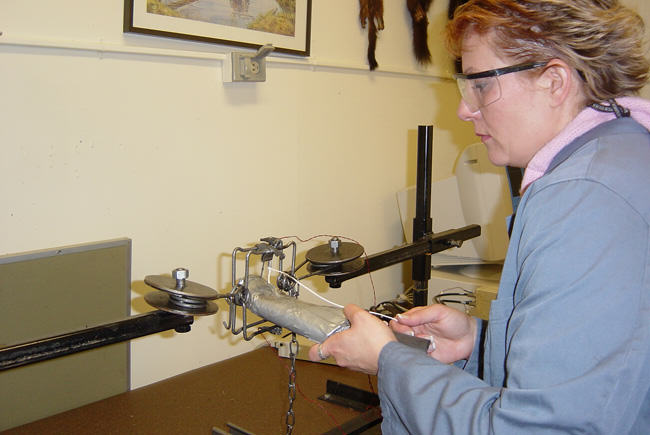
Jotham: First, we established of the world’s first state-of-the-art trap-research facility in Vegreville, Alberta, which includes a testing compound in a natural setting. All our testing protocols were approved by the Canadian Council on Animal Care (CCAC), the same group that approves animal research protocols in Canadian universities, hospitals and pharmaceutical laboratories.

In 1995, another dramatic breakthrough was made: the researchers had collected enough data to develop algorithms that allowed evaluation of the humane potential of traps without using animals at all; we can now analyse the trap’s mechanical properties with computer simulation models. This made it unnecessary to capture, transport and house thousands of wild animals – while saving millions of dollars.

TaF: Did this research help with the formulation of the Agreement on International Humane Trapping Standards (AIHTS)?
Jotham: Canadian research was vital for the AIHTS. We had begun working on trapping standards as early as 1981, with the Canadian General Standards Board (CGSB), and by 1984 we had the first standard for killing traps. But with calls growing in Europe for a ban on leg-hold traps – and because virtually every country in the world uses trapping for various purposes – the CGSB suggested that there was a need for an international standard. To this end, ISO Technical Committee 191, of the International Organization for Standardization, was established in 1987, with yours truly as the first Chairman.
Our timing was good; by 1991, a EU Directive was being proposed that would not only ban the use of “leg-hold” traps in Europe, but would also block the import of most commercially-traded wild furs from any country that had not done the same. Because the stated goal of the legislation was to promote animal welfare – and because all EU member states permit the trapping of animals with methods basically the same as those used in Canada – Canadian diplomats succeeded in having the EU Directive amended to admit furs from countries using traps that “meet international humane trapping standards”.
The problem was that no such standards existed yet, and animal activists on ISO Technical Committee 191 refused to allow the word “humane” to be used in our documents. The deadlock was resolved by agreeing that ISO would develop only the trap-testing methodology, leaving it to individual governments to decide what animal-welfare thresholds they would require.
In 1995, the governments of the EU and the major wild-fur producing countries (Canada, the USA and Russia) developed the AIHTS, which was signed in 1997, and ratified by Canada in 1998. (For constitutional reasons, the US signed a similar but separate “Agreed Minute”.) The AIHTS explicitly requires that ISO trap-testing methodology must be used to test traps.
TaF: What are the main contributions of the AIHTS?
Jotham: The AIHTS is the world’s first international agreement on animal welfare, I think we can be very proud of that. Concerns about the humaneness of trapping that had been raised since the 1920s, are now being addressed seriously and responsibly. And, of course, the Agreement kept EU markets open for wild fur; Article 13 states that the parties will not use trade bans to resolve disputes, so long as the AIHTS is being applied. In other words, science and research, not trade bans, will be used to promote animal welfare. This is a very positive development.

TaF: And how do you feel about the Fur Institute of Canada introducing a new “Neal Jotham Award for the Advancement of Animal Welfare”, in 2015?
Jotham: It is wonderful that the trapping community has embraced animal-welfare so strongly. And the award is very gratifying personally, of course, especially when I remember how suspicious some trappers were when I first arrived at the FIC. They were convinced that I was an activist mole, while many of my old animal-welfare friends thought that I had “sold out” to the fur industry. But whether I was with the CAHT, the CFHS, the CWS or the FIC, I was always pursuing the same goal: to make trapping as humane as possible. It was a long road, but we succeeded in bringing all the stakeholders to the table to seriously address this important challenge. I think we can be very proud of what we have achieved together.
***
In 2016, Neal Jotham won a Nature Inspiration Award for Lifetime Achievement from Canada's Museum of Nature.
5 Reasons Why PETA Won’t Make Me Ditch My Canada Goose
by Alan Herscovici, Senior Researcher, Truth About FurIt is minus 23 degrees Celsius (-32C with the wind-chill) but I am snug as a bug in my Canada…
Read More
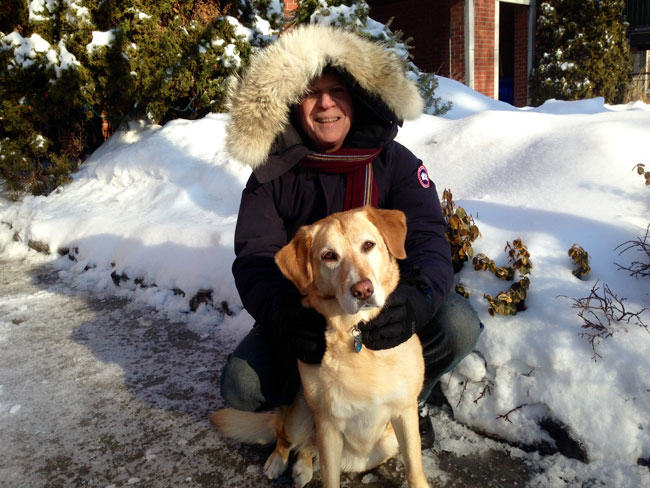
It is minus 23 degrees Celsius (-32C with the wind-chill) but I am snug as a bug in my Canada Goose parka as I walk Maggie, our 9-year-old Labrador Retriever.
It is so cold in Montreal this Valentine’s Day weekend that I cinch my parka hood completely closed, the soft coyote fur ruff forming a cozy, protective ring around my face. The goose down stuffing keeps the rest of me warm. I wonder how our animal activist friends are enjoying the bitterly cold weather, because this is the weekend they have chosen for their National Anti-Fur Day (“Have A Heart, Don’t Wear Fur”) protests in Montreal and other cities across North America.
As a sign of the times, Canada Goose parkas are the target of choice for this year’s anti-fur rituals. Why? Because even though fewer traditional full-fur coats are being worn these days, fur is now omnipresent in smaller items, accessories and trimmings. This has made fur much more affordable, and it is now being worn by more – and younger – people than we have seen in decades. It has been democratized.
SEE ALSO: Why fur trim keeps us warm.
In response, PETA has unleashed a new campaign “juxtaposing Canada Goose’s coyote-fur jackets with a disturbing video of a trapped coyote suffering after being shot.” The video is prefaced with a “warning” that it contains upsetting images, but this has apparently not discouraged many of PETA's fans because, it claims, the video “has received more than 16 million views.”
To drive home PETA's message, volunteers “wearing nothing but body paint and faux-fur ears and tails” would be posing “in bloody leg-hold traps” outside retailers selling Canada Goose parkas over the weekend. According to PETA Senior Vice President Lisa Lange, “Anyone who buys or sells one of Canada Goose’s fur-and-feather jackets is responsible for these animals’ terrifying and painful deaths.”
So has PETA’s “shocking” video convinced me to give up my Canada Goose? Not a chance, and here's why:
1. Video Shows Perfect Kill
The first problem is that PETA’s campaign video does not show a coyote “suffering after being shot”. Quite the contrary, we see the animal killed instantly with a direct shot to the head – exactly how it is supposed to be done. This is the most humane way to euthanize animals taken in restraining traps, as taught in trapper training manuals and mandated by the Agreement on International Humane Trapping Standards (AIHTS).
This is also the method proposed by the Canadian Council on Animal Care (CCAC) guidelines.
”3. Physical Methods: These techniques, when properly applied, kill rapidly and cause minimal stress. They may offer a practical solution for field euthanasia of various sized animals and prevent pharmaceuticals from entering the food chain ...
... Gunshot: While a shot to the brain of an animal produces a quick and humane death (Longair et al., 1991), it is best attempted when the animal is immobilized by injury or physical restraint.”
In other words, despite PETA's sensationalist warning – intended to shock people who have never seen an animal killed – its own video confirms that approved and humane methods are being used to euthanize coyotes.
2. Coyote Mums Not "Desperate"
PETA claims that “trapped coyote mothers desperate to get back to their starving pups have been known to attempt to chew off their own limbs to escape.” While this may have happened very occasionally with some species (e.g., muskrats) with older trapping systems, it never happens with modern foot-hold traps.
Furthermore, the whole "starving pups" scenario never happens with fur trapping for one simple reason: like other furbearers, coyotes are hunted for their fur in the fall and winter because that's when their fur is prime. At this time of year, their young are no longer dependent on them.
3. Coyote Predator Problem
As important as the nonsense PETA does say is what it doesn't say: It omits to inform us that coyotes have expanded their range across North America and are now so abundant that they are the number one predator problem for ranchers, preying on new-born calves and lambs. It also fails to mention the increasingly frequent reports, from Toronto to Los Angeles, of coyotes carrying away pet dogs and cats.
Several states and provinces have even offered bounties to reduce over-populated coyotes.
SEE ALSO: Will urban coyotes change the animal rights debate?
Culling must be carried out both to protect livestock and pets, and also the health of coyote populations themselves. Given that coyote populations must be managed, it is surely more respectful, and responsible, to use their fur for clothing than to throw it away.
SEE ALSO: Is it ethical to produce, buy or wear fur?
4. New Foot-Hold Traps Designed to Prevent Injuries
The foot-hold traps used to capture coyotes (as shown in PETA’s video) are not the diabolical, steel-toothed devices that activists love to hate. Their use was banned decades ago in North America.
The new live-holding (“restraining”) traps have rubber-laminated, “off-set” jaws that do not close completely. Springs and swivels on the anchoring chain and other features have also been added to prevent injuries. In fact, these new “soft-catch” traps are commonly used by wildlife biologists to capture wolves, lynx and other furbearers for radio collaring or relocation/release into areas where they were once extirpated. Clearly they could not be used in this way if they injured animals as activists claim.
SEE ALSO: Types of traps.
5. PETA Opposes All Animal Use
Most importantly, PETA’s claims about fur are not credible because PETA is not looking for more humane ways to capture or kill animals we use. PETA opposes any use of animals, even for food or vital medical research.
PETA would have us all wear synthetic materials, most of which are derived from petroleum, a non-renewable resource. This is fundamentally anti-ecological. The modern fur trade, by contrast, is an excellent example of the sustainable use of renewable (and biodegradable) natural resources, a key ecological principle that is now promoted by all serious conservation authorities.
SEE ALSO: Fur is a sustainable natural resource.
A sixth, “bonus” point is a bit more philosophical. No one is obliged to wear fur (or leather or silk or down), but many of us appreciate the warmth and beauty of high-quality natural materials. The coyote fur and goose down in my Canada Goose coat also remind me that everything we depend upon for our survival still comes, ultimately, from nature. Thus the importance of protecting natural ecosystems for future generations.
***
UPDATE: Animal activists lodged a complaint with the Competition Bureau (the Canadian federal regulator) accusing Canada Goose of “false advertising” for claiming on its website that its furs are collected by licensed trappers using humane methods. We are pleased to report that this complaint was rejected by the Competition Bureau. See: Competition Bureau drops inquiry into false advertising claim against Canada Goose, by Christina Stevens, Global News, Mar. 10, 2016.
COMMENTS: Comments are now closed for this post.
Wildlife Control Expert or Trapper? Who You Gonna Call?
by Ross Hinter, wildlife control professional, bushcrafterIf there’s a beaver dam in your neighbourhood, or your septic field really don’t look good, who you gonna call? A…
Read More
If there's a beaver dam in your neighbourhood, or your septic field really don't look good, who you gonna call? A wildlife control expert or trapper? Or is the only difference in the length of his beard?

"This is my friend Ross and he's a trapper."
This is my introduction to the lady standing in front of me. As I watch her eyes, I realize she is floating between her polite manners and her abhorrence of my title, not yet decided whether she will shake my hand. She takes a step back. After all, "He's a trapper!"
My mind smiles as I recall, not three days past, being introduced by a friend from the University of Alberta to someone else. Only in this case I was introduced with the title of “wildlife control expert”. In that case, the lady was smiling and taking a step forward with out-stretched hand, saying, “Well hello Ross, what a pleasure it is to meet you. What an interesting profession. I would love to learn more about what you do and how you deal with wildlife.”
I consider myself very fortunate to have spent most of my life with wildlife. As a matter of fact, it’s been even better than I could have imagined. I could never have planned a life quite like this, but it sure has been a great time of learning.
Wearing two hats, out of the same office so to speak, has given me a chance to see such contrasting experiences. I reflect back upon one of those that stayed etched in my memory.

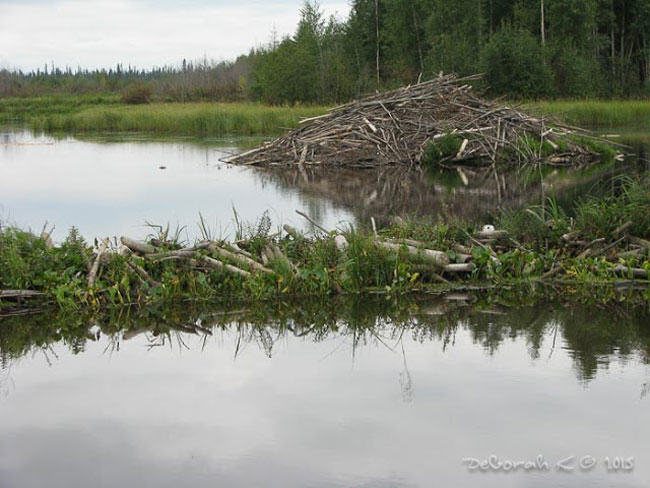
Several years back, I received a call from a farmer who had been given my number by Fish and Wildlife. He needed help with a beaver problem so we set up a time and I drove out to visit. I could see from the roadway that the beaver had already dammed up the creek and the water had backed up causing flooding and erosion. As we walked he told me how, four years prior, his family had been so excited when they had first spotted beaver swimming in their creek. His children could watch from their tree fort in the fall as the beaver cut down the trees and pulled them along as they swam.
That first year, he went on to share, he was quite pleased to see that as the beaver dammed up the small creek, it held back enough water to make it easier for his cattle to drink. He felt he had a couple of water managers working with him on the farm.
Plugged-Up Crossing, Washed-Out Road
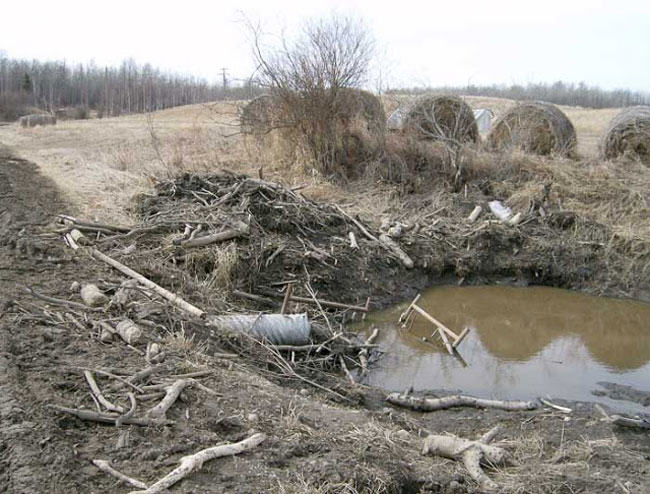
As we walked up to where the creek separated a hay field, I could now see that the beaver had plugged up the crossing. The roadway was completely washed out. The trees along this “now pond” were laying all criss-crossed throughout the banks, with not much chance of anything getting down to the water without climbing over stumps and de-barked dead aspen. As I stood there, looking over this mess, he told me that two of his cows had broken their legs after falling through the banks, and as I climbed down I could see the bank had caved in from where the beaver had undermined it.
We made our way back over the fields talking about the over-population of the beaver, and I explained that if we could wait a couple more months it would be winter and we could trap them and the pelts would not be wasted. If we took the beaver now, the pelts would have no market value and be wasted. He understood and agreed, knowing it made sense to wait. Removing them at the opportune time would allow the land to recover and the pelts would be utilized.

He suggested I take a trip down the road and view another beaver lodge he had seen and inquired if I believed those beaver might also over-populate and end up migrating over to his area. I assured him that this is the usual course of action when it comes to beaver in this situation. I agreed to go visit the site and assess it for activity. He did not know the landowners there, as they were new to the area from the city. I obtained the directions and off I went, assuring him I would return in a couple of months to begin.
Look of Horror
Upon traveling down another gravel road, I arrived on the doorstep of the neighbours. The door opened and a couple inquired what I wanted. I told them I was a trapper and that their neighbour down the road was having issues with beaver causing flooding and damming. I asked if they might like to me to deal with their beaver colony, as in a short time these also would cause flooding and damming on their property.
The response was a look of horror and a quick explanation about their reasons of refusal. They had recently bought the land to enjoy nature in all its forms and there would be absolutely no trapping on their land as long as they were the owners. I quickly apologized, said I could see that I had upset them, and left. As I gazed across the land, I could see a current beaver lodge on the far side of their creek bank and already they had felled some aspen trees that were lying down.
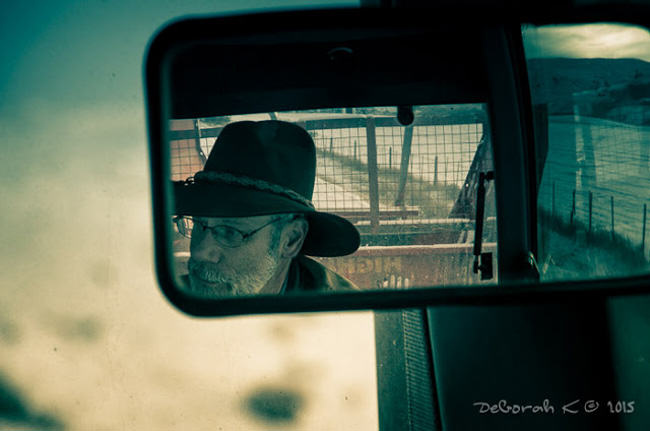
Driving away, I had a strange feeling while I gazed at my reflection in the mirror. Somehow my mind wandered to a decision I’d made that year to grow a beard. I even decided that I most likely looked a little rough, maybe along the lines of a mountain man, deciding that this presentation had not helped my acceptance during the discussion with this couple who had shut the door firmly in my face.

Onward I went, fulfilling the request of the farmer and eliminating the problem beaver on his land. There was no waste as I prepared all the pelts I’d taken for market.
We Are Desperate!
Forward two years, it's spring-time and my phone rings. The woman on the other end of the line was sounding quite desperate. She told me she had obtained my number from Fish and Wildlife, who had informed her I was a Wildlife Damage Control expert. She quickly brought me up to speed on the dire situation out at their acreage. They had been flooded out by some beaver and needed my help as soon as possible! I regretfully advised her that the timing wasn’t good as I was extremely busy working on a wolf predation issue with Fish and Wildlife and could I contact her as soon as I had some free time? It was then she begged me, pleading with me to come at least just to look. “We are desperate for help!” she exclaimed.
So off I went next morning, following the directions she’d provided, and as I reviewed my county map I had a sense I’d visited that area before. And then I realized where I was going. I turned down the gravel road and drove up to the exact same house I had visited a couple years earlier. I could readily see the mess the beaver had made from the road. A huge pond was now located where a field had been before, and the water level was above the fence posts. The pond was so large it was not far from the yard.

I thought, “Well this should be interesting.” I parked and made my way to the house, and as I approached the man came out and thanked me for coming on such short notice, all the while shaking my hand. His wife followed and as she also began thanking me, I wondered if they would say something about the last time I was here. I then realized, “They don’t recognize me!”
So I stood there feeling awkward and decided it just wasn’t worth bringing up at this point. I figured, maybe because now I was clean-shaven and didn’t have my old hat on, they didn’t make the link. He said he would show me where the beaver lodge was. I told him I could see it from there and asked if they had thought about how they wanted to control them. He looked at me with a puzzled expression and asked, “What do you mean?” I said, “Well, they are good little water managers and have just overpopulated, but, properly managed, they could be good to have around.”
His wife responded with a resounding, “No, I want them out of here. We had no idea they would do this! We can't even flush our toilet! They have flooded the whole place and the water has backed up the septic field.”
I Was Scruffy-Looking, A Trapper
As I stood there listening, something snapped in the back of my head and I let it go. “You folks don’t remember me, do you?” I said. His reply: "Should we?” I said, “Yes, I was here a couple of years back, a scruffy-looking fellow with a beard and cowboy hat. A trapper?”
They gazed at each other while I continued. “I came here to talk to you in the fall about managing the beaver, and you wanted nothing to do with me, shutting the door in my face. Now that your toilet won’t flush, you don’t care about nature any longer! You are asking me to go in now, in the spring, while the young are still nursing, and remove them. The young will starve to death in the lodge without their mother’s milk, and all because your toilet won't flush!”
ALSO BY ROSS HINTER: SHOULD WE BE TRAPPING WOLVES IN CANADA?
I told them that, as a trapper, I understood there was a season to manage animals and that I would not trap them in the spring. They would have to find another trapper or wait until the fall before I would return and trap the beaver humanely.
This time, I drove away from them, leaving once again two upset and angry landowners, but this time because I wouldn’t trap for them! I felt somewhat guilty about not helping them in their hour of need, but strong in my conviction. I did feel some triumph, I have to admit, but as the day moved on and I reached my next appointment, I reflected on the level of ignorance in the world, about how nature really works, feeling a tweak of sadness, but also one of hope, that one day, I might be able to help, in my own way, to show my world to those who would listen.
We as humans are part of nature. It isn’t something separate from us. We are part of it, and it is part of us. The more we learn about it and remove the ignorance, the better for us all!
***
Recommended YouTube viewing from Ross Hinter's Bushcrafting - Learning How:
Beaver Trapping - Why Do It?
Trapping, Conservation & Animal Habitat with Ross Hinter
It’s durable, warm, glamorous and striking. And it comes from an animal that is abundant in the wild, easy to…
Read More

It’s durable, warm, glamorous and striking. And it comes from an animal that is abundant in the wild, easy to trap, and easy to farm. In short, all the right boxes are checked for a great fur. It was also once the height of fashion. Yet today it's rarely seen in stores, and a pelt sells for the price of a coffee.
This is the conundrum that is skunk fur. Are the fur trade and consumers turning their noses up for no good reason?
Tale of the Tape
Let’s start with the end product.
Skunk fur is durable - less durable than beaver, but ahead of the pack and on a par with mink.
Skunk fur is warm. It's no caribou, but unless you live in the Arctic, it'll work fine.
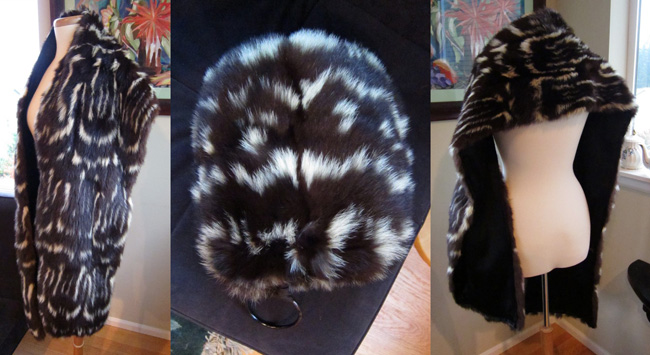
Skunk fur is glamorous and striking. The guard hairs are long (1-2") with a glossy lustre, and are held erect by thick underfur. And the colouration is unmistakeable: deep brown or black, usually with white striping and cream patterns.
The most prized pelts have solid black backs with a blue sheen, and come from colder regions where pelts are thicker, hairs are finer, and the black is blackest. (No fur is blacker than northern skunk.) If there is one white stripe, and it's long and wide (hooded skunk), this may be retained in a garment, while pelts with two stripes (striped skunk) are normally dyed a uniform black.
So what’s the downside? Not much.
The guard hairs are slightly coarser than fox, the most luxurious long-haired fur.
The black guard hairs, if not dyed, fade to a dull reddish-brown if exposed to sunlight for too long a time. (Just store your fur in a closet.)
Skunk fur is reputed to have an odour, especially when wet, but this should not be a problem today. Using proper trapping techniques, it is rare that an animal sprays. And even if there is a slight vestigial smell, a skilled fur dresser can remove it.
And last, but perhaps not least, it’s called “skunk”.
Skunk Fur Production
So how easy is it to produce skunk pelts? Pretty easy. Let’s start with trapping.
First, skunks are abundant. The striped skunk, the most commonly traded species, has a conservation status of “Least concern” with the International Union for the Conservation of Nature. It ranges from southern Canada to northern Mexico, co-exists with humans, and in many parts of its range is growing in numbers.
Second, skunks lack caution and cunning. A box trap works great for nuisance skunks, but is too costly and bulky for fur trapping. Foothold (restraining) traps or bodygrip traps are better.

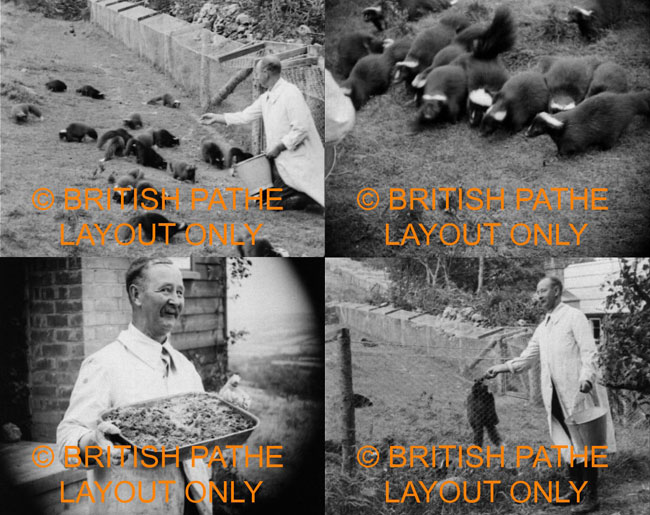
Farming skunk is also easy. Indeed, skunk farms were once seen as a stepping stone for beginners looking to graduate to more challenging and valuable furbearers.
Reasons why farming is easy include: Skunk are easily tamed, and at feeding time just come running. They’re poor climbers and have few natural predators, so pens are open-topped. They’ll eat just about anything - table scraps are fine. And selective breeding produces all-black skunk in just three or four generations.
Curious History
So why aren’t we all dressed from head to toe in skunk fur? Its curious history may shed some light.
For the longest time North Americans had no interest in skunk fur, but it wasn't a case of singling it out. They weren't crazy about fox either. And even when skunk was “discovered” in the mid-1800s, demand was not at home but from Europe.
Skunk quickly became America's second most valuable fur harvest after muskrat, with almost all pelts being traded in London and Leipzig. To meet demand, the first farms emerged in the 1880s, but unreliable pelt prices forced most pioneers to close. Then the farms sprung up again at the turn of the century as European demand surged. In 1911, pelt sales in London peaked at just over 2 million.
And that's how things stayed right up to World War I. The domestic market remained tiny, a fact historians attribute to a lack of Europe's deodorising skills. Or perhaps it was that American dressers had to work with pelts so pungent, European brokers wouldn't take them.
Whatever the case, World War I changed everything, not just for skunk but the entire fur trade. With shipments to Europe disrupted, the age of major American auction houses began, first in St. Louis in 1915, then in New York in 1916.
Demand for skunk in North America finally took off, and when the European market came back on stream in 1918, the golden age of skunk had arrived.
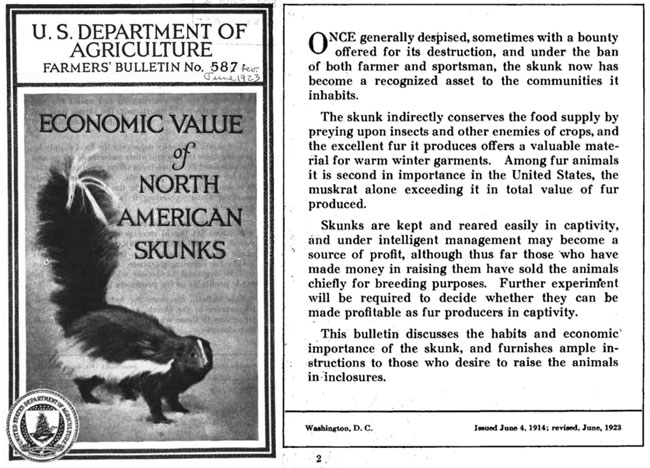
Seeing the potential, the US Department of Agriculture published the Economic Value of North American Skunks, in 1914 and again in 1923. “Skunk fur is intrinsically of high value,” it stated unequivocally. “The propagation of skunks for their fur promises to develop into an important industry.”
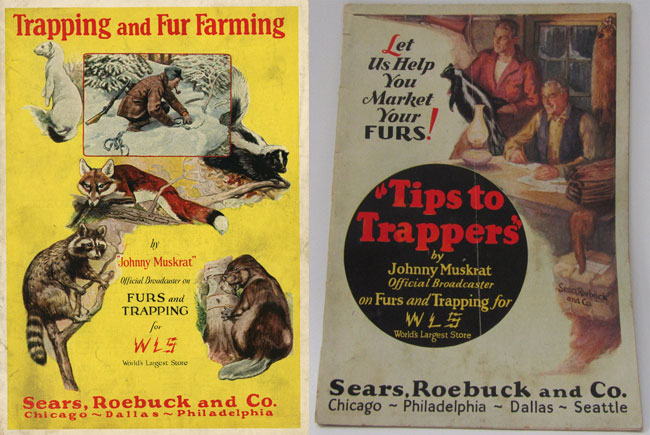
Skunk trapping also helped countless rural families weather the Great Depression, mailing their pelts to Sears, Roebuck in return for a check or store credit. Through its annual newsletters and radio shows, Sears (aka "Johnny Muskrat") created a whole new generation of trappers, and became one of the largest fur buyers in the US.

All in the Name?
And then the age of skunk was over. World War II ended and fur fashion shifted dramatically. Long hair was out and short hair was in. Skunk pelts were almost worthless, red fox pelts were "unsaleable", and even silver fox was scorned. Mink was the new king, a position it has not relinquished to this day.
SEE ALSO: Why is American mink the world's favourite fur?
But a change in fashion was not the whole story. If it had been, skunk would have rebounded along with fox, which still has a loyal following today.
Some observers blame skunk's demise on stricter labelling laws. In the 1930s, the fur trade often took considerable liberties when it came to labelling. Women of all social classes wanted fur, but with the Depression raging, few husbands could afford the premium stuff. What they could afford was humble rabbit, but that didn't sound very glamorous. Enter creative marketing.
“Minkony” was rabbit dyed to look like mink. “Ermiline” was white rabbit, sometimes with black spots for that authentic ermine look. Then there were totally fictitious species like “Baltic black fox”, “Belgian beaver”, “French sable” and “Roman seal” - all rabbit!
Other furs got the creative treatment too. “Hudson seal” was one of the most popular sellers, though it was actually sheared and dyed muskrat. And no fur, of course, needed a new name more than skunk. Why tell Ma’am she was swathed in the skins of foul-smelling critters when you could sell her “American sable”, “Alaskan sable” or “black marten”?
Finally the US Federal Trade Commission cried foul. From 1938 on, the true identity of the furbearer had to be given, though the name of the animal being imitated could stay. Goodbye “American sable", hello "sable-dyed skunk".

In 1952 it went further with the Fur Products Labeling Act. Explaining the need for the new law, the Chicago Tribune wrote, “Mrs. Eskimo, who cures the pelt brought to her by husband, has no trouble telling a mink from a muskrat. But Mrs. Housewife, shopping for a fur coat, finds herself in a quandary. There are so many furs and so many names!”
Henceforth, only “the true English names for the animals in question" should appear, "or in the absence of a true English name for an animal, the name by which such animal can be properly identified in the United States.”
The trade resisted, and some unusual new names were approved. "Rock sable", for example, became "bassarisk", even though most people called them ring-tailed cats. But it spelled the end for furs like “China mink” and “Japanese mink” (both weasel).
As for skunk, in a few short years it had gone from being "American sable" to “sable-dyed skunk”, to plain ol' "skunk". Was it too much for consumers? Are we really that shallow? Apparently yes. A rose by any other name does not smell as sweet!
Skunk Fur Today
The last skunk fur farms closed decades ago, and offerings of pelts at auction today are small. Prices, meanwhile, seem frozen in time.
The largest seller today of skunk fur is North American Fur Auctions, in Toronto. At its wild fur sale last June-July, 2,332 pelts were offered (compared with 310,667 muskrat), of which 70% sold. Average price was $5.97.
In February 1920 in St. Louis – that’s almost a century ago - skunk pelts brought an average of $5.14. In today's money that's $61!
From time to time, skunk has made small comebacks. In the early 1970s, in particular, it was considered quirky and cool, but it soon went the same way of Afros and bell bottoms.
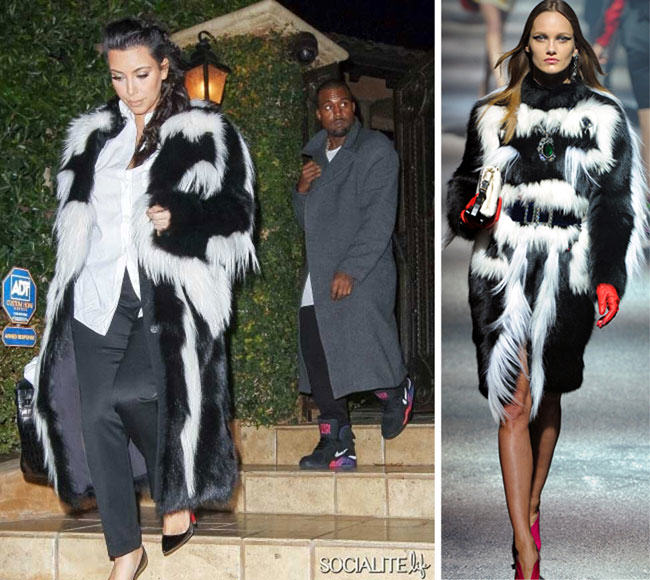
Popular designers and fashion houses are still willing to give skunk a try. Just recently, America’s darling of the gossip columns, Kim Kardashian, caused a stir when she stepped out in a fabulous skunk coat from Lanvin.
Can Kim bring skunk in from the fashion cold? Or will it remain forever sealed in a 1930s time capsule?
Could a kick-start campaign bring this remarkable, but under-appreciated, fur back into the limelight? What do you think?
The number one threat to all wildlife in North America is loss of habitat. Let me explain why I feel…
Read More

The number one threat to all wildlife in North America is loss of habitat. Let me explain why I feel it necessary to stand on this statement, in the context of trapping wolves in Canada.
Habitat and carrying capacity - these are unavoidable issues that need to be addressed by all those involved in this controversy, from industry to agriculture to municipalities, conservationists, wildlife protectors, and everyone in between.
Wolves are at the top of the food chain in many of our forested regions in this country. The regions that they are utilizing as habitat are sometimes unable to sustain the population as wolves continue to produce offspring.
My heart lies in addressing what I believe is the real issue. In discussing wolves, I’d like to begin with population dynamics.
Habitat and Population Dynamics
Using the example of a pack of seven wolves, the adult females could birth seven pups in the spring. The mother cares for the pups during their early weeks of life, and the male goes out to hunt and returns with food, so she can concentrate on raising the pups. The entire pack is involved with the raising of the young. The mortality rate is lower than other wildlife because of this.
The habitat they are ranging in could be from 100 to 250 square miles depending on the available food in that habitat.
If all seven pups survive and are healthy, they will reach the size of their mother by the end of the fall season and coming of winter.
That means that the winter that follows the spring birthing, there will now be 14 wolves in that pack. The need for food for this pack will have doubled in less than a year.
So now we have seven pups that will be trained how to kill in order to survive and be an integral part of the pack. This is in one year and the math shows the results after five years is enormous for the same habitat and food source. Some may break away, some will die, but this is the top of the food chain with no predators that are preying on the wolf.
I want to be clear on this point: letting nature take care of itself by allowing it to sort itself out, like nature used to do in generations past, is no longer a viable and responsible option. It is imperative for us to take responsibility to manage the over-population of the wolves.
Nature will cull the numbers through disease, starvation, etc., but as one who has spent the better part of my life involved in wildlife control, it is not a humane thing to witness. If any animal is going to die then it has been my job to see that it is done humanely and as quickly as it can be done.
It then becomes quite obvious that the numbers of wolves in excess of the carrying capacity of the habitat, these animals will need to be removed.
Public Perception
There is a void in the public perception, and an idolizing of wolves that is not helping to protect, but instead is a hindrance!
The simple fact remains contrary to many people’s understanding, we have wiped out so much habitat throughout North America, that this type of population growth will have an astounding effect on the prey species. I’ve seen the results upon horses, lambs, elk calves, moose, deer, caribou, bison and domestic pets.
Where suitable habitat exists, wolves have lived in close proximity to livestock for several years, with little predation issues. But, how long in any area before the growth number of the wolf packs exceeds the available habitat and food source causing livestock and predation problems?
It’s an obvious fact something must be done to control population levels. The most important thing for us to consider is this! There is a need to work together to ensure that if there is a culling process taking place, it should happen in the most humane and effective method available.

Trapping – Viable Option?
Trapping is often viewed as a hated solution to population controls, but under the humane trapping standards, utilizing modern equipment, it still remains as one of the best options. Performed in the winter months, when the young are not being nursed, the pack numbers have peaked since the summer and the carrying capacity will now have more pressure on it. The fur will not be wasted and can be a resource to be utilized.
It is an industry that, through provincial wildlife laws, takes the approach of removing the surplus of furbearers, many of which will not find enough suitable habitat in the winter months to survive. This is a simple fact and has enough data and documentation to show a very successful program that continues to be a key element in the health and survival of these animals.
I believe that is something to be proud of as wise use of management!
I can think of no country in the world that does not trap. They may have stopped fur trapping but it still continues and is then called "wildlife control" or "animal damage control" which must be done, to control over-population of species as they continue to produce more offspring than the habitat can sustain. These animals are not used for anything and are treated as vermin and are incinerated or treated as trash. This is not true wildlife management. We are better than this. The carcass of that animal is used by trappers and taken back out to the land to feed other carnivores. The fur is prepared and shipped and sold to be tanned and used.
There is no “nice part” of the dying of any living thing and nothing works perfectly, but we have come a long way and Canada continues to be the world leader on humane trapping standards. There are many pictures circulated throughout public media showing the mistakes made by untrained individuals and just plain carelessness causing suffering and pain, but as a professional I can assure you this is not the norm.

Carrying Capacity
Human encroachment into wolves' habitat results in conflict that is unavoidable. So, we have created the problem, and we need to take responsibility to manage it. Wolves are predators, and whether we want to view the destruction or turn away from it, will not make it go away.
It is sometimes difficult for some to consider their lifestyle in relation to loss of habitat for wildlife. We are all consumers by the way we live. We may not eat meat but if we use toilet paper, magazines, books or newspapers, or if we buy lumber to build a bird house or picnic table, we are supporting a lumber industry, which is taking out habitat.
If we use oil, gasoline, plastic etc., we are supporting an oil industry that is wiping out habitat. The point being here that we are all in this together. Nature is not something separate from us and it never will be. We can’t survive without it.
There is a direct link between our choices to buy more and more stuff, traveling less distances to get it, and habitat that is being lost at an alarming rate. Less destruction of habitat is an absolute if you are going to preserve the current wolf population dynamics.
ALSO BY ROSS HINTER: WILDLIFE CONTROL EXPERT OR TRAPPER? WHO YOU GONNA CALL?
Final Thoughts
As always, knowledge and understanding are powerful tools. In such an emotionally charged time in human history and love of wildlife, those that hate the wolves and those that love the wolves will need to find a balance of true and clear knowledge of what is really taking place.
This includes a full understanding of loss of habitat. Instead of wasting so much time and money arguing about who is responsible, we would better serve the preservation of the species by collaborating together to find viable solutions that work long term. The money in this effort would then be well spent.
We have taken the habitat and continue to do so, therefore we are responsible to manage the population in the most humane and ethical manner available to us.
This is the sensible approach to a very heated conflict and one that is going to continue to make headlines.
My life as a professional trapper has proven to me what an important resource Canadian trappers are, both to the academic and scientific community, along with both provincial and federal government departments and conservationists at all levels.
Ethical trappers are the front line of conservation and will continue to be a valuable tool and play a key role in the welfare of our furbearing wildlife.
FOLLOW ROSS HINTER'S "BUSHCRAFT - LEARNING HOW" ON:
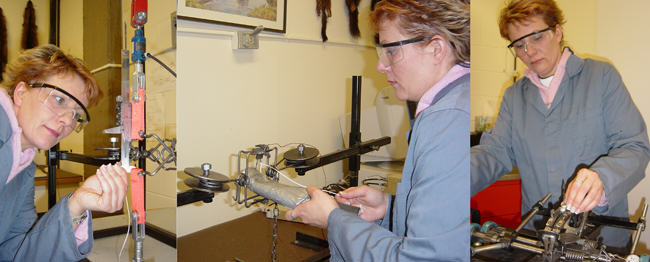

Hair density has always fascinated the fur trade because the densest furs are also the softest and most luxurious. Before the advent…
Read More

Hair density has always fascinated the fur trade because the densest furs are also the softest and most luxurious. Before the advent of modern conservationism, this meant that the densest furs were prone to over-harvesting. Today, we have learned from past mistakes. Trade in the densest fur of all is still restricted, but the animal's recovery is considered a great conservation success. And due to a remarkable story in the history of farming, the second-densest is abundant and readily available.
To appreciate what makes fur dense, let’s set a baseline: human hair. And because human hair varies depending on ethnicity and hair colour, we’ll choose the densest of all, a pale blond(e).
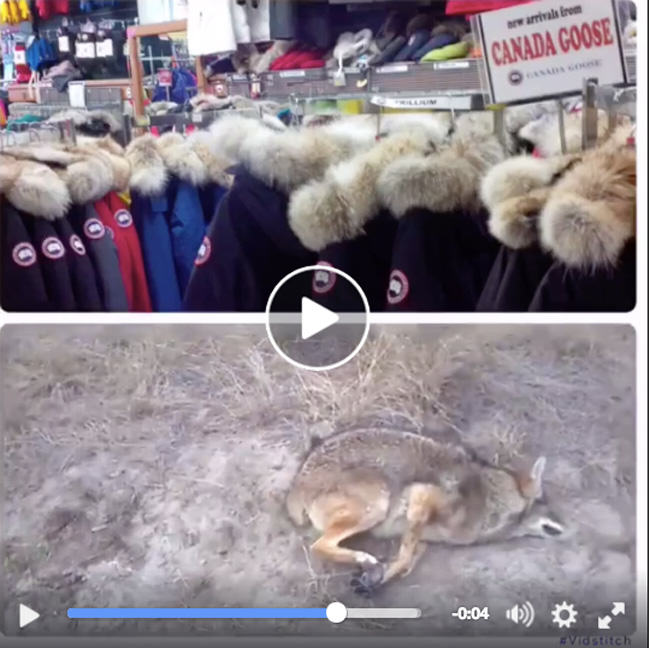
A blonde’s fine hairs average about 190 per cm2, varying depending on the part of the scalp. That's almost double Afro-textured hair, the least dense.
Now step aside blondie, and make way for that benchmark of luxury, mink.
A mink’s hair density varies by season and body part. Also, farmed mink is denser than wild, and a dressed pelt is denser than a live animal. But as a guide, a dressed, farmed pelt has about 24,000 hairs per cm2. That’s 126 times denser than the thickest human pelage!

Impressed? Well hold on. Prepare for furs so dense and soft that words to describe them are hard to find. Like talcum powder, perhaps?
SEE ALSO: WHY IS AMERICAN MINK THE WORLD'S FAVOURITE FUR?
Chinchilla
Animals with the densest furs live where climates are cold, humid and windy. Size also matters; because small mammals are more vulnerable to heat loss, they generally have denser fur.
And so we find ourselves in the high Andes, home of the long-tailed Chinchilla lanigera and short-tailed Chinchilla chinchilla. Being small and nocturnal makes them elusive. They're also very rare. The International Union for Conservation of Nature (IUCN) classifies both as "critically endangered".
We can blame the “tragedy of the commons” for that. Though the term was coined for what happens when no one owns common grazing land, it also played a role in the historic fur trade.
Spanish explorers first sent chinchilla pelts home in the 16th century, but it wasn’t until the late 19th century that Europeans developed an insatiable appetite for them. Populations collapsed, prices soared, and by the early 20th century a peasant trapper could feed his family for a month with just one pelt - if he could find one!
Only late in the day, in 1910, did the range states of Argentina, Bolivia, Chile and Peru unite to ban the trade, but effective enforcement was still decades away. Extinction seemed inevitable.
Farmers to the Rescue!
And then the cavalry arrived, in the unlikely form of fur farmers.

It all began with Californian miner Mathias Chapman who, in 1923, was allowed by Chile to take 11 live chinchilla home for breeding. (It took him three years to trap them!) Ten survived the trip and one gave birth en route.
Chapman originally planned to breed pets, but he switched to fur farming. Today, chinchilla farms are found from Canada to Argentina, and in many European countries, and almost all their stock are believed to descend from Chapman's original 10.
Farming of animals can help conserve their wild cousins. By meeting demand, it reduces pressure on wild populations, as in the case of mink and fox. But it can also encourage illegal hunting and provide a cover for smuggling - the fear with tiger farming.
In the case of chinchilla, farming didn't just help protect wild populations, it probably saved them. And even if most chinchilla now live in pens and eat hay and pellets, there is absolutely no chance of them going extinct!
Dense Is Desirable
So what is all the fuss about with chinchilla fur? Hair density. No other terrestrial mammal comes close.

Hairs grow from organs called follicles which, in humans, are densest on the forehead – about 290 per cm2. Chinchilla have as many as 1,000.
Then there's the number of hairs per follicle. Hairs grow in tufts, with 1-3 (rarely 4) sprouting from each human head follicle. But a regular chinchilla has about 50 hairs per follicle, while a show “chin” (as pet owners call them) may have 100.
That means a regular chin has 50,000 per cm2 - double a farmed, dressed mink pelt, and 263 times more than our human blonde. So dense is a chin's fur that it's said fleas and ticks can’t penetrate it, and if they could, they'd suffocate!
"Soft Gold"
Amazingly, there is fur even denser than chinchilla - so dense it drove men to endure the harshest conditions nature could throw at them, far from home, for more than 100 years. This was the Great Hunt!
In the early 18th century, Russian fur traders found themselves on the Pacific shores of Siberia. Drawn by a cornucopia of desirable furs, notably sable, they had spent 150 years opening up Russia's vast eastern territory.
Now they took to their boats in pursuit of fur so dense, and so valuable, it was known as "soft gold": sea otter.
SEE ALSO: AMAZING FACTS ABOUT FUR: DRESSING FOR THE ARCTIC
Starting from the Kuril Islands, the traders island-hopped across the North Pacific, harvesting one otter population after another, plus highly profitable hair seals they found along the way. The otter trade in Alaska boomed, and then the traders headed south. There they were joined by adventurers from all over North America and Europe in the great California Fur Rush.
The moniker "soft gold" was deserved. In 1775 otter pelts sold in the Russian port of Okhotsk at up to 30 times the price of sable. In the 1880s, a pelt brought $165 in London, but by 1903, as supplies dried up, made a staggering $1,125.
Thankfully the ground-breaking North Pacific Fur Seal Convention of 1911 put an end to seal otter fever by imposing a moratorium on the hunt. But was it too late? Perhaps fewer than 2,000 otters remained. Could they ever recover?
Yes they could! Sea otters have rebounded in two-thirds of their historic range, and are today cited as a great success story in the annals of marine conservation. As a precaution given the lesson of history, IUCN still classifies them as endangered, but Alaskan fishermen are now complaining the population is growing so fast, they've become a pest!
Exempted from the hunting ban, Alaskan coastal communities are also building a highly regulated trade in sea otter handicrafts and garments.

So what is it about sea otter fur that's so alluring? You know the answer already: density. Not even chinchilla compares.
Sea otters need superb insulation because, unlike other marine mammals, they have no blubber. And unlike that other four-legged marine mammal, the polar bear, they don't leave the water unless they absolutely have to. Imagine, swimming in the North Pacific, 24/7, in winter. Unless you have inches of blubber, or are a halibut, it's almost inconceivable.
And that's why sea otters have the greatest follicle density of any mammal, and hair density that ranges from 100,000 per cm2 on the legs and chest up to 400,000 on the sides and rump.
At its upper range, that’s four times denser than the finest show chin, 16 times denser than a farmed mink, and 2,105 times denser than our human blonde. That is dense fur!
***
FURTHER READING
Alaskan native Peter Paul Kawagaelg Williams, founder of Shaman Furs, is in a special position to bring sea otter to the international fashion scene. By Vanessa Friedman, New York Times, Dec. 1, 2016.
Ask most people what fur is good for and they’ll say it keeps the wearer – animal or human –…
Read More

Ask most people what fur is good for and they’ll say it keeps the wearer – animal or human - warm. True enough, but some types of fur are so much warmer than others, and the reasons why may surprise you. In this first of a series to introduce some of the amazing facts about fur, we’ve planned a hunting and fishing trip and now it's time to plan our wardrobe. We’re headed to the Canadian territory of Nunavut, and we need to dress for the occasion!
Nunavut is actually the size of Western Europe, so even though almost the whole territory is classed as having a polar climate, there are considerable differences in weather and hours of sunlight. Time of year also makes a big difference. So let’s narrow it down and say we’re headed for the capital of Iqaluit at 63°N, in late March.

We’ll have about 6 hours of sunlight a day, enough for some good hunting or fishing close to home. But with average temperatures for March at -28°C, and a record low of -44°C, we can forget our birdspotter’s anorak. Heck, with wind chill factored in, the mercury once hit -62°C, so you might be tempted to leave your entire wardrobe at home, but don't. Jeans and sneakers will get a lot of use when we're not actually out on the land or ice.
It’s time to plan our new wardrobe and then figure out how to get it, because it's not going to be from your typical downtown furrier. Mink, fox or chinchilla are not up to the job, plus we'd prefer not to run up a huge cleaning bill on our return.
What we’re after is fur that’s full of holes.
Hollow Hairs Please
One of the key functions of fur in nature is thermoregulation: helping furbearers stay cool in hot weather and, more importantly, warm when it’s freezing. This is achieved primarily by means of insulation, and one of the greatest insulators is air. Or, to be more precise, trapped air.
Heat travels more slowly through air than through solids or liquids, (For comparison, water is 24 times more effective at conducting heat than air.) Furbearers take advantage of this by trapping air between the dense hairs of their underfur, then sealing it in with their long guard hairs. For us humans, it's a case of dressing in layers: two thin sweaters, with a layer of air between, keep us warmer than one thick one.
But some furbearers, mostly species of deer, have taken it to the next level. Not only do their guard hairs help trap air in the underfur, but those guard hairs also have air trapped permanently inside each one! Commonly known as “hollow” hairs, think more in terms of a honeycomb center, with countless tiny pockets of air. (Click here for an example of a scanning electron micrograph of red deer hairs.)
So we’re going to go with a local favourite in Nunavut, caribou fur.

Caribou must endure bitter cold for months at a time, and they don’t even shiver. How do they do it? It's not all in the fur; a highly efficient means of minimising heat loss known as countercurrent heat exchange functions in their legs and nasal passages. But the key is their winter coats, three inches thick and covering them from nose to hooves, all topped off with those hollow hairs. (Interestingly, it is also these hollow hairs that cause caribou to swim so high out of the water, further conserving heat.)
So we’ll start with a couple of knee-length parkas, not for alternate days but to wear as a pair if needed. The outer parka, worn on its own with the fur on the outside, will be for less cold weather or trips close to home when a sudden change in the weather just means a sprint home. The inner parka will be added, with the fur facing our body (yes, we'll need a shirt or other kind of lining!), when the mercury plummets or we're traveling farther afield.
Since we're not dressing to impress but looking for utilitarian wear, we'll go with plain parkas, not the decorated versions commonly associated with Inuit culture. Caribou hair sheds easily and the hollow shafts are constantly breaking, so decorated parkas are for special occasions only (and for sale to tourists).
And since it's not mid-winter, we'll go with summer caribou skins, which are also those generally used for garments. The hair is shorter than winter skins so they're not as warm, but this also makes them less prone to shedding. Summer skins are also easier to dress than winter skins, and while dressing is said to reduce warmth, it does make them more durable.
And if you're ready to go totally native, caribou pants and socks come next, both with the fur on the inside, then caribou mittens and kamik (traditional footwear) to round off your ensemble.
A word of caution though. Unless you're actually out on the land or ice, dressing head to toe in caribou will make you stand out from the crowd. Plus, propping up the bar in Iqaluit will very quickly cause you to overheat! That's where the jeans and sneakers come in.
Hydrophobic Hood
Before you shell out for your parkas, though, pay particular attention to their most important feature: the hood lining. It must be hydrophobic.
OK, we don’t literally want it to be “hydrophobic” or it would be scared of water. What we want is a strong “hydrophobic effect”, meaning it appears to repel water. (There is no actual repulsion involved, just an absence of attraction.)
The hydrophobic effect can be found everywhere and is essential to life on Earth. Observe a droplet of dew on a leaf. The water and the leaf want nothing to do with each other, to the point where the dew forms a sphere. The hydrophobic effect is also seen in all fur, but some types are more hydrophobic than others.

And why is a hydrophobic hood lining so important? Well, here’s what happens if you don’t have one. You’re out one day when a blizzard blows in and the temperature suddenly drops to -30°C. You pull up your hood with its big, fluffy synthetic lining and laugh at Mother Nature. Next thing you know, your breath is freezing on the lining which then freezes to your face. Lesson learned. You’ll never wear a synthetic hood lining again, at least not in the Arctic.
Better to do it right the first time and go with the ultimate in hydrophobic hood lining, wolverine fur. Since that is not always available, northern grey wolf makes an excellent second choice.
Nature’s Raincoat
But we also need a second outfit, still for time on the land, but for days when caribou will make us feel like a baked potato. The sky is clear and the forecast is for temperatures around freezing. There's a chance of rain and slush underfoot, so being waterproof is paramount. It's time for Nature’s raincoat, sealskin.
People from down south often assume sealskin must be the ultimate in cold-weather clothing, but it’s not the case, and that’s because the species used – mainly ringed seals, as in Nunavut, and harp seals – have no underfur. Sometimes known as "hair seals", their pelts are composed entirely of short, shiny guard hairs.

The "flat" fur that comes from hair seals is not as warm as "true" fur (with underfur), like caribou, but it has some real pluses. Because there is no underfur, sealskin is light. It is also incredibly durable, more so than any other flat fur like calf or antelope (which is why it's used to make rope). Its structure resists wind, its oil content repels rain, and its porosity allows it to breathe (which is why it also makes great tents).
And oh yes, it's virtually waterproof, which is why it's used to skin kayaks.
Sealskins, then, are the Arctic's warm, wet-weather clothing, "warm", of course, being a relative term. Mittens, a lighter parka, and most definitely sealskin boots therefore make it on to our shopping list.
Shopping Time
And now comes the hard part. It's so hard, in fact, that if you're planning a quick in-and-out visit to Nunavut, you're not going to be wearing caribou or ringed seal anyway, so just pack the best of the rest. Unfortunately, buying an outfit of traditional Nunavut clothing is, like hollow hairs and hydrophobia, amazing - amazingly hard!
Forget about buying outfits off the peg, in Iqaluit or anywhere else. It's not going to happen, though not for want of trying. Efforts have been made in Nunavut over the years to establish a garment industry with ensured availability from suppliers and standardised sizes and prices, but all to no end. The workforce with the necessary skills - older women, with kids to care for, working from home - have not taken to the idea of a production line.
So what to do? You can sign up for an expensive sport-hunting package and get the clothing, including a decorated parka made of dressed skins, thrown in. Finding someone to make it then becomes your tour operator's headache.
Or you turn up in Iqaluit, ask around, negotiate hard, and be prepared to pay $1,500+ for a plain caribou parka, pants, kamik and mittens - and that's summer skins, probably not dressed. If you're staying a month, it should be ready by the time you're heading home.
The good news is that Canadian harp seal garments can be bought on-line (here or here, for example), provided you don't live in a country that denies you the freedom to import them. Which brings us to the last amazing fact about seal fur.
Nonsensical Bans
Almost all sealskin garments come from healthy populations of either harp seals or ringed seals. So healthy are these populations that the International Union for the Conservation of Nature (IUCN) classifies both harp and ringed seals as "Least Concern".
And yet two of the biggest potential markets for seal products, the US and the EU, are closed for no good reason.
SEE ALSO: EU SEALING POLICY IS HYPOCRITICAL, ANTI-DEMOCRATIC
The US has banned imports of all seal products since 1972 under the Marine Mammal Protection Act, legislation that is fiercely defended by the nation's animal activist community.

In the EU, the ban went into effect in 2009, since when the European Commission has made a pig's ear of justifying it because it can't. Everyone knows the ban was passed not for any rational reason, or even to satisfy popular demand, but because it was bought and paid for by lobbyists in Brussels working for animal rights groups.
Now, true to their reputation for feeble-minded solutions (like the bendy banana law), Brussels' finest have sought to placate Canada's angry Inuit by exempting them from the ban. Not surprisingly, many Inuit representatives have called the gesture colonialistic and racist, so we'll see how that works out!
Truly, the politics of fur are no less amazing than the science and cultural traditions of this beautiful, warm and sustainable natural resource. Send us a postcard from Iqaluit!