Like any advocacy group, People for the Ethical Treatment of Animals (PETA) thrives on media attention, and when a campaign… Read More
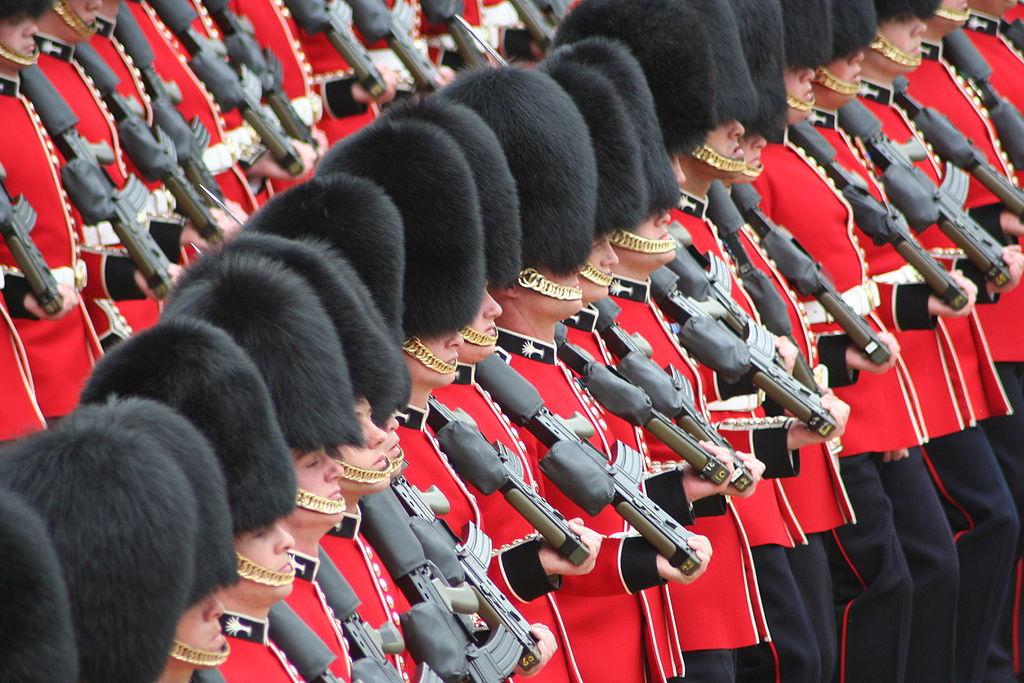
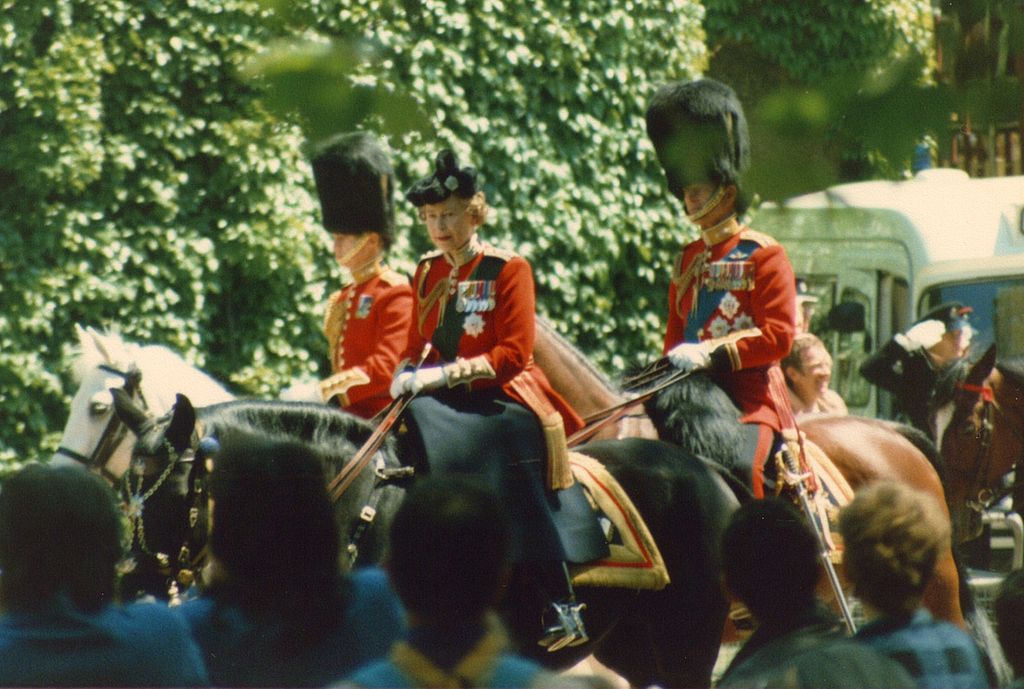
Foot Guards in their bearskins are an icon of British culture, a fact that PETA milks to the full. Photo: Sarahhoa, CC BY-SA 2.0, via Wikimedia Commons.
Like any advocacy group, People for the Ethical Treatment of Animals (PETA) thrives on media attention, and when a campaign generates that attention year after year, you keep it going. That's how it has been with PETA UK's 20-year campaign to have bearskins removed from the heads of the King's Foot Guards.
As long as PETA fails to achieve its goal – something it's "successfully" failed to do since 2002 – this gift just keeps on giving. Indeed, so successful has PETA been at failing, that cynics now wonder whether it wants to win at all, since winning would kill the goose that lays the golden eggs.
Bearskin caps are actually worn by the military and marching bands of no fewer than 10 countries, including Canada. But above all they are associated with British pomp and circumstance, and are a must-see for any tourist visiting London. It's hard to imagine the Changing of the Guard without them.
For the last two decades though, PETA has been badgering the UK's Ministry of Defence (MOD) to drop bearskins and go fake instead. True, the synthetic replacements would be made from polluting petroleum, but PETA calls them a "vegan upgrade", so they must be good for the planet, right?
To no one's surprise, the MOD has resisted – in deeds if not always in words. And all the while, PETA has milked the to-and-fro for its endless supply of free publicity.
Life of Its Own
Images of the King's Guard are simply irresistible. Photo: Jon, CC BY 2.0, via Wikimedia Commons.
When PETA started this campaign, it probably never dreamed it would take on a life of its own.
Its humble beginnings came straight out of the standard PETA playbook. Pick a target (the Guards), trot out the usual stories about how terribly animals (black bears) suffer, then see if the media would take the bait.
Not interested, said the MOD. The Guards took "great pride" in wearing an "iconic image of Britain", and wearing plastic just wouldn't be the same.
But unlike the MOD, the media were very interested, because the story provided a perfect mix of what readers craved. The visuals came easily: a spectacular photo (or five, for the tabloids) of Guards on parade (just as we have done), with the Queen or other prominent royals for good measure. Then the text need only mention the royal family and suffering animals to provoke a range of strong emotions, and a PETA spokesperson would happily provide the mandatory quote while blowing their own horn. Perfect for selling papers, and perfect for PETA.
Royalty and bearskins are a winning combination. Queen Elizabeth II flanked by her husband and eldest son, 1986. Photo: Sandpiper, Public domain, via Wikimedia Commons,
Indeed, the free publicity came so easily that PETA just had to keep it going, but how? Then it had a brainwave: offer the MOD a fake alternative specially developed to meet its requirements, and hope the MOD played along. Crucially (some say naively), the MOD did just that, agreeing to test whatever PETA came up with. PETA's foot was firmly in the door.
And so began PETA's partnership with fake fur maker Ecopel, knowing that if they could keep supplying prototypes, headlines would be guaranteed at least until the MOD capitulated, and that could take years.
Since 2015, the MOD has conducted tests on four iterations of fake bearskin, and each time determined that they don't meet requirements. PETA, meanwhile, says its latest offering meets, or even exceeds, those requirements, and is now threatening legal action, accusing the MOD of failing to fulfill its "promise" to carry out a proper evaluation.
All the while, fresh publicity is generated for PETA every time photos of glamorous Guards and royals adorn the media. And this will continue for as long as PETA keeps feeding the media fresh hooks to hang their stories on. Next, presumably, will be the lawsuit itself, but whether it is thrown out or not, PETA will be there, lapping up the attention.
Trans-Atlantic Cooperation
Looking to sell more papers? Just run photos like this. Photo: Carfax2, CC BY-SA 3.0, via Wikimedia Commons.
Of course, the MOD realises now that it's painted itself into a corner, especially when it has to answer questions in Parliament, as happened this July. So all the fur trade can do is ensure the MOD has the best information available.
Particularly concerned is the Fur Institute of Canada (FIC), since the bear pelts used in the MOD's bearskins are sourced exclusively from Canada.
"The good news is that the MOD are completely on-side," says FIC executive director Doug Chiasson. "They understand that Canada's black bear harvest is strictly regulated and informed by both the best available science and Indigenous knowledge. They know that black bears are abundant here, and that they must be managed to ensure the health of the overall population while limiting human-wildlife conflict. And particularly important in the battle against PETA, they know that we don't kill bears to order. The same number of bears will be hunted whether the MOD buys them or not."
The FIC and MOD have also discussed all the benefits of natural fur compared to the petroleum-based variety. It's a renewable natural resource, fur garments last for decades, and they biodegrade at the end of their long lives.
But that doesn't mean it's time to relax, he cautions.
"Just because the MOD has all the arguments on its side, doesn't mean we've won. Under the current Conservative government, bearskins are probably safe, but with the UK's departure from the EU, pressure is mounting to ban all fur imports. If Labour wins the next general election [to be held no later than January 2025], the future of bearskins will be up in the air. So we must remain vigilant, and continue to ensure that the MOD and other parts of the UK government have the most accurate information at their fingertips to fight the disinformation from PETA."
Meanwhile PETA UK just keeps counting all the golden eggs this goose has laid, and wondering how long it will live. Obviously the MOD doesn't want PETA to win, but maybe PETA is in no hurry to win either!
Who better to stand sentinel on such a solemn occasion? Photo: Katie Chan, CC BY-SA 4.0, via Wikimedia Commons.
***
To learn more about donating to Truth About Fur, click here.
Animal activists want to drive all animal users out of business, so it pays for the fur trade to keep… Read More
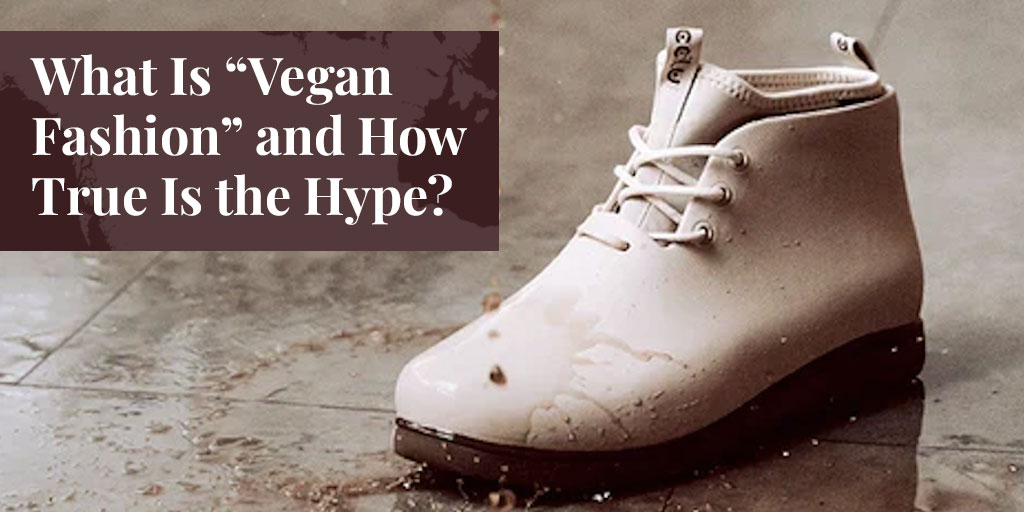
These vegan shoes from Japanese company Ccilu are made of recycled plastic bottles and spent coffee grounds!
Animal activists want to drive all animal users out of business, so it pays for the fur trade to keep abreast of their latest tactics. One now being pushed hard is "vegan fashion", but what exactly is it? And how true is the hype? Does it really save animal lives, as proponents claim? And is it really more sustainable than alternatives?
First up, what qualifies as vegan fashion?
There is no strict definition, but the general idea is that no animals can be killed or harmed in any stage of its production. So it's much like a vegan diet, except that you keep it in your closet.
But there is one important difference. Vegans only eat plants, but if you think they only wear plants, think again. Vegan fashion also contains lots of synthetics made from oil.
The most popular plant fibre with vegan fashionistas (and everyone else, for that matter) is cotton, but there are a lot of other choices. Some are familiar, like linen, hemp, cork and rubber, while others are obscure, like ramie, banana leaves, mushrooms and even coffee grounds!
Then there are semi-synthetics derived from plants, like bamboo rayon, viscose from wood pulp, and modal (made from the pulp of beech trees).
And then there are all the petrochemical synthetics vegans can wear with a (supposedly) clear conscience, like polyester, spandex, nylon, PVC and acrylic. Vegans say they prefer if their synthetics are recycled, not virgin (new), but since most recycled synthetics contain some virgin product for added strength, it's hard to know if they're getting what they want.
As for materials that are off-limits, some are obvious, like leather, fur, wool and silk. But others require vigilance if they are to be avoided.
For example, the glue used in shoes and handbags normally contains collagen derived from animals. So vegans must seek out synthetic alternatives, even if there are health risks associated with making and using them.
They must also avoid screenprinting inks containing gelatin from cows and pigs. A popular synthetic alternative is plastisol, but again, vegans must look past the health risks of the phthalates usually found in plastisols.
And a minefield for vegans is buying cosmetics and personal hygiene products. Anything with honey, lanolin or keratin is out, as are soaps, shampoos, shaving cream and lotions containing stearic acid from animal fat. If your skin moisturiser contains glycerol, beware that the most common source is tallow, a rendered form of beef or mutton fat.
So Does Vegan Fashion Really Save Animals?
The main claim made for vegan fashion is that no animals are killed or harmed in its production. At first glance this sounds logical, but the claim does not stand up to scrutiny. It would be accurate to say that no animals are bred and killed to produce vegan fashion, but plenty of animals still die.
But before we start pointing fingers at who kills most animals, we need to recognise that there are different ways of counting animal lives, depending on our biasses.
In theory, we should give equal weight to all lifeforms, such that swatting a fly is equal to slaughtering a cow. In practice, though, we never do this. We prioritise, valuing some species over others.
Most of us are class-biassed (mammals trump reptiles, for example, and insects always come last). We prefer benign herbivores to carnivores that might eat us. Beautiful animals come before ugly ones. Or if you're a conservationist, an endangered native species always beats a plentiful invasive one.'
And all these biasses give rise to paradoxes that can be hard to reconcile, like self-proclaimed "animal lovers" who feed their pet dogs the meat of other animals, bathe them to kill ticks and fleas, deworm them, and give them vaccines tested on other dogs in labs.
Vegans, of course, have their biasses too, so when they say vegan fashion saves animal lives, which animals do they actually mean? All animals? No. Above all, they mean barnyard animals that are purposely bred to provide food and clothing.
If their calculations were to include all animals, would switching to vegan fashion really save lives? It's highly unlikely, and in fact the death toll would probably rise.
Killer Cotton
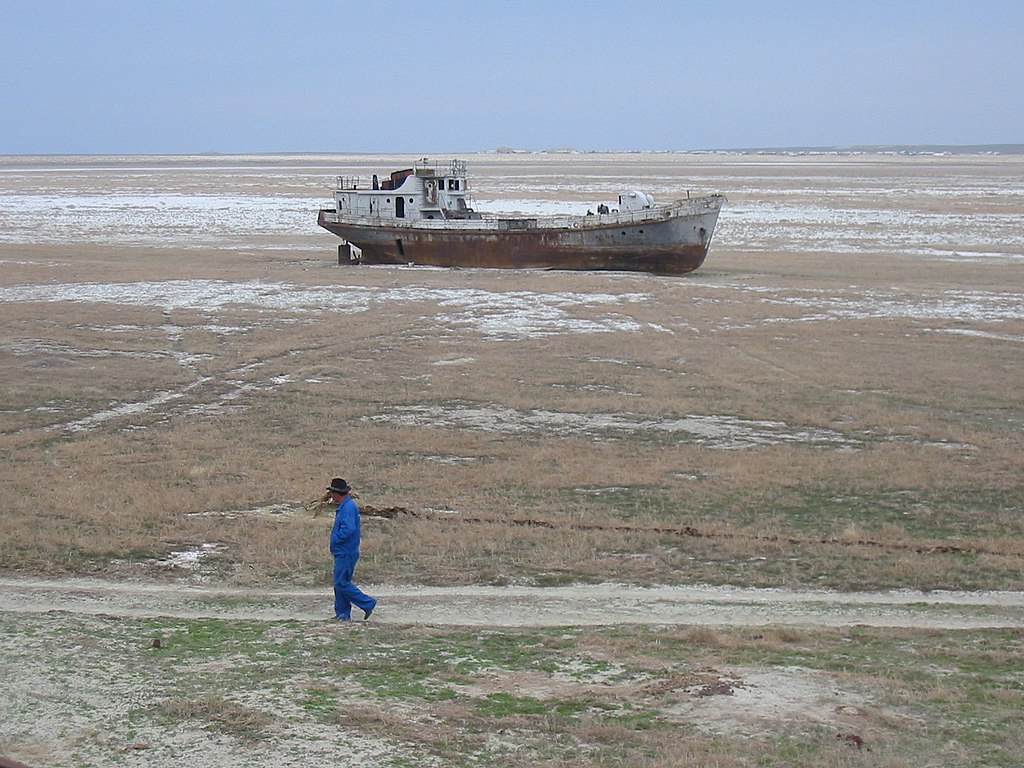
The Aral Sea is a glaring example of the environmental damage growing cotton can cause. Photo: Staecker.
Now let's take a closer look at what are probably the two most common materials in vegan fashion, cotton and polyester, and ask how animal- and environment-friendly they really are.
Everybody loves wearing cotton, but we also know that growing it – especially by traditional methods – is punishing on the environment.
The trouble starts the moment natural habitat is destroyed and replaced by a monocultural plantation. Then the crop is notoriously thirsty, often requiring far more water than can be supplied by rain alone. And then there's the heavy use of pesticides. All of these factors exact a toll on animal life, as well as damaging the environment in other ways.
Much of the killing is intentional, as farmers wage war on the myriad insects that cotton attracts. Bollworms, boll weevils, mirids, aphids, stink bugs, thrips, spider mites – the list is long.
And once the insecticides have fulfilled their purpose, they don't stop killing, or even stay within the confines of the plantation. They drift on the wind, and wash into waterways. Birds, lizards and amphibians die when they eat insects or seeds that have been sprayed, or mistake insecticide granules for food. Fish die when insecticides enter rivers. Pollinators like bees die too, often resulting in lower crop yields.
Genetic modification of cotton is helping reduce the need for insecticides, but there's still a long way to go. Meanwhile, so-called organic cotton, which uses far less in the way of synthetic fertilisers and pesticides, still only accounts for 1-2% of global cotton production.
Other unintentional deaths occur when water supplies are mismanaged, harming or even destroying surrounding habitat. To appreciate just how badly things can go wrong, look at Central Asia's Aral Sea – or what's left of it. Once the world's fourth-largest lake, tributaries were diverted to irrigate crops, mainly cotton, and most of the sea just vanished. Billions of animals surely died, and populations may never recover, including 20 local species of fish now thought to be extinct.
In short, if we all ditched leather, wool and fur tomorrow, and increased cotton production to fill the shortfall in clothing materials, the total number of animal lives lost would certainly rise.
Plastics Are No Better
Synthetic materials made from oil have revolutionised the fashion industry, but the environmental cost has been huge. Photo: Genghiskhanviet.
So how about the other staple material of vegan fashion, polyester? Its credentials as a clothing material are impressive. It's cheap, durable, wrinkle-resistant, stretchy, lightweight, quick-drying, it breathes and it wicks moisture. No wonder it accounts for at least half the world's clothing, and dominates fast fashion and sportswear.
But like cotton, it's also terrible for the planet. It's made from non-renewable oil which must be extracted from the ground. The manufacturing process leaves a big carbon footprint – up to 40% of the fashion industry’s total CO2 emissions. When washed, polyester garments release microfibres that pollute the oceans and are now turning up in the food chain, even in drinking water. Polyester is also part of the bigger problem of plastic pollution in general. A widely cited estimate is that plastic pollution kills 100,000 marine mammals and turtles, and a million seabirds, every year. And of course, these plastics don't biodegrade.
In their defense, vegan fashionistas say that a lot of the polyester they wear is recycled, which means it's actually good for the environment, "sustainable" even. But this is essentially an exercise in denial.
Furthermore, recycling polyester cannot possibly be sustainable since it is inherently dependent on a nonrenewable resource. All it does is extend the life of polyester already in circulation. Plus, limitations in current recycling technology mean that recycling polyester actually perpetuates demand for virgin polyester. Each time polyester is recycled, it loses strength, and this problem is rectified by mixing in virgin material. And when polyester is blended with other fibres (typically cotton), recycling is all but impossible. Last but by no means least, just like virgin polyester, recycled polyester still sheds microfibres and does not biodegrade.
Just to confuse consumers even more, companies producing and using petrochemical-based synthetics now routinely face accusations of greenwashing – making false claims about the environmental friendliness of their products.
It comes as no surprise when animal activists engage in greenwashing, since they have never let the truth get in the way of a good story. So if they tell you wearing recycled soda bottles will reduce global warming, you can believe it or not.
More troubling are apparent efforts by the fast-fashion industry to improve its public image. Having faced a storm of criticism in recent years for various practices, the industry is now desperate for a makeover, which includes casting petrochemical synthetics in a better light.
But now the media, consumer protection groups, and others are asking tough questions.
Matters came to a head last June, when the New York Times ran an in-depth article entitled "How fashion giants recast plastic as good for the planet". Renaming products is just one way, the article says. For example, fake leather used to be called "pleather", a clear indicator of its plastic origins, typically polyurethane. But now it's called "vegan leather", a change the NYT calls "a marketing masterstroke meant to suggest environmental value."
In critics' crosshairs is the controversial Higg Index, launched in 2012 by the Sustainable Apparel Coalition (SAC), a nonprofit group that includes major fashion brands and retailers, and the US Environmental Protection Agency. Intended to rate the environmental impact of various fabrics used in clothing, the Index "is on its way to becoming a de facto global standard," says the NYT.
But hold on, the article continues. The Index "strongly favors synthetic materials made from fossil fuels over natural ones such as cotton, wool and leather. Now, those ratings are coming under fire from independent experts as well as representatives from natural-fiber industries who say the Higg Index is being used to portray the increasing use of synthetics as environmentally desirable despite questions over synthetics’ environmental toll."
In particular, critics say the Index doesn't accurately reflect the full life-cycles of synthetics, including harmful emissions during production, how much ends up in landfills or incinerators, and microfibres polluting the oceans.
While the debate will continue to rage about how best to clothe 8 billion humans, the simple truth is that all currently available alternatives have their downsides. They all result, directly or indirectly, in the deaths of animals, and leave environmental footprints of varying size.
But since the two major claims being made for vegan fashion are simple, let's try to answer them in simple terms:
Does vegan fashion save animal lives? If enough people were to wear vegan fashion, and especially if they were to adopt a vegan diet too, fewer barnyard animals would be bred. So in that sense, yes, vegan fashion has the potential to save the lives of domesticated species like cows, pigs and sheep. But if all animal lives are given equal weight (i.e., a snake or boll weevil is equal to a cow), this saving would be more than offset by the loss of animal life caused by converting more land to plant agriculture.
As for petrochemical synthetics like polyester, it is now universally recognised that their usage is harmful to the environment, including wildlife. So even if your polyester blouse is made from recycled soda bottles, it may slow the production of virgin polyester, but in the long term it offers nothing in the way of a solution.
Is vegan fashion more sustainable than alternative choices? There is almost no basis for this claim, as vegan fashion currently exists.
Noble efforts make the headlines regularly as innovative companies strive to develop more sustainable materials and methods of producing them. But we're not there yet. Which means that vegan fashion will continue to rely on crops like cotton, which are harmful to the environment, and petrochemical plastics like polyester, which are not only harmful but also the antithesis of sustainable.
***
To learn more about donating to Truth About Fur, click here.
In his 2012 book The Righteous Mind: Why Good People Are Divided by Politics and Religion, social and cultural psychologist… Read More
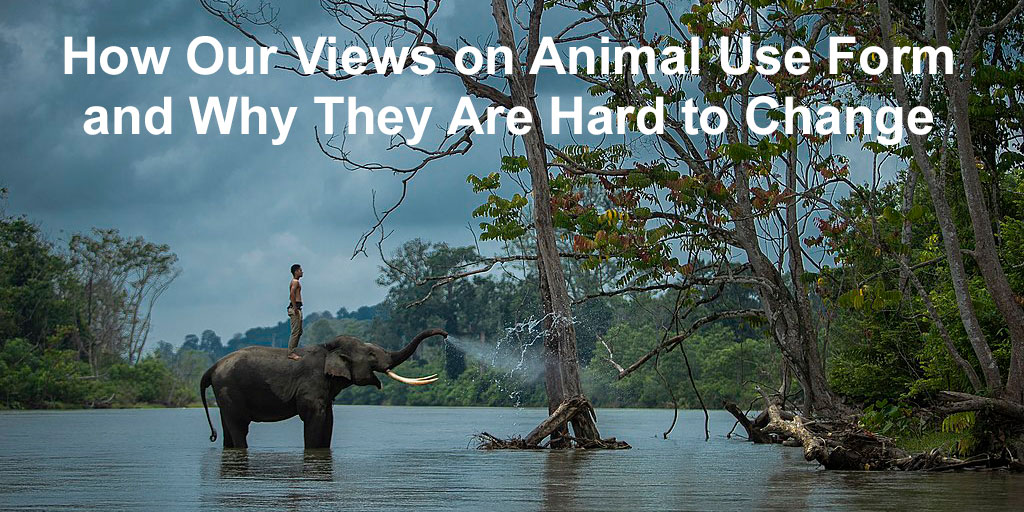
Jonathan Haidt uses the metaphor of an elephant and its rider for how we decide whether something is good or bad. Photo: Hendrapictures, CC BY-SA 4.0, via Wikimedia Commons.
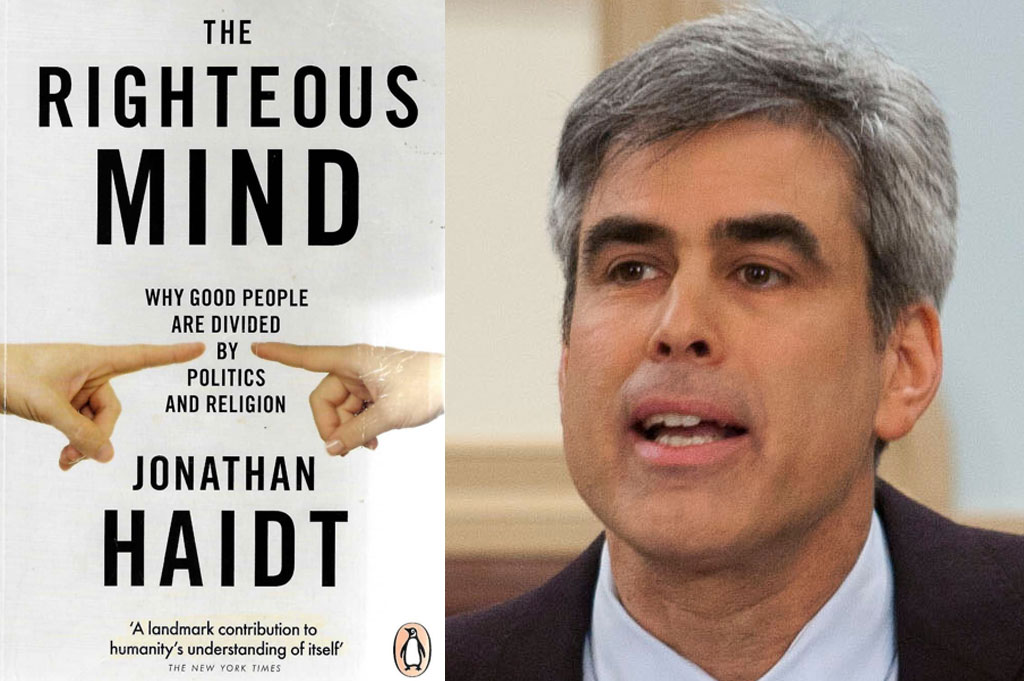
In his 2012 book The Righteous Mind: Why Good People Are Divided by Politics and Religion, social and cultural psychologist Jonathan Haidt explains why people hold such wildly differing beliefs and why others’ views seem so illogical. Understanding his arguments may be key to reversing the decline in support for various animal uses seen in urbanised societies, and ensuring industries such as the fur trade still have a future.
Ethics (morality) is about the way in which people want to act. Ethics invite us to do the right thing. That there is not always agreement about what is right in a particular case, as for example using animals for food or fur, is due to the fact that morality is partly innate, and partly learned and influenced by the environment (urban or rural) in which someone grows up.
According to recent analyses, our ethical behaviour is based on a matrix of six moral modules that have arisen in our brains during our evolution. The trapper in the North, the cattle farmer in the countryside, and the animal activist in the city centre of a Western country, all have a moral vision based on a moral matrix formed by these six universal modules in their brains.
Every society builds its own moral matrix because its moral values, claims, and institutions rest differently on each of the six moral foundations. The moral matrix built in the brain of young people in a hunting culture will be different from those in an agricultural culture, or in a modern industrialized culture where most people live in cities completely distanced from nature. That is why our judgment of whether something is good or bad is partly connected with the human and world vision presented in our environment. The differences in sensitivity to the various six moral matrices explain the different moral visions that individuals take on certain social issues within the same society.
Photo: Miller Center of Public Affairs flickr page, Charlottesville, VA, CC BY 2.0, via Wikimedia Commons.
This moral matrix in our brain produces quick, automatic gut reactions of sympathy or disgust when certain things are observed. These then lead to a judgment as to whether something is good or bad. First comes the feeling, then comes the reasoning.
Haidt describes this by using the metaphor of an elephant and its rider. The elephant represents our automatic intuitions. This is about 99% of our mental world, the part that has been around for a very long time where the automatic processing of information, including emotions and intuition, happens. Evolutionarily speaking, the rider has only recently joined.
When Homo sapiens developed the capacity for language and reason during the last 600,000 years, the automatic processing circuits in our brains didn’t suddenly stop and allow themselves to be taken over by reason. This ensures the controlled processing of information and our “Reason why something is good or bad”. The rider reasons afterwards about what the elephant felt.
The rider (the language-based reasoning) acts as the elephant’s spokesperson, and is very good in making post hoc justifications for everything the elephant has felt. Within a fraction of a second of us seeing or hearing something, our elephant already starts to lean in a certain direction, and this tilt to a particular side influences what we think and say next. By leaning to one side, the rider has little or no interest in the other side of the story. After all, his function is not to find the truth, but to seek arguments to explain why the elephant leans to one side.
The metaphor of the elephant (automatic intuition) and its rider (reasoning), stating that the rider is at the service of the elephant, does not mean that we never question our intuitive judgments. The main reason we can change our minds about moral issues is through interaction with other people. After all, while we are very bad at finding evidence that undermines our own beliefs, others are happy to do this for us, just as we are quite good at finding fault with the reasoning and beliefs of others.
If we want other people to be open to our side of the story, we must first tilt their elephant to the other side. This is not possible by using rational arguments alone. We must look for something emotional, something that acts on their gut feeling, that makes their elephants lean to our side and opens their minds to our arguments. Animal activists, like all populists, are very strong on responding to the gut feeling of the people and make sure that the elephant leans to the side they want. Lies and deceit are not shunned by these people. Just think of the notorious staged video, in 2005, of a raccoon dog being skinned alive for its fur.
The animal-use sector has a much harder time appealing to people’s gut feelings. In an urbanized society, more and more people are developing a moral matrix that is intuitively negative for this sector, in large part because of propaganda from animal activists. The fur trade, for example, has endured this negative propaganda for fully 40 years. The impact of this propaganda on the general public can be explained in the same way as advertising: tell someone a thousand times that food X is healthy, and after a while he or she will be intuitively convinced of that fact. Therefore, it will be vital for the fur trade to find that emotional gateway to open the elephant to our arguments.
Fur checks all the boxes: production is sustainable, animal welfare standards are high, businesses are small and artisanal, and the end product is natural, long-lasting and biodegradable! But as long as we cannot hit the gut feeling of the general public growing up in the city, our rational arguments will fail.
What Are the Six Moral Modules, and Which One Guides the Animal Rights Movement?
Jonathan Haidt summarises his six moral modules as follows:
“1. The care/harm foundation: evolved in response to the adaptive challenge of caring for vulnerable children. It makes us sensitive to signs of suffering and need.
“2. The fairness/cheating foundation: evolved in response to the adaptive challenge of reaping the rewards of cooperation without getting exploited. It makes us want to see cheaters punished and good citizens rewarded in proportion to their needs.
“3. The loyalty/betrayal foundation: evolved in response to the adaptive challenge of forming and maintaining coalitions. It makes us trust people that are team players and hurt those who betray us or our group.
“4. The authority/subversion foundation: evolved in response to the adaptive challenge of forging relationships that benefit us within social hierarchies. It makes us sensitive to signs of rank and status and to signs of other people behaving or not behaving properly, given their position.
“5. The sanctity/degradation foundation: evolved in response to the adaptive challenge of the omnivore’s dilemma, and then to the broader challenge of living in a world of pathogens and parasites. It makes it possible for people to invest objects with irrational and extreme values which are important for binding groups together.
“6. The liberty/oppression foundation which makes people notice and resent signs of attempted domination. It triggers an urge to band together to resist or overthrow bullies and tyrants.”
Since the sensitivity to each of these six moral modules is not the same for everyone, everyone possesses their personal intuitive moral matrix. For example, there are people who are extra sensitive to the caring/harm, fairness/cheating and liberty/oppression foundation, but usually little sensitive to the loyalty/betrayals, the authority/subversion and the sanctity/degradation foundation. There are also those who have a more spread sensitivity on all six moral foundations, and whose sensitivity for the first three foundations is less pronounced as compared to the first group.
There are also people whose moral matrix is triggered on almost only one module. These then become moral extremists who have a principled ethic. The convinced animal activist is such a person. Everything is reduced to one principle and everything else is irrelevant in their eyes.
The ideologically driven animal activist has a very pronounced sensitivity to the liberty/oppression foundation and not, as we might expect at first sight, to the care/harm foundation. The latter is the case with people who are committed more to animal welfare and who believe that people should be allowed to use animals for human purposes.
In the first sentence of the introduction to his 1975 book Animal Liberation: A New Ethics for Our Treatment of Animals, Australian philosopher Peter Singer writes: “This book is about the tyranny of humans over animals.” Further in his introduction, he states that he “does not feel any love for animals”, but that he wants to end oppression and exploitation, wherever they may occur.
The animal rights activist plays with the general public on their care/harm foundation but their own motivation is the liberty/oppression foundation and their goal is therefore an end to the use of animals for human purposes, not animal welfare. Animal welfare is just the lubricant used by this movement to help it in its attempt to force its moral vision and way of life upon us.
The strength of this animal rights movement is the moral conviction that they are fighting a right fight.
However history shows that moral convictions can have enormous practical consequences. A recent example is Marxism. Marxists saw their beliefs not merely as personal views, but as absolutely certain scientific knowledge. Their socialism thus became “inevitable” and they had the future on their side, as it were. “History is on our side,” they liked to say. Their enormous self-confidence made them very intolerant of dissenters. Seventy years after Karl Marx’s death, about a third of humanity lived under regimes that called themselves “Marxist”. Instead of the expected ideal and just society, Marxist rule produced poverty and tyranny. When it became clear that the facts did not agree with Marx’s theories, so-called “revisionism” arose. Several Marxist thinkers tried to match Marx’s theories with the facts — and the facts with Marx’s theories.
Marxism was a stunning phenomenon because its ideas triumphed while on a practical level it failed permanently and the societies it spawned collapsed or eventually turned away from their Marxist policies.
In this area I see parallels with the animal rights movement and its leaders. They are also firmly convinced that they are right, and regard animal rights as a logical historical extension of rights for ethnic minorities and women, although this comparison does not hold. They also claim that acceptance of animal rights is “inevitable”; it is only a matter of time before anyone who disagrees sees the error of their ways. They also claim that their ideology is scientifically substantiated. And they, too, often adopt an intolerant attitude towards philosophies of life that do not fit their needs. Their views on animal rights are not open to discussion. The appearance of being open to collaborating with others is only part of a deliberate strategy to create a society free of all animal use.
The animal rights movement calls its own principled statement – that animals have the right to be left alone and live freely and undisturbed – the only morally correct position. To live up to this statement, it must curb the freedom of the human animal. Freedom of choice, inherent in being human, must be limited by law to the choice of those who claim to defend the freedom of all animals!
Wanting to apply the principle of moral equality also to beings who have no morality leads to absurd situations and takes us far from reality. It is very easy to point to an animal from a privileged situation and say, “We are not going to use that anymore”, but all things considered, such a method is worthless.
***
To learn more about donating to Truth About Fur, click here.
On November 5, Lana Popham, British Columbia’s Minister of Agriculture, Food and Fisheries, announced that the province “is beginning a… Read More
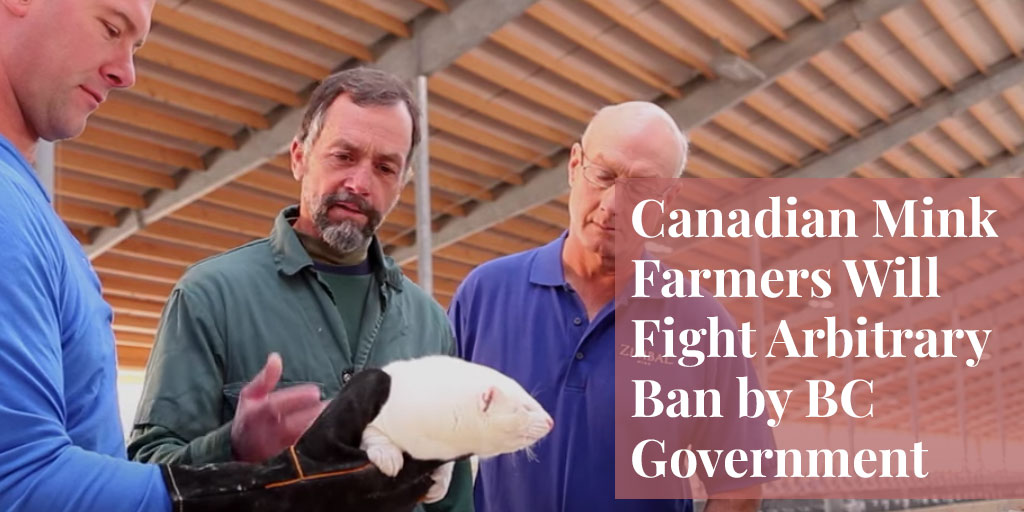
Dr. John Easley (centre) says the arbitrary ban is “not supported by science.” Image: Zimbal Mink Farm.
On November 5, Lana Popham, British Columbia’s Minister of Agriculture, Food and Fisheries, announced that the province “is beginning a process to phase out B.C.’s mink-farming industry due to ongoing public-health risks associated with COVID-19.” But one of North America’s most respected veterinary experts has denounced this arbitrary ban as an “overreaction” that is “not supported by science”.
“The British Columbia government’s declaration to end the livelihood of these farm families does not seem to be supported by the current scientific knowledge and appears to be an overreaction to a situation with very limited health risk to the general human population,” says Dr. John Easley, director of research for Fur Commission USA. (See his full statement, below.)
The government’s decision seems especially unjustified now that a new vaccine has been developed to protect mink from the Sars-CoV-2 virus, he says.
While the Sars-CoV-2 virus has been detected on mink farms in many countries over the past 18 months, “the vast majority of these infections have been self-limiting, and posed very limited risk to the caretakers of the livestock,” he continues. No Variants of Concern have developed on mink farms, according to the World Health Organisation.
Most viral mutations are species-specific in their pathology, so the virus circulating in the human population – especially the unvaccinated population – presents by far the greatest risk to produce a Variant of Concern. “So, if the governmental agencies’ goal is to reduce the risk of a new Variant of Concern being developed, why haven’t they already mandated that all the citizens be vaccinated?” asks Dr. Easley.
“And how are they going to address the risk due to the domestic cat population’s susceptibility to the virus – or all the other animal species [including hamsters, ferrets, and white-tailed deer] that we now know can be infected and reproduce the virus?”
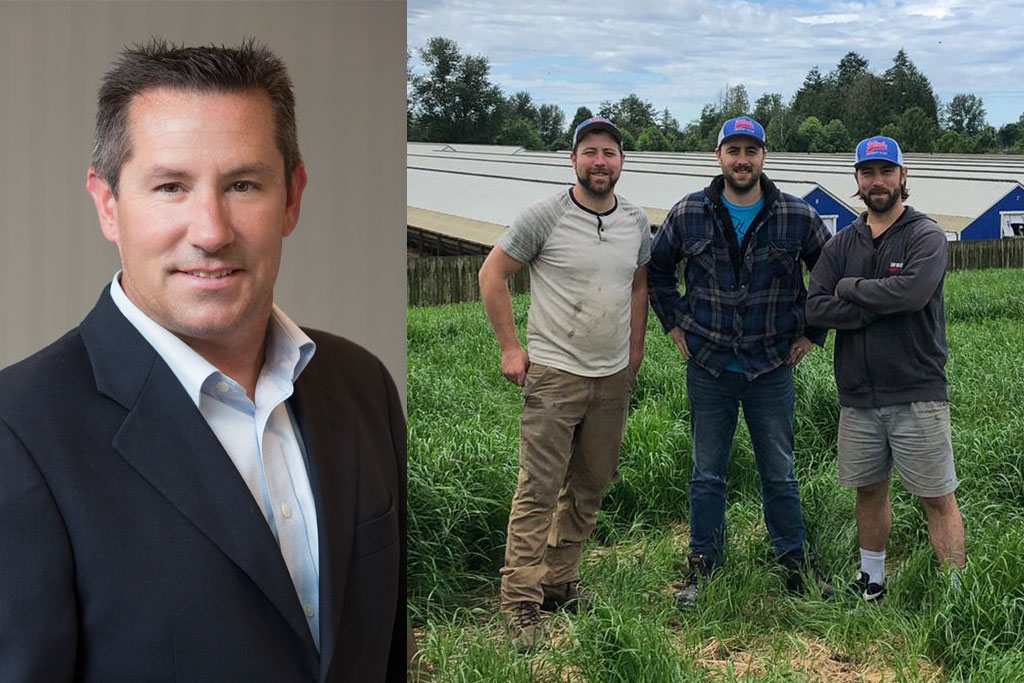
“Since we learned that mink can contract Covid-19 from humans, Canadian mink farmers have worked with government agencies to implement strict biosecurity protocols,” says Rob Bollert, a mink farmer and president of the Canada Mink Breeders Association (CMBA). “As proof of how conscientiously these measures have been applied, the Sars-CoV-2 virus has been detected on only three of our farms – just 5% of the 60 Canadian mink farms situated across the country.”
“This arbitrary and radical decision by the BC government is simply devastating for farm families,” says Bollert. “It takes generations of work, including excellent nutrition and care as set out in Canada’s comprehensive codes of practice, to develop the quality of mink that Canada is famous for – and these bureaucrats are destroying all that effort, without any real scientific justification. With only one Sars-CoV-2 positive farm in BC at the present time, this will mean that farmers will be forced to kill perfectly healthy herds of animals. This is unprecedented.”
“We know that animal activist groups in BC have been campaigning against mink farming for years, as the thin edge of the wedge in their efforts to eliminate all animal agriculture. They have been fanning Covid fears to further that agenda. But it is shocking that the BC government would surrender to activist pressure tactics, rather than basing policy on science and proven good practice,” says Bollert.
In the US, Sars-CoV-2 has been detected on 16 farms in four states, but the Centers for Disease Control (CDC) and the US Department of Agriculture have not recommended culling healthy animals or banning mink farms. Dr. Anthony Fauci, director of the National Institute of Allergy and Infectious Diseases in Maryland and Chief Medical Advisor to the US President, has stated that, with proper biosecurity measures in place, the CDC considers the Covid risk that mink farms represent for the general public to be low.
“Pandering to Animal Activists”
Matt Moses, president of the Nova Scotia Mink Breeders Association, is non-plussed. “BC mink farmers have implemented all the security measures requested.”
“When cases of Swine Flu or Avian Flu emerged in this country, the government didn’t shut down pork or chicken production – although that’s exactly what animal activists were calling for,” says mink farmer Matthew Moses, president of the Nova Scotia Mink Breeders Association and past president of the CMBA. “Instead, government agencies worked with producers to responsibly manage the situations.”
“BC mink farmers have implemented all the security measures requested by the BC health and agriculture officials, but it looks like the BC government in this case is more interested in pandering to animal activists. Is it because we are a very small sector, with only nine farms in BC? Is that why they are ready to destroy the work and livelihoods of these farm families?” asks Moses.
“The proof that the BC government does not really believe mink farming to be a public health risk is the fact that they are permitting producers to keep live mink on their farms for another 18 months, and to sell or transport them to other provinces,” states Moses.
“The BC government’s knee-jerk decision is especially disappointing because mink fur is a sustainably produced, long lasting, and biodegradable, natural clothing material – exactly what environmentalists are saying we should be choosing instead of petrochemical-based, throwaway, ‘fast fashion’,” says Bollert.
“We are looking at all our options to fight this arbitrary decision. Animal activists are saying openly that this is just the first step in their campaign to eliminate all production of animal products, including meat and dairy. This is a wake-up call for all agriculture, and for everyone who believes that government policy should be based on science, not activist propaganda.”
* * *
Response to BC government’s arbitrary ban on mink farming, by Dr. John Easley, Director of Research, Fur Commission USA (November 5, 2021)
https://www.youtube.com/embed/5809NZNzCDM
This is an unfortunate decision that doesn’t seem to be supported by the experience and knowledge we have gained during the last 18 months since the North American farmed mink industry started to address the mink’s susceptibility to the Sars –CoV-2 virus.
Over that period many counties have experienced infections in their farmed mink operations and the vast majority of these infections have been self-limiting and posed very limited risk to the care takers of the livestock. No Variants of Concern have ever been developed due to the viral replication in mink according to the WHO. Many viral mutations are species specific in their pathology; so, the virus circulating in the human population, especially the unvaccinated population, is by far the greatest risk to produce a Variant of Concern that would put the general population at risk. So, if the governmental agencies’ goal is to reduce the risk of a new Variant of Concern being developed, why haven’t they already mandated that all the citizens be vaccinated? How are they going to address the risk due to the domestic cat population’s susceptibility to the virus and/or all the other animal species that can be infected and reproduce the virus, thusly, potentially producing a new Variant of Concern?
The North American farmed mink industry has worked collaboratively with many governmental agencies to develop effective biosecurity protocols for the farms and their employees. They have also supported the development and the utilization of a Sars-CoV-2 vaccination for the mink. This vaccine was granted experimental approval by USDA and was tested in 90% of the mink in the United States, over 3.2 million doses were utilized. It was proven to be extremely safe. Since the enactment of the enhanced farm biosecurity measures, the farm animal caretakers being vaccinated and the mink themselves being vaccinated, there have been no new diagnosed farm infections in the USA.
The British Columbia government’s declaration to end the livelihood of these farm families does not seem to be supported by the current scientific knowledge and appears to be an overreaction to a situation with very limited health risk to the general human population.
John Easley DVM Director of Research Fur Commission USA
Animal welfare and sustainability are both commendable goals for any company’s strategic plan, but they’re also like chalk and cheese…. Read More
Animal welfare and sustainability are both commendable goals for any company’s strategic plan, but they’re also like chalk and cheese. They’re unrelated, which means you don’t advance one by advancing the other. Yet these days, whenever a designer, brand or retailer announces it is dropping fur supposedly for animal welfare reasons, it also claims this will make it more sustainable. This is totally illogical, and they must be called out for it.
Worse still, the deceit appears to be intentional, not just the result of lazy thinking. In a conscious and cynical bid to associate themselves with two of the hottest buzzwords in marketing today, companies are pitching the message, “We believe in animal welfare and sustainability, so we won’t be using furry animals anymore. (Just don’t ask about all the other ones.)”
So why should the fur trade cry “Foul”? Because sustainability is the strongest argument in favour of fur, and we need to defend it against misuse. Now the debate is being twisted and co-opted to make it appear that fur is the very opposite of sustainable.
First let’s look at sustainability and animal welfare separately, and then see how some sneaky companies pretend they are related.
Sustainability Is One Thing …
Just about every business today claims to be striving for greater sustainability, and with good reason. Not only is it good for the planet, it also sells! It’s something customers want to hear. So even if your business is not sustainable today, at least say you are trying, and promise some vague delivery date like 2030.
For a few lucky industries, including the fur trade, sustainability has already been achieved. Historically, it wasn’t always the case, as some wild species were over-harvested. But with the advent of fur farming and a raft of regulations covering harvest sizes and trade, the modern industry has become a model of sustainability.
Here are its main credentials:
Furbearers, whether trapped or farmed, are a renewable natural resource.
Fur is fully biodegradable, even after processing, no matter what animal rights groups claim.
A fur garment can last for decades, or be restyled as fashions change. It is the complete opposite of wasteful “fast fashion”.
These credentials look even stronger when you compare real fur to fake fur made from non-biodegradable, non-renewable oil.
… Animal Welfare Is Another
Animal welfare is a different issue entirely. While sustainability is concerned with quantifiable inputs such as reproduction rates and environmental impacts, animal welfare deals with the quality of life and death of the animals we use.
It’s difficult to explain in logical terms how companies bundle animal welfare and sustainability together, because the “logic” they employ is false. They first present an erroneous argument, hope we don’t notice, and then use this argument to justify their business strategy. It’s like saying, “2 + 2 obviously equals 5, we can all agree on that. So now let’s focus on that number 5.”
The false logic they want us to fall for is typically along the following lines. “Treating animals well will result in a kinder and gentler world, which we all want to live in. That world must also be sustainable. Therefore, being kinder to animals is integral to ensuring the future sustainability of our planet. And since it’s impossible to achieve an acceptable level of welfare in the fur trade, the most sustainable option is not to use fur at all.”
QED: Fur is unsustainable.
And when you’ve finished wrestling with the twisted logic, take special note that companies are using it only to justify dropping fur. Not leather. Or feathers. Or any other animal products. For these, it’s business as usual. In other words, the level of animal welfare in producing crocodile handbags or goose down is acceptable, and therefore these products are sustainable. What?
Case Studies
Now let’s look at three real-life examples of fashion companies that have dropped fur, and see the knots they tie themselves in to justify it.
Gucci: In 2017, CEO Marco Bizzarri shocked the fashion world by announcing that his company would be dropping fur. He also announced that Gucci had signed on to the Fur Free Retailer program of the Fur Free Alliance, a group that, in its own words, wants to end the fur trade by “raising the serious animal welfare issues related to fur farming and trapping.” The Alliance expresses no interest whatsoever in promoting sustainability. But still, Bizzarri described Gucci’s move as demonstrating “our absolute commitment to making sustainability an intrinsic part of our business.”
The remarkable thing was that only the fur trade challenged Bizzarri to explain how jumping in bed with an animal rights group and dropping fur would make Gucci more sustainable. The media were all over the dropping fur part, but not one journalist questioned the logic. Why was real fur unsustainable? Was fake fur more sustainable? And why was Gucci not dropping leather, exotic skins and feathers too?
So in one fell swoop, Bizzarri framed Gucci as loving both animals and the planet, and he got away with it.
Nothing has changed since either. If you want to know more about Gucci’s stance on animal welfare, the go-to document is titled – wait for it – Gucci Sustainability Principles! This 21-page document on sustainability refers to animal welfare no fewer than 40 times. And there are three whole pages devoted to the “Kering Animal Welfare Standards” (Kering being Gucci’s parent). Why these in-house, self-serving animal welfare standards belong in a document on “sustainability principles” is not explained, but clearly we are supposed to accept that animal welfare is an integral part of sustainability.
Canada Goose: Known for its iconic performance parkas with coyote trim, Canada Goose is now in a tricky spot PR-wise, largely of its own making. For decades, it was a strong advocate of fur as a sustainable natural resource – an industry leader, in fact. Indeed, a page still on its website but that will presumably disappear soon, states: “We remain committed to the functionality and sustainability of real fur.” Then last June it announced that it was dropping fur.
Observers were in no doubt that this was a response to relentless pressure from animal rights groups, but CEO and president Dani Reiss wasn’t about to admit this. Instead he dug himself a hole, saying, “This decision was driven by our commitment to sustainability …”
So the official line is that Canada Goose is dropping fur voluntarily, as part of its ongoing commitment to sustainability, and you can believe that if you want. But the really tricky part is that it can’t actually say fur is unsustainable, because it’s been saying the polar opposite for years. Which leaves us in the odd position of having to turn off our brains and accept that while fur is sustainable, “fur-free” is more sustainable.
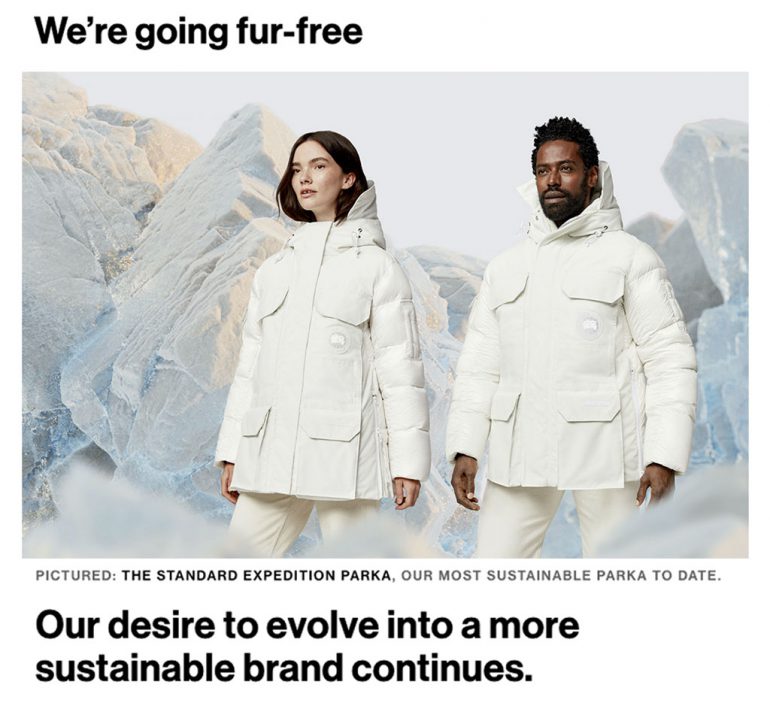
And here’s what it looks like in practice:
(Note: Truth About Fur has removed a small amount of white space for layout reasons only. Click to see the original.)
This new page on the Canada Goose website sports the headline, “We’re going fur-free”, unquestionably an animal rights slogan with no connection to sustainability. But the subhead reads, “Our desire to evolve into a more sustainable brand continues.” No matter what explanation Canada Goose may have for this, it is impossible for a visitor to this webpage not to connect these two ideas. The message, intentional or not, is clear: Canada Goose is going fur-free BECAUSE it is more sustainable.
Mytheresa: And this quote says it all – no further explanation required. This August 26, the Munich-based luxury retailer announced it would not sell fur beyond 2022. Said CEO Michael Kliger, “At Mytheresa, we believe that sustainability is an important part of our future strategy, and this view is clearly shared by our customers, partners and employees. As we already stopped buying exotic skins in spring 2021, it was clear that going fur-free is the natural next step for Mytheresa. We are proud to be making this change and thank the Humane Society of the United States, Four Paws and the Fur Free Alliance for supporting this policy.”
Each company that drops fur will claim slightly different reasons for equating animal welfare with sustainability, but it always boils down to placing them in the best possible light for consumers. And it looks doubly great if you can check two boxes at the same time!
But it’s all nonsense. Animal welfare and sustainability have as much in common with each other as chalk and cheese. It’s also damaging to businesses that really are sustainable, like the fur trade. And that’s why companies that practice this deception should be called out.
***
To learn more about donating to Truth About Fur, click here.
The recent news that Canada Goose would stop trimming the hoods of its performance parkas with coyote fur by the… Read More
Canada Goose has long been a champion of fur, especially in the North. What now? Photo: Canada Goose Project Atigi.
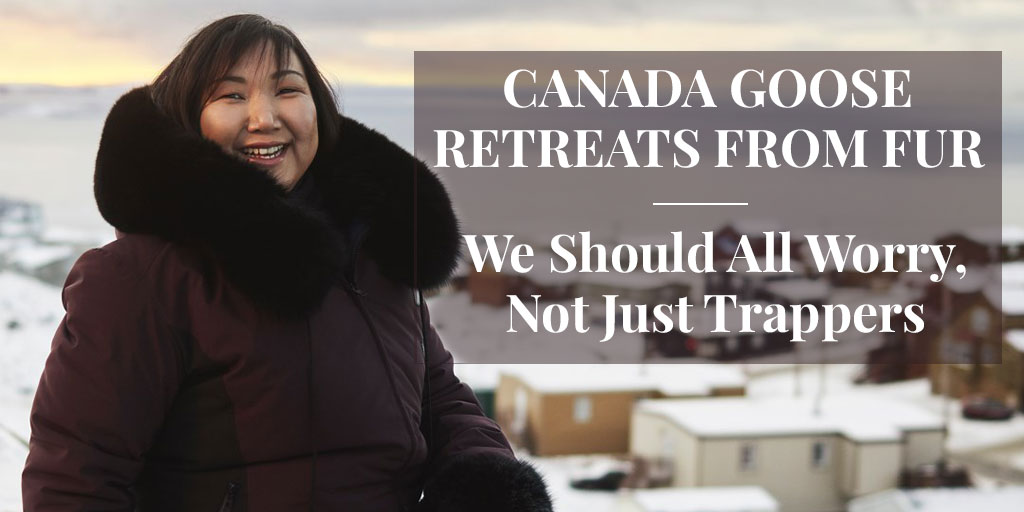
The recent news that Canada Goose would stop trimming the hoods of its performance parkas with coyote fur by the end of 2022 disappointed and angered many trappers and others in the fur trade. But anyone who cares about nature and democracy should be worried too. Here’s why.
First, despite the rhetoric of animal activists and the chatter of some media pundits, it’s clear that the company’s decision to retreat from fur was not driven by consumer trends or evolving societal values. Canada Goose has offered parkas with and without fur trim for years, but thousands of young people continue to choose the iconic coyote ruff – as you can see on the streets of Montreal, Toronto, New York, London, Paris, and other cities as soon as the thermometer dips each fall.
No clothing brand has ever been subjected to such aggressive campaign tactics.
The real reason for Canada Goose’s retreat from fur is clearly because the security, PR, and other costs of responding to relentless protests from animal activists simply became too much to bear. No clothing brand has ever been subjected to such aggressive campaign tactics. Store invasions, social media barrages, even noisy protests in front of CEO Dani Reiss’s home – Canada Goose held strong through it all for more than a decade. But the company’s extraordinary success in making fur cool for hip young consumers singled them out as a primary target for increasingly aggressive activist attacks.
While Dani Reiss always expressed pride about the northern roots of the company his grandfather founded, it no doubt became increasingly difficult to resist activist pressure once a majority share was sold to Bain Capital Private Equity, a US private investment firm, in 2013, and especially when Canada Goose was listed on the New York and Toronto stock exchanges, in 2017. The bean counters were now in control, and the financial and other costs of defending fur presumably became harder to justify as the company targeted new (warmer) markets, and expanded its product line with lightweight, all-season apparel and accessories.
Simply put, Canada Goose did not decide to stop trimming its parkas with coyote fur because consumers didn’t want to buy them. Canada Goose is dropping fur because it was subjected to the equivalent of a mafia protection racket. The activist message was: “Do as we say or we will destroy your business!” And, after years of intense (and costly) pressure, it worked. This should worry anyone who believes in freedom of choice, no matter what you think about fur.
Coyotes now roam North America’s cities, eating pet dogs and cats. Photo: Connar L’Ecuyer / National Park Service.
Another reason why activist bullying tactics should worry the public is that they undermine responsible and successful wildlife conservation policies. As Ontario Fur Managers Federation general manager Robin Horwath explained in media interviews, “Coyote populations are at record levels; they will have to be managed to maintain a balance, whether we use the fur or not … but if activists succeed in destroying the market, it’s tax-payers who will foot the bill.”
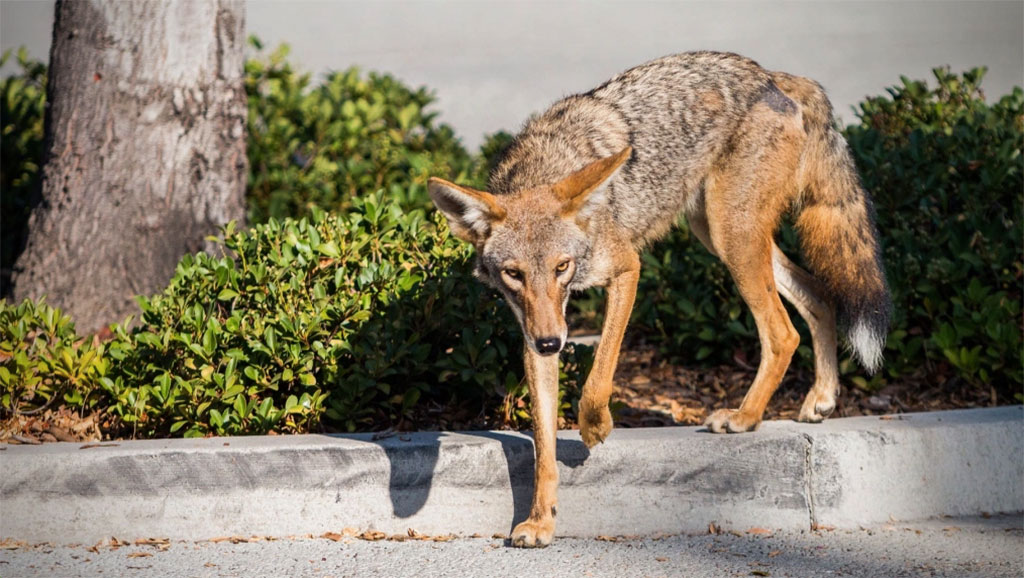
Coyotes are overpopulated across North America; they kill calves and lambs, and are now in our cities – from Los Angeles to Toronto – eating pet dogs and cats, and even attacking people, something rarely seen in the past.
Without a market incentive for trappers, the situation will only worsen. Instead of being valued as a natural resource, to be used responsibly and sustainably, coyotes will again be reduced to the status of “pests”. Governments will again be obliged to offer bounties, as several states and provinces did until not so many years ago. Coyotes will still be killed, but the fur will be wasted. So much for the ethical treatment of animals!
First Nations leaders are also expressing their concern for how Canada Goose’s decision will impact the markets for furs their communities rely on.
Unfortunate Statement
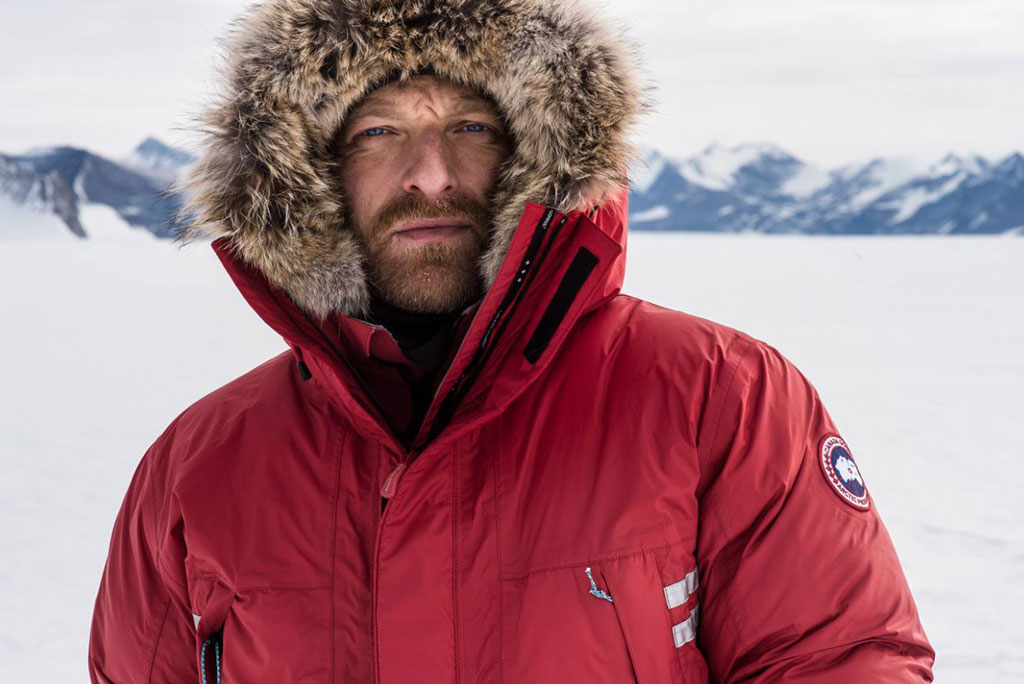
Resplendent in coyote trim, polar explorer Ben Saunders is just one of Canada Goose’s many brand ambassadors. Photo: Canada Goose / Ben Saunders.
Caught in the middle between activist pressure and the trappers they have worked with for decades, it should be noted that the media statement issued by Canada Goose about its new policy carefully avoided any negative comment about fur. Fair enough. It is unfortunate, however, that it did include a statement from the CEO of Humane Canada, a coalition of SPCAs and other animal welfare groups, claiming that this was “a significant step forward toward building a more humane and sustainable world.”
The use of coyote and other furs in North America is, in fact, an excellent example of the responsible and sustainable use of nature. And there is nothing humane about leaving nature (i.e., starvation and disease) to manage coyote populations. The leadership at Canada Goose knows this. So why was this misleading and provocative Humane Canada statement included in its announcement? We can only guess that Canada Goose is working with Humane Canada to provide cover for its continued use of goose down, which is the core of its business.
In fact, responding to the decision by Canada Goose to drop fur, PETA announced “a moratorium” on protests against its stores, while pledging to work “behind the scenes” to end the company’s use of down. (Can you spell “Protection Racket”?)
Meanwhile, hardly a week goes by when we don’t hear that another major brand or retailer is “going fur free”. It becomes a self-reinforcing cycle, because when Saks, Neimans, Holt Renfrew, and other retailers say they will stop selling fur, there is even less incentive for brands like Canada Goose to continue producing it. If allowed to continue, this vicious circle will also make it more difficult for politicians to resist calls to ban the retail sale of fur products entirely.
SEE ALSO: Progressive politicians should promote fur, not ban it. Truth About Fur.
So what should the fur trade be doing about this? Some people are writing to Canada Goose CEO Dani Reiss to express their concern. We should also be writing to and supporting the brands that continue to use fur, including Rudsak, Kanuk, Mackage, and others.
Most importantly, however, the fur trade must make a huge communications effort to regain control of our own story. We must explain to the public how fur is responsibly and sustainably produced in North America, and why fur is now, more than ever, an ethical choice. We must also sound the alarm about how activist bully tactics are eroding consumer choice, and threatening public health and safety by sabotaging responsible wildlife management. Must a child die from a rabid raccoon bite or being mauled by an urban coyote for the public to appreciate the role trappers play in controlling wildlife populations?
And we must make it personal: it’s time to put the real people of the fur trade – trappers, farmers, craftspeople – at the forefront of this campaign. These are the people whose livelihoods, cultures, and ethics are attacked by increasingly arrogant animal activists. Activist campaigns play on emotions — and in public debate, emotions trump logic — but we have feelings and values too. It’s time we were heard!
***
To learn more about donating to Truth About Fur, click here.
Animal rightists have been badgering the UK government to ban the fur retail trade for years, and with their country… Read More
Animal rightists have been badgering the UK government to ban the fur retail trade for years, and with their country now out of the EU and no longer bound by its laws, the government is seriously considering giving them what they want. Such a precedent would give a major boost to animal rights activists lobbying for similar restrictions in other European countries, and even the US and Canada. So while the UK may not be a major consumer market, it is imperative that anyone who supports the responsible use of animals should now take action to ensure that a UK fur-sales ban doesn't happen.
Of course, it's easy to feel jaded when it comes to the UK, and even write it off as a lost cause. After all, despite a long and noble history of championing responsible animal welfare, this tiny island is now a breeding ground for virulent animal rightists, right up there with California. Plus, few British people wear fur anyway, so does it really matter?
The answer is yes, it matters. Courtesy of its language, its history, the Beatles, and a host of other factors, the UK's influence on global trends is unquestionably profound. If the British decide to ban fur retail sales, animal rights campaigners will surely hold it up as a model for other countries – and their legions of Anglophiles – to follow.
The danger is especially evident when we consider who now has the ear of Prime Minister Boris Johnson. On May 29, he married Carrie Symonds. Who is Ms. Symonds? Well, for one thing she believes that "Anyone that wants to buy fur really is sick." She was also PETA UK's 2020 Person of the Year. And she's sleeping with the PM...
DEFRA Questionnaire
Now for the "good" news. Rather than just diving in head first with a ban, the government's Department for Environment, Food and Rural Affairs (DEFRA) is testing the water thoroughly first. This it is doing by inviting everyone – including foreigners – to partake in a "call for evidence", with a deadline of June 28. The process is easy too: just click on DEFRA's online questionnaire and let your voice be heard. And as an added bonus, it will send you a link to download a PDF of your responses once you're done.
(Note: Don't be confused by the questionnaire's reference to Great Britain, rather than the UK. GB refers to England, Scotland and Wales, as the other UK member, Northern Ireland, remains in the EU Customs Union and will be unaffected by a ban.)
The questionnaire is also refreshingly different from previous polls on the fur trade. Rather than asking how we feel about fur, with multiple choices ranging from "Strongly approve" to "Strongly disapprove", almost all the 39 questions are looking for solid information. And there's something for everyone, so ignore the ones that don't apply, and let rip on the others.
Something for Everyone
Question 11, for example, is for ranting, if you so choose. "What is your attitude towards the import and/or sale and/or export of fur or fur products in GB?" it asks. TAF, however, opted for restraint, given our status as a voice for the trade. "It's a legal, regulated activity that should be allowed to continue," we wrote. "The government should always be vigilant about sources of fur to ensure only fur that is harvested humanely exists in the marketplace. However, it would be overreach on the part of government to ban all trade in fur, as this would be forcing the views of one sector of society on everyone. The UK is supposed to be a democracy in which everyone's views are respected. Banning fur would be a move in the wrong direction."
Then there are a few "fun" questions to test your knowledge, like Question 12. "Other than for clothing and apparel, what uses of fur should we be aware of?" TAF came up with the obvious furnishings like pillows, rugs, etc., and the always-overlooked use of fur in fishing flies. Are there others DEFRA should know about? Are the markets for mink eyelashes and calligraphy brushes too small to mention?
Of course you might also find a couple of questions rather stupid, like Question 27: "What do you consider to be the total value (in £ sterling) of imports to and exports from GB in relation to (i) raw furskins; (ii) tanned or dressed furskins; (iii) articles of apparel and clothing; (iv) artificial fur?" We suggest a politely worded response like, "Look them up yourself. The UK government – which you represent – publishes these stats. It is irrelevant what anyone 'considers' them to be."
Perfect for North Americans
And then there are some great questions, including Question 38, which is just perfect for North Americans. Asks DEFRA, "We are interested in finding out more about other countries’ existing or planned restrictions on fur. Please provide any information and/or evidence that you are aware of."
Of course, TAF went to town describing the divisive, arbitrary, and counter-productive nature of fur retail bans in the US, especially in California. If you don't already know our myriad objections, here is just a sampling:
So whether you think it will make a difference or not, please do take the time to fill out this questionnaire. Because, as sure as the sun rises each day, animal rights groups will be giving it their full attention.
And as your parting shot, here's an idea for your answer to the final question, number 39. DEFRA asks: "Please provide any other relevant evidence you would like to include to inform decisions on the GB fur trade." TAF took the high road, and referred the UK government to our website. But we were sorely tempted to write, "We are concerned that Prime Minister Boris Johnson may be swayed by the fact his wife is rabidly anti-fur. Can DEFRA assure us that Mrs. Johnson will not unduly influence government policy going forward?"
***
To learn more about donating to Truth About Fur, click here.
A troubling new trend among progressive legislators in the US is to virtue signal by proposing to ban the sale… Read More
A troubling new trend among progressive legislators in the US is to virtue signal by proposing to ban the sale of natural fur products. Apart from the question of whether it is appropriate for government to legislate such personal choices, even a quick review of the facts suggests that progressives should be promoting natural fur, not seeking to ban it.
Unfortunately, the sponsors of recent fur-ban proposals in Massachusetts, Rhode Island, and several other states have clearly not bothered to do their own research. Instead, they just parrot animal activist inaccuracies and even lies.
Take, for example, a House bill in Rhode Island, H 7483, and a House bill, H.965, and Senate companion, S.623, in Massachusetts. All three bills use the exact same language in claiming that farm-raised mink “endure tremendous suffering”, despite the fact this simply isn't true. North American farmed mink receive excellent nutrition and care, not just because it's the ethical thing to do, but also because it's the only way to produce the high-quality fur for which North America is known. Standards for pen sizes and handling farmed mink are developed by veterinarians, animal scientists, and animal-welfare authorities.
Scaremongering Over Covid
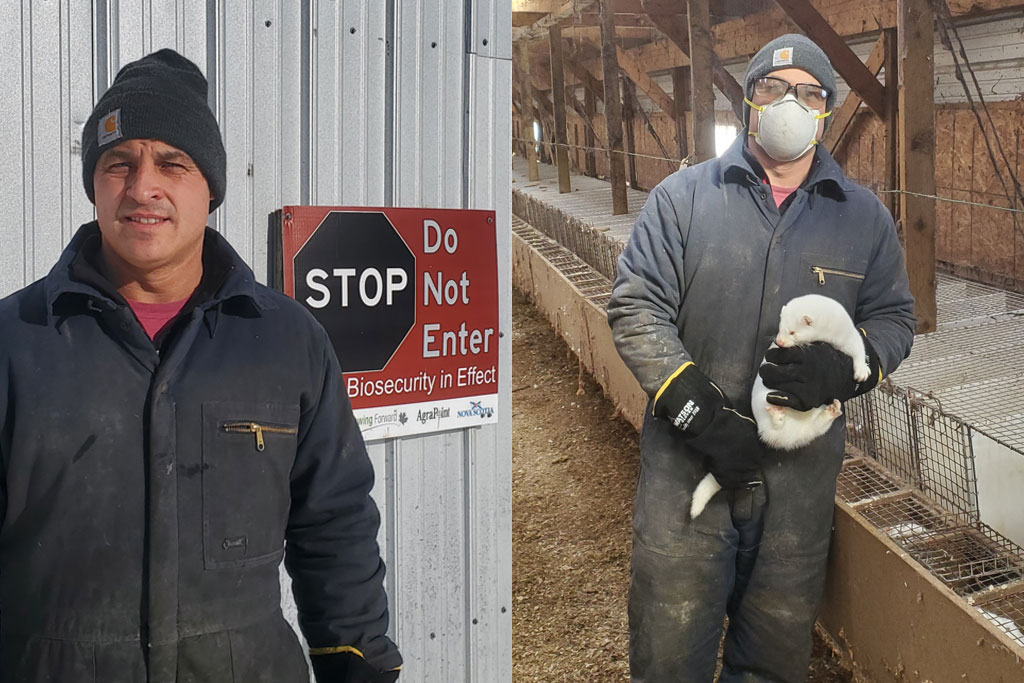
Biosecurity measures on North American mink farms have been extremely effective at limiting outbreaks of Covid-19. Photo: Matt Moses, president, Canada Mink Breeders Association.
Fur-ban supporters are also guilty of scaremongering about the susceptibility of mink to Covid-19, claiming that mink farms are a threat to public health. Strict bio-security measures in place on all North American mink farms are one reason the Centers for Disease Control and Prevention can state: "Currently, there is no evidence that mink are playing a significant role in the spread of SARS-CoV-2 to people."
As for the fear that a virus strain that showed up on mink farms in Denmark will lower the efficacy of vaccines, America's top infectious disease official is not too worried. "[A]t first cut, it doesn't look like something that's going to be a really big problem for the vaccines that are currently being used to induce an immune response,” said Dr. Anthony Fauci, who was Chief Medical Advisor under President Trump and has stayed in the role under President Biden.
Bear in mind also that when there are outbreaks of swine flu (H1N1) or avian flu in chickens, we do not ban the sale of pork and poultry – although this is exactly what animal activists call for. Instead, farmers work closely with public officials to resolve the problems, just as US mink farmers have done with Covid-19.
Ignoring Positive Contributions
Wisconsin is America's leading producer of cheese, which is also a great source of protein for mink. Image: Fur Commission USA.
Fur-ban proponents also refuse to acknowledge the many positives of producing and wearing fur.
For example, they ignore the fact that farmed mink, as carnivores, eat by-products from human food-production – the parts of cows, pigs and fish that we don’t eat, expired cheeses, broken eggs – that might otherwise end up in landfills. Manure, soiled straw bedding, and other farm wastes are composted to produce organic fertilizers, completing the agricultural nutrient cycle. And mink are raised on family-run farms, providing employment and revenue to support rural communities.
They also fail to mention that half the fur produced in the US is taken from the wild, and from abundant species only. This way they avoid the awkward truth that many of these furbearers are so numerous that they'd have to be culled even if we didn't use their fur. Overpopulated beavers flood homes and roads; raccoons spread rabies and other dangerous diseases; coyotes are the main predators of young calves and lambs, and even pet dogs and cats; and the list goes on. Regulated trapping, as practiced in the US, helps to maintain more stable and healthy wildlife populations by smoothing out boom-and-bust cycles. And if we must cull some of these animals, it is surely more ethical to use their fur than to throw it away.
Finally, it is grossly misleading for fur-ban proponents to claim that alternative materials render the use of natural fur “unjustifiable”. Fake furs – and more than 60% of all our clothing – are synthetics, mostly made from petroleum, a non-renewable resource. We now know that each time these synthetics are washed, they leach micro-particles of plastic into our waterways that are now turning up in marine life, drinking water, and even breast milk. Cruelty-free indeed!
Natural fur, by contrast, is produced responsibly and sustainably. Each fur garment is cut and sewn individually by artisans maintaining heritage handcraft skills. A well-made mink coat can be worn for 30 or 40 years or more, passed from mother to daughter and granddaughter. Unlike most clothing, a natural fur coat can be taken apart and completely restyled. And after decades of use, it can be thrown into the garden compost where it will biodegrade completely. Using natural fur makes more sense than ever at a time when environmentalists are saying we should buy better-quality clothing and keep it longer.
Scapegoating Artisans
The fur trade is small and artisanal, and a soft target for lazy politicians. Photo: Diane Giroux.
So why do we hear so much anti-fur rhetoric? Despite its “luxury” image, the fur trade – from farmers to trappers to craftspeople -- is a small and artisanal industry that has been unfairly stigmatized and scapegoated. The fur trade is easily sacrificed by politicians bent on winning votes and raising funds, in the knowledge that it simply doesn't have the resources to compete with multi-million-dollar, media-savvy, “animal rights” lobby groups.
No one is obliged to wear natural fur – or, for that matter, wool or leather – or to eat meat or dairy. These are personal choices, and they are rarely black and white. For example, despite the growing popularity of vegetarianism, few of us actually go the whole nine yards, let alone become vegans. Instead, we may opt to become pesco- or ovo-vegetarians, meaning we still eat seafood or eggs. Others choose to buy organic beef, or free-range eggs.
As we navigate these choices, we want more information about the environmental and ethical implications of our decisions. In response, the International Fur Federation is launching FurMark this year to further enhance traceability and transparency about industry standards.
What is not appropriate is for legislators to impose such decisions from on high. Rather, it behooves them to actually meet with the people whose cultures, reputations, and livelihoods they are so blithely and unfairly attacking. Politicians who fancy themselves to be progressive may then find that they should be promoting natural fur, not seeking to arbitrarily ban it.
***
To learn more about donating to Truth About Fur, click here.
David Suzuki styles himself as an environmentalist, so it is surprising he recently sent a letter (co-signed by three other “scientists”) to the BC Minister of Agriculture criticizing mink farming.
Mink farming plays a key role in the agricultural cycle. Mink are carnivores and are fed leftovers from our own food production, the parts of chickens, cows, fish and other food animals we don’t eat (often as much as 50 per cent of biomass) – “wastes” that would otherwise end up in landfills. In turn, mink manure and carcasses are composted to produce organic fertilizers to replenish the soil. Nothing is wasted.
David Suzuki is misguided. When farms were found to have Swine Flu and Avian Flu, we didn’t close them down. Photo: Holger Motzkau 2010, Wikimedia Commons, CC BY-SA 3.0.
At a time when we are encouraged to buy better quality clothing and keep it longer, to reduce waste, using fur makes more sense than ever. Mink fur is a remarkably warm and long-lasting natural clothing material. We often see mink coats that are 30 or 40 years old, or older. Fur is one of the few examples of clothing that is passed from one generation to the next. A fur coat can also be taken apart and “restyled” into a new coat, or recycled to make vests, handbags or other accessories. After decades of use, old furs can be thrown into your garden compost where it will biodegrade completely.
By comparison, synthetics from which 80 per cent of our “fast-fashion” clothing are now made are generally derived from petroleum, a non-renewable, polluting and nonbiodegradable material. Such synthetics may cost less than natural materials like fur, leather or wool, but they don’t last long – millions of tons of these nonbiodegradable synthetics are thrown into the trash each year. These synthetics also leach millions of microparticles of plastic into our waterways each time they are washed – plastics that are now being found in marine life. Not good for nature!
Claims that mink farming is “cruel” are also misinformed. Like other animal agriculture in Canada, mink farmers follow codes of practice developed by veterinarians, animal scientists and animal welfare authorities, under the auspices of the National Farm Animal Care Council. Mink farms in BC are inspected and licensed by the Department of Agriculture to ensure codes are followed. And farmers have every reason to ensure their animals have excellent nutrition and care: this is the only way to produce the high quality fur for which Canada is known internationally.
The mink on BC farms are not “wild animals,” as activists claim; mink have been raised on farms in Canada for more than 100 years. They are well adapted to farm life and physiologically different than their wild cousins.
The rarity of Covid-19 on North American mink farms shows that biosecurity measures are effective.
Similarly, activist claims (parroted by Suzuki) that mink farming should be banned because mink can be susceptible to COVID-19 are not supported by science. Although COVID-19 has been detected on farms in four US states, top infectious disease expert Doctor Anthony Fauci and the US Centers for Disease Control have not recommended culling infected farms, let alone an end to mink farming. They have implemented quarantines and strict biosecurity controls – the same precautions that have been applied in BC. The fact that the virus has emerged on only two Canadian farms, nine months after the first cases were detected in Europe, shows that these biosecurity measures are effective.
Suzuki’s call for a ban on mink farming is misguided. When Swine Flu (H1N1) and Avian Flu were found on farms, we didn’t all stop eating pork and chicken or close down pig and poultry farms (although that is what animal activists called for then, too); instead, farmers worked with authorities to responsibly contain and eliminate the viruses. That is exactly what mink farmers are doing now.
As Canadian farm families work to protect their animals and their livelihoods, they need our support, not unfair attacks from urban activists and their celebrity cheerleaders. For the producers’ side of the fur story, please visit TruthAboutFur.com.
***
To learn more about donating to Truth About Fur, click here.
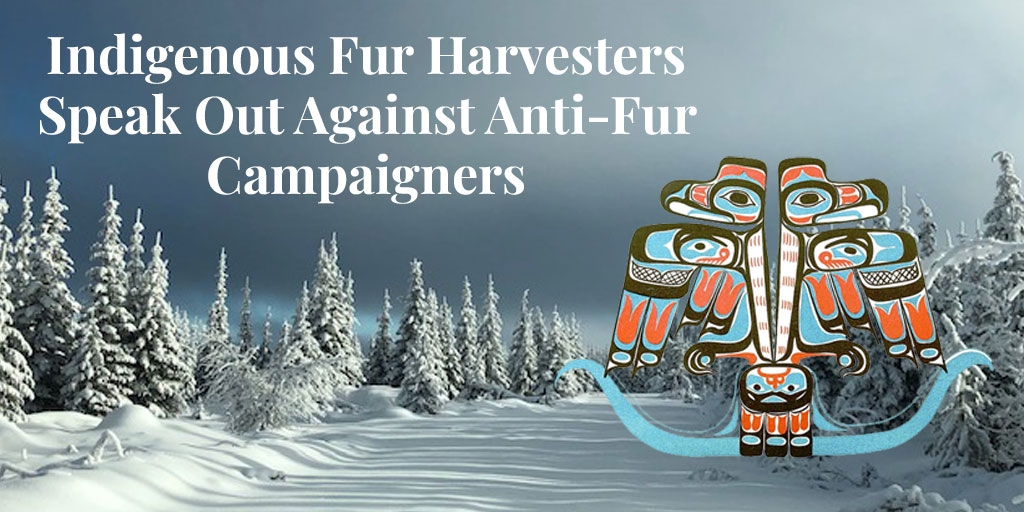
The following statement from the four signatories below was released to the media on Jan. 24, 2021. “Harvesting and trading… Read More
Indigenous fur harvesters are exercising an inherent right. Photo: Karen Dunstan; Artwork: Internet Archive Book Images.
The following statement from the four signatories below was released to the media on Jan. 24, 2021.
"Harvesting and trading fur and other gifts of nature is our inherent right since ancient times, not a privilege to be bartered or revoked!" says Chief Brian Wadhams, trapper, of the 'Namgis First Nations.
As Indigenous trappers and traditional trapline holders, we
can no longer remain silent about self-appointed “animal rights” activists who
think they have a right to spread lies about the fur trade and call on
politicians to ban the production or sale of fur products.
The latest example of this vicious and misleading campaigning is a recent call by animal activists for the Canadian Government to ban mink farming, after mink on two BC farms tested positive for COVID-19. While mink farming is not a tradition in our culture, we oppose this attack on small family-run farms and on rural communities where the majority of Indigenous harvesters live. And we are not naïve: we understand that this attack on mink farming is just the latest weapon in an orchestrated plan to turn the public against any use of fur – a campaign that directly attacks our culture and inherent rights as Indigenous peoples of Canada. We call this for what it is: Cultural Genocide.
Karen Dunstan and her husband Bob, out on their trapline in British Columbia.
The fur trade played a central role in Canada’s history, and it's an important part of our Cultural Identity; our people were harvesting and trading furs long before Europeans ever set foot on our eastern shores. The harvesting and sale of fur still provides income for many First Nations communities throughout Canada. Beavers, muskrats, and other furbearing animals also provide nutritious food for many hunters and their families. The respectful harvesting of fur and food from abundant wildlife populations is central to our relationship with the land – a relationship that the federal and provincial governments are legally mandated to protect.
Let us be crystal clear: the goal of animal activists – including those now calling for a ban on mink farming – is to destroy all markets for fur, to further their own ideological agenda. In doing so, they are directly attacking our right to responsibly harvest and trade nature’s gifts, which is our inherent right, a right recognized by the Supreme Court of Canada and by the United Nations Declaration on the Rights of Indigenous People (UNDRIP).
It is doubly unfortunate that animal activists seek to mislead the public and the government about fur at a time when Canadians seek to live in better harmony with nature. Furs are a sustainably produced, long-lasting, and biodegradable natural clothing material. It is the Honest Fabric. By contrast, the fake furs and other synthetics promoted by animal activists are generally made from petroleum, a non-renewable, non-biodegradable, and polluting resource.
Indigenous people have respected and protected the survival of the animal populations upon which we depend since time immemorial. Our message today to self-appointed “animal rights” extremists and their celebrity cheerleaders is this: Your misguided attacks on the fur trade are not “progressive”; they are attacks on Indigenous people. Your uninformed and misguided lies must stop NOW!
On the land in British Columbia's Region 3. Photo: Karen Dunstan.
We take this opportunity to remind the Government of Canada,
and their provincial and municipal counterparts, that fur trapping, trading,
displaying and selling fur is our Inherent Right, not a privilege to be
bartered or trifled with. You are responsible for protecting these rights!
Furthermore, governments cannot make any changes in policy or legislation concerning the responsible harvesting, production, displaying, selling or bartering of fur products without full consultation and consent from Indigenous people, as the Supreme Court of Canada has ruled.
We will no longer remain silent while self-appointed urban activists attack our cultural traditions and livelihoods. It is time you showed some honesty, decency, and respect for Indigenous fur harvesters and our fur trade partners.
It's time to take a stand. We call on all Canadians to say “No!” to the lies and cultural intolerance promoted by anti-fur groups. We ask you to support Indigenous harvesters, to support the responsible and sustainable use of nature's gifts -- and to buy and proudly wear Canadian Fur.
It’s the Holiday Season, a time of good cheer, so let’s pretend for a moment that Covid-19 hasn’t made the… Read More
The fur trade has suffered some setbacks of late, but it’s not all bad. Photo: NOAA/AOML/Hurricane Research Division.
It’s the Holiday Season, a time of good cheer, so let’s
pretend for a moment that Covid-19 hasn’t made the last year thoroughly miserable
for everyone, including the fur trade. After all, every cloud has a silver
lining, right? What follows may seem like a stretch, but not everything about
2020 was bad.
Silver Lining 1: Closed Season on Retail Bans
New York’s fur trade successfully fought off animal rights groups, but it was exhausting. Photo: Maria Reich.
Let’s start with something that didn’t happen in 2020: if there were any new campaigns launched to ban fur retail in the US, Truth About Fur didn’t hear about them. This bore out a prediction we made last March that, with the pandemic building, no one would have time to argue about animal rights.
Before the pandemic, animal rights groups were on a roll in California. They started small, in trendy West Hollywood, where a retail ban went into effect in 2013. Then Berkeley fell in 2017, San Francisco’s ban began last January, and a Los Angeles ban starts in 2021. In 2023, California’s statewide ban is scheduled to begin. (The sad irony, of course, is that the politicians who supported these bans pride themselves as being "progressives" -- in which case, as Truth About Fur's Alan Herscovici explained, they should be promoting fur, not trying to ban it!)
Activists tried the same tactics in New York City (and state) in 2019, but stalled in the face of stiff opposition. And, just before the pandemic reached the US, they were targeting Minneapolis.
The fur trade mounted challenges to all these campaigns -- and legal challenges forced San Francisco to acknowledge that furs can still be purchased by mail order in that city -- but putting out fires left and right is expensive and time-consuming. Then Covid-19 came and stole the show, ably supported by such explosive events as the Black Lives Matter riots and the US election. Any interest in talking up fur sales bans evaporated, and they remain irrelevant to this day.
It won’t last, of course. Once Covid is under control and there’s a slow news day (remember those?), animal rights extremists and attention-hungry politicians will be teaming up again. But until then, the fur trade can take a breather and regroup. It’s not much of a silver lining, but a breather was definitely needed!
Silver Lining 2: Denmark’s Loss May Be Your Gain
If Danish mink production ends, prices should rise. Photo: Kopenhagen Fur, public domain.
It’s never nice to benefit from another’s misfortune, but it happens in business all the time. Now the world’s largest exporter of mink has been struck down, and other producers -- especially in North America -- stand to gain.
In November, the Danish government ordered the culling of the country’s entire mink herd – believed to be about 14 million animals according to insiders, not 17 million as widely reported – after a mutation of the coronavirus was found that, some feared, might reduce the efficacy of a human vaccine. The government has admitted it had no legal authority to order the cull, and the threat posed by the mutation has been questioned (not least because it hasn’t been seen since September). But the cull went ahead anyway, and the Danish government has forbidden further breeding in that country until 2022.
It’s still unclear whether Denmark’s mink industry is really finished, but Kopenhagen Fur, the world’s largest auction house whose main supplier is the Danish Fur Breeders’ Association, seems to think so. “It is a de facto permanent closure and liquidation of the fur industry,” said chairman Tage Pedersen, who predicted 6,000 lost jobs -- including more than 1,100 farm families. The auction house has said it will clear reserve stocks while implementing "a controlled shutdown over a period of 2-3 years."
So what’s the silver lining here? Well, if the Danish industry is truly over, as Pedersen suggests, the next few years should see a significant drop in supply and, consequently, rising prices. In particular, North America's mink farmers should benefit since their fur pelts are widely considered to be the world’s finest, though its chief rival, Denmark, produced far more. Other fur types, like fox, may see a rebound too as garment makers look for alternatives.
In fact, Saga Furs, in Finland, may have shown a glimpse of the future on Dec. 15 when it concluded its first international auction – online, of course -- since the Danish cull. Summarizing the results for Truth About Fur, a representative said that almost all (90%) of the one million mink on offer were sold “at overall prices up by 50% since last auction, with North American mink sold at a premium. China, with support from Italy and Turkey, were the main buyers, with multiple bids per lot. Blue foxes were also up, by 17%, and shadow foxes up 10%.”
The mink-farming sector now has an unexpected opportunity to reset its output. Until 2013, when prices were peaking, many observers feared rapidly escalating over-production. Both prices and production have fallen since then, but with Denmark out of the picture, we could see a leaner, meaner, and more profitable industry with world production more closely aligned with actual demand. Of course, farmers in other countries might just ramp up production to fill the shortfall. But with prices still barely covering production costs (if that), and the current uncertainty in retail markets, it is unlikely that mink production will return to recently-seen levels any time soon.
Personally, I find it hard to believe Denmark’s mink industry will roll over and die so easily. But its production will, at the very least, take a major hit in the short- to mid-term. And therein, sad as it may be, lies a silver lining for most everyone else.
Silver Lining 3: The Rush to Replace NAFA Is On
NAFA was North America’s largest auction house, but others are filling the void.
Last but not least in our doggedly joyous roundup of 2020, there’s the North American auction scene. After the biggest player bowed out, a period of great uncertainty ensued as others jockeyed to take up the slack. They haven’t quite sorted themselves out yet, but the good news is that a number of strong options have already emerged.
Until late last year, North American Fur Auctions was, by far, the continent’s largest fur auction house. Based in Toronto with facilities in Wisconsin and elsewhere, NAFA was North America's leading marketer of both farmed and wild fur. This dominance was assured in 2018 with the collapse of its Seattle-based competitor, American Legend Cooperative.
And then it all came unglued. On Oct. 31, 2019, NAFA was granted creditor protection, leaving many fur farmers wondering how to sell their furs – or, for that matter, what would happen to furs already consigned to -- or sold by -- the auction house.
The auction scene is still in flux, with news that New York-based American Mink Exchange will be selling in collaboration with Fur Harvesters Auction in North Bay, while Saga Furs is also poised to play a stronger role in North America. Meanwhile, Fur Harvesters Auction -- a cooperative venture of First Nations and other trappers -- is gearing up to greatly expand its wild fur offerings, while Illinois-based Groenewold Fur & Wool Co. has stepped up its presence in Canada. Other projects are also rumoured to be in the works.
In the meantime, the silver lining of NAFA’s demise is that there seems to be no shortage of parties ready to take its place. Imagine if no one had wanted the job! But if there are two words that describe the people of the fur trade, they are "tenacity" and "adaptability". Let's see how they play out in 2021!
***
To learn more about donating to Truth About Fur, click here.
Quick to turn the misfortune of others to their own benefit, animal activists have jumped on reports about Covid-19 on… Read More
Biosecurity protocols on North American mink farms have never been stricter. Photo: Truth About Fur.
Quick to turn the misfortune of others to their own benefit, animal activists have jumped on reports about Covid-19 on mink farms in Europe (and some US states) to call for a complete ban on fur farming in North America. In media interviews and opinion pieces they are sounding the alarm that the SARS-CoV-2 virus mutated in Danish mink and, in some cases, was passed back to humans; this new mink-related strain could threaten the efficacy of future vaccines, they argue. Their fear-mongering received a boost when the Danish Government ordered the culling of millions of mink, citing the same concerns.
In fact, most public health authorities do not agree. The European Centre for Disease Prevention and Control issued a statement on November 12 in which it concluded that the overall level of risk to human health posed by SARS-CoV-2 mink-related variants is low for the general public, no different than other (non-mink) strains. (1)
World Health Organisation chief scientist Soumya Swaminathan said that “mutations [in viruses] are normal ... I don’t think we should come to any conclusions about whether this particular mutation is going to impact vaccine efficacy.” WHO spokesperson Dr. Margaret Harris added that some members of the international community and the media have misunderstood the threat level. (2)
Similarly, respected US virus expert Dr. Anthony Fauci said: “It does not appear, at this point, that that mutation that’s been identified in the minks is going to have an impact on vaccines and affect a vaccine-induced response.” (3)
The World Organisation for Animal Health (OIE) stated that “although several animal species have been infected with SARS-CoV-2, these infections are not a driver of the COVID-19 pandemic; the pandemic is driven by human to human transmission.” (4)
Preventative Measures
Protective suits, masks and visors are now standard on North American mink farms Photo: Truth About Fur.
The OIE does not propose mass culling of mink herds, let alone an end to mink farming. Rather, it advises a range of preventative measures including human testing; infection prevention and control for workers; animal testing and prevention of spread from animals; and the development of preparedness and response strategies. These are precisely the precautions that US and Canadian mink farmers have implemented to protect their animals, their own families, and the public.
North American mink farms, like most animal agriculture, maintain biosecurity protocols to prevent the spread of infection from wildlife or other farms. These measures were immediately tightened when it was learned that mink in Europe had contracted Covid-19 from humans. Only essential personnel are permitted onto farms, and workers who feel ill must be tested for Covid-19 before coming into contact with the animals. Masks, visors, and gloves are used when handling mink. If Covid-19 is found on a mink farm, this must be reported to the state or provincial chief veterinary officer and public health authorities, who decide whether further measures are required.
“The European situation gave us lead time to put stricter biosecurity into place,” said Matt Moses, a Nova Scotia mink farmer and president of the Canada Mink Breeders Association. No cases of Covid-19 have been found on Canadian mink farms, and while some cases were recently found on US farms, they appear to have been rapidly and effectively contained.
Mink farming is also very different in North America than in Europe. While some 3 million mink are being produced annually on about 200 farms spread out across Canada and the US, in Denmark, more than 1,200 farms were producing over 17 million mink in an area smaller than Vancouver Island -- or less than one-fifth the size of Wisconsin. The risk of inter-farm contagion is clearly far lower in North America.
Meanwhile, the “Cluster-5” Covid-19 mutation found on Danish mink farms has not been detected since mid-September, and has “most likely become extinct,” the Danish Health Ministry admitted last week. (5)
None of this has dampened the enthusiasm of animal activists
who sense an opportunity to deliver a body blow to the fur industry. There is
no justification for taking even the smallest risk, because fur farming is
“cruel” and “unnecessary”, they argue.
Cruel? In fact, animal welfare is a priority on North American mink farms. Producers work hard to provide their animals with excellent nutrition and care, as this is the only way to produce top-quality fur.
By contrast, the fake furs and other synthetics proposed by animal activists are generally made with petroleum, a non-renewable and non-biodegradable resource. These synthetics represent about 80 percent of our clothing, and leach millions of micro-particles of plastic into our waterways each time they are washed; plastics now being found in marine life. Cruelty-free indeed!
Mink are raised on small, family-run farms, supporting employment in rural communities. Mink help to reduce waste: they are fed left-overs from our own food production, the parts of cattle, poultry, and fish we don’t eat -- by-products that might otherwise end up in landfills. Mink manure, straw bedding, and carcasses are composted to produce organic fertilizers, replenishing the soil and completing the agricultural nutrient cycle.
As for the new risks posed by Covid-19, mink farmers take their biosecurity responsibilities very seriously, to protect their livelihoods, their animals, and their families. Of course, no one is obliged to wear fur -- or leather, or wool; or to eat meat or dairy -- but that does not give activist groups the right to unfairly attack the livelihoods and reputations of North American farming families.
To learn more about donating to Truth About Fur, click here.
Manage Consent
To provide the best experiences, we use technologies like cookies to store and/or access device information. Consenting to these technologies will allow us to process data such as browsing behavior or unique IDs on this site. Not consenting or withdrawing consent, may adversely affect certain features and functions.
Functional
Always active
The technical storage or access is strictly necessary for the legitimate purpose of enabling the use of a specific service explicitly requested by the subscriber or user, or for the sole purpose of carrying out the transmission of a communication over an electronic communications network.
Preferences
The technical storage or access is necessary for the legitimate purpose of storing preferences that are not requested by the subscriber or user.
Statistics
The technical storage or access that is used exclusively for statistical purposes.The technical storage or access that is used exclusively for anonymous statistical purposes. Without a subpoena, voluntary compliance on the part of your Internet Service Provider, or additional records from a third party, information stored or retrieved for this purpose alone cannot usually be used to identify you.
Marketing
The technical storage or access is required to create user profiles to send advertising, or to track the user on a website or across several websites for similar marketing purposes.