You may recall that Coloradans recently defeated an anti-fur ballot initiative, and probably assume that the state is safe for… Read More
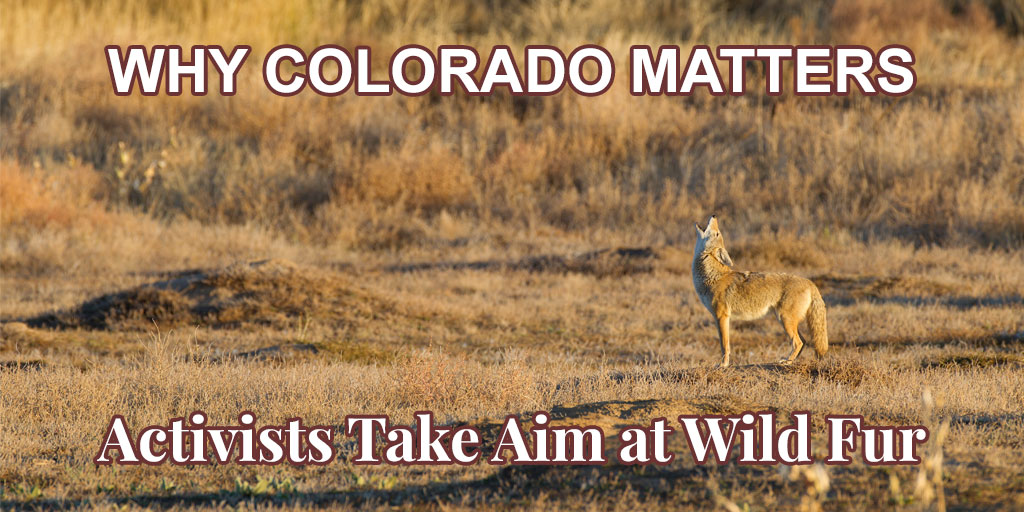
A coyote howls in Rocky Mountain Arsenal National Wildlife Refuge. Photo: USFWS Mountain-Prairie, Public domain, via Wikimedia Commons.
You may recall that Coloradans recently defeated an anti-fur ballot initiative, and probably assume that the state is safe for now. But your assumption would be wrong. Now opponents of fur are looking to introduce a statewide ban on the sale of all wild fur – something they've not tried in the past.
That battle, which garnered a lot of news coverage, especially for the slogan "Hands off our hats", sent a clear message that most Coloradans would not stand for animal rights groups telling them what they could and couldn't trade. But perhaps the message was not clear enough. Now a petition from the anti-fur Center for Biological Diversity has accused the Colorado Parks and Wildlife Commission (CPWC) of violating sound conservation practices, with the aim of forcing a statewide ban on all trade in wild fur.
Attacking Wild Fur
As Executive Director of the Fur Institute of Canada (FIC), I frequently attend meetings, auctions, trade shows and the like, across Canada and around the world, where fur is the number one topic of conversation. But at many of these events, I am also in a minority. Why? Because our organization represents the interests of all kinds of fur, including wild fur.
Much of the global fur trade deals only with ranch fur. Many designers and manufacturers, for example, are concerned above all with the different colour phases of ranch foxes and mink, but have no interest in where or when the best coyotes are harvested. (This reality is also why fur ranchers attract so much attention from anti-fur activists.)
When combined with the strong and easily understood arguments in favour of regulated trapping, this explains why many folk assume wild fur is comparatively “safe”. Trapping plays a key role in wildlife management, it's an important part of livelihoods for Indigenous communities, and its heritage underpins so much of our shared history across North America.
But that idea is now being challenged in Colorado. If successful, the anti-fur lobby will use the CPWC to introduce a statewide ban on the sale, trade and bartering of all wild fur.
Over the last 40 years or so, trappers have grown used to attacks that focus on the welfare of individual animals caught in traps, but this time things are different.
This time, the aim of the anti-fur lobby is not to attack wild fur for how it's harvested, but rather to claim that the mere act of trapping violates the North American Model of Conservation, as spelled out by the Association of Fish and Wildlife Agencies.
When the CPWC meets next on March 4–5, it will discuss a proposal from the Center for Biological Diversity that says the state's current science-driven regulations are not fit for purpose, and that there needs to be a statewide commercial ban on wild fur.
As a community, we must stand together against efforts to restrict, reduce or eliminate the fur trade. That includes trappers, hunters, farmers, ranchers, First Nations, rural landowners, fur buyers, manufacturers, retailers, designers and artisans, from all parts of North America. Everyone who enjoys our world-class garments and accessories needs to be heard.
Both the FIC and the CRWM firmly believe that by standing together, we can be far more than the sum of our parts. Now is the time for all of us to support efforts to keep commercial fur trapping alive in Colorado. And that is why the FIC will be joining CRWM in Denver next week, giving voice to all Canadians who support science-based, well-regulated wildlife management.
the Citizen Petition Form "Prohibiting the sale of furbearer furs with exemptions", June 16, 2025;
"Petition to amend 2 CCR 406-018 to prohibit the commercial sale of wildlife fur in Colorado", submitted by the Center for Biological Diversity, June 16, 2025; and
the recommendation to deny the above petition submitted by the Division of Parks and Wildlife, Department of Natural Resources, February 19, 2026.
Manage Consent
To provide the best experiences, we use technologies like cookies to store and/or access device information. Consenting to these technologies will allow us to process data such as browsing behavior or unique IDs on this site. Not consenting or withdrawing consent, may adversely affect certain features and functions.
Functional
Always active
The technical storage or access is strictly necessary for the legitimate purpose of enabling the use of a specific service explicitly requested by the subscriber or user, or for the sole purpose of carrying out the transmission of a communication over an electronic communications network.
Preferences
The technical storage or access is necessary for the legitimate purpose of storing preferences that are not requested by the subscriber or user.
Statistics
The technical storage or access that is used exclusively for statistical purposes.The technical storage or access that is used exclusively for anonymous statistical purposes. Without a subpoena, voluntary compliance on the part of your Internet Service Provider, or additional records from a third party, information stored or retrieved for this purpose alone cannot usually be used to identify you.
Marketing
The technical storage or access is required to create user profiles to send advertising, or to track the user on a website or across several websites for similar marketing purposes.