Over the last couple of months, I needed care in our local hospital in Fraser Valley, British Columbia, for a… Read More
Shutting down mink farming in Fraser Valley has been a loss for the whole community. Photo: Mimigu at English Wikipedia, CC BY 3.0, via Wikimedia Commons.
Over the last couple of months, I needed care in our local hospital in Fraser Valley, British Columbia, for a medical issue. (A big rave to the healthcare system and the great care I received!) While waiting during one of my visits, I was sitting close to a sign recognizing the contributors to a recent update to the hospital. All the donors were recognized, and I was a little surprised to see a local fur farm listed. There was also a local resident’s name that is also likely that of a family connected to the mink-farming community.
I was not surprised that they had donated. But I was surprised that they had chosen to be listed as donors.
You see, as a trapper, I have always felt that fur farming was important. The market for farmed fur has a major impact on the value we see for wild fur. So I've made a point of getting to know some of the local fur farmers and I've been impressed. They are multi-generational and very passionate. It felt like the list of donors was just that – people with close ties to the local community, and a long or rich history in the community. In short, they care about and support important projects.
But in 2021, the BC government decided to phase out all mink farms in the province, calling them a public health risk.
I do not have to ask to realize that support for the community from these farms has now gone. Farmers no longer have the capacity, the will or the desire to make donations. Despite being in an industry with a huge target on them, they had donated and also chosen to be recognized for that. Community pride at its best!
Yet it was the same world of charitable donations that eventually brought down BC's fur farms, and I find that sad.
Immoral Use of Charitable Donations
Langley Memorial Hospital is a valued member of its community, as the large number of donors shows..
The two groups responsible for pressuring the government to end fur farming in BC were The Fur-Bearers and the B.C. Society for the Prevention of Cruelty to Animals, both of which use the same model to solicit donations. They then used these donations to fight and shut the industry down.
It feels immoral to me that an organization can be allowed to fundraise as a charitable entity and then use those funds to fight and shut down a legal industry.
Further, it was done without fair and equitable treatment or compensation to the fur farmers, despite their years of local community support. Rather, an industry has gone because of the louder voices of a minority.
Also lost is the spin-off support farms gave to other local businesses in the community – the tractors and feed they bought, the staff they hired, the taxes they paid, and the stores they supported for so many years.
My moral compass feels charitable status should be reserved for a better society, not pushing the ideologies of a minority onto society.
I am proud to be Canadian, and proud also of our right to choose. If you do not wish to wear fur, that is your choice. I respect that, in the same way I respect the right of those who choose a vegan diet, wish to hunt, or wish to be a farmer, or identify as LGBTQ.
Before the latest health crisis, Tim Killey (right) and students show off a stretched beaver pelt.
The smoke and mirrors used by the government to depict our mink farms as a public health risk were insane.
Every industry comes with some risks to society, including all types of farming. For example, we have bird flu, mad cow disease, and swine fever. But we manage the risks.
Mink farms had the ability to manage the risk, including a new vaccine developed in the US specifically for Covid-19 – an option not available for all diseases. Meanwhile, of course, human populations were receiving their own vaccines. This combination was apparently acceptable to all, except of course for the BC government!
Leading the way for Canada's mink farmers was the government of Nova Scotia, which even offered to subsidize the cost of vaccinating mink against Covid-19. The only difference I could see between Nova Scotia's decision-makers and those in BC was that the former were doing their jobs, while the latter allowed themselves to be influenced by a vocal minority group.
I will continue to fight for the right to trap, hunt and fish, following in the footsteps of our forefathers that built the great nation we call Canada. I will also continue to defend our freedom to choose, and that includes our right to choose where to donate our hard-earned dollars. Hopefully my friends, family and colleagues will also take an extra minute the next time they donate funds, to review the options and pick a true charity dear to their heart.
This is the story of just one students’ club in British Columbia, with a trapping component, that could use a… Read More
This is the story of just one students' club in British Columbia, with a trapping component, that could use a helping hand. But hopefully it will also open eyes across Canada. You probably live far from BC, but maybe there's a trapping club nearby that faces similar problems. Can you help? Or maybe you're struggling to start your own trapping club, and can learn from this young man's experiences.
Meet Cole Mark, a 25-year-old born in BC's capital, Victoria, and a student at the University of Victoria, or "UVic" to those in the know.
By anyone's definition, Cole is an outdoorsman. When he is not studying forest biology or working for the BC Wildfire Service, he is hunting, rock climbing, backcountry skiing, fishing, scuba diving, spearfishing, shooting (guns and bows), and foraging. He also has "strong passions" for wildlife management and sourcing his own food.
It was in character, then, that in 2023 he started the UVic Freediving and Spearfishing Club, and followed this up in 2024 with the UVic Fish and Game Club – the one we're going to talk about today.
As the name suggests, the UVic Fish and Game Club dabbles in a wide range of activities, both hands-on and involving educational presentations and licensing courses. One of the most successful components has been shooting, with nearly 50 members completing their firearm safety training in the club's first semester alone.
The trapping component, however, is proving more challenging to get off the ground – something we'll circle back to.
Making of an Outdoorsman
Cole keeps himself busy! When he's not studying or running two clubs, he's working as a firefighter.
Truth About Fur: In your own words, Victoria "offers limited exposure" to outdoor activities, while your parents are a teacher and a lawyer. How, then, did you become an outdoorsman?
Cole Mark: My love of nature was largely instilled in me by my late grandfather and my uncle. My grandfather and I spent days fishing, and he shared stories about hunting and fishing. My uncle, a commercial diving captain, often took me fishing and crabbing, further shaping my passion for the ocean and outdoors.
Ironically, as for Victoria, the capital of BC, its limited offering of exposure is largely because of considerable social pressure to oust these foundational pieces of Canadian tradition and heritage. This makes it awfully intimidating for people to take interest in, never mind trying to be a part of, outdoor recreation.
As many of you know, and starting well before I was born, there was a slow clawing at everything trapping, hunting, fishing and shooting. However, today it's been turned into more of a cutting away. As a young man who cares deeply about his country, neighbour, and having a family of his own one day; I quickly realized that I needed to be the change I wanted to see. I knew it wasn’t going to easy. The idea alone of starting a fish and game club that promotes the education of firearms and trapping at the University of Victoria was completely nuts. And it has been a wild ride for me to say the least. But, I knew I needed to make a difference where I could. I understand how intimidating these pursuits can seem to people with no background in them, and this is what drives me to make outdoor education more accessible. I want others to discover and appreciate this important part of Canadian tradition, heritage and culture.
TAF: Starting the Freediving and Spearfishing Club and then the Fish and Game Club was a logical step for you, then?
CM: That's right. The mission of both clubs is to provide a space where students can develop practical skills, build a deeper connection with nature and food, and promote safety, ethics, and conservation in all activities with friends and without worrying about backlash. Both clubs have been incredibly rewarding to start and run, and they have taught me a lot about leadership, community building, and sharing my passion with others.
TAF: Could society do with more such clubs?
CM: I certainly believe so, especially at the university level. I keep my club entirely apolitical. My goal is to give anyone an experience and working knowledge so they can make informed opinions from choosing whether or not to buy a fishing rod at a local store, getting a firearms license (restricted or not), or casting a ballot.
Additionally, many of the outdoor recreational activities that fish-and-game clubs foster, including trapping, are being phased out in my generation. And as they disappear, we are also losing the heritage, values and most importantly the virtues they bring and inherently teach.
Our UVic club also just had our first hunting event approved! This event utilized an initiation hunting license where any student could get a license and hunt for the first time with a licensed student. It must be the first hunting trip a university club in BC, or maybe even in Canada, has done in decades.
TAF: You have no background in trapping, and yet your club offers this skill. How did this come about?
CM: I acquired my trapping license in 2021. I can thank Mr. Steven Rinella and a few whispers of stories about trapping here on the island for developing my interest. Ever since, it's been a defining part of my development as an outdoorsman and as a young academic. It has taught me lessons that my degree could not, from hands-on wildlife management and land stewardship to the practicalities of renewable resource management. It has taught me that there is a gap in understanding the vital role that trapping plays in sustainable wildlife management, land stewardship, and in renewable resources. It has instilled in me a profound respect for the delicate balance of ecosystems, the patience to observe and understand animal behaviour, and the discipline required to work ethically within nature’s cycles. And it has reinforced the values of responsibility, resilience, and humility, showing me that a true connection with the outdoors is not all from theory but also time spent in the bush.
These are the lessons I hope to pass on to my fellow club members.
Hurdles to Trapping
Many thanks to veteran trapper Jerry Baker for helping pass on skills to a new generation.
TAF: You say that two hurdles stand in the way of really getting trapping off the ground at your club: cost and limited opportunities to "get out".
CM: That's right. Overall, the club is doing well. We currently have around 130 members, and our numbers continue to grow as more students seek outdoor experiences and opportunities to learn. Of all the activities we offer, though, trapping presents unique challenges.
There's a decent amount of interest in trapping at UVic, but we need to provide more opportunities for club members to spend time on actual traplines, and we also need to provide a way for them to become licensed. Both face issues of accessibility and cost.
In BC, you can only trap on traplines or on private property. Traplines that were once hundreds of dollars, are now tens of thousands. BC only has around 1,800 licensed trappers, which is roughly a 40% decrease from the 1950’s. I fear what kind of future my own children will face. Will the lifestyle be reserved for a select few diehards and those willing to endure unnecessary scrutiny, criticism, and death threats? I sure hope not.
As for helping students obtain their trapping licenses, so far about 30 students have expressed interest in taking a course, but only one has done so. This was through the British Columbia Trappers Association. Courses cost around $800, are a two-hour drive from town, and only run once a year. So we've been working with the BCTA to offer a more accessible and affordable alternative for club members, but it's a work in progress.
The pride in passing on, and receiving, knowledge is plain to see.
TAF: So have you been able to offer members any opportunities at all to gain hands-on trapping experience?
CM: Thankfully, yes. A very generous local trapper and former instructor, Jerry Baker, agreed to host a workshop for just $30 per student! Unfortunately, he will be selling his line soon as he is unable to work it any longer due to age, so we're still looking for a long-term solution. I have had one trapper reach out to us about a line that's pretty close to UVic, however, they’re looking for ~$25,000 which is well more than I have.
My hope is to arrange a partnership or access agreement with a trapper or landowner here on Southern Vancouver Island. My vision is to secure a trapline that the club can use for education, mentorship, and hands-on learning. We have limited funding but I am more than happy to work on something that is mutually beneficial.
I also believe that having guaranteed access to a trapline could offer students unique research opportunities on local furbearing species, and provide new perspectives on how trapping can play a more active role in modern coservation efforts as a wildlife management tool.
Succession Plan
TAF: You'll be graduating from the University of Victoria soon. Do you have a succession plan to make sure the UVic Fish and Game Club continues once you've gone?
CM: I plan to continue my education in forest biology after graduating, with the goal of earning my Registered Professional Biologist (R.P. Bio) and Registered Professional Forester (RPF) accreditations. So I may not be leaving Victoria just yet. But as you say, I must ensure the club has been set up for long-term success, enabling it to thrive as a permanent part of student life at UVic.
To this end, we have a vice-president and an executive team to make sure our leadership succession is smooth and the club has capable hands to carry it forward.
I am also in talks with department heads (Program Coordinator and Dean of EPHE) to explore the possibility of making the club a funded program here at the university. This process is complex and takes time, but if successful, it will give the club access to stable funding and administrative support, which will go a long way toward ensuring its sustainability long beyond my own time here. It also sets a provincial precedent; in BC, there are no institutionally recognized Fish and Game or Shooting Clubs.
Meanwhile, we are gathering every bit of support we can, from organizations, sponsors, and individuals, because not only do we have very minimal funding but these also strengthen our application and demonstrate the value of what we are doing. I am proud to say that we have already received support from the BC Wildlife Federation, Safari Club International, Belisle Traps, the Bass Pro Shops and Cabela's Outdoor Fund, and the Canadian Coalition for Firearm Rights. If you’re interested in seeing more you can check our Instagram page or email us at [email protected].
TAF: We wish you every success, and who knows, maybe your future partner on Southern Vancouver Island – be it a landowner or trapline operator – is actually reading this interview! And as we said in the introduction, it's almost certain that similar initiatives exist across Canada that need a helping hand. Could that helping hand be yours?
A fresh opportunity is coming soon for future designers to receive a holistic education on working with fur, against a… Read More
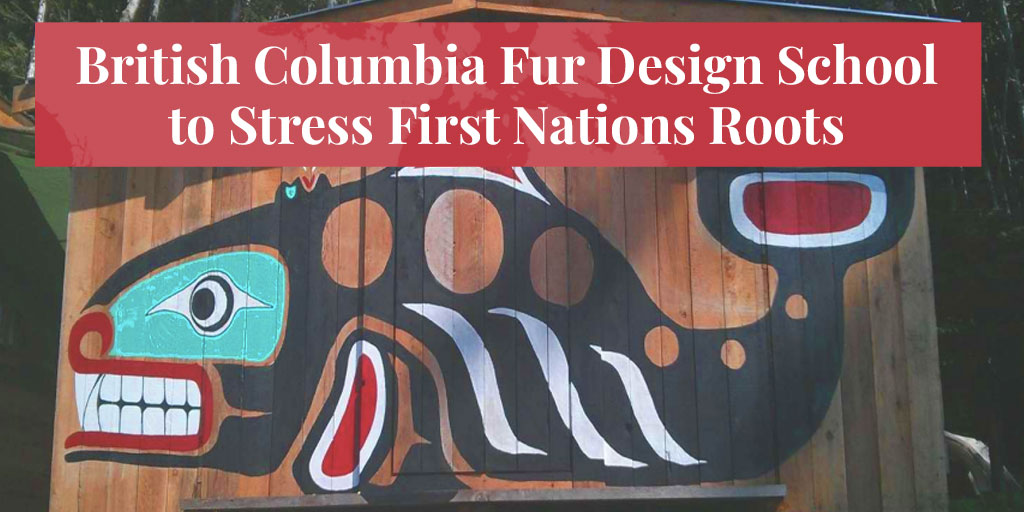
Canada's First Nations have been harvesting fur for 4,000 years. Artwork: Tom Sewid.
A fresh opportunity is coming soon for future designers to receive a holistic education on working with fur, against a backdrop of its cultural and historical importance to British Columbia's Indigenous First Nations.
The Learning Hub of Education and Design School will be held in Alert Bay on the 'Namgis Indigenous First Nations Traditional Territory of Vancouver Island. It’s a product of a partnership among BC's First Nations, Pacific Balance Marine Management Inc., and Nanaimo-based FurCanada. The ultimate aim of this partnership is to re-establish sealing and the fur trade as an important player in the economy of BC, where commercial sealing ended in the early 1970s. The Learning Hub executive would like to thank the 'Namgis First Nations for sponsoring this program.
Pacific Balance Marine Management Inc. is a First Nations group pushing for a license to sell pinniped products, including furs, human and pet food, and seal oil. FurCanada, which will organise the Learning Hub, is a fur manufacturing company in Nanaimo specialising in luxurious home décor, including blankets, pillows, floor coverings, garments, furniture and accessories. It is also known for its museum-quality taxidermy mounts.
FurCanada CEO and president Calvin Kania had hoped to welcome the inaugural batch of students this March, but Covid-19 has pushed the launch back to at least November. Once the green light is given to proceed, 25 students will engage in 10 days of intensive study, with all materials, tools, machinery, accommodation, meals, transportation, field trips and instructors covered by a nominal fee of $500 per head. Prior experience will not be a factor in the selection process, but prospective participants must demonstrate a genuine interest in learning about fur, including its history. For full details and updates about applying, see FurCanada's website.
Expert Instruction
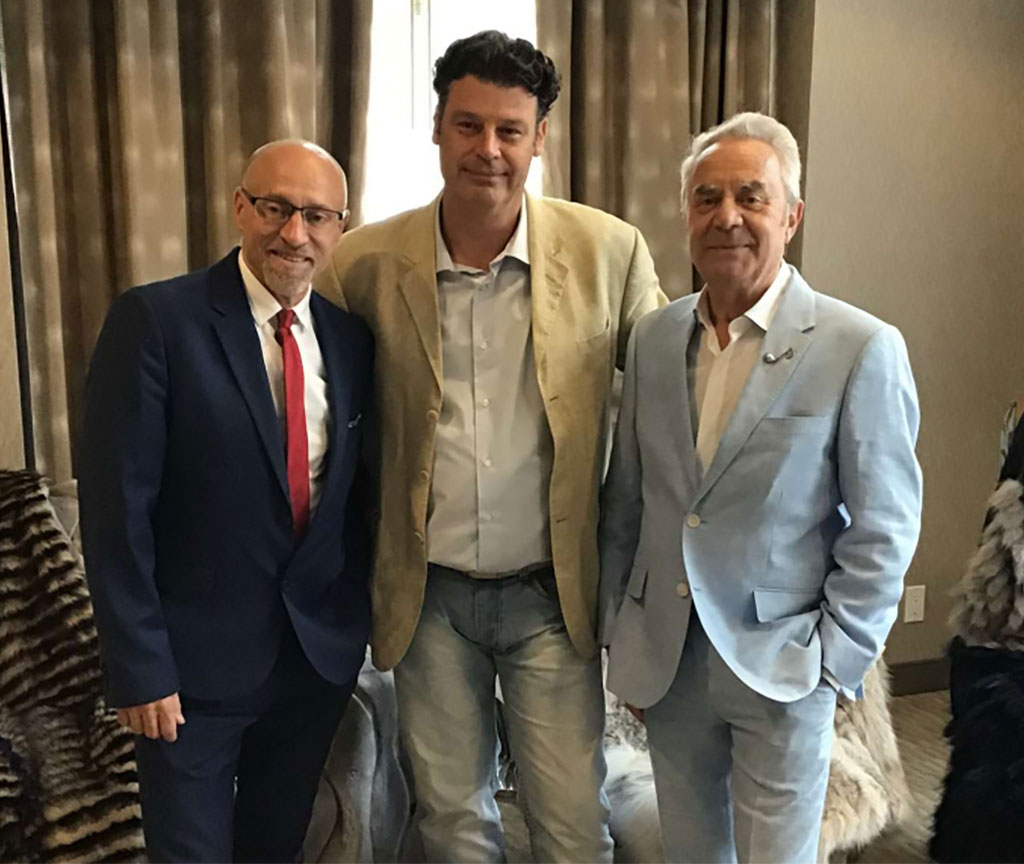
Calvin Kania with expert instructors Panagiotis Panagiotidis and Vasilis Kardasis.
Instruction will be provided by two experts with extensive
international résumés.
Heading the program will be Prof. Vasilis Kardasis, who is
currently FurCanada's Innovation and Design Director responsible for the
company's Seal Fur Workshops. He is a visiting professor at the Royal College
of Art in London, England, and has done stints at Dior, Givenchy, Balenciaga,
Saga Furs, and Studio NAFA.
Assisting him will be Panagiotis "Panos"
Panagiotidis, currently Master Furrier and Production Manager at FurCanada.
Like Prof. Kardasis, Panagiotidis has years of experience working with European
fur companies, and the two previously cooperated in organising the Summer Fur
School in Kastoria, Greece.
Under their tutelage, students will work with a range of furs, including seal, beaver, mink, sable, fox and coyote. They will practice stretching and nailing (“blocking”) skins, and proper handling of a fur knife when cutting pelts to fit a pattern. They will also be taught how to sew furs and leathers – including smoked-tanned moose, elk or deer – by machine and by hand. And they'll work with textiles ranging from traditional hemp to modern, high-tech fabrics. Plus they'll spend half a day covering the basics of one of FurCanada's specialties, taxidermy.
To broaden their understanding of the fur trade still further, students will take field trips to a mink farm (Covid permitting), a trapline, and a fur retailer, and they'll take part in a First Nations seal harvest where they will learn proper retrieval and how to remove hides, blubber and meat.
Special Advisors, Guest Speakers
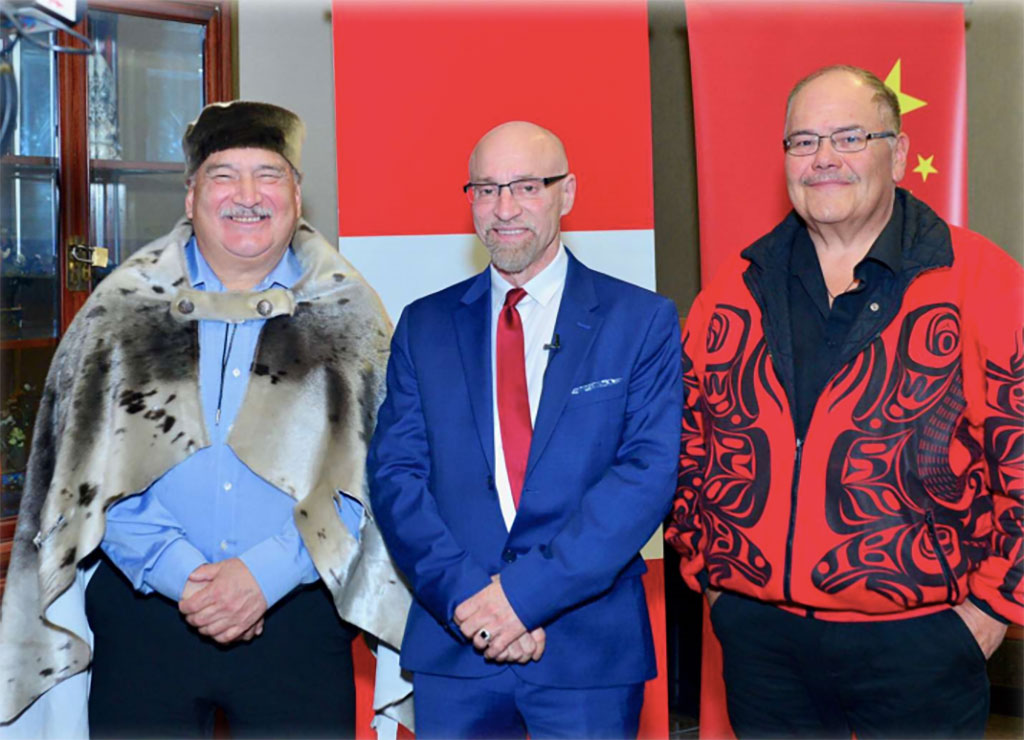
Special advisors Chief Roy S. Jones Jr. (left) and Tom Sewid flank Calvin Kania.
In devising the Learning Hub program, FurCanada wanted to
reflect the strong roots Canada's modern fur trade has in the 4,000-year-old
culture and heritage of the First Nations. For this, it was imperative to bring
the right advisors on board.
This role has been filled by three British Columbians, who will also serve as guest speakers: Chief Roy S. Jones Jr. of the Haida Gwaii First Nations; Tom Sewid, artist and commercial fisherman, of the Kwakwaka’wakw First Nations; and Chief Brian Wadhams of the 'Namgis First Nations.
Other guest speakers will represent fur retailing, trapping,
fur farming, fur manufacturing, taxidermy, auction houses, tanning, and
industry associations. There will also be government officials on hand to
explain the importance of environmental protection and animal welfare in this most
regulated of industries.
Last but not least, two special slots have been reserved for
media representatives to join the program, so they too will learn about the fur
trade and be able to tell our story. "We want the world to know First
Nations fur trappers and the Canadian fur trade are here to stay, to revive, to
flourish and to succeed," says Kania.
Why Teaching Matters
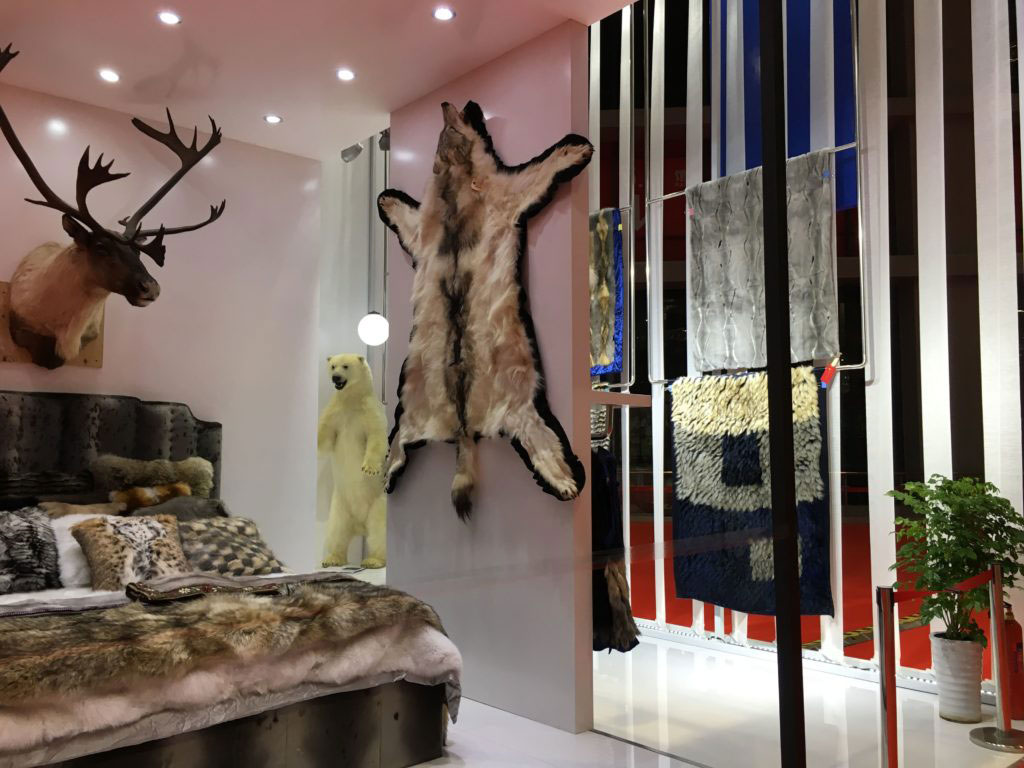
FurCanada's booth at the China International Import Expo 2019, Shanghai.
While the Learning Hub program is new, it's not FurCanada's
first foray into the world of teaching: last March it launched a series of Seal
Fur Workshops. So what drives Kania and his team to educate others?
"Perseverance and passion for the trade, passion for fur trappers, passion for Canada’s cultural heritage and our country’s history. There wouldn’t be a Canada today if it were not for the fur trade," says Kania. "And above all, passion for the animals that were sustainably harvested with the world's top state-of-the-art traps – which happen to be the most humane trapping devices available anywhere.
"I come from a fur trapping family, so it was very important to me that this element of the trade takes a leading role in this program. Fur schools have come and gone over the years, but none that I can recall enveloped the entire trade in one program. No other country has all the elements as Canada does – wild fur, farm-raised fur, trappers, fur auction houses, furriers, manufacturers, designers, tanners, and fur traders.
"And of course there's my passion for Indigenous First Nations people and their struggle within Canada. Among many issues facing the fur industry, the trade itself will have to come to terms at some point in acknowledging Indigenous reconciliation. Now, more than ever, is the right time to change the channel on how our trade functions. It’s time we think outside the box and make some radical changes if we wish to see it survive another 400 years. It starts with educating young people, one person at a time."
So is this how the Learning Hub fits into Kania's vision?
"Yes. In general terms, we want to ensure the preservation and continuation of the fur trade in Canada and also worldwide," he says. "And for the Canadian industry to survive and succeed in the 21st century, we must reach out to our most important benefactor, ally and the original producers of fur – the First Nations. The fur trade existed and flourished among First Nations long before white settlers arrived on our shores."
More specifically, the Learning Hub curriculum is designed
to give students a combination of practical skills and the knowledge they will
need to go out into the world and represent the fur trade accurately.
"For the fur designers and furriers of tomorrow to prosper, they should acquire as much knowledge as possible, not just about working with fur, but also where it comes from and its history," says Kania. "Learning Hub students will be the future of the trade, and we must give them the necessary tools to carry us forward."
***
To learn more about donating to Truth About Fur, click here.
Fur Trade Tales feature real-life stories from real people of the fur trade. This is our third Trapline Tales, but… Read More
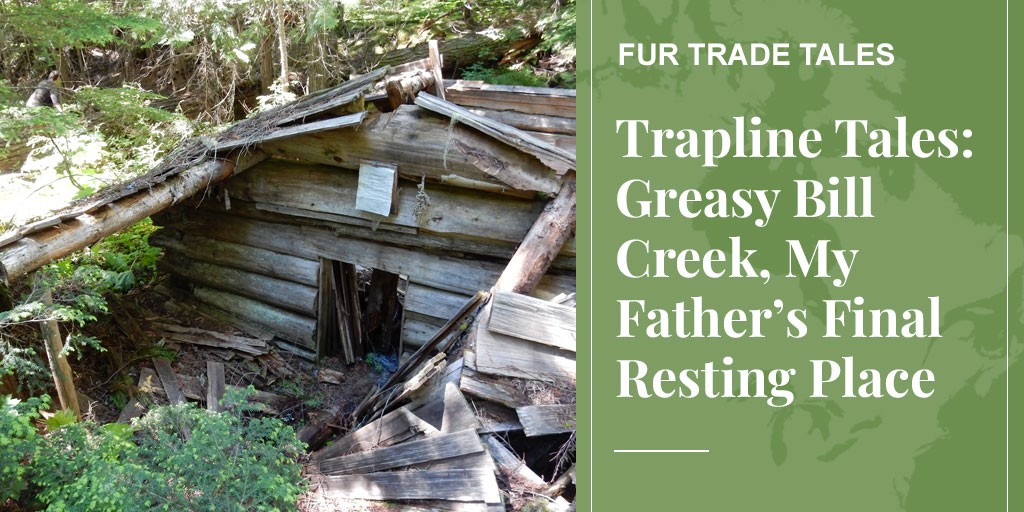
Fur Trade Tales feature real-life stories from real people of the fur trade. This is our third Trapline Tales, but look out for Fur Farm Tales, Furrier Tales, and more to come. If you'd like to contribute, please contact [email protected]
I love reminiscing about the wholesome way of life I experienced growing up in British Columbia on my parents' trapline in the 1960s and '70s. In this instalment of Trapline Tales, I'll introduce an old trapper who played an important part in our lives, even though none of us even know who he was: Greasy Bill.
Our trapline was registered in my father's name only, but rest assured it was every part my mother’s trapline too. Often she was a weekend widow throughout the winter months, but after I left home, both my parents spent many a day on the trapline, and great times they were.
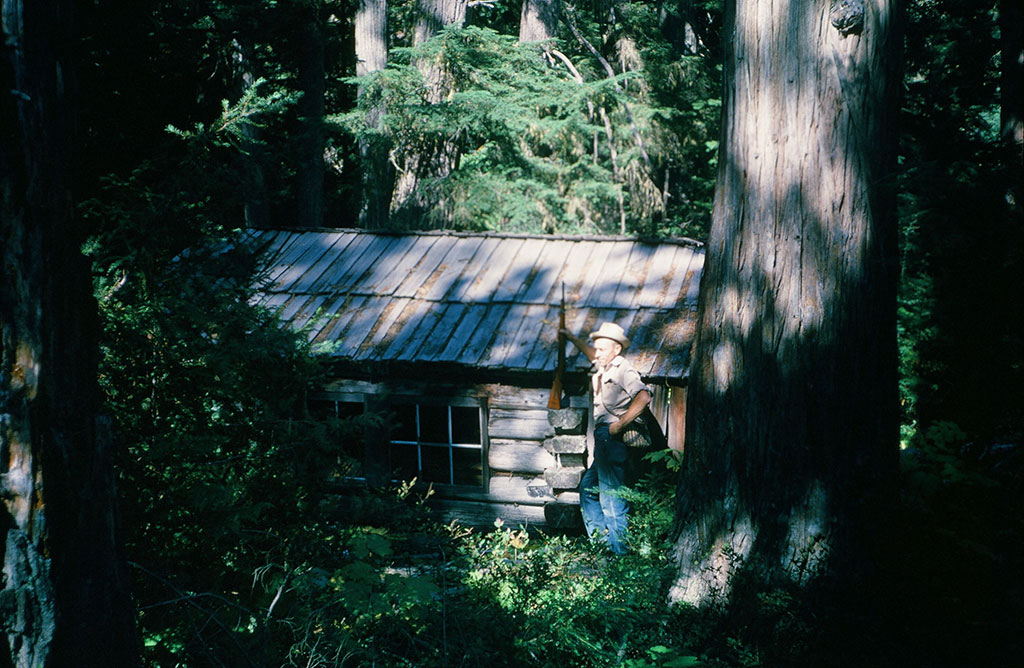
So one November, Ma and Pa (as they called each other) headed for a trapper's cabin located at the confluence of Grizzly Creek and Greasy Bill Creek to get ready for the season that was upon them. The cabins on Dad's line were built in the 1940s by old-time trappers, this one by a trapper called Greasy Bill. I'm not sure why he got that nickname, but I can only imagine!
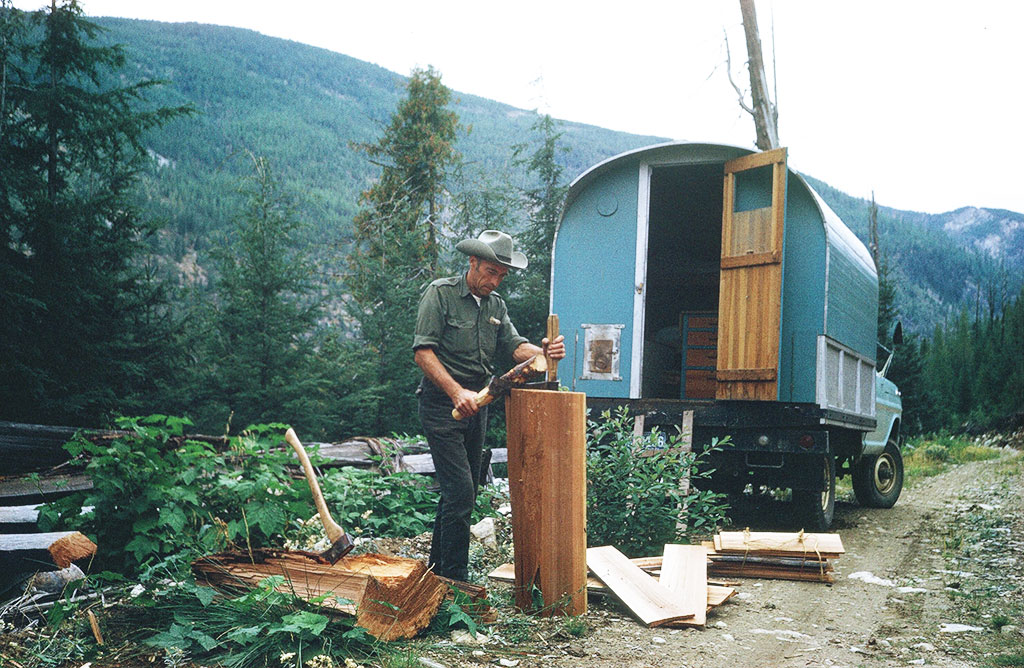
The cabins were small, built from large timbers of western red cedars and roofed by hand-split cedar shakes. They were low-rise structures typically fitted with one window, one door, a table or bench and two chairs, a bed, and a wood-burning stove. Flooring was made of wood planks, and a large overhang extended out the front of the porch to keep the firewood dry and to provide a place to hang furs while they were drying. Furs were also dried inside the cabins, but sometimes the ol' wood stove would be pumping out so much heat the furs could dry too fast.
My father, Ed Kania, outside Greasy Bill's cabin in 1968.
My father liked getting out in November for beaver trapping so he would have marten bait later in the season. For the beaver trapping, he would take the truck back out of Grizzly Creek and head up into the main valley of Koch Creek to a place called Camp Eleven, an old logging camp of the 1940s. Just down the road at Camp 10, which was the main logging camp, is where David Suzuki’s father almost lost his life in an avalanche. My father's trapline has a lot of colourful history. You could never see any beaver activity from the upper road, but once you got down into the main creek, there was beaver logging everywhere.
At the end of their beaver trapping day, my parents settled into their evening of playing a couple of card games, probably whist or pinochle as that’s what we grew up with, and a shot of rye whiskey was course for the evening. It being November, the rains started to fall, the fog rolled into the narrow valleys and a dampness set in, but with the wood stove burning, Greasy Bill's cabin was toasty warm.
Wood is the best heat as it’s the most comfortable. My home on the west coast is electric baseboard as back up, but I have wood-burning stove inserts upstairs and downstairs. If it gets too warm, I just open the doors to outside and don’t feel the least bit guilty.
My father splitting cedar shakes in 1974.
As my parents' evening of playing cards came to an end, they settled into bed. The coal oil lantern was turned off and left on the kitchen table across the room. It was pitch black. My father could not see his own hand in front of his face. As he was getting comfortable, my mother was already sound asleep and blowing the horn. He chuckled to himself, lying thinking about what and where wolverine and lynx cubbies he was going to build over the next few days. Then he realized that darned wood stove was pumping out the heat again, so much so that he reached over and unlatched the door to the cabin, which slowly opened and a coolness wafted in.
Mystery Visitor
He was lying there thinking of tomorrow when all of a sudden he heard footsteps - four of them. It was right there beside the bed, beside him. It took a few sniffs, walked into the cabin, and sniffed around some more.
My father lay there, thinking out loud in a whisper, “Coal oil lantern on the kitchen table, flashlight on the cupboard bench, rifle standing in the corner on the other side of the room. Hmmm, what now?"
He thought, “The nearest light is the pack of matches in my pants pocket at the end of the bed. Any slight move is going to spook or provoke this animal in perhaps not a good way. What do I do?"
It was either a lynx, wolverine, coyote, bobcat or young black bear. Its footsteps were heavy enough to be any of those. He was anxious to see what it was that so innocently entered the cabin, but if he made a dash across the floor to the flashlight on the bench, there was a good possibility of a mid-room collision. Nah, not a good idea.
He had to be quick, so the matches at the end of the bed were his best bet. He abruptly sat up, grabbed his pants, twisted them upside down, right side up, fumbled for the matches, only to find they were a bit damp and didn’t want to light right away. At the same time the four-legged creature made a quick exit out the cabin door and into the darkness.
While all this commotion was taking place, my mother snorted lightly a couple of times, woke up, and in a groggy voice said, “Huh, what’s going on?” My father replied, “Ahh nothing, I’ll tell you in the morning.”
It being November and the rains upon them, snow had not quite reached the cabin area, so there weren't any tracks to look for in the morning. The mystery animal will be a mystery forever.
Changing Times
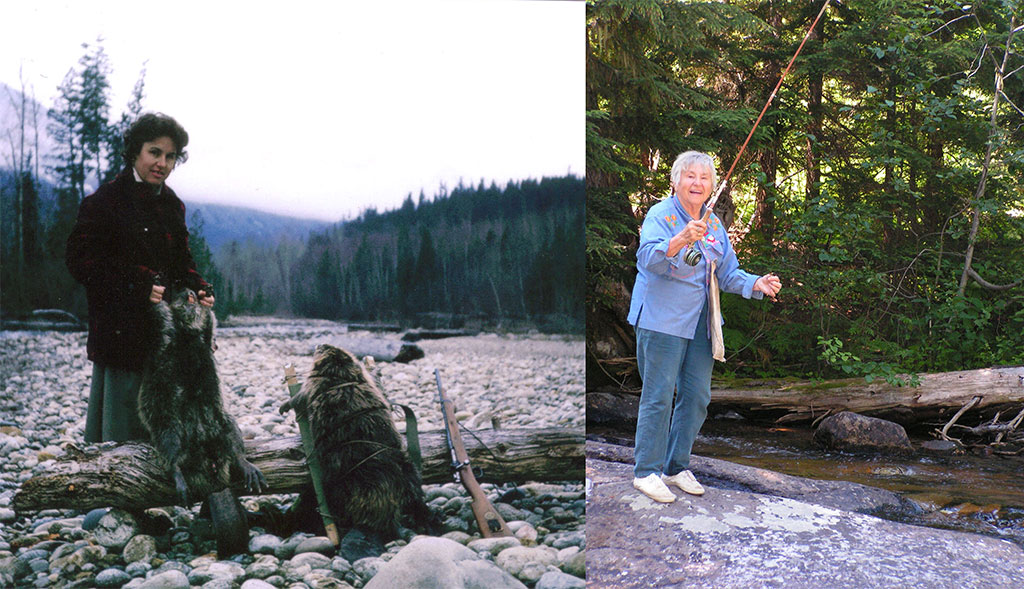
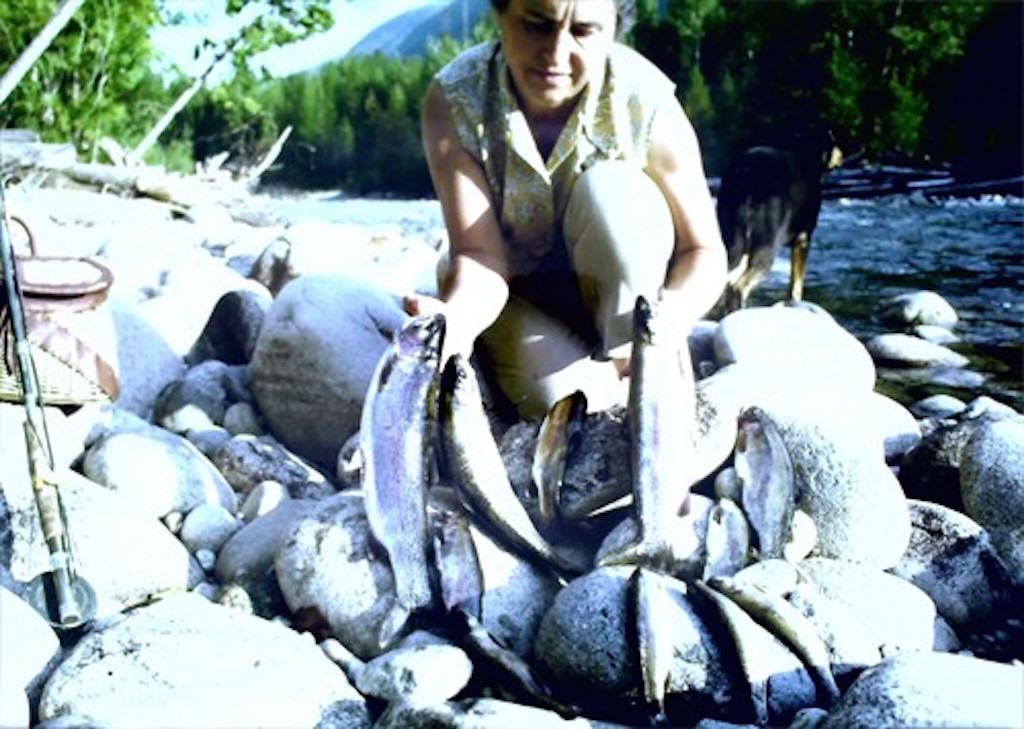
How time flies! My mother out on the trapline in 1968, and fishing for trout in 2009.
They were great times. Everyone was accepting of the lifestyle, and the Hudson’s Bay Company (HBC) ruled the fur market in Canada from buying trappers' fur pelts to selling fur garments in their department stores from Victoria to Halifax. Although HBC Point Claire Quebec Auction House did have competition from rivals Dominion Soudak in Winnipeg, Ontario Trappers Fur Auction in North Bay, and Ted Pappas at Western Canadian Fur Auction Sales in Vancouver, they still ran the show. Oh, how times have changed.
Today, I find myself criss-crossing China and other parts of the globe searching out markets for our furs. We have to, as many Canadians no longer understand our trapping heritage. That’s right, our fur trapping heritage.
Canada does have a unique fur-trapping culture which is one of the building blocks of our nation, but it seems that many Canadians are ashamed of it. I will probably take flak for this, but much of the blame lies squarely at the feet of the Canadian fur industry as we allowed this to happen. Companies like Canada Goose should receive the Order of Canada for promoting fur to Canadians. Instead, they’re scapegoated by animal-rights terrorists and an ill-informed public. There is nothing more natural than fur.
Canada is the leading nation when it comes to international trapping standards. We are signatories to the Agreement on International Humane Trapping Standards (AIHTS). I sat on that committee in the early years when Canada was forced to adopt trap standards in order to meet European Union legislation on the importation of wild fur.
Sharing the Land
Speaking of the changing world, I want to share a story with all trappers across Canada. Be very aware of your trapping rights. It’s your heritage and don’t let anyone tell you otherwise.
You have to protect yourself against the possibility that, despite following all proper procedures, a domestic animal or pet could unfortunately be captured or harmed. With modern trapping standards this doesn't happen often, but it can happen. I cannot reiterate enough the importance of having liability insurance on your trapline to cover any eventuality.
Be very aware of your trapping rights. It’s your heritage and don’t let anyone tell you otherwise.
This past winter we found ourselves in a difficult situation. My assistant on the trapline accidentally caught a pet dog in a bobcat set. He was cleared of any wrongdoing by the Provincial Conservation Officer Services; he had followed the law and proper procedures to the letter. My trapline is on Crown Land as all Registered Traplines are in British Columbia. It's also on Sinixt First Nation Traditional Territory for which I sought permission to be on and was granted permission. However, after a few months we were served with a civil lawsuit by the pet owners in the Supreme Court of British Columbia in Vancouver.
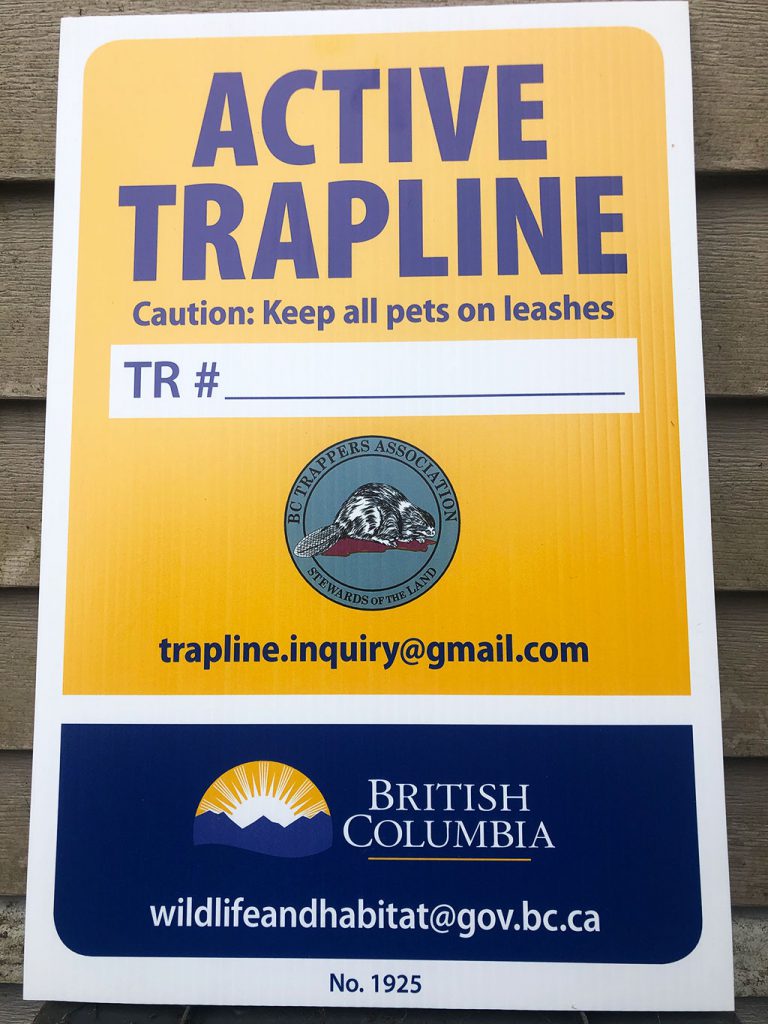
As more city people move into rural areas, the potential for problems increases and trappers are doing what they can to avoid conflicts. For the 2019/20 season, for example, all Registered Traplines across British Columbia will be posted with "Active Trapline" notifications. The BC Trappers Association is working with the Ministry of Forests, Lands, Natural Resource Operations and Rural Development in rolling out this program.
I would also urge fellow trappers to consider posting a notice in your local paper, advising the public about trapping seasons and reminding them of the importance of keeping dogs on-leash - for the welfare of ground-nesting birds and prevention of harassment to other wildlife, and reminding the public about their own responsibilities in the woods.
Trappers also need to put your local Conservation Officer Services on notice that you expect them to enforce the law under the Wildlife Act and lay charges against anyone interfering with legally set traps. If you are worried about interference, trail cams can help to document unlawful acts.
As for our lawsuit we have reached an agreement with the plaintiffs in which the details are locked up in a confidential contract and cannot be disclosed.
Return to Greasy Bill Creek
My father passed away in November 2015, on his 97th birthday. A few days before he died, I took my mother to visit him at the seniors home, she knelt down beside his bed and asked, “Well Pa, do you have any regrets?” "No Ma, I don’t," he replied."We did everything we wanted to do in life and more. Heck, we pretty much outlived all our friends. What about you Ma?” She answered, "No Pa, none."
The service for my father was two weeks later, family and friends attended from far and wide. Through the whole ordeal and for several months after, I never once saw my mother mourn or grieve. Was it shock? Or was it just because they had been together so many years and it was time to go?
The following summer the family arranged a week-long gathering to celebrate my father's life. The whole family - children and spouses, grandchildren and great grandchildren, uncles, aunts, cousins, in-laws and out-laws - converged on the family homestead. A celebration it was!
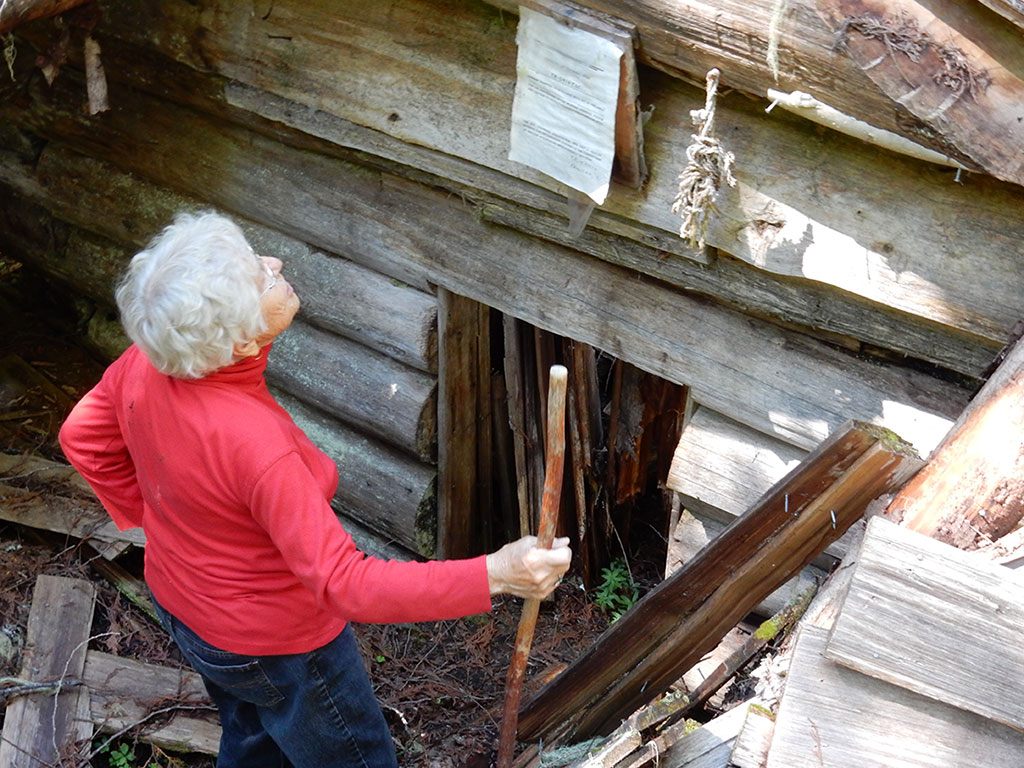
We arranged one of our favourite family outings, heading to Greasy Bill Creek for a fish fry. Kids and adults were fitted with fishing licences, fly rods and flies, and were dispersed in all directions up and down both creeks to catch lunch, with instructions to return by 1 p.m. As we approached Greasy Bill's old cabin, we found it had seen better days. A large hemlock next to the creek had decided to lay its timber across the roof of the shack, and it had caved. But the door was still upright, and above the doorway a sign read, "Trappers Cabin, please respect it and keep door closed. Ed Kania - Trapper".
As soon as my mother read that, was the moment she broke down and grieved and mourned. It was then and there that took her back to those marvellous days on the trapline with a man she had married 72 years earlier.
My mother broke down on reading a note left by my father years before at Greasy Bill's cabin.
Welcome to Fur Trade Tales, our series of real-life stories from real people of the fur trade. This is our… Read More
High country of the Selkirk Mountains, British Columbia. Photo: Calvin Kania.
Welcome to Fur Trade Tales, our series of real-life stories from real people of the fur trade. This is our second Trapline Tales, but look out for Fur Farm Tales, Furrier Tales, and more to come. If you'd like to contribute, please let us know at [email protected]
As a teenager growing up in the Selkirk Mountains of British Columbia, trapping with my father in the high country was exciting and fun. He taught me to respect the animals we trapped because they gave their lives for our livelihood. For him, it wasn't how many he caught, but how he caught them and in particular how humanely he could do so. He felt there had to be better methods of trapping and better tools than were on the market.
While Dad pursued his dream of making a better mouse trap, I was more inclined to pursue the next marten or muskrat. I loved marten-trapping because we did it in the high alpine country. It was always a struggle to get there in January, with the steep inclines of the logging roads and the fresh powder snow, but it was worth it – pristine country, brisk, fresh, pure white and untouched, under a clear blue sky. We would find a big ole spruce or hemlock tree with the boughs drooping down to create shelter from the five feet of snow that lay around, then under the tree we'd build a fire and make a pot of tea.
But make no mistake, trapping in the high country is anything but easy. As you will hear in the tale I'm about to tell, it requires perseverance and stubborness.
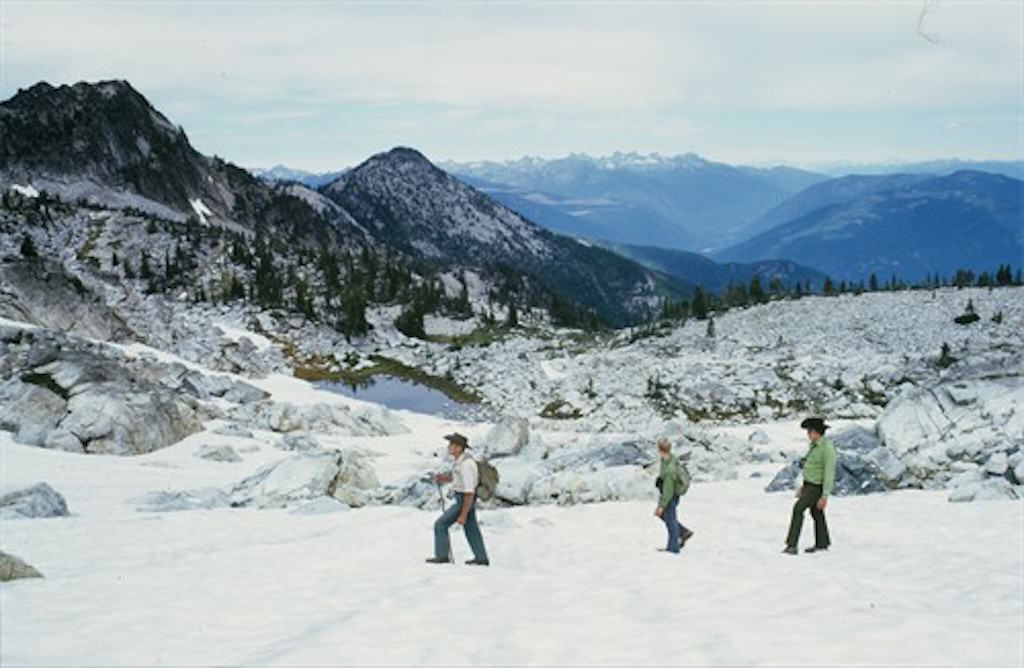
Summer hiking in the high country of the Selkirk Mountains in the mid-1970s. Dad takes the lead, while our friend and fellow trapper Vern Varney brings up the rear.
One Sunday in the summer of 1974, when I was 15, my parents and I headed up Airy Creek, a pristine area we had not trapped for five years, for berry picking and a fish fry. Picking berries has always been one of Mum's favourite things, and along the way her eagle eyes were hard at work. "Stop the truck," she cried. "I see some huckleberries!"
Now a few years earlier, she'd wanted to pick wild strawberries and dragged me along to help because that's what kids were for in those days. Do you have any idea how small wild strawberries are? About the size of a small button on my golf shirt. So imagine how long it took to fill an ice cream pale. All day. So when Mum got excited about picking those huckleberries on her own, we stopped the truck right away. "Yep, no problem Mum! Way you go! See you later!"
Fish Fry
Dad and I then ventured on up the old logging road until we came to a spot where a bridge used to be. The timber company had not logged here since 1970, so they hadn't kept up with road and bridge maintenance. Most logging roads in British Columbia are "de-activated" if the logging company is not intending to log the area again for some time, and with the total loss of this bridge, you could definitely say it was de-activated. The creeks here are not that big to traverse, but big enough to keep our truck and snowmobiles out when there's no bridge. Anyway, Dad decided if we were going to trap into the head end of Airy Creek, we needed to find a way to cross it come winter time.
Since it snows very heavily in the Selkirk Mountains, it wouldn’t take much to make a bridge to hold a snowmobile. So we got busy cutting three good-size hemlock trees and fell them across the creek side by side. We then winched them up onto the road bed on both sides of the creek, and cabled them to some larger trees on the bank.
By this time it was getting late in the afternoon and Mum finally caught up to us with her bucket of freshly picked huckleberries. She looked around and asked where the fish were. "In the creek," says Dad. "Are they cleaned yet?" "No, they're still swimming around." "Boy," she says, "I send you two up here to catch some fish for supper and you're fooling around with logs. Don’t you get enough of that around the farm? If I have to do your work and mine, so be it." And off she went with her fly rod.
"I send you two to catch some fish for supper and you're fooling around with logs!"
About an hour later she emerged with a few trout and saw no fire or tea pail boiling. Yep, we dropped everything in an instant and got on that fire and cleaned the fish!
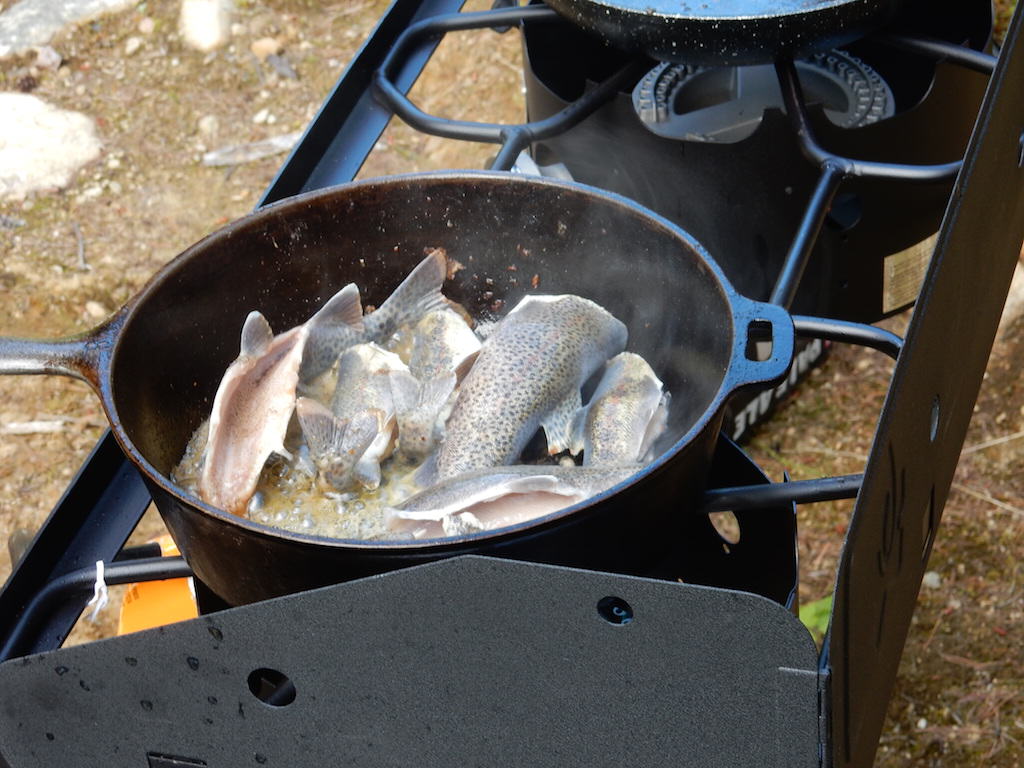
Let me tell you, there is nothing better than a fish fry on an open fire on a beautiful summer afternoon. The fire is ready, the black cast-iron pan is hot, and half a pound of butter is thrown in to melt. The fish are gently laid in the pan, but before you know it, they curl up so fast. With fresh home-baked bread, tartar sauce, fresh cucumbers and tomatoes from the garden, those little trout tasted so good with our freshly boiled tea.
The day came to an end and we were all full of Mother Nature's bounty.
Nothing beats a fish fry on an open fire on a beautiful summer afternoon.
Bridge-Building
That fall, Dad and I drove up to check on our bridge, hauling along some 1x4 wood planks Dad had sawn up on his portable sawmill. The three timbers were still in place, and we laid the planks across them so they looked like a railroad track.
But those planks were still two feet apart from each other, so we spread some hemlock boughs across them. In this high country in winter, the snow falls gently in big flakes and accumulates very quickly. By the time we were ready to trap, there would be four feet of snow piled up on that makeshift bridge, and our snowmobiles would have no problem crossing.
We never trapped the high country until after Christmas. Snow in December came hard and fast, accumulating at two or three feet a week, and that made it almost impossible to break trail to check the line every few days. So we usually left it until mid-January when the snow eased up, started to settle, and gave us a good base to travel on.
Trapping Time
January was now here and it was time to trap some marten, lynx and wolverine up Airy Creek. I was so excited as we got our gear together – traps, bait, hatchets, nails, snowshoes, extra gas, and a sled to pull our supplies.
And for goodness sakes, we couldn’t forget our eau du toilet marten call scent (see recipe here). After all Mum had endured during our creation of this fine call scent, we'd darn well better not forget it! It was such a wonderful scent that it was stored in a quart jar with a lid and a very stiff 12-inch metal wire handle wrapped around the base of the lid for carrying. Even us trappers didn’t want to get any of it on our mitts or clothes!
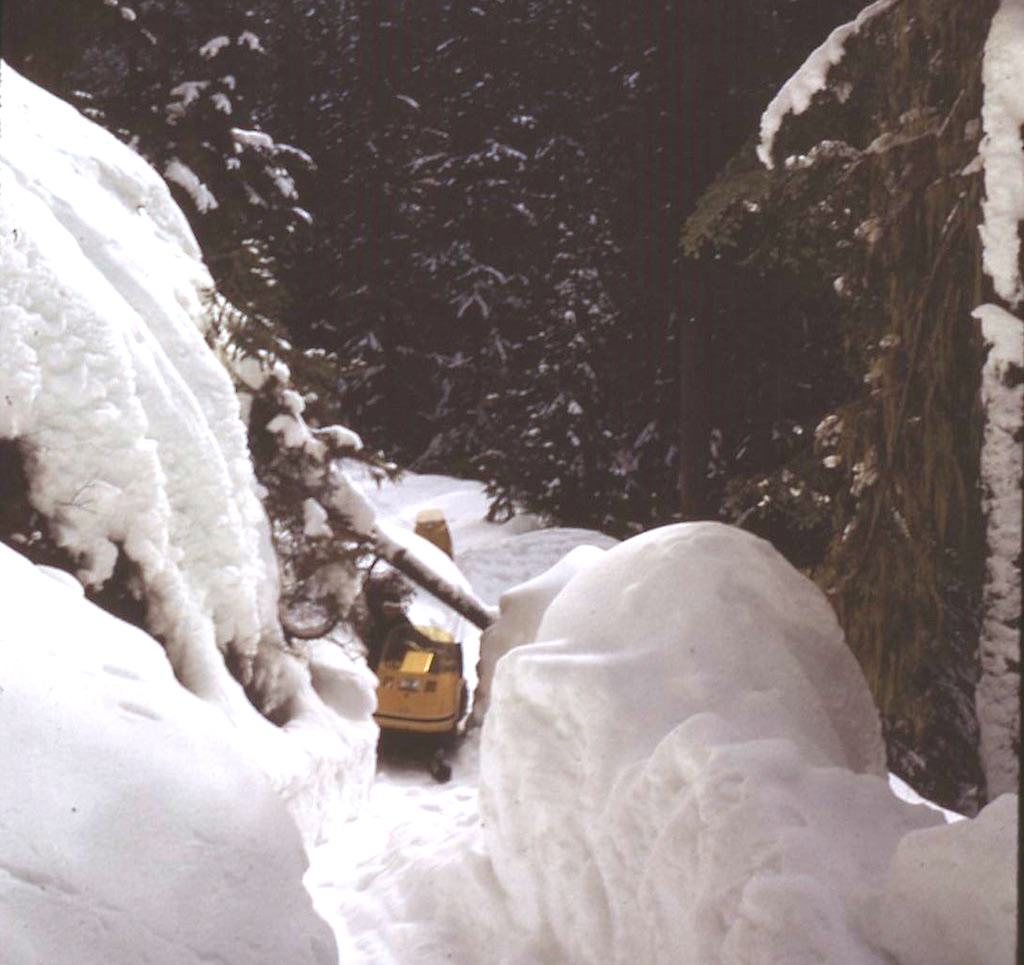
With both snowmobiles mounted on the trailer – our vintage Bombardier and the newer Ski Doo Elan – and all the supplies loaded up, we started the truck and headed down the road. We reached our destination within half an hour because the logging company had kept the main road open. There we unloaded our equipment, fired up the snowmobiles and off we went, breaking trail over the old logging road.
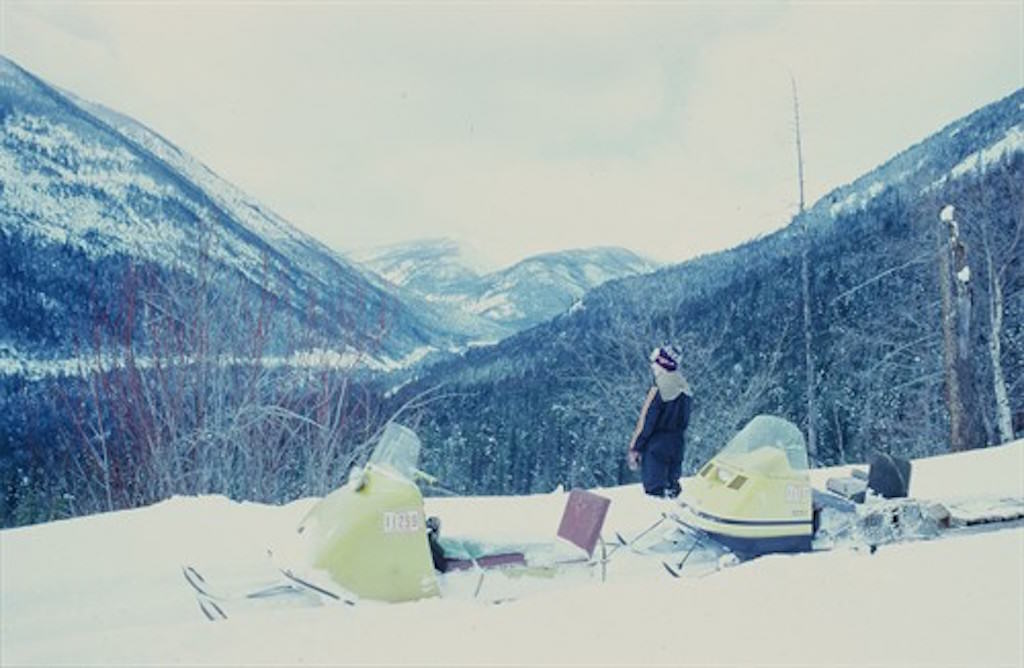
Here I am on our trapline in the mid-1970s. At left is our Bombardier snowmobile, bought in 1963 and the first in our area. We used the larger Ski Doo Elan to pull our sled.
It was pretty easy at this point as most of the road bed was level. Then we started to climb, and the machines slowed as we were now pushing snow, but we finally reached our bridge without having to break out the snow shoes.
"Wow! Look at that bridge!" I yelled. It was a thing of beauty. At least four feet of snow was piled up on it and it had a bow in it, but not to worry, Dad said. We got out the snow shoes and carefully walked across, packing the snow so it would be easy for the snowmobiles to cross.
Dad went first with the Bombardier. It was smaller and lighter than the Ski Doo so it could stay on top of the snow better and was easier to break trail with. He fired it up, gunned it, and was across in no time.
Now it was my turn, and I was pulling the sled. "Don’t go so fast," warned Dad. "If the sled slips off the bridge, you’ll be going with it into the creek." Oh gee thanks, wasn’t that something to look forward to! I was also scared of heights even at that early age. "Don’t look down," he said, "just straight ahead. When you get to this side you can gun it 'cause we have a steep hill ahead and we need as much traction as we can get before we bog down."
I let him get a couple hundred yards past the bridge before I started across. "Don't look down!" I kept telling myself, and lo and behold, I was across and feeling exhilarated. Now the work begins, I thought, because I knew those snow shoes were going to get a good workout breaking trail further up.
My machine was doing well because I was following in Dad's broken trail. He was already out of sight around the first bend because we were not to stop. We were gaining elevation fast and had to break as much trail as we could. Then I came around the next bend and there he was, stopped! What the !? We hadn’t gone a quarter of a mile. "What happened to the road?" I asked. "There isn't any," he replied. "It's down there at the bottom of the creek."
Mega Project
All of our summer work, gone in a flash. There it was, no road, for all to see. Over the years since the timber company last logged there, one spring the creek must have been high and washed 100 yards of road entirely away. All that was left was a barren hillside of sand and gravel with a drop of 300 feet to the creek below. "Now what?" I asked. "I guess we just start building a makeshift trail across the hillside along the bank," Dad said.
Well, if you think the bridge-building was a project, this was going to be a mega project. But first we had to build a trail under the trees that came off the hillside and piled up on this side of the road where it ended in mid-air. Of course it would have been a whole lot easier to have checked out this road last summer before we went to all the trouble of building a bridge.
Trail-building along a hillside was a mega project!
It took us all day to build a trail across that embankment. It was a good thing we always carried a snow shovel, and Dad knew a few things about road-building having worked on the Alaska Highway during World War II.
We decided to break some more trail before daylight ran out, but we'd only gone another half mile when I'll be darned if we didn’t hit another washed-away road. We shook our heads in bewilderment. "We've come this far and done this much work," said Dad. "There's no turning back now. We’ll just come up tomorrow and work on this section."
Well, we eventually found our way to the head of Airy Creek, and that winter caught 35 marten, two lynx and three wolverine. There were remnants of old logging camps scattered about, some going back to the 1940s, and an old collapsed cookhouse and bunk house were great locations for our lynx sets. No more washed-out roads, and our bridge held up through the season.
We did it for income, of course, and it helped that Dad knew how to stretch a penny. But we also did it for the love of trapping, and for simply being out there. And we couldn't have done any of it without Dad's perseverance and stubborness, qualities which he passed on to me and which have helped me survive close to 50 years in the fur trade.
Welcome to Fur Trade Tales, our new series of real-life stories from real people of the fur trade. We kick… Read More
The author hard at work in Fur Canada's store with executive assistant Jialin.
Welcome to Fur Trade Tales, our new series of real-life stories from real people of the fur trade. We kick off with our first Trapline Tales, but look out for Fur Farm Tales, Furrier Tales, and more to come. If you'd like to contribute, please let us know at [email protected]
Everyone in the fur trade has tales to tell, and I am honoured that Alan Herscovici – the creator of Truth About Fur – thinks mine are worthy of launching Trapline Tales. It’s the least I can do. Alan has devoted his working life to the trade, sometimes at great personal cost, and has been a passionate spokesperson to the media on behalf of us all. We owe him a great debt of gratitude.
Today I run a company called Fur Canada, making a range of fur products, museum-quality taxidermy specimens, and traps, but my journey in the fur trade began long ago, in a place called the West Kootenay, in British Columbia. I grew up there in the 1960s and '70s, and it had to be the best childhood any kid could experience. With my parents and siblings, I learned the ways of living off the land. We grew every kind of vegetable, had milk cows, chickens, horses and beef cattle, and in winter I would assist my father on his fur trapline.
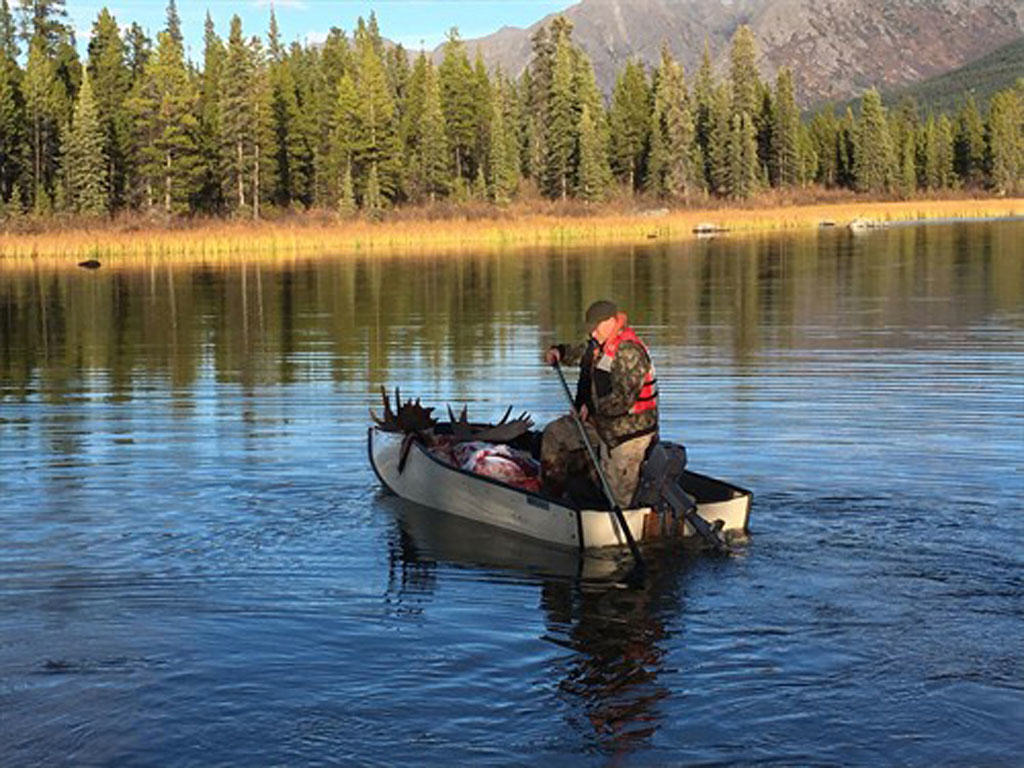
Growing up in British Columbia, I learned many skills for living off the land, including moose fishing!
Snowmobiles – and a Missed Opportunity
Every weekend during winter was a new experience. My father's trapline was 100 kilometres long, and it took us five years just to rotate every corner of it. In 1963, we also acquired the area's first snowmobile.
One day my mother and I were shopping in Nelson when I spotted a parked truck with two big, yellow snow-plowing machines on a trailer. "What are they?" my mother inquired of the gentleman attending them, who happened to be a distributor. He graciously explained how they worked and their advantages over snowshoeing. He called them "snowmobiles", and they were made by a Quebec company called Bombardier. She said her husband was a trapper and might be interested in one, so he followed us home. My father quickly took a liking to these machines, and since it was late, invited the gentleman to stay the night.
Next morning, my older brothers and father road-tested the machines, and by lunchtime the deal was made. We were the proud owners of a brand new Bombardier snowmobile! I still have it to this day, and one day will restore it to its original state.
During that winter and the next, the gentleman made follow-up visits in case repairs were needed. He was very impressed with my father and his success with the machine, because within that first winter, he had contracts with the power company and timber company to check on their power lines and spar tree equipment that was inaccessible in the back country.
On one of his visits he told my father that he was the sole distributor for Alberta and British Columbia, and the territory was now more than he could handle. Would my father like to take over the distributorship for BC? My father pondered for a moment and could only envision the excessive work ahead in promoting, selling and servicing the product during the trapping season – the most important part of the year for him. His answer was an emphatic "No!" I'm not sure he gave much thought to setting up his two teenage sons and me, then just six years old, in the snowmobile business, as fur trapping was his passion. You could say, there was a great missed opportunity for the family, as hindsight is always 20/20.
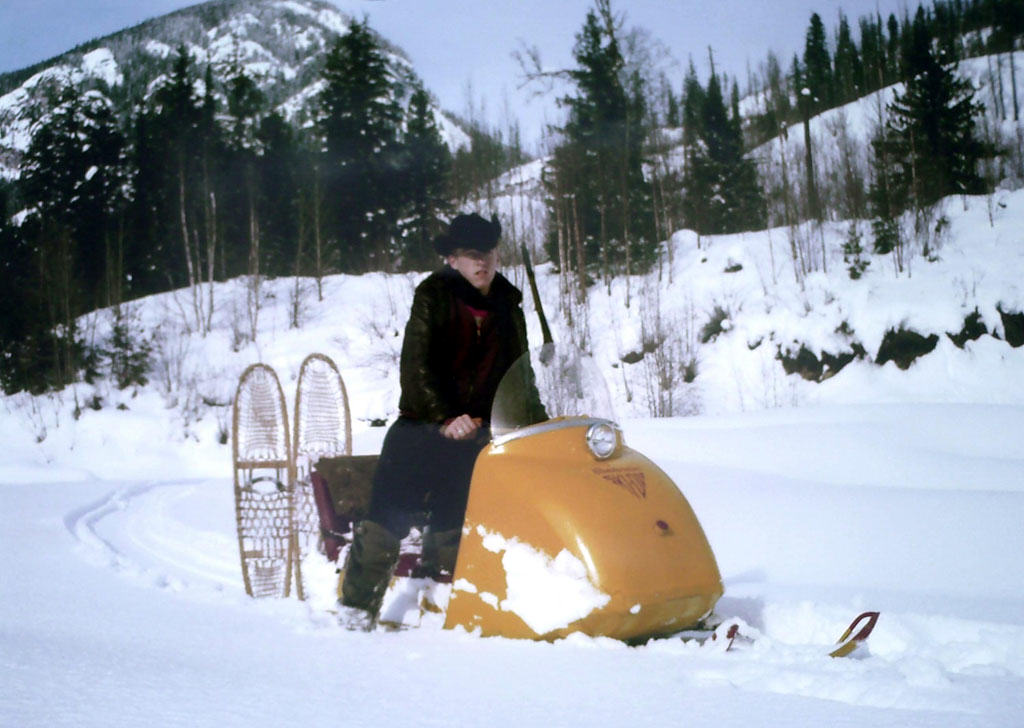
My brother Ken, in 1963, proudly modelling our Bombardier snowmobile.
Breaking Trail
A few years later my father purchased another snowmobile. At this point Bombardier was selling them under the brand name Ski Doo, and our new Ski Doo was called an Olympic.
At 10 years old, I was operating our original Bombardier and my father ran the Olympic, because it was much bigger and heavier. We were trapping in the high Selkirk Mountains, so it was common to get 40-60 centimetres of snow in a week. He would break trail and I would follow. When the snow became too deep and the machines bogged down, out came the snowshoes and I would start breaking trail one step at a time. In that deep, fluffy snow it was difficult, so I would only go about 300 metres and return to the snowmobile. I would get it unstuck, fire it up and away I went. Straddling my freshly broken snowshoe trail, I would get the machine up to full speed until that ole Bombardier hit the virgin snow, go 20 metres and come to a stop, stuck again. Out came the snowshoes and the process started all over again.
Many a Saturdays were spent breaking trail. We would return the following day to set traps. Then a few days later return to check the traps. This kind of fun went on from December to the end of February, when the high-country trapping season ended.
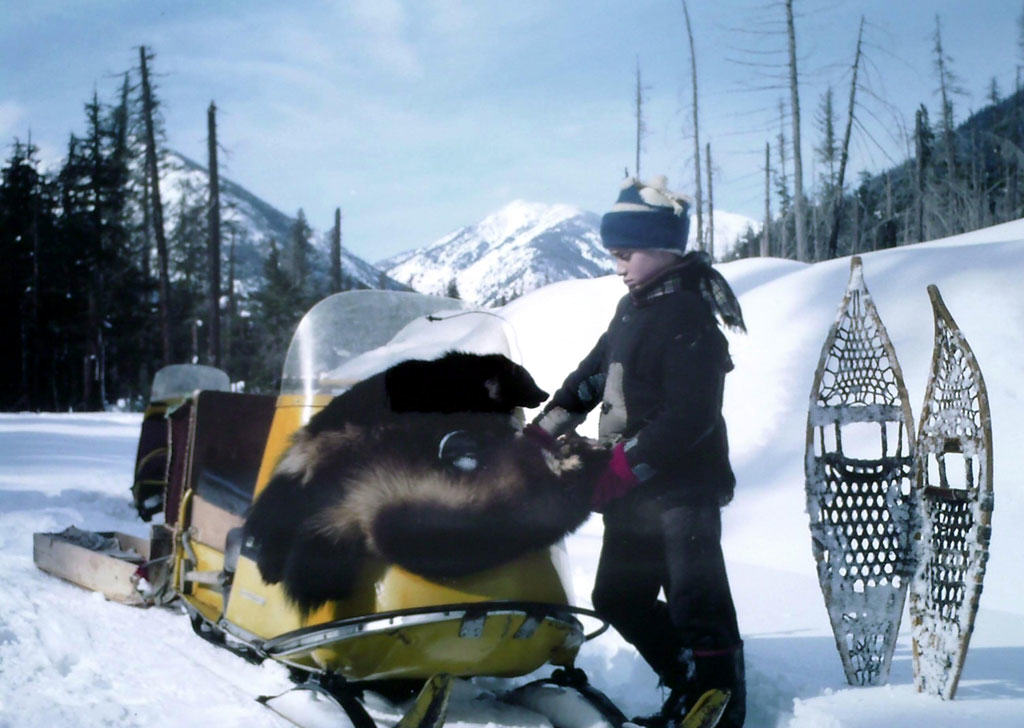
Here I am, aged 10, with our Ski Doo Olympic and two wolverines from our trapline. My father was ingenious, always seeking new ways to outsmart the wolverine.
Stinking Rotten Scent
In the summer there was no trapping, of course, but it was still on our minds, and one of the highlights was making call scent for marten. There were two goals. First, it should not freeze. And second, it should be a stinking rotten scent, and the hot summer weather was perfect for this.
Here's how we did it:
Take 10-20 mink scent glands, and 10 complete beaver castor glands. Chop and mash them into a fine paste, then place in a glass gallon jar.
Add 2 cups of herring fish roe.
Add 1 litre of fish oil – herring or salmon works great.
Stir ingredients until fully mixed.
Place the jar atop the roof in full sun with a light lid cover.
Every 30 days give ingredients a stir.
After 90 days, remove the jar from the roof and secure with a tight lid until trapping season starts.
During the summer, our recipe would cook and percolate on the roof. It was one of those odours that had to be acquired in order to appreciate the effort that went into making this eau du toilet scent.
All trappers understood the value and creativity of such a fine call scent and its importance in trapping marten. My mother, on the other hand, did not have the same appreciation for our efforts. She had a few choice words for us during those hot spells when she was hosting summer garden parties and the marten eau du toilet scent would waft its way down from the roof top and into the party.
Parting Shots
• Shame on provincial governments! Shame on Air Canada! Canada has a free trade agreement with the USA, Mexico, Korea and others, but we don’t have free trade and free flow of goods within our own country! And can you imagine? Our national airline has an embargo on a wildlife species that the Inuit people of the Canadian Arctic legally harvest for sustenance!
• Sorry Mum! The first critters my father trapped, back in the 1920s, were skunks, when their fur was highly prized. He always joked that his wedding day, November 10, was also the first day of the skunk-trapping season. He told that joke for 72 years until he passed away on his 97th birthday. My mother did not quite see the humour. She says the joke wore off after the first five years.
• Squirrel surprise. When I was about 10, a chum and I ventured into the realm of squirrel cuisine. After hours setting up a spot in the woods, including a makeshift rotisserie, finding dry wood in three feet of snow with wet matches, smudge smoke in our eyes, wet clothes and cold feet, we were ready. We skinned and eviscerated that little critter, then stuffed it with hazelnuts and roasted it over an open fire. Surely this would be a mouth-watering meal, the best-tasting squirrel ever! Well, let's just say that it sounded better than it turned out. It was several more years before I ventured back into the fine cuisine of squirrel cooking.
• Name-dropping. Among the many products my company makes are coyote fur collars for parkas, and one of our clients has an impeccable pedigree: Amundsen Sports of Norway. The name rings a bell, right? CEO Jorgen Amundsen is carrying on a family tradition of adventurers started by his great uncle, Roald Amundsen, the first man to set foot on the South Pole in 1911!
Manage Consent
To provide the best experiences, we use technologies like cookies to store and/or access device information. Consenting to these technologies will allow us to process data such as browsing behavior or unique IDs on this site. Not consenting or withdrawing consent, may adversely affect certain features and functions.
Functional
Always active
The technical storage or access is strictly necessary for the legitimate purpose of enabling the use of a specific service explicitly requested by the subscriber or user, or for the sole purpose of carrying out the transmission of a communication over an electronic communications network.
Preferences
The technical storage or access is necessary for the legitimate purpose of storing preferences that are not requested by the subscriber or user.
Statistics
The technical storage or access that is used exclusively for statistical purposes.The technical storage or access that is used exclusively for anonymous statistical purposes. Without a subpoena, voluntary compliance on the part of your Internet Service Provider, or additional records from a third party, information stored or retrieved for this purpose alone cannot usually be used to identify you.
Marketing
The technical storage or access is required to create user profiles to send advertising, or to track the user on a website or across several websites for similar marketing purposes.