


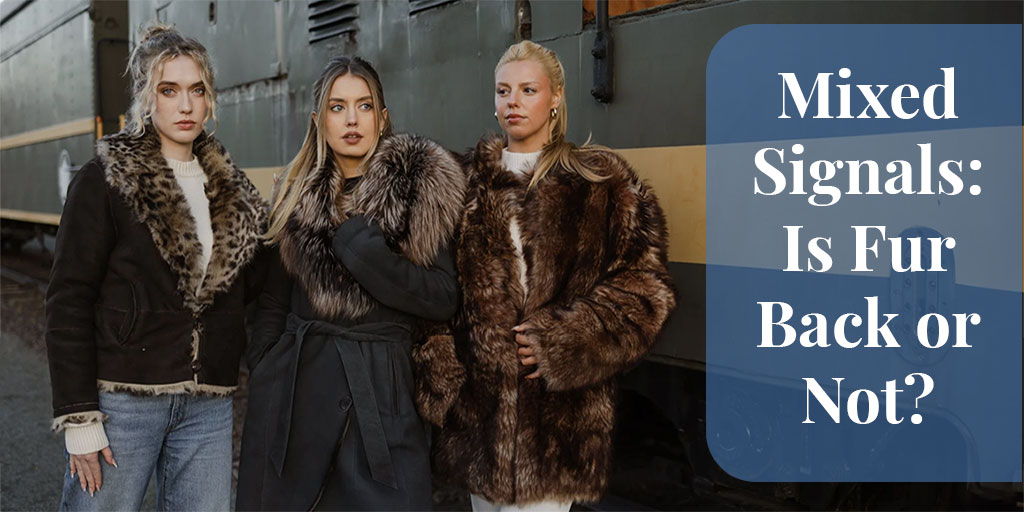
Consumers are receiving mixed signals, with some saying fur is back and others saying it’s on its last legs. So does someone have the story wrong? Let’s see where the evidence points.
Compared with the 1980s, when fur sales were strong in all traditional markets, today’s trade has shrunk, a fact it blames on the anti-fur lobby. But it also says fur is making a modest comeback. In contrast, anti-fur campaigners insist the fur trade is terminal.
Meanwhile the media can’t decide. Some editorialise that fur is fashionable again, while one presenter flaunts fur at a football match and another wears coyote at a New Year’s Eve show. Yet others say fur is finished, though they are sometimes transparent about pushing an agenda.
In our quest for the truth, let’s journey back in time, hoping this will help explain where fur really stands today.
Animal Rights Playbook
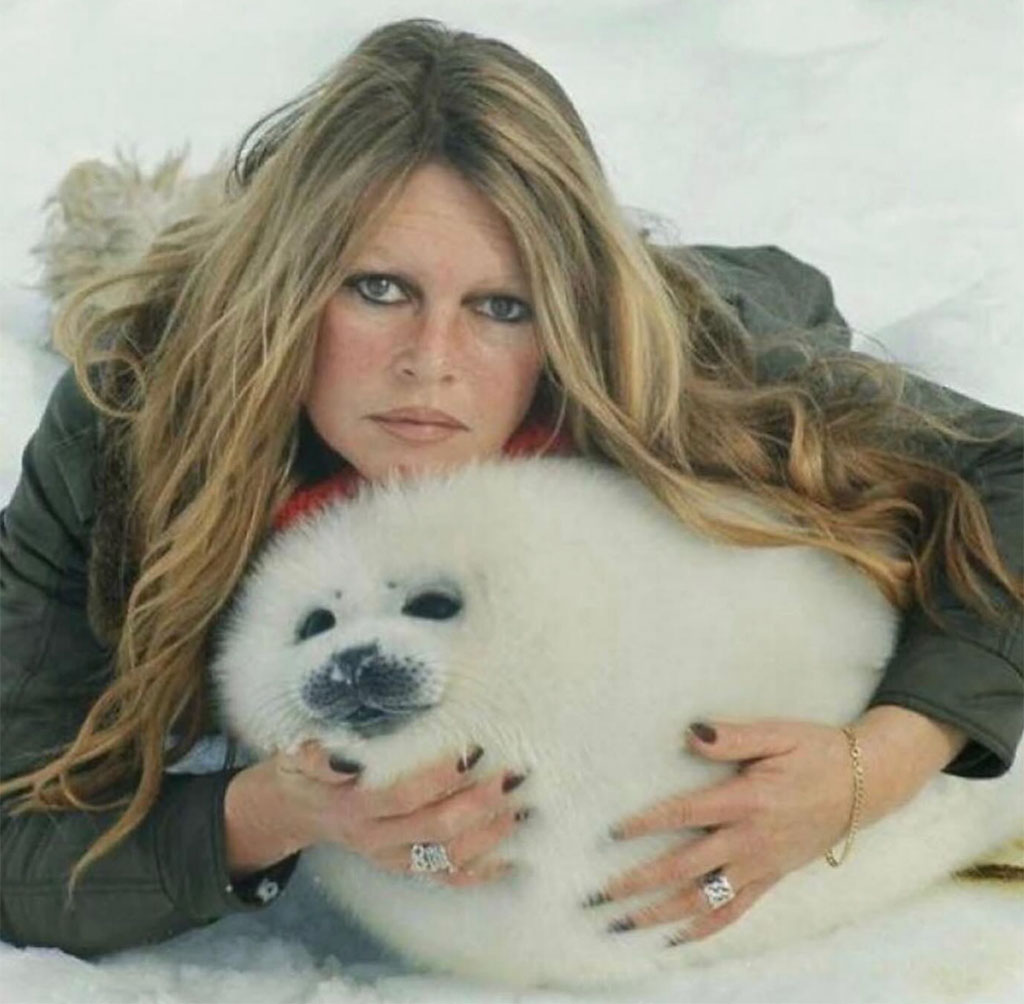
The modern animal rights playbook was written in the 1970s on the blood-stained ice floes of Atlantic Canada. With a cast of cute seal pups and “evil” sealers wielding hakapiks, protesters learned that all they had to do was provoke a fight (think Paul Watson) while Brigitte Bardot added credibility and sex appeal. The media lapped it up, and the campaign was hugely effective.
Another landmark came in 1990 when People for the Ethical Treatment of Animals launched the campaign “I’d rather go naked than wear fur”. Everyone knew that sex sold, but this was the first time animal rights had been conflated with naked women. Again the campaign was a media hit, prompting PETA founder Ingrid Newkirk to tell The New Yorker in 2003: “We are complete press sluts”. (PETA officially “retired” the campaign in 2020, but this was probably just to give media an excuse to run old campaign photos.)
Meanwhile, the fur trade was losing ground. The media (and their viewers) were by now hooked on images of stressed animals and naked women, and the fur trade couldn’t compete. Plus, funds were running low for public relations, and while some people were determined to fight back, they couldn’t agree on how to do this.
New Tactics
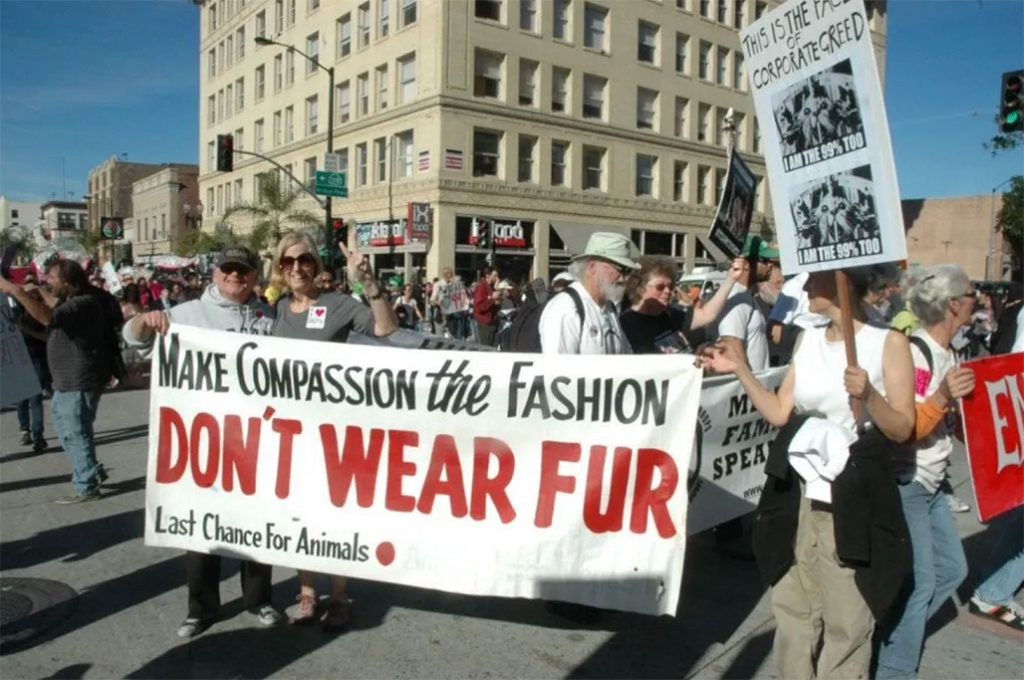
Then the 2000s arrived and the anti-fur lobby expanded its already strong arsenal with some new tactics.
Pushing local fur bans: One tactic has been to push US city governments to ban production and/or sales of fur. The fur trade must then file lawsuits to have ordinances overturned.
Almost all of the anti-fur lobby’s victories so far have come in Californian cities, followed by a statewide ban from 2023. Notably absent has been the snowball effect campaigners hoped for in major cities and states elsewhere.
Still, it’s an effective tactic even when ban attempts fail, since it generates media exposure and costs the fur trade money. This has happened in cities where fur is more entrenched, like New York City in 2020, Denver in 2024, and Chicago in 2025.
Pressuring players to switch from real fur to fake: Another tactic has been to get key players to drop real fur in favour of fake, with the anti-fur lobby then taking credit for players “seeing the light”. While a few early converts required little persuasion, most victories have only come about after harassing executives with methods like demonstrating outside workers’ homes. Targets have been diverse, ranging from luxury brands and designers, to department stores, fashion shows and even magazines.
Fur farming bans: Yet another tactic has been to pressure governments to ban fur farming or pass regulations so draconian that it makes no sense to continue.
Though in its third decade, this campaign gained fresh legs during the Covid-19 pandemic as activists stoked fear that mink farms breed zoonotic diseases. This fear was key in the 2020 move by Denmark – then the world’s leading mink farmer – to cull its entire herd, and British Columbia’s 2021 decision to phase out mink farming.
This campaign has been especially effective in the European Union, with most members having already introduced partial or total bans, the latest being Poland. Meanwhile, the “Fur Free Europe” citizens’ initiative gathered over 1.5 million signatures opposed to fur farming and the sale of farmed products, obliging the European Commission to decide by next March whether to propose an EU-wide ban.
Whether an EU-wide ban happens is still unknown, plus the issue of wild fur will remain on the table. But with some 70% of fur currently coming from farms, and global output contracting steadily, who, if anyone, will pick up the slack?
So kudos to the anti-fur lobby. Though it has often fought dirty, its tactics have undeniably hurt the fur trade.
Plastic Windfall

But another version of this story has it that fur is making a comeback. If true, it all began with a windfall for the trade: a miscalculation by its opponents.
When the modern animal rights movement emerged in the 1970s, Western society was made keenly aware of animal welfare issues. These remain important today, but have been superseded by existential issues threatening the very future of the planet.
In recent years, society has undergone a sea change, with terms like “sustainability”, “climate change”, “global warming” and “renewable energy” entering everyday usage. And the cause célèbre is how to wean ourselves off fossil fuels like petroleum.
Of course, the fur trade has always known fur is sustainable: it’s durable, biodegradable and renewable, and its environmental footprint is a lot smaller than the anti-fur lobby claims. So logically, society’s shift in priorities should benefit real fur, and work against fake fur made of non-renewable, polluting, non-biodegradable, petroleum-based plastics that only add to the tons of microplastics already in our watersheds and oceans.
So what have most anti-fur groups done? Rather than keeping their message simple and opposing all fur, real and fake, they have thrown their support behind fake fur as a replacement for the real deal, falsely claiming it is more sustainable!
This is now backfiring. Not only has fake fur kept the furry look (real or fake) on the fashion radar, it has also exposed the anti-fur lobby as dishonest.
Perhaps the biggest shock for the fur trade came in 2017, when Gucci announced it was dropping real fur. Both the world-famous brand and its animal rights handlers effused about how the move enhanced sustainability, and for a while the fur trade feared society would simply fall for this deception. But now, the media and consumers are at least questioning whether fake fur was the right way to go.
The anti-fur lobby, meanwhile, has attempted damage control, such as by calling plastic garments “vegan clothing”, and promising we’ll all be wearing “bio-fur” soon, made of fungi, nettles, pineapple and the like.
Maybe one day we will. But for now, almost all manufacturers of fake fur still prefer the petrochemical kind, so the harm it does to the environment continues.
Recycled Vintage Fur

Then, to confuse matters further, along came vintage fur.
As any fashionista knows, recycled and remodeled vintage furs have been in vogue for a few seasons. Many come from thrift stores and are at least 40 years old, though with demand still strong, it’s inevitable that dwindling supplies are seeing ages fall.
For an example of just how vintage furs have confused the picture, look at media coverage last February of the New York and London Fashion Weeks.
Hoping as always for a new angle, on Feb. 16 the New York Times ran a piece titled “What happened to the stigma of wearing fur?” “[I]n January,” wrote Jessica Iredale, “women and men all over town were busting their furs out of storage in what felt like an abrupt reversal of social values.” For years, wearing fur in the US and Europe had felt taboo. “Except, suddenly, people don’t seem to care – especially if the wearer can assert the mantle of ‘vintage’, as no animals were freshly killed and upcycling old clothes is more virtuous than buying new.”
The Wall Street Journal followed suit on Feb. 18, with “Fashion turned on fur. Young customers want more“. Then on Feb. 19, the New York Post ran with “Real fur is making a comeback after years of exile. ‘You’ll see it on the runway again’“. And on Feb. 28, Women’s Wear Daily declared that “Furry textures – some real, some faux” were all over the runways in New York. In short, America’s most populous city was awash in fur again!
The irony was that last December, New York Fashion Week announced a ban on fur from 2026!
Even more ironic was a report in The Standard (Feb. 21) during London Fashion Week titled “How luxury fell back in love with real fur and crocodile skins”. It was commenting on the street scene rather than on the show’s runways, because it couldn’t do otherwise. London Fashion Week had already banned fur, in 2023, followed the next year by exotic skins and feathers!
What message were these reports sending to consumers?
Was the real story not about vintage furs, but about the resurgence of fur in general? Were the likes of New York and London Fashion Weeks just part of an ivory tower trying to move past fur, while the streets said the opposite?
Predictions
So where does this leave the fur trade today?
Let’s first agree who we’re talking about. I’ll call it the Western fur trade, that caters primarily to certain consumers in two regions: North America and Europe, and an East Asian bloc, centering on China and South Korea, that buys a lot of pelts at Western auctions and has designers showing on Western runways. Millions of fur users, especially Indigenous peoples in the High North, don’t belong in this category, and won’t stop using fur just because of a few bans passed in Western capitals.
That said, the Western fur trade has been under attack for decades, giving the anti-fur lobby plenty of time to refine some highly effective tactics.
No one will deny that these tactics have hurt the fur trade, but many believe the trade has now turned a corner to recovery. Assuming this is true, how durable that recovery is depends on the trade’s ability to change.
One change that may be unavoidable is a fall in total output of farmed fur, plus a shift in suppliers. When shortages seemed likely in the past, North American, European and (in this century) Chinese farms simply increased production. But this time around will be different.
Obviously, EU production is falling and may stop entirely, but it’s also down in North America due to bad publicity from the anti-fur lobby, and no one is expanding right now. So unless Chinese farmers step up again, or another country fills the breach, a supply shortage could be looming that requires the fur trade to operate at a reduced scale.
There are, however, a few avenues that are already expanding.
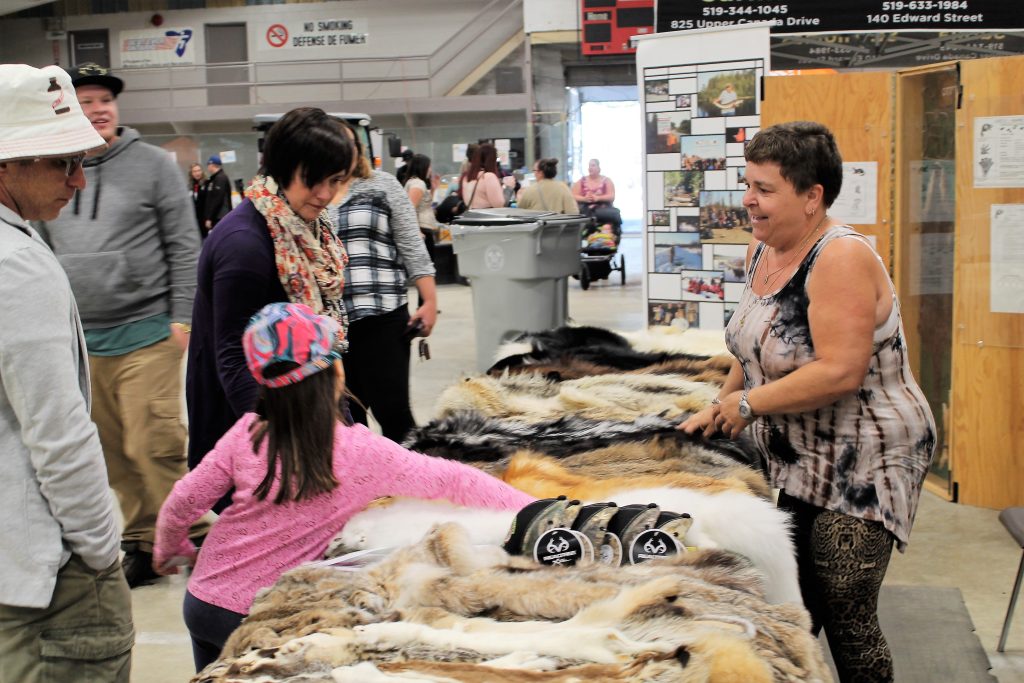
One is sales of wild fur. Pelt prices are edging up for some species; for example, at Fur Harvesters Auction last month, interest was strong in bobcats, marten and wild mink. Also, the number of trappers is increasing in many places. And since trapping is now widely recognised as an important conservation tool, choosing wild fur is one way consumers can show their support for sustainable use. There is still opposition to trapping where wildlife and human habitats coincide, notably among dog walkers, but also on the rise are problem animals like coyotes with mange, rabid raccoons and destructive beavers, so trapping won’t disappear anytime soon.
Other avenues for expansion are better opportunities for artisanal designers and online retailers, especially in remote areas. Factors fueling this growth include the departure of most luxury brands and department stores from the real fur market, the closure of many brick-and-mortar furriers in expensive downtown locations, and of course the rise of the Internet, which makes it possible to run businesses in remote locations that were not viable before.
Whether all this translates into a comeback for fur remains to be seen, but the signs so far are promising. For now, there’s a paradox: on the one hand, the anti-fur lobby continues its efforts to end the fur trade, with a lot of success. But on the other, many media reports and eye-witness accounts say fur is back in fashion. Who is right? Only time will tell for sure.
SEE ALSO:
Fur is firmly back in fashion – and even more divisive than ever. BBC, April 8, 2025.
Fur sure: In the era of sustainability, a winter icon makes a comeback. Buffalo Spree, Dec. 26, 2025.
As real fur creeps back into fashion, is faux the way to go? Daily Telegraph, Dec. 27, 2025.




Fur is back at last